The automotive landscape in the GCC has transformed dramatically over the past five years. Chinese car manufacturers have moved from being curious newcomers to serious contenders in the region's competitive market. From the streets of Dubai to the highways of Riyadh, brands like BYD, Chery, Geely, and MG are becoming increasingly common sights. But with this rapid growth comes natural questions: Are these vehicles reliable? Do they offer genuine value? Will they hold their resale value in the notoriously selective GCC market?
This comprehensive Chinese car buying guide answers these questions and more, providing you with the essential knowledge needed to make an informed decision about purchasing a Chinese car in the UAE, Saudi Arabia, or anywhere across the Gulf region. Whether you're considering your first Chinese vehicle or looking to understand what sets these brands apart from their Japanese, Korean, and European competitors, this guide covers everything from brand origins to long-term ownership costs.
1. Understanding Chinese Car Brands: Who's Behind the Badge?
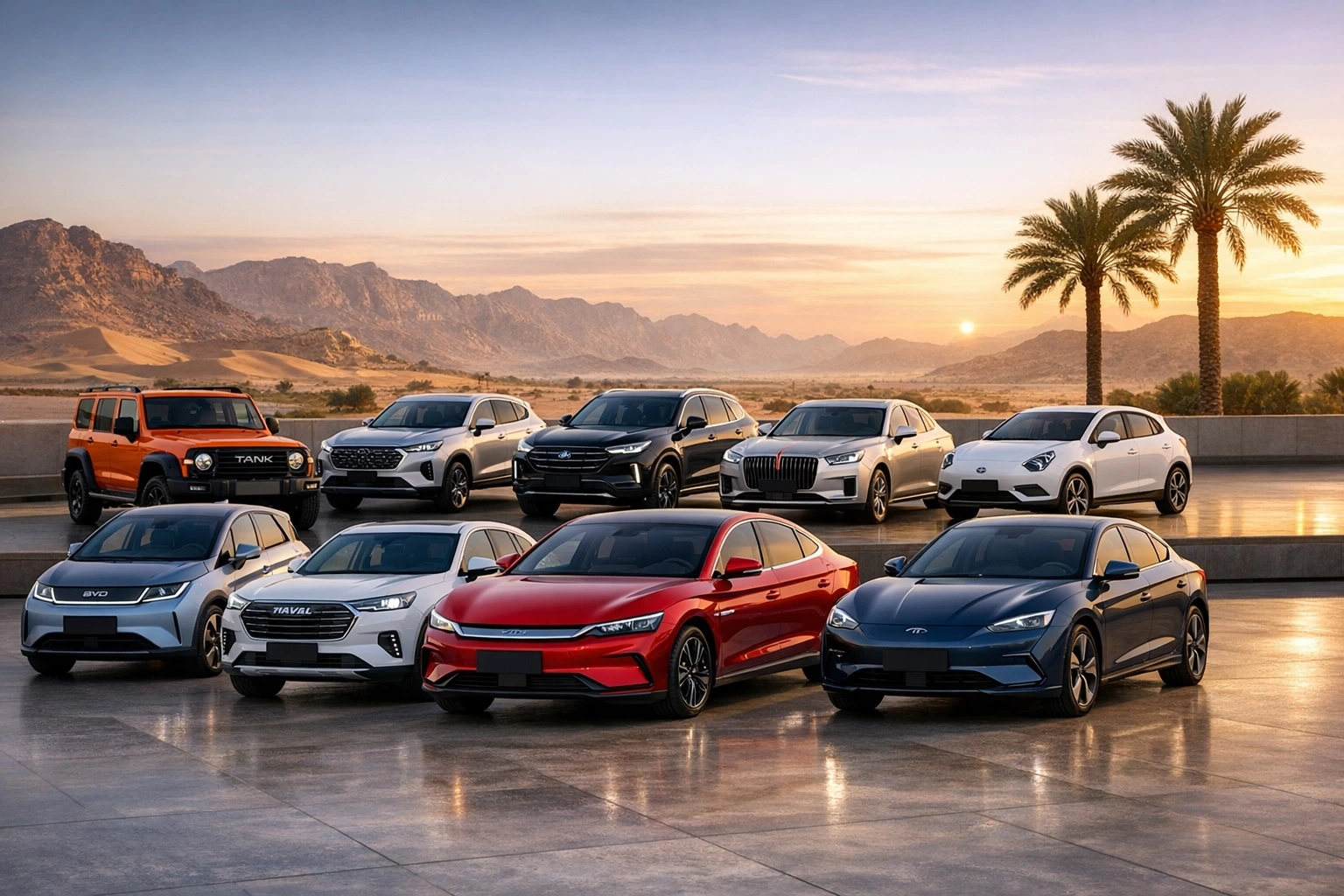
The GCC market currently hosts more than fifteen Chinese automotive brands, each with distinct characteristics and market positioning. Understanding who's behind these brands and their global standing helps buyers make informed decisions and builds confidence in their choices.
Top Chinese Car Brands in UAE and Saudi Arabia
BYD stands as the world's largest electric vehicle manufacturer and has established a commanding presence across the Gulf region. Originally known as Build Your Dreams, BYD has evolved from a battery manufacturer into a vertically integrated automotive powerhouse. The company produces its own batteries, semiconductors, and electric motors, giving it a significant technological and cost advantage. In the GCC, BYD offers popular models including the Atto 3 electric SUV, the Seal sedan, and the Dolphin compact EV, all backed by comprehensive warranty coverage and an expanding service network.
Chery represents one of China's oldest and most established automakers, with over 25 years of manufacturing experience and exports to more than 80 countries. The brand has invested heavily in the Middle East market, establishing local assembly facilities and comprehensive parts distribution networks. Their Tiggo series of SUVs has gained particular traction among GCC families, offering spacious interiors, modern features, and competitive pricing. Chery's collaboration with Jaguar Land Rover in joint ventures demonstrates their engineering capabilities and commitment to international quality standards.
Geely owns several international brands including Volvo, Lotus, and Polestar, bringing sophisticated engineering expertise to their own-brand vehicles. This cross-pollination of technology means Geely vehicles often incorporate safety systems and platform architectures developed for premium European markets. The Coolray and Azkarra SUVs showcase this technology transfer, offering advanced driver assistance systems and build quality that rivals established competitors.
MG Motor, while technically British in heritage, operates under Chinese ownership through SAIC Motor Corporation. The brand has successfully leveraged its European legacy while incorporating modern Chinese manufacturing efficiency and technology. The MG HS and ZS models have become bestsellers across the GCC, offering familiar styling with contemporary features at accessible price points.
Other Leading Chinese Automotive Brands
Other significant players include GAC Motor, known for their sophisticated GS series SUVs; Changan, one of China's oldest automakers with military vehicle heritage; Haval, the SUV-focused brand under Great Wall Motors; and Jetour, targeting the adventure and lifestyle segment. Each brand brings unique strengths, from Haval's off-road capability to GAC's premium positioning and Jetour's family-focused designs.
Understanding corporate relationships proves valuable for buyers. Geely's ownership of Volvo means shared safety technology and engineering standards. BYD's vertical integration ensures parts availability and service consistency. These corporate structures directly impact ownership experience, warranty fulfillment, and long-term vehicle support in the GCC market.
2. How Reliable Are Chinese Cars in 2025?
Chinese cars have undergone a remarkable transformation in reliability and build quality over the past decade. Modern Chinese vehicles from established manufacturers now meet or exceed international quality standards, supported by rigorous testing protocols and advanced manufacturing processes that rival Japanese and European production facilities.
The reliability question represents the primary concern for potential buyers, and it's a legitimate one based on historical context. However, the Chinese automotive industry of 2025 bears little resemblance to its state even five years ago. Major manufacturers have invested billions in research and development, hired engineering talent from global automakers, and implemented ISO-certified quality control systems throughout their production chains.
International Safety Ratings and Crash Test Results
Euro NCAP and ANCAP testing provides objective evidence of Chinese car quality improvements. The BYD Atto 3 achieved a five-star Euro NCAP rating with an impressive 90% adult occupant protection score. The Geely Coolray earned five stars from ANCAP, matching scores achieved by established Japanese and Korean competitors. The MG ZS EV received strong safety ratings across multiple international testing bodies, demonstrating consistent build quality across different production batches and markets.
These ratings aren't outliers or marketing exercises. They represent comprehensive crash testing, pedestrian protection assessments, and safety assist technology evaluation conducted by independent organizations. Chinese manufacturers specifically target these ratings during development, understanding that international credibility requires meeting global safety benchmarks.
Build Quality, Materials, and Manufacturing Standards
Step inside a modern Chinese vehicle and the quality impression often surprises first-time buyers. Soft-touch materials replace the hard plastics of earlier generations. Panel gaps meet tight tolerances. Paint finishes show consistent quality. These improvements stem from automated production lines using robotic assembly systems similar to those in Japanese and German factories.
Chinese manufacturers source components from international suppliers including Bosch, Continental, and ZF, ensuring critical systems meet global quality standards. Infotainment screens come from BOE and other display manufacturers supplying Apple and Samsung. Battery cells in Chinese EVs often exceed the performance and safety standards of older battery technologies, with extensive thermal management and safety protocols.
Warranty Coverage: 6-7 Years vs Industry Standard 3 Years
Perhaps the strongest indicator of manufacturer confidence in reliability comes from warranty terms. BYD offers six years or 150,000 kilometers comprehensive warranty on their vehicles in the GCC, with battery warranties extending to eight years or 150,000 kilometers. Chery provides seven years or 150,000 kilometers coverage across their range. These extended warranties significantly exceed the typical three-year terms offered by many Japanese and European brands, transferring long-term reliability risk from buyer to manufacturer.
Real-world ownership experiences in the GCC market increasingly support these warranty commitments. Early adopters of Chinese brands from 2019-2020 report generally positive reliability experiences, with routine maintenance requirements and minor issue rates comparable to established competitors. The GCC's demanding climate provides a rigorous testing environment, and Chinese manufacturers have adapted their vehicles accordingly with enhanced cooling systems, air conditioning capacity, and heat-resistant components.
Service network expansion across the UAE and Saudi Arabia further supports reliability through accessible maintenance and parts availability. Major cities now host multiple authorized service centers for leading Chinese brands, with parts distribution networks ensuring reasonable repair turnaround times. This infrastructure investment demonstrates manufacturer commitment to long-term market presence rather than short-term sales gains.
3. What Technology and Features Do Chinese Cars Offer?
Technology represents the single most compelling advantage of Chinese vehicles in today's market. Chinese automakers lead in electric vehicle technology, advanced driver assistance systems (ADAS), and connected car features, often offering capabilities found only in premium segments from established manufacturers, but at mainstream pricing.
Electric Vehicle (EV) Technology and Battery Innovation
Chinese manufacturers dominate global EV development and production, and this expertise translates directly into superior electric vehicle offerings. BYD's Blade Battery technology provides industry-leading safety through its unique cell-to-pack design that virtually eliminates thermal runaway risks. This innovation allows BYD to offer genuine peace of mind in the GCC's extreme heat conditions, where battery safety concerns rank highly among potential EV buyers.
The BYD Atto 3 delivers up to 420 kilometers of real-world range in GCC conditions, with rapid charging capability that adds 200 kilometers of range in approximately 30 minutes using DC fast chargers. The BYD Seal sedan pushes range beyond 500 kilometers while maintaining aggressive pricing that undercuts European EV competitors by 30-40%. These aren't theoretical specifications but proven capabilities validated by GCC owners in daily driving conditions.
Chinese hybrid technology similarly impresses with sophisticated systems that rival Toyota and Honda. Plug-in hybrid variants offer pure electric driving for daily commutes while maintaining long-distance flexibility through efficient gasoline engines. Battery thermal management systems, crucial in the Gulf climate, receive particular attention in Chinese designs, with active cooling and heating systems maintaining optimal operating temperatures.
Advanced Driver Assistance Systems (ADAS) and Safety Tech
Features once exclusive to luxury vehicles now appear as standard equipment on mid-range Chinese cars. Adaptive cruise control with stop-and-go functionality handles traffic jams automatically. Lane keeping assist actively centers vehicles in their lanes rather than simply warning about departures. Automatic emergency braking systems detect vehicles, pedestrians, and cyclists, intervening when collision risk exists.
The Geely Coolray offers a 360-degree camera system with transparent chassis view, making parking and low-speed maneuvering remarkably simple. The Chery Tiggo 8 Pro includes automatic parking assist that handles parallel and perpendicular parking with minimal driver input. Blind spot monitoring, rear cross-traffic alert, and door opening warning systems appear across Chinese lineups, enhancing safety in urban GCC environments.
Chinese manufacturers integrate these systems more comprehensively than many competitors. Rather than offering ADAS as expensive option packages, brands like BYD, Geely, and MG include advanced safety technology as standard equipment, democratizing features that improve safety for all drivers rather than reserving them for premium buyers.
Infotainment Systems and Smart Car Connectivity
Large, responsive touchscreens dominate Chinese car interiors, with screen sizes ranging from 10.25 inches to massive 15.6-inch rotating displays. These systems run sophisticated operating systems with over-the-air update capability, meaning vehicles gain new features and improvements throughout ownership rather than remaining static from purchase.
Smartphone integration goes beyond basic Apple CarPlay and Android Auto. Built-in 4G connectivity enables real-time traffic data, weather information, and location-based services. Voice recognition systems understand natural language commands in multiple dialects of Arabic and English, controlling climate, navigation, and media without hand manipulation. Mobile apps allow owners to remotely check vehicle status, precondition climate systems before entering, and locate vehicles in crowded parking areas.
Digital instrument clusters replace traditional analog gauges, offering customizable information displays that adapt to driving modes and driver preferences. Head-up displays project essential information onto windshields, keeping driver attention focused on the road. These technologies, standard or available on Chinese vehicles, often cost thousands extra on Japanese and European competitors.
Practical Features and User-Focused Innovation
Chinese automakers demonstrate particular strength in understanding and implementing features that improve daily usability. Panoramic sunroofs extend across first and second rows, addressing GCC buyers' preference for light and openness. Wireless phone charging pads include cooling fans to prevent overheating in high ambient temperatures. USB ports proliferate throughout cabins, recognizing modern families' device charging needs. Rear seat entertainment systems appear on family SUVs at price points where competitors offer basic cloth seats.
This technology advantage stems from China's position as the world's largest automotive market and its leadership in consumer electronics manufacturing. The same companies producing smartphones, displays, and computer chips supply Chinese automakers, creating technology transfer and cost advantages that translate into feature-rich vehicles at competitive prices.
4. What Are the Ownership Costs of Chinese Cars in the GCC?
Understanding the total cost of ownership proves essential when evaluating any vehicle purchase, and Chinese cars present an interesting value proposition that extends beyond their attractive initial pricing. Maintenance costs, fuel efficiency, insurance premiums, and parts availability all factor into the long-term financial equation.
Service and Maintenance Costs Comparison
Chinese manufacturers position their service costs competitively to attract buyers from established brands. Routine maintenance intervals typically span 10,000 kilometers, matching industry standards. Service costs for oil changes, filter replacements, and inspections generally run 20-30% lower than equivalent Japanese or European vehicles, though specific costs vary by brand and model.
BYD electric vehicles deliver particularly impressive maintenance cost advantages, as EVs eliminate engine oil changes, transmission servicing, spark plug replacements, and exhaust system maintenance entirely. Annual service visits primarily involve brake fluid checks, cabin filter replacement, and software updates. Owner reports from early BYD Atto 3 adopters in the UAE indicate annual maintenance costs below AED 500, compared to AED 1,500-2,000 for conventional vehicles.
Extended warranty coverage from Chinese manufacturers provides cost certainty during the ownership period when major component failures might occur. Seven-year warranties mean buyers face no unexpected repair bills for critical systems during the period when most GCC owners retain vehicles. This coverage effectively locks in ownership costs, eliminating the repair cost uncertainty that sometimes affects older vehicles from brands with shorter warranty terms.
Spare Parts Availability and Pricing in UAE & KSA
Parts availability has improved dramatically as Chinese brands establish permanent GCC presence. Major brands maintain regional parts distribution centers in Dubai and Dammam, ensuring common service items reach dealers within 24-48 hours. Structural and body panels typically arrive within one week, competitive with established brands operating in the region.
Parts pricing generally undercuts Japanese and European equivalents by 15-25%, reflecting manufacturing cost advantages and brand positioning strategies. Consumable items like brake pads, filters, and fluids cost significantly less than premium brand alternatives while meeting international quality standards. Insurance repair costs benefit from these lower parts prices, potentially resulting in reduced premium calculations.
The growth of the Chinese car population in the GCC creates aftermarket opportunities, with independent parts suppliers beginning to stock common components for popular models. This competition further moderates parts costs over time, similar to the pattern seen with Japanese and Korean brands during their market establishment phases.
Fuel Efficiency and Running Costs
Modern Chinese vehicles deliver competitive fuel economy through downsized turbocharged engines and advanced transmission technology. The Chery Tiggo 7 achieves approximately 7.5 liters per 100 kilometers in mixed GCC driving, comparable to similarly sized Japanese SUVs. The Geely Coolray's 1.5-liter turbocharged engine returns around 7 liters per 100 kilometers despite offering robust performance.
Electric vehicles from BYD and other Chinese manufacturers deliver the most significant running cost advantages. Charging an EV at home costs approximately AED 10-15 for 100 kilometers of range, compared to AED 25-35 for the equivalent distance in a gasoline vehicle at current GCC fuel prices. Public charging costs vary but typically remain below gasoline equivalents. Over a typical annual driving distance of 20,000 kilometers, EV owners save AED 3,000-5,000 annually in fuel costs alone.
Hybrid models offer compromise between conventional and electric vehicles, delivering fuel consumption figures around 5-6 liters per 100 kilometers in real-world GCC conditions. These savings accumulate significantly over ownership periods, offsetting any price premium versus conventional powertrains.
Insurance Premiums and Coverage
Insurance costs for Chinese vehicles generally track below premium brands due to lower vehicle values and replacement costs. Comprehensive insurance for a mid-range Chinese SUV typically costs 3-4% of vehicle value annually in the UAE and KSA, compared to 4-5% for equivalent European models. The combination of lower purchase prices and lower premium percentages results in meaningful annual savings.
Some insurers initially approached Chinese brands cautiously due to limited claims history and parts cost uncertainty. However, as claims data accumulates and demonstrates reasonable repair costs and parts availability, insurance pricing has normalized. Major insurers now provide standard coverage terms for established Chinese brands without premium loadings or special conditions.
Total Cost of Ownership: 5-Year Calculation
Calculating five-year total cost of ownership reveals Chinese vehicles' financial advantages. Consider a mid-size SUV purchased for AED 90,000 versus a Japanese equivalent at AED 110,000. The Chinese vehicle saves AED 20,000 at purchase, approximately AED 5,000 in fuel costs over five years, AED 3,000 in service costs, and AED 2,000 in insurance premiums. These savings total AED 30,000 before considering potential resale value differences, presenting compelling value for budget-conscious buyers or those prioritizing features over brand prestige.
5. Do Chinese Cars Hold Their Resale Value in the GCC?
Resale value remains the most significant financial uncertainty surrounding Chinese vehicles in the GCC market. While these cars offer impressive initial value, feature content, and ownership costs, their depreciation patterns and used car market acceptance continue to develop as the segment matures.
Current Depreciation Trends and Market Data
Chinese vehicles generally depreciate faster than established Japanese brands during their first three years, losing approximately 45-50% of original value compared to 35-40% for equivalent Toyota or Honda models. This accelerated depreciation reflects brand establishment challenges, buyer uncertainty about long-term reliability, and limited used car demand from conservative buyers preferring familiar nameplates.
However, depreciation patterns show significant variation by brand and model. MG vehicles, benefiting from European heritage and longer GCC presence, retain value more effectively than newer Chinese entrants. The used MG HS maintains approximately 55-60% of original value after three years, approaching mainstream Japanese depreciation rates. BYD electric vehicles demonstrate stronger residual values than anticipated, driven by rising EV demand and limited competition in the affordable electric SUV segment.
Popular models with strong sales volumes establish better resale markets than slow-selling variants. The Chery Tiggo 8, one of the best-selling Chinese SUVs in the GCC, maintains healthier resale values than less common Chery models due to buyer familiarity and parts availability confidence. This pattern mirrors the experience of Korean brands during their market establishment phase in the 2000s.
Factors Improving Future Resale Prospects
Several positive trends suggest improving resale performance for Chinese vehicles over coming years. Market acceptance grows as initial buyers complete ownership cycles and share positive experiences, reducing uncertainty for subsequent buyers. The expansion of certified pre-owned programs from Chinese manufacturers provides warranty coverage and quality assurance for used buyers, addressing reliability concerns that suppress values.
Increasing new car prices across all segments enhance used Chinese car appeal. As Japanese SUVs push toward AED 120,000-150,000 when new, three-year-old Chinese alternatives priced at AED 50,000-60,000 present compelling value propositions for buyers prioritizing features and size over brand. This price gap creates natural demand that supports resale values.
The growing Chinese car population establishes network effects beneficial for resale. Independent service providers develop Chinese brand expertise, reducing maintenance cost concerns for used buyers. Parts availability improves through both official and aftermarket channels. Buyer familiarity increases through market presence, friend recommendations, and positive ownership experiences shared in online communities.
Electric Vehicle Resale Value Considerations
Electric vehicle resale presents unique factors affecting Chinese EVs. Battery technology advancement creates concern that older EVs become obsolete as newer models offer superior range and charging speed. However, BYD's Blade Battery technology demonstrates minimal degradation over time, with owners reporting less than 5% capacity loss after 100,000 kilometers. This durability supports stronger residual values than EVs using older battery technologies.
Government incentives and internal combustion engine restrictions in some GCC cities may enhance EV resale values over time. As emissions regulations tighten and urban access restrictions potentially emerge, electric vehicles gain regulatory advantages that translate into market premiums. Early BYD and MG EV adopters may benefit from these policy shifts, seeing better-than-expected residual values.
Setting Realistic Resale Expectations
Buyers should approach Chinese car purchases with realistic resale expectations. Plan for higher depreciation than equivalent Japanese brands during the first three to five years. However, factor in the initial purchase price advantage and lower ownership costs when calculating total financial impact. A Chinese SUV purchased for AED 80,000 that depreciates to AED 40,000 after three years delivers the same net cost as a Japanese SUV purchased for AED 100,000 that retains AED 60,000 in value.
Consider extended ownership periods to maximize value extraction. Chinese vehicles reward long-term ownership through their extended warranties and lower operating costs. Owners planning to keep vehicles beyond five years face minimal resale value risk while maximizing the benefit of initial price advantages and feature content.
The used Chinese car market in the GCC remains young and evolving. Early indications suggest improving trends as market maturity increases, brand awareness grows, and positive ownership experiences accumulate. Buyers accepting current depreciation realities gain access to impressive new vehicles at accessible prices, while those prioritizing resale value may prefer waiting for further market development or choosing established brands despite higher initial costs.
6. How to Choose the Right Chinese Car for Your Needs
Selecting the ideal Chinese car requires matching your specific requirements, budget, and priorities against the diverse range of available models. The Chinese automotive market offers vehicles across all segments and price points, from compact city cars to premium electric SUVs, ensuring suitable options for virtually every buyer profile.
Best Chinese Cars by Budget Category
Under AED 70,000: This segment offers excellent value propositions including the MG ZS, a compact SUV delivering modern styling, comprehensive equipment, and solid build quality at entry-level pricing. The Chery Tiggo 4 Pro provides spacious family transportation with surprising feature content for budget-conscious buyers. These vehicles suit first-time buyers, young families, or those prioritizing value over brand prestige.
AED 70,000 - AED 100,000: This mid-range bracket represents Chinese automotive strengths, offering feature-rich vehicles that compete directly with established mainstream brands. The Chery Tiggo 8 Pro delivers seven-seat capacity, advanced technology, and refined road manners at prices undercutting Japanese competitors by AED 20,000-30,000. The Geely Coolray offers dynamic styling and engaging driving characteristics in the compact SUV segment. The BYD Atto 3 provides electric mobility with genuine usability at pricing that makes EV ownership accessible to mainstream buyers.
AED 100,000 - AED 150,000: Premium Chinese offerings compete with entry-level European vehicles in this segment, offering superior equipment levels despite lower brand prestige. The BYD Seal delivers sports sedan performance with electric efficiency, rivaling BMW and Tesla alternatives at significantly lower prices. The Geely Monjaro (Xingyue L) provides luxury SUV amenities including premium audio systems, advanced driver assistance, and sophisticated interior materials approaching European quality standards.
Above AED 150,000: High-end Chinese vehicles from brands like BYD, NIO, and premium Geely variants challenge established luxury brands with cutting-edge technology and extensive feature lists. These models suit early adopters and technology enthusiasts willing to trade traditional brand prestige for advanced capabilities and innovative designs.
Choosing by Use Case and Driving Needs
Daily Commuting and City Driving: Compact SUVs like the MG ZS or Geely Coolray offer ideal dimensions for urban navigation while providing elevated seating positions and adequate cargo space. Electric options including the BYD Dolphin deliver zero-emission urban mobility with range sufficient for daily commutes and local errands, while avoiding fuel costs entirely.
Family Transportation: Seven-seat SUVs represent Chinese manufacturers' particular strengths, offering spacious third-row seating at prices where Japanese competitors provide five seats only. The Chery Tiggo 8 Pro and GAC GS8 deliver genuine seven-seat usability with adequate third-row space for teenagers or adults on shorter journeys. Comprehensive safety equipment, multiple USB ports, and rear entertainment options cater specifically to family requirements.
Long-Distance Travel: Larger SUVs with powerful engines suit frequent highway driving and weekend road trips. The Haval H6 provides refined highway manners and comfortable long-distance cruising capability. Plug-in hybrid options offer extended range without range anxiety, combining electric efficiency for daily driving with gasoline backup for longer journeys.
Off-Road and Adventure: While Chinese brands primarily focus on on-road comfort, models like the Haval Dargo and Jetour X70 Plus provide adequate off-road capability for desert driving and weekend adventures. Four-wheel-drive systems, adequate ground clearance, and durable construction suit light off-road use, though serious off-road enthusiasts may prefer dedicated Japanese or American alternatives.
Key Decision Factors When Buying Chinese Cars
Prioritize established brands with proven GCC presence when reliability and resale value rank highly in your decision criteria. MG, BYD, and Chery demonstrate commitment through extensive dealer networks, parts availability, and years of market presence. These brands offer lower ownership risk than newer market entrants still establishing support infrastructure.
Consider electric vehicles seriously if daily driving remains below 300 kilometers and home charging proves practical. The ownership cost advantages, environmental benefits, and technology leadership of Chinese EVs offset range limitations and charging infrastructure constraints for many buyers. However, buyers frequently undertaking long-distance journeys or lacking home charging access should consider conventional or hybrid alternatives.
Test drive multiple alternatives before committing to purchases. Chinese vehicles vary significantly in driving dynamics, interior quality, and refinement levels. What appears similar on specification sheets may feel markedly different in real-world driving. Spend time evaluating build quality, seat comfort, road noise levels, and control layout ergonomics during extended test drives.
Research specific model reliability through online owner communities and reviews. While Chinese vehicles generally demonstrate improved quality, individual models may exhibit specific issues or weaknesses. Understanding common problems before purchase allows informed decision-making and realistic expectation setting.
Chinese Cars vs Japanese and Korean Alternatives
Compare Chinese options against used Japanese alternatives when budget constraints exist. A three-year-old Toyota RAV4 may cost similar to a new Chery Tiggo 8, presenting a choice between newer warranty coverage and features versus established brand reliability and resale value. Each approach offers legitimate advantages depending on buyer priorities.
Korean alternatives from Kia and Hyundai represent middle ground between Chinese value and Japanese reliability. While priced above Chinese equivalents, Korean vehicles offer stronger resale values and brand acceptance while maintaining competitive feature content. Buyers uncertain about Chinese brand commitment might find Korean alternatives attractive compromises.
The optimal Chinese car choice emerges from honest assessment of priorities, realistic budget allocation, and clear understanding of intended use. Chinese automotive offerings provide genuine value across multiple segments, rewarding buyers who prioritize features, technology, and ownership costs over brand prestige and maximum resale values. The expanding range of quality Chinese vehicles ensures suitable options exist for most buyers willing to embrace these emerging brands.
The Future of Chinese Cars in the GCC Market
The trajectory of Chinese automotive brands in the GCC market points decisively upward. Market share grows quarterly as consumer awareness increases and product quality improvements become undeniable. What began as curiosity purchases by early adopters has evolved into mainstream consideration, with Chinese brands now appearing on shortlists alongside established competitors.
Government partnerships and local assembly initiatives demonstrate manufacturer commitment to permanent GCC presence rather than opportunistic market entry. BYD's partnership with local distributors in Saudi Arabia and the UAE signals long-term investment in sales networks, service infrastructure, and brand building. These commitments reduce ownership risks and enhance resale confidence as buyers recognize manufacturer dedication to market support.
Electric vehicle adoption will likely accelerate Chinese brand growth, as their technology leadership and competitive pricing position them advantageously as GCC governments promote sustainable transportation. Investment in charging infrastructure across the UAE and Saudi Arabia removes practical barriers to EV ownership, while Chinese manufacturers offer the broadest range of affordable electric options in the market.
The next five years will prove critical in establishing Chinese automotive brands as permanent fixtures in the GCC market. Continued quality improvements, expanding model ranges, and positive ownership experiences from early adopters will drive increasing acceptance. Buyers who embrace Chinese vehicles now benefit from exceptional value propositions while participating in the automotive market's most dynamic and innovative segment.
Final Thoughts: Should You Buy a Chinese Car?
Chinese automotive brands offer compelling alternatives to established competitors, delivering advanced technology, comprehensive features, and attractive pricing that democratizes vehicle ownership and premium equipment access. While considerations around resale value and brand newness remain valid, the total ownership proposition frequently favors Chinese vehicles for buyers prioritizing value, features, and low operating costs.
Successful Chinese car ownership requires realistic expectations, thorough research, and careful model selection aligned with specific needs. The diverse range of available vehicles ensures suitable options across budgets and use cases, from affordable city runabouts to sophisticated electric SUVs. As the market matures and acceptance grows, early adopters of quality Chinese vehicles position themselves advantageously, gaining years of cost-effective transportation while supporting the automotive industry's most innovative segment.
The question facing GCC car buyers has evolved from "Should I consider a Chinese car?" to "Which Chinese car best suits my needs?" This shift reflects profound changes in product quality, market acceptance, and competitive dynamics. The automotive landscape continues transforming, and Chinese brands drive much of this change through technological innovation, aggressive pricing, and consumer-focused feature development.