
This week I was handed keys to the 2015 Renault Fluence. This is a car I never had the pleasure to sit in before let alone drive it. So, naturally I was a bit skeptical about how this little European car would behave. It was a mixed feeling: on one hand you have a European brand which generally means un-boxy styling and better than average interior with decent handling but, on the other hand, you have a cheap car. So, will that reduction in cost satisfy the European characteristics? Let’s find out.
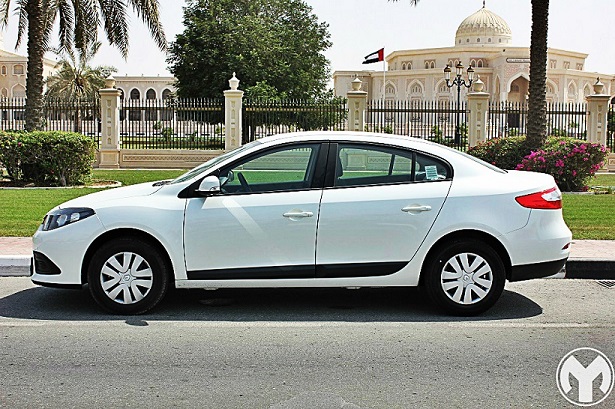
The look of the car sure satisfies the Euro quotient. The design is elegant yet understated. There are no bold lines. Instead, there is a smooth flowing design which makes the car appealing if not drool-worthy. Other than Kia/Hyundai, no other manufacturer makes compact sedans which are cheap yet appealing. So, credit to Renault in the design department.

Well, all that praise for styling ends at the exterior as the interior is CHEAP. The only other car I can think of, with such a cheap interior, is the Avanza. I was quite disappointed by the interior finishing as its competitors – Civic and Corolla – offer a much better interior; if not premium – for a price. The seats are adequate, though the material made my back sweat quite a lot in this heat. Also the road/wind noise is on the higher side.

The Fluence scores decent marks for the visibility as the driving position is satisfactory and I was able judge my surroundings easily even with the absence of parking sensors.
Legroom is also above average as four adults sit comfortably with space for a child in the middle. However, I still haven’t driven a compact car yet with a bigger interior space than the Honda City. The boot space is respectable as well.

I was given the basic trim level (I judged that by noticing the lack of alloys) but I still felt disappointed. In an era where manufacturers have bespoke infotainment systems, the Fluence is fitted with something which looks like an aftermarket in-dash audio system – which also seems like something you will get from Dragonmart. Why am I criticizing so much? I will give you an example. When I first sat in the car and turned on the audio system, I couldn’t hear anything. I connected my phone via Bluetooth and there was no audio. I thought probably there is some issue with the phone so I switched on the radio and there I faced the weirdest glitch ever in an audio system. When have you ever turned on the car radio – in middle of the city – and tuned into a channel to find out that the radio station is not found and the device is ‘searching’ for it? Well, that’s the case with the Fluence. I turned on the radio and waited for around 5-10 minutes till it ‘searched’ for 104.8 FM. After the ‘searching’ got over, I still couldn’t hear anything. I thought about going back to the dealer and complaining about it but I instead tried to switch off and on the ignition again. Turns out, the audio worked albeit after ‘searching’ process. Hallelujah!

The Fluence I got was powered by 2.0 liter engine producing 143 BHP and 195 Nm of torque – decent figures for a compact sedan (I had confirmed the specs with the dealership as it did not feel like a 2.0). This engine is mated to a CVT transmission which generally means better fuel economy. Well, for the most part, it is good for in city drive as the small engine is initially not punchy but after a while it gets into the groove – something I will ignore considering it is not meant to be a sports sedan. But, once I got on the highway, the engine revealed its shortcomings. It became challenging to overtake at highway speeds as the car takes its sweet time to accelerate. Moreover, during the test run, it accelerated from 0-100 in 13.4 seconds! A Honda City with a 1.5 liter engine accelerated in 10.5 seconds. This figure is nowhere close to the claimed 10.1 seconds by Renault. But, this is still not the shocking part. During the whole road test, the car gave an average mileage of a mind-boggling 12.6 l/100 km – from a tiny 2.0 liter engine. Comparatively, the Range Rover Sport Supercharged with a 5.0 liter V8 gave 15.5 l/100 km.
Renault seriously needs to fine tune the engine for a better fuel economy because its target customers can look beyond the dismal acceleration as they are looking to buy this car for its economic value. But, after looking at these figures, they are bound to have second thoughts.

The car behaves like any other compact sedan would – heavy body roll in the corners and soft suspension. So, no complains in this department. You are getting your money’s worth.
The brakes are squishy and can use some tweaking to make them hard and responsive. But, overall they work fine. During the test run, the car decelerated from 100-0 in 4.2 seconds.

With a price tag of around 60K, the 2.0 liter Renault Fluence is a bit too expensive – given the drawbacks. The 1.6 liter will be a better option as it costs 50K which is cheap in the segment. However, if you really want to spend 60K+ on a compact sedan, go for the Honda City as it is spacious, has a punchier 1.5 liter engine and has decent tech and finishing satisfying your needs. However, it doesn’t have the charming looks of the European Fluence.