Hajj 2026 begins on 25 May, with the Day of Arafah falling on 26 May. If you're planning to drive to Makkah from the UAE, here’s what you need to know:
-
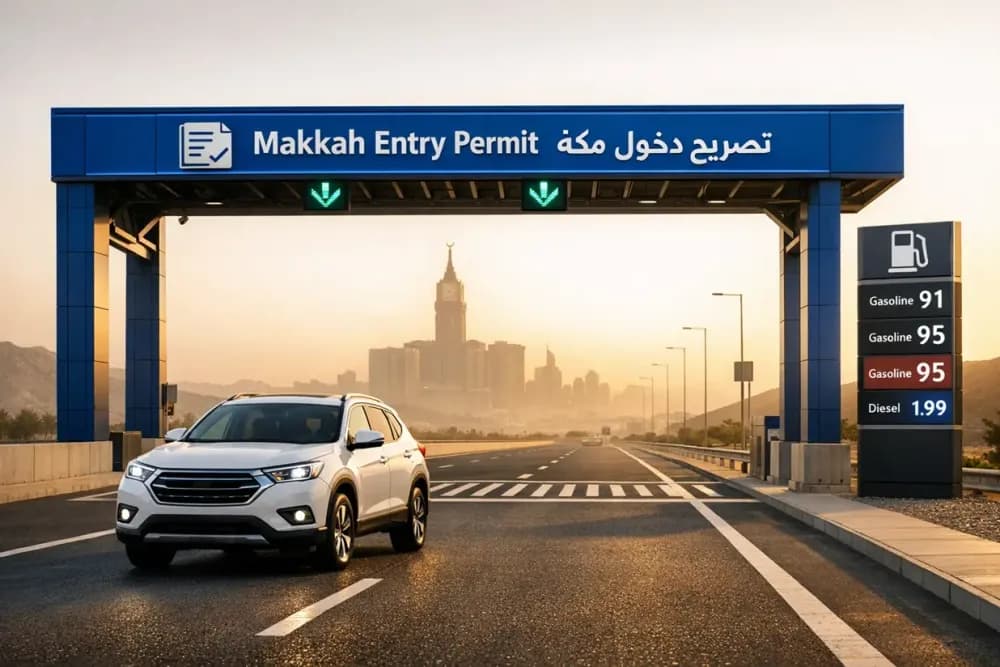
Permits Are Mandatory: Entry to Makkah requires a valid Hajj permit, linked to your vehicle via the Tasreeh system. Violations can lead to fines up to SAR 20,000 and deportation.
-
Fuel Costs: Petrol in Saudi Arabia is affordable, with Gasoline 91 priced at SAR 2.18/litre. A round trip from the UAE to Makkah (1,800–2,000 km) can cost around SAR 503–559 for fuel in a mid-range vehicle.
-
Rental Cars: Renting a car in Saudi Arabia is often easier than renting in the UAE for cross-border travel. Popular options include Toyota Yaris for small groups or Toyota Hiace for larger groups.
-
Border Crossing: Enter Saudi Arabia via the Al Batha border. Ensure you have valid documents like your Hajj visa, UAE driving licence, and vehicle insurance.
-
Parking and Shuttle Services: Private vehicles aren't allowed near the Haram. Use designated parking zones with shuttle services to the Grand Mosque.
Plan ahead, follow the rules, and ensure your journey is well-organised for a smooth Hajj experience.
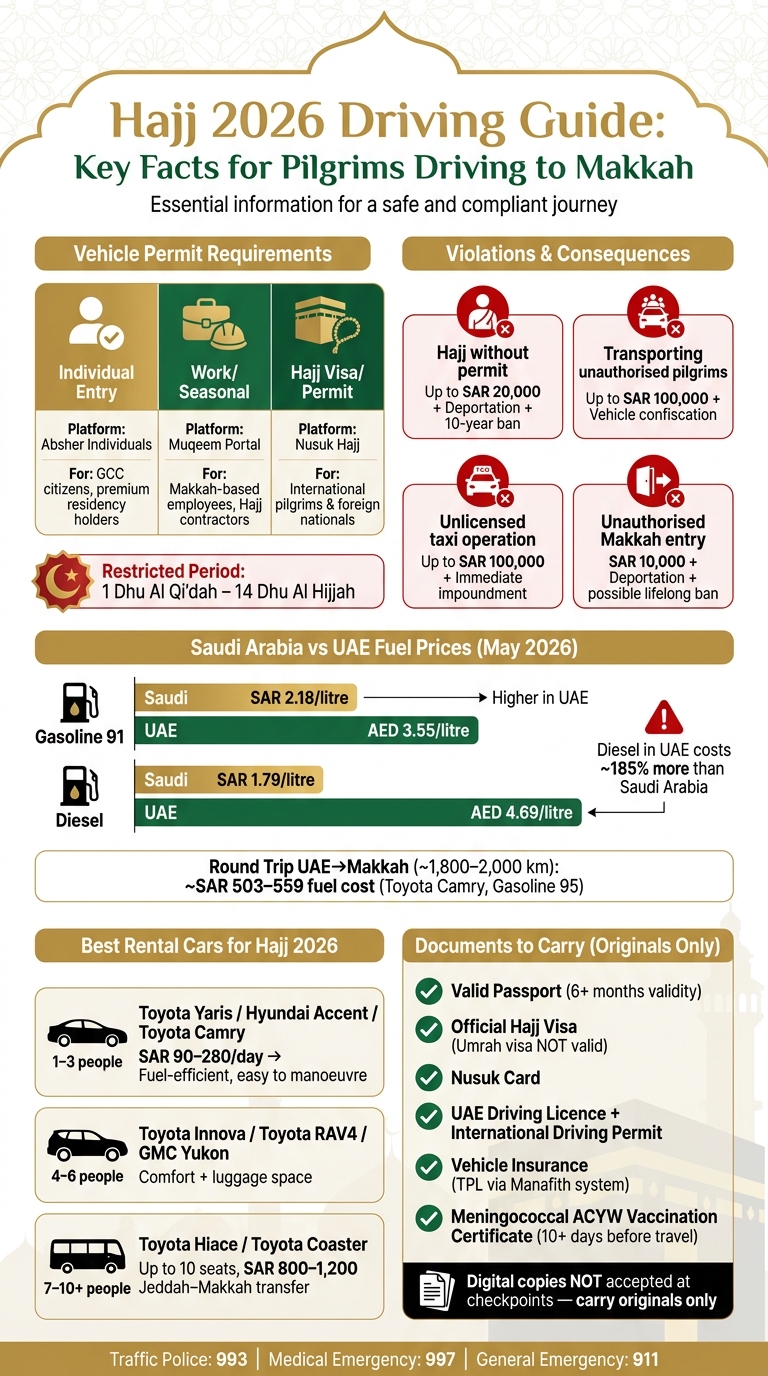
Hajj 2026 Driving Guide: Permits, Fuel Costs & Rental Cars at a Glance
Makkah Permit Rules for Hajj 2026
How the Vehicle Permit System Works
Saudi Arabia has introduced an electronic permit system for Makkah ahead of Hajj 2026. This system is managed through Tasreeh, a unified digital platform that links vehicle access permissions with individual Hajj authorisations, ensuring a smooth entry process into Makkah. During the restricted period, every vehicle entering Makkah must be registered and approved via Tasreeh to pass through checkpoints.
Checkpoints are set up on all major routes leading to Makkah, including the Jeddah–Makkah highway, the old Makkah road, and roads from Madinah and Taif. Only vehicles with Nusuk approval will be allowed entry. It’s essential to ensure all necessary approvals are in place before reaching these checkpoints. Expatriates without a Makkah-issued iqama, a valid Hajj permit, or an official work permit for the holy sites will not be allowed to enter Makkah during this period.
How to Apply for a Vehicle Permit
The process for obtaining a vehicle permit depends on your residency or employment status. Below is a breakdown of the platforms and their respective users:
| Permit Type | Application Platform | Who It's For |
|---|---|---|
| Individual Entry Permit | Absher Individuals | GCC citizens, premium residency holders, investors, domestic workers |
| Work / Seasonal Permit | Muqeem Portal | Employees of Makkah-based firms, Hajj season contractors |
| Hajj Visa / Permit | Nusuk Hajj | International pilgrims and foreign nationals |
It’s crucial to apply as early as possible since processing delays are common, especially with the restricted period starting on 13 April 2026. Use only official government platforms for your application - permits obtained from third parties are invalid.
If you’re renting a vehicle, confirm with the rental company that the car is cleared for entry into the Masha'ir (holy sites) and that they can provide the necessary documents for your permit application. Ensure you carry original documents at all times.
Additionally, review road closures and fines to stay compliant during your trip.
Road Closures, Restrictions, and Fines
The restricted period runs from 1 Dhu Al Qi'dah to 14 Dhu Al Hijjah. Entry into Makkah using visit visas, including tourist, personal, and eVisas, is not allowed during this time. Violating these rules comes with heavy penalties:
| Violation | Fine (SAR) | Additional Consequence |
|---|---|---|
| Performing Hajj without a permit | Up to 20,000 | Deportation and potential 10-year re-entry ban |
| Transporting/assisting unauthorised pilgrims | Up to 100,000 | Vehicle confiscation via court order |
| Operating an unlicensed taxi | Up to 100,000 | Immediate vehicle impoundment |
| Unauthorised Makkah entry | 10,000 | Deportation and potential 10-year or lifelong ban |
Filming or photographing Saudi security personnel, vehicles, or checkpoint infrastructure is strictly prohibited and can lead to detention. If you observe any permit violations, report them by calling 911 (Makkah, Madinah, Riyadh) or 999 (all other regions).
Route Planning and Travel Documents
Border Crossings and Highway Routes
Pilgrims from the UAE typically enter Saudi Arabia via the Al Batha land border crossing. From there, well-maintained expressways lead to the holy cities, offering two main options: the route through Riyadh or the coastal highway via Jeddah, which connects to Makkah. The Jeddah–Makkah highway is the most frequently used final stretch. However, during peak Hajj periods, this road can experience heavy congestion, with traffic delays lasting up to 3–4 hours. To minimise delays, consider travelling during "Green Zone" hours - between 3:00 AM and 6:00 AM. Keep in mind that Saudi expressways have a speed limit of 140 km/h, with a 4 km/h margin, monitored by the Saher system. Before starting your journey, double-check that you have all the necessary documents.
Documents You Need for the Drive
Only original copies of the required documents are accepted at checkpoints - digital versions are not allowed. Here's what you'll need:
| Document | Requirement |
|---|---|
| Passport | Must be valid for at least 6 months |
| Hajj Visa | Only the official Hajj visa is accepted (Umrah visas are not valid) |
| Nusuk Card | Mandatory for all pilgrims; checked at holy site entrances |
| UAE Driving Licence | Valid in Saudi Arabia; an International Driving Permit is also recommended |
| Vehicle Insurance | Mandatory third-party liability (TPL) insurance via the Manafith system (manafeth.najm.sa) |
| Vaccination Certificate | Proof of Meningococcal ACYW vaccine, administered at least 10 days before travel |
To save time at the Al Batha border crossing, purchase your third-party liability (TPL) insurance online through the Manafith website or app before you arrive. Additionally, if you have a chronic medical condition, bring a detailed medical report with your prescription history alongside your vaccination certificate.
Safety Tips for Long-Distance Driving
Once your documents are in order and your route is planned, keep these safety tips in mind for a smoother journey. Be vigilant for camels on desert highways, especially at dawn and dusk, as they can appear unexpectedly. At checkpoints like Shumaisi, have your Nusuk card, passport, and vehicle permit ready for inspection. Also, download offline maps of your route in advance, as mobile signals can be unreliable in remote areas.
Fuel Costs and Trip Budgeting
Petrol and Diesel Prices in Saudi Arabia for 2026
Driving to Makkah can save you a significant amount on fuel. Saudi Aramco regulates fuel prices, and they are updated monthly, usually around the 10th. Here's a snapshot of the fuel prices as of May 2026:
| Fuel Type | Saudi Arabia (SAR/litre) | UAE (AED/litre) |
|---|---|---|
| Gasoline 91 (Regular) | 2.18 SAR | 3.55 AED |
| Gasoline 95 (Premium) | 2.33 SAR | - |
| Diesel | 1.79 SAR | 4.69 AED |
Diesel in the UAE costs around 185% more than in Saudi Arabia. This price difference can significantly lower the overall cost of your trip.
How to Calculate Your Fuel Cost
To estimate your fuel expenses, divide the total distance (in km) by your car's fuel efficiency (km/l) and multiply the result by the price per litre. For a one-way trip from the UAE to Makkah, the distance via the Al Batha border and Jeddah–Makkah highway is approximately 900–1,000 km, making the round trip about 1,800–2,000 km.
For example:
-
A Toyota Camry, consuming 12 litres per 100 km, would require about 216–240 litres for the round trip. At 2.33 SAR per litre (Gasoline 95), this adds up to around 503–559 SAR for fuel within Saudi Arabia.
-
A more fuel-efficient car, like a Toyota Yaris, which uses roughly 7 litres per 100 km, would consume nearly half the amount of fuel.
If you’re renting a car, ensure the rental agreement includes unlimited mileage to cover the 1,800–2,000 km journey.
Parking Fees and Other Costs to Expect
While fuel costs are straightforward, don’t forget about other travel expenses. Saudi Arabia's highways are toll-free, except for the King Fahd Causeway to Bahrain, which costs 25 SAR. However, this toll won’t typically apply to those heading to Makkah.
Parking near the Haram presents a challenge, especially during Hajj. Private vehicles are not allowed in central Makkah, and parking near the holy sites is extremely limited. You’ll likely need to park on the outskirts and use licensed shuttle buses or taxis. During peak Hajj season, taxi fares from Jeddah to Makkah range between 350–500 SAR for a standard sedan and 750–950 SAR for a VIP SUV.
Additionally, factor in potential traffic fines. The Saher camera system monitors violations like speeding, seatbelt misuse, and mobile phone use. Fines start at 150–300 SAR for minor offences and can go up to 1,000 SAR for serious violations.
Lastly, if you’re returning a rental car, ensure it has a full tank to avoid additional refuelling charges. By accounting for fuel, parking, and other transit costs, you can better plan your trip and ensure a smooth pilgrimage experience.
Choosing the Right Rental Car for Hajj
Renting in the UAE vs. Renting in Saudi Arabia
When planning for Hajj, one of the key decisions is whether to rent a car locally in Saudi Arabia or in the UAE. This choice can have a big impact on the ease of your journey.
Renting in Saudi Arabia is often more convenient. It eliminates the hassle of cross-border paperwork, ensures access to local breakdown services, and provides vehicles pre-approved for the Jeddah–Makkah expressway. Companies like Theeb and Yelo are popular options, offering competitive rates and vehicles designed for desert terrain.
If you decide to rent in the UAE and drive to Saudi Arabia, you’ll need written authorisation from the rental agency before you leave. Be aware that many UAE rental companies don’t allow cross-border travel, and even those that do often charge extra fees and require advance notice. Without proper authorisation, you could face issues at the border or Saudi checkpoints.
Given the high demand during the Hajj season, it’s best to book your vehicle 2–4 weeks in advance. This planning step ensures you’ll have a car that meets the unique needs of Hajj travel.
What to Look for in a Hajj Rental Car
When selecting a rental car for Hajj, focus on comfort, safety, and compliance with travel regulations. Here are four critical factors to consider: air conditioning, passenger capacity, fuel efficiency, and insurance coverage.
With Makkah temperatures often exceeding 41°C in late May, a vehicle with a dependable air conditioning system is non-negotiable. Fuel efficiency is another important consideration, as it directly affects your travel costs. Additionally, Saudi law prohibits overloading, so make sure the car has enough room for passengers and luggage.
Most rental agreements include a Collision Damage Waiver (CDW), but it often comes with a high deductible - sometimes up to SAR 18,000. Upgrading to a Super Collision Damage Waiver (SCDW) can provide full coverage and peace of mind.
Recommended Car Models by Group Size
The size of your travel group will largely determine the best car for your trip.
| Group Size | Recommended Models | Why It Works |
|---|---|---|
| 1–3 people | Toyota Yaris, Hyundai Accent, Toyota Camry | Affordable, fuel-efficient, and easy to manoeuvre (SAR 90–280 daily) |
| 4–6 people | Toyota Innova, Toyota RAV4, GMC Yukon | Offers comfort and ample luggage space |
| 7–10+ people | Toyota Hiace, Toyota Coaster | Spacious options that comply with Saudi loading laws |
For larger groups, the Toyota Hiace (Grand Cabin) is a standout choice. It seats up to 10 passengers comfortably, and during Hajj, licensed Hiace transfers between Jeddah and Makkah typically cost SAR 800–1,200. If you’re looking for a more premium option for 6–7 travellers, consider the GMC Yukon XL, which provides added comfort and access to exclusive drop-off zones near Makkah hotels. Licensed Yukon transfers generally cost SAR 750–950.
"The Saudi authorities have officially announced that anyone caught transporting pilgrims illegally during the Hajj season faces a devastating SAR 100,000 fine, immediate vehicle confiscation, and lengthy jail time for the driver." - UmrahTransit
Before driving off, take a full video of the car’s interior and exterior. This precaution can save you from disputes over damage claims when returning the vehicle.
Driving During Hajj: What to Expect
Driving Behaviour and Vehicle Checks in Saudi Arabia
During Hajj, Saudi Arabia enforces strict traffic rules, and violations can lead to immediate fines. Speed limits are clearly marked, seatbelts are mandatory for everyone in the car, and using a handheld mobile phone while driving is prohibited, with on-the-spot penalties for offenders. On expressways, speed limits can go up to 140 km/h, so it’s crucial to ensure your vehicle is in excellent mechanical condition.
The intense heat is another critical factor to consider. With temperatures in Makkah often surpassing 41°C during Hajj, you’ll need to check your vehicle’s coolant levels and carry at least 5 litres of water per person. In case of a vehicle breakdown, you can contact the traffic police by dialling 993, call 997 for medical emergencies, or reach general emergency services at 911.
Getting Around Makkah and Finding Parking
Once your vehicle is ready, the next challenge is navigating Makkah’s parking and traffic restrictions. Private cars are not allowed to drop passengers directly at the Haram gates. During Hajj, traffic cordons are set up, and only licensed vehicles with pre-registered plates are permitted near Masjid al-Haram for drop-offs. If you’re driving, the best option is to park at one of the designated peripheral parking areas. These facilities are clearly signposted and provide shuttle services to the Grand Mosque.
Street parking near the Haram is almost impossible to find during peak days. To avoid unnecessary stress, consider booking accommodation that includes dedicated parking. Road signs throughout Makkah and on major highways are displayed in both Arabic and English, which makes navigation more manageable.
Coordinating Your Drive with Your Hajj Group
Once you’ve familiarised yourself with the driving rules and parking options, it’s time to coordinate with your Hajj group. Traffic congestion around key ritual sites like Mina, Arafat, and Muzdalifah is at its worst on peak ritual days. During these times, private cars face heavy restrictions, and even licensed vehicles can experience long delays. A practical solution is to rely on Nusuk-approved transport for these specific days, reserving your private or rental vehicle for arrival, departure, and other non-restricted travel. Be aware that unlicensed vehicles are closely monitored at checkpoints, and passengers may be asked to disembark.
To avoid confusion, plan your group’s itinerary in advance and agree on a meeting point outside restricted zones during the busiest days of the pilgrimage. Clear communication is key to ensuring a smooth experience for everyone involved.
Hajj 2026 - Webinar 2 - Hasan Travel - Guidance on Nusuk

Conclusion and Key Takeaways
Planning a smooth Hajj drive requires careful attention to permits, routes, and vehicle readiness. By organising your documents, ensuring your vehicle is in top condition, and managing your budget effectively, you can make the journey stress-free and focused on the spiritual experience.
Permit and Travel Rules: A Quick Recap
To enter Makkah during Hajj, your vehicle must be Nusuk-approved and registered in the Saudi government’s digital manifest system. Always carry original permit documents with you. Both private and rental vehicles must park in designated areas outside the city, with access provided through official shuttles. For details on fines and penalties, refer to the earlier permit guidelines.
These rules are crucial for planning your budget and preparing your vehicle for the journey.
Final Budget and Vehicle Checklist
While fuel in Saudi Arabia is affordable - SAR 2.18 per litre for 91 octane and SAR 2.33 for 95 octane - your overall budget should also include additional costs. These may include rental deposits (ranging from SAR 1,000 to SAR 3,000), transport fares during peak times, and any one-way drop-off fees. If you’re renting a vehicle, ensure it includes Collision Damage Waiver (CDW), and for long-distance trips, consider upgrading to Super Collision Damage Waiver (SCDW) to avoid high excess fees that can go up to SAR 18,000.
Here’s a handy checklist to ensure you’ve covered all the essentials:
| Checklist Item | What to Confirm |
|---|---|
| Nusuk Permit | Ensure it’s valid, linked to your passport, and covers your travel dates. |
| Physical IDP | Carry a physical International Driving Permit; digital copies are not accepted. |
| Vehicle Insurance | Minimum CDW is essential; upgrade to SCDW for added protection on long trips. |
| Vaccinations | Meningococcal ACWY vaccine must be administered at least 10 days before travel. |
| Vehicle Capacity | Ensure you don’t exceed the seating limit, as overloaded vehicles will be stopped at checkpoints. |
| Emergency Contacts | For emergencies, dial 911. |
Double-check these details before setting off to ensure a hassle-free Hajj journey.
FAQs
When do Makkah entry restrictions start for Hajj 2026?
Starting 13 April 2026, entry restrictions to Makkah will be in effect. From this date, both expatriates and residents will need official permits to access the city.
Make sure all your documentation is properly prepared to avoid any travel issues during this period.
Which permit platform should I use (Absher, Muqeem, or Nusuk)?
To apply for your Mecca entry permit for Hajj 2026, use the Absher or Muqeem platforms. These are the official online portals authorised for permit applications. Make sure to submit your application early to avoid any potential delays.
Can I drive my rental car into Makkah and park near the Haram?
If you're planning to drive a rental car into Makkah, it's important to follow local regulations. Non-Muslims are not permitted to enter the Haram area, so be mindful of the designated zones. For Muslims, parking near the Haram is typically allowed, but make sure you adhere to all local rules and guidelines to avoid any complications.