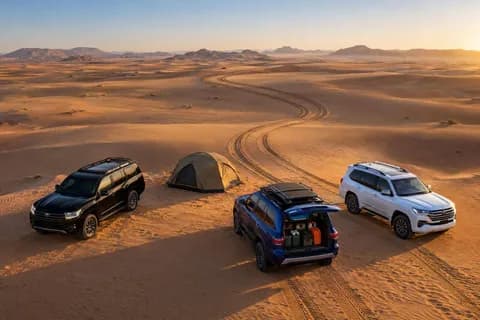
If I’m driving from Dubai to Salalah in Khareef 2026, I’d pick a car based on four things first: comfort, fuel range, wet-road grip, and luggage space. That matters more than looks or badge on a route that runs about 1,200–1,300 km each way and can take 12–17 hours.
Here’s the short version:
-
I need a car that stays calm on long desert highways and wet Dhofar roads
-
I don’t need full 4WD for the main route, but AWD/4WD helps if I plan mountain detours
-
I’d look for strong AC, working demisters, LED lights, driver-assist tech, and decent ground clearance
-
Fuel stops can be far apart, with some stretches seeing stations 100–150 km apart
-
For family trips, boot space and rear comfort matter just as much as power
The eight picks in this list cover the main trip styles:
-
Toyota Land Cruiser Prado – long range, 4WD, big luggage room
-
Nissan X-Trail – family SUV with AWD and low running costs
-
Mitsubishi Pajero – simple 4x4 with strong hardware
-
Toyota RAV4 Hybrid – low fuel use in an SUV shape
-
Kia Sportage – good value, good tech, good cabin space
-
Hyundai Tucson – quiet crossover with AWD options
-
Honda Accord – best sedan choice for paved-road trips
-
Lexus RX – premium SUV for comfort and low cabin noise
Dubai to Salalah: What Happens When You Drive 1300km?
Quick Comparison
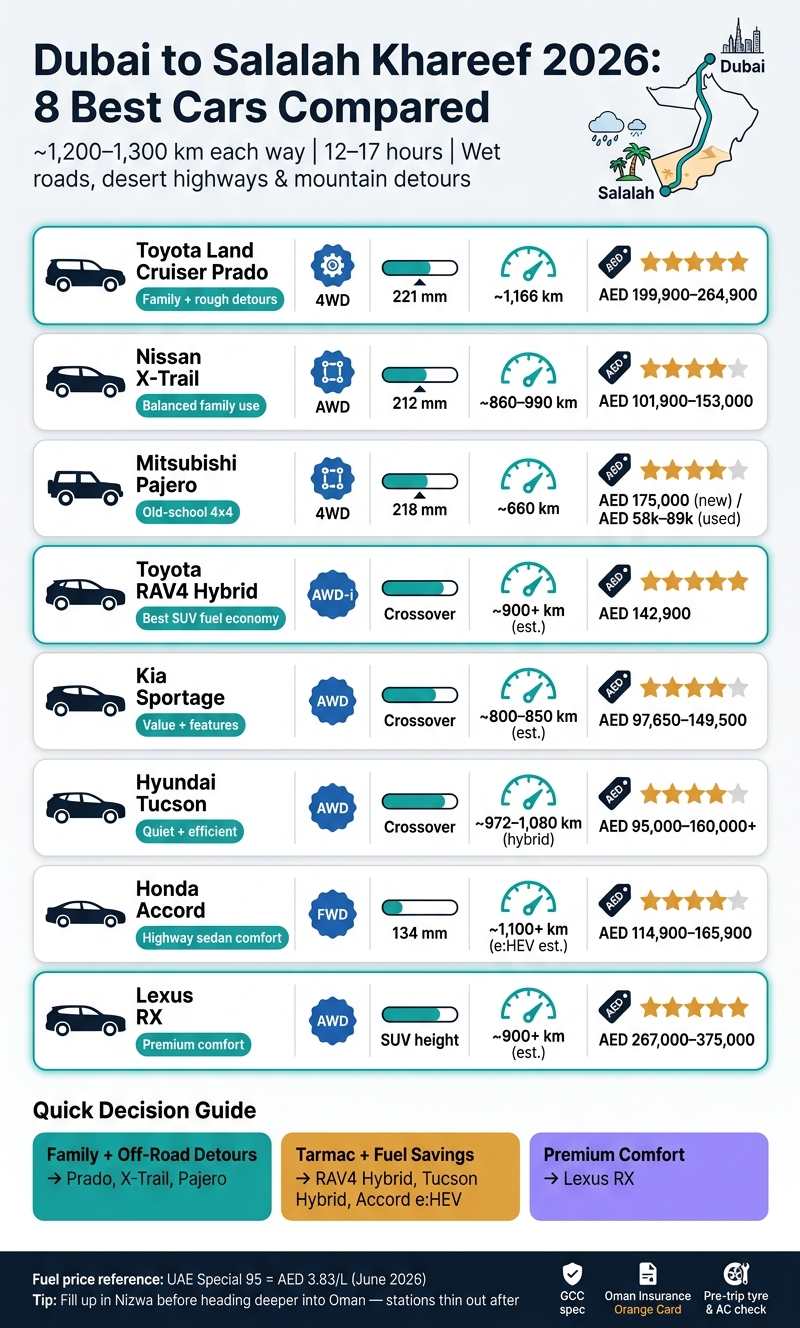
Dubai to Salalah Khareef 2026: 8 Best Cars Compared
| Model | Best for | Drivetrain | Range focus | Ground clearance / road type |
|---|---|---|---|---|
| Toyota Land Cruiser Prado | Family trips, rougher detours | 4WD | Very long | 221 mm, highway + mountain use |
| Nissan X-Trail | Balanced family use | AWD on upper trims | Strong | 212 mm, highway + light detours |
| Mitsubishi Pajero | Old-school 4x4 use | 4WD | Shorter | 218 mm, rougher mixed routes |
| Toyota RAV4 Hybrid | SUV fuel saving | AWD-i | Very strong | Crossover use, paved + light rough patches |
| Kia Sportage | Value and features | AWD on some trims | Mid-pack | Crossover use, mostly paved roads |
| Hyundai Tucson | Quiet daily-road-trip mix | AWD on some trims | Mid to strong on hybrid | Crossover use, mostly paved roads |
| Honda Accord | Long paved-road comfort | FWD | Very strong on hybrid | 134 mm, best for tarmac only |
| Lexus RX | Premium long-distance comfort | AWD on hybrid trims | Strong | SUV ride height, paved + light rough patches |
My takeaway is simple: if I’m travelling with family, bags, and plans to leave the main road, I’d lean toward the Prado, X-Trail, or Pajero. If I’m staying on tarmac and want lower fuel spend, I’d look at the RAV4 Hybrid, Tucson Hybrid, or Accord e:HEV. If comfort sits at the top of my list, the Lexus RX is the one I’d compare first.
Before I leave Dubai, I’d also check tyres, coolant, brakes, AC, wipers, lights, paperwork, and Oman insurance. On this trip, a small check before departure can save a long delay later.
Why the Right Car Matters for This Drive
This is a long-haul drive. So the things that matter most are simple: seat support, cabin quietness, AC performance, and boot space. That gives you a clear filter when choosing a car: comfort first, then stability, range, and safety.
The route also brings a few demands that are hard to ignore. Dubai heat, wet mountain roads, and Khareef fog call for strong AC, fast demisting, and a clean cabin filter. After a car has been parked in the sun, the AC should cool the cabin fast. The demisting system also needs to work well when conditions turn damp. And yes, a clean cabin air filter matters on this route.
After that, the big question isn’t whether the car looks off-road ready. It’s whether it stays calm and planted on wet roads and during long highway runs.
Full 4WD isn’t a must for most of this route. Major Khareef spots like Mughsail Beach and Wadi Darbat can be reached in a sedan. Still, moderate ground clearance - crossover level or more - helps with wet shoulders and sandy pull-offs. On this drive, highway stability matters more than full 4WD, because long desert motorways and crosswinds can make a shaky car tiring to handle.
For families, boot space is non-negotiable. You need room for luggage, rain gear, and all the extra things that come with travelling with kids. Driver-assistance features like adaptive cruise control and lane-keeping assist also help cut fatigue on long highway stretches. These are the standards used in the eight picks below.
What to Look for Before Choosing a Car
Start with the route. 2WD is fine for the main highway. Go for AWD or 4WD only if you’re planning detours into the mountains. That’s where the choice starts to matter most, especially once the road climbs into the Dhofar Mountains. During Khareef, you can run into mist, rain, and slippery tarmac.
If roadside pull-offs in Dhofar are part of the plan, ground clearance matters more than many people expect. Aim for at least 200 mm. Most crossovers sit in the 170–190 mm range, which can feel a bit tight once the road surface gets rough. Full-size SUVs give you more breathing room.
For a 2,400–2,600 km round trip, fuel range isn’t just a spec on paper. It affects how relaxed the drive feels. Fill up in Nizwa before heading deeper into the interior highways, where fuel stations become less frequent. A tank size of 70–80 litres is a good target if you want to keep stops under control. And with UAE Special 95 at AED 3.83 per litre in June 2026, fuel economy adds up over a trip like this. Outside the main highway corridor, pump options can thin out fast.
Then there’s comfort. On a drive that can stretch to 12–17 hours, small things stop being small. Supportive seats, decent rear legroom, and low cabin noise make a big difference. Power-adjustable seats with lumbar support are worth paying attention to on a journey this long.
Weather gear matters too. In Khareef conditions, with fog, drizzle, and slick mountain roads, it makes sense to look for:
-
LED headlights with fog lamps
-
Adaptive cruise control
-
Lane-keeping assist
-
Wet-grip tyres
Here’s a simple way to size up the options:
| Under AED 80,000 | AED 80,000–150,000 | AED 150,000+ | |
|---|---|---|---|
| Typical driving range per tank | ~700 km | ~800–1,000 km | 1,100+ km |
| Typical safety tech | ABS, ESC, basic ADAS | Full ADAS, 360° camera | Advanced ADAS, premium lighting |
| Ground Clearance | ~170–190 mm | ~210–228 mm | 235 mm+ |
| Comfort | Fabric seats, dual AC | Ventilated/leather seats | Massaging seats, air suspension |
Use these filters to judge the eight cars below.
1. Toyota Land Cruiser Prado
The 2026 Toyota Land Cruiser Prado is one of the best all-round picks for the Dubai-to-Salalah route. It ticks the main boxes for this drive: a capable drivetrain, long fuel range, solid comfort, and up-to-date safety kit. Prices start at AED 199,900 for the 2.4L TXR and go up to AED 264,900 for the top-spec VXR.
Wet-Road Stability and Drivetrain
The Prado uses a full-time 4WD system with a central differential lock and a transfer case with high and low-range gearing. That matters in Khareef, when the roads up into the Dhofar Mountains can turn wet, slick, and covered in mist. In plain terms, this setup gives the Prado the grip you want when the surface gets tricky.
Power comes from a 2.4L turbocharged four-cylinder that makes 267 hp and 430 Nm of torque, matched with an 8-speed automatic transmission. That torque helps when you're climbing steep sections in the wet. Ground clearance is 221 mm, which gives the SUV a bit more breathing room over uneven patches and water-slicked stretches.
Long-Distance Comfort and Boot Space
This is where the Prado starts to make a lot of sense for family road trips. The cabin is set up for long hours behind the wheel, not just short city runs. Higher trims come with ventilated and heated front seats, power-adjustable lumbar support, tri-zone or 4-zone climate control, and a 14-speaker JBL audio system.
Upper variants also get a 12.3-inch multimedia display, which adds a more polished feel to the cabin. With the third row folded, boot space expands to 742–906 litres. That's a lot of room for bags, snacks, jackets, and the usual pile of things that seem to grow on any family trip. The third row is there if you need it, but for this kind of long drive, it's better suited to children.
Fuel Efficiency and Driving Range
The 2.4L petrol turbo has a claimed combined fuel economy of 10.6 km/L. Pair that with a 110-litre fuel tank, and you get a theoretical driving range of about 1,166 km on one fill.
That's a big plus on a route like Dubai to Salalah. Fewer fuel stops can make the trip feel a lot less broken up, especially when you just want to keep moving.
Safety Tech and GCC Suitability
Toyota Safety Sense 3.0 comes as standard on all Prado variants. That includes Adaptive Cruise Control, Lane Trace Assist, Pre-Collision System, and Adaptive High Beam. On a long highway drive with shifting weather and light, those features aren't just nice to have. They can take some of the strain out of the trip.
Upper trims add Blind Spot Monitoring, Safe Exit Assist, and a 3D Multi-Terrain Monitor. The last one can be handy when visibility drops and the mountain roads get covered in fog.
If you're shopping used, check for GCC spec. That's worth doing for the cooling system and A/C setup, especially in regional heat.
For buyers who want something smaller, lighter, and easier on running costs, the next option keeps the same route-first thinking without the Prado's size or price.
2. Nissan X-Trail
The 2026 Nissan X-Trail fits families that want mid-size room, usable AWD, and lower running costs than a full-size SUV. Pricing starts at AED 101,900 for the base 2WD model and reaches AED 153,000 for the top-spec 2.5L SL 4WD 7-seater. If you're planning to drive through wet mountain stretches, the AWD trims make far more sense. They give you that extra bit of confidence without pushing you into a bigger, heavier SUV.
Wet-Road Stability and Drivetrain
The X-Trail’s Intelligent 4x4 system helps it stay settled in rain and on rougher surfaces. It can shift traction based on changing grip levels, which is handy when roads go from dry to slick without much warning. It also comes with five drive modes - Auto, Eco, Sport, Snow and Off-Road - which cover most conditions drivers are likely to face. Ground clearance stands at 212 mm, so speed bumps and mild rough patches along the route shouldn’t be much of a worry.
Under the bonnet is a 2.5L naturally aspirated engine producing 181 hp and 244 Nm of torque, paired with an Xtronic CVT with paddle shifters. The manual mode is useful on descents because it adds engine braking. On steep climbs with a full load, though, the 2.5L can feel a bit less relaxed.
Only the AWD versions - SV, SV Plus, N-Trek and SL - get the Intelligent 4x4 system. That makes the base S 2WD model a weaker choice for wetter mountain roads.
Long-Distance Comfort and Boot Space
For long drives in Gulf heat, the X-Trail does a lot right. Its Zero Gravity ventilated leather seats and rear AC vents can make a big difference after a few hours on the road. Boot space ranges from 445 litres to 1,396 litres, which gives families decent flexibility for bags, coolers, and the usual travel clutter.
The third row is there if you need it, but it’s best suited to children on a trip like this. Adults will find it cramped.
Higher trims bring in a few nice extras:
-
12.3-inch infotainment display
-
10.8-inch Head-Up Display
-
10-speaker Bose audio system
Fuel Efficiency and Driving Range
The 2.5L AWD delivers an estimated 15.7–18 km/L on the highway. With a 55-litre fuel tank, that translates to about 860–990 km of highway range per tank. For a family SUV with AWD, that’s a strong result and one of the X-Trail’s main selling points.
Safety Tech and GCC Suitability
The X-Trail comes with a 5-star Euro NCAP rating, Safety Shield 360, and available ProPILOT Assist for lane centring and adaptive cruise. Those features can take some of the strain out of long highway runs, especially when traffic starts bunching up.
For regional heat, the 2026 model also gets improved cooling systems, dual-core radiators and desert-grade coolant.
If fuel economy matters more than outright size, the next pick goes even farther on a tank.
3. Mitsubishi Pajero
For drivers who want something tougher and more old-school than the X-Trail, the Pajero is a clear step up. It fits the Dubai-to-Salalah run well, especially if your trip includes desert highways, mountain roads, and slick Khareef tarmac. The 2026 Pajero 3.8L Signature Edition costs about AED 175,000 new. Used 2020 models usually sit around AED 58,000–89,000, based on mileage and trim.
Wet-Road Stability and Drivetrain
One of the Pajero’s biggest strengths here is its Super Select 4WD-II system. It can switch between 2H and full-time 4H at speeds of up to 100 km/h, which is handy when dry road suddenly turns wet and you don’t want to pull over just to change modes.
When the road gets steeper or the surface gets loose, 4HLc and 4LLc lock the centre differential for extra grip. That gives the Pajero a bit more confidence on mixed terrain, not just smooth motorways.
Its 218 mm ground clearance also helps on rough shoulders and unpaved stretches, and the suspension is built for that kind of use. The 3.8L V6 is smooth in daily driving and handles heat well, paired with a proven 5-speed automatic.
Long-Distance Comfort and Boot Space
Inside, the Pajero keeps things roomy and practical. With the third row folded, boot space comes to 1,081 litres. That’s a useful amount for family luggage, camping gear, or a full holiday load.
It also covers the basics for Gulf road trips well:
-
Dual-zone climate control
-
Rear AC vents
-
Leather seats
-
Glass sunroof
-
Onboard mini-fridge
Those last three come with the 2026 Signature Edition.
Fuel Efficiency and Driving Range
This is the part where you make a trade-off. The 3.8L Pajero is rated at about 7.7 km/L, so it’s not cheap to run by current standards. With its 88-litre fuel tank, estimated highway range is around 660 km.
That said, the payoff is simple: you’re getting a larger SUV with the kind of hardware that suits a route with changing road and weather conditions.
Safety Tech and GCC Suitability
For GCC buyers, one of the main things to check is how well the car is set up for local heat and dust. On that front, GCC-spec Pajero models come with larger cooling radiators and dust-resistant cabin filters.
The downside is that it misses some of the newer driver-assist features, including adaptive cruise and forward collision mitigation. If you like simple, mechanical 4x4s and don’t mind doing more of the driving yourself, that may not be a deal-breaker.
4. Toyota RAV4 Hybrid
The 2026 Toyota RAV4 Hybrid Adventure HEV sits in a sweet spot for this kind of drive. At AED 142,900 new, it gives you a smart mix of grip, fuel savings, and day-long comfort. For wet roads in Khareef and long hours on the motorway, that mix makes a lot of sense.
Wet-Road Stability and Drivetrain
The RAV4 Hybrid’s intelligent AWD-i system is a good fit for wet Khareef roads and long highway stretches. It can send torque to the wheels that need it most, which helps when the road surface gets slick. Toyota also includes Multi-Terrain Select with Mud/Sand and Rock/Dirt modes.
There’s also Hill Start Assist, which helps on steep and slippery inclines. Add in the lower centre of gravity, and the RAV4 stays settled at higher speeds on the highway. On a Dubai-to-Salalah drive, that kind of road manners matters just as much as fuel use.
Long-Distance Comfort and Boot Space
Toyota lowered the dashboard by 40 mm, which improves forward visibility and can help cut driver fatigue over long distances. The controls are placed within easy reach, so the cabin feels simple to live with on a long run.
Boot space is another plus. It handles family luggage without drama, and that’s a big deal on a trip where you’re packing for days, not just a weekend.
Fuel Efficiency and Driving Range
The RAV4 Hybrid is frugal, with rated fuel consumption of 22.2–24.8 km/L. It also makes 236 hp combined, which is 11% more than the previous base petrol version.
That’s the appeal in plain terms: you get strong range without ending up with a car that feels underpowered. For a road trip of 1,000+ km, that balance is hard to ignore.
Safety Tech and GCC Suitability
On Khareef roads, peace of mind comes from more than just AWD. Toyota Safety Sense 4.0 adds an Emergency Driving Stop System that can find a safe shoulder and bring the car to a controlled stop if the driver stops responding.
GCC-spec models are also set up for local conditions, with larger radiators, stronger A/C, and UV-blocking glass to deal with Dubai heat and Salalah humidity. Toyota backs the hybrid battery in the UAE with a 7-year or 160,000 km warranty.
5. Kia Sportage
The 2026 Kia Sportage is a smart choice for buyers who want strong value without giving up comfort or usable performance. Prices sit at about AED 97,650 to AED 149,500, depending on trim. For this trip, the SX 4WD (2.0L Turbo) makes the most sense. It fits drivers who want a well-priced SUV with enough comfort, cabin room, and road grip for the Dubai-to-Salalah drive.
Wet-Road Stability and Drivetrain
The 2.0L Turbo puts out 263 HP and 353 Nm of torque, and it can do 0–100 km/h in around 7.5 seconds. That means easy highway cruising and stress-free overtaking when traffic opens up. AWD versions also get multi-terrain modes for slippery roads. On this route, AWD is the better pick over FWD. It gives the Sportage a more planted feel when conditions change, without making it less comfortable on long motorway stretches.
Long-Distance Comfort and Boot Space
One of the Sportage’s strong points is how quiet the cabin stays on the move. On higher trims, you get ventilated and heated front seats, a power-adjustable driver’s seat with memory, dual-zone automatic climate control, and a 12.3-inch curved display that handles both the instrument cluster and infotainment. Rear passengers get their own AC vents and USB chargers too, which helps a lot on family trips.
Boot space ranges from 538 litres in standard versions to 591 litres in the long-wheelbase L model, while the 2,755 mm wheelbase gives rear passengers more legroom for long hours on the road. The 60:40 split-folding rear seats also make packing easier for a multi-day drive. That mix of space and comfort is a big plus when the trip isn’t just a quick weekend run.
Fuel Efficiency and Driving Range
The 2.0L Turbo hits a good middle ground between performance and range. The Hybrid can go farther between fuel stops, but the turbo is still the better all-round choice for this drive. With a fuel tank of 54L to 62L depending on trim, the Sportage has enough range to deal well with the long desert parts of the route.
Safety Tech and GCC Suitability
Across the 2026 line-up, standard safety kit includes 6 airbags, Forward Collision-Avoidance Assist, Lane Keeping Assist, and a rearview camera. Higher trims add a 360-degree camera and Blind-Spot Collision-Avoidance, both of which are handy on narrow and foggy Khareef roads.
6. Hyundai Tucson
The 2026 Hyundai Tucson is a smart mid-size crossover for drivers who want AWD confidence, a quiet cabin, and solid fuel economy on the Dubai-to-Salalah run. It fits buyers who want a good middle ground: more grip and comfort than a basic crossover, without moving up to a larger SUV. Prices start at around AED 95,000 and can go past AED 160,000, depending on trim. For this route, the 2.0L HTRAC AWD at about AED 115,000 stands out as the most sensible choice.
Wet-Road Stability and Drivetrain
HTRAC AWD sends power to the wheels that need it most on wet roads and uphill stretches into Dhofar. The 2.0L AWD produces 156 HP and 192 Nm, which is enough for steady highway driving and mountain climbs. You also get Drive Mode Select, so you can switch to Eco on long highway sections and Sport when the road starts to twist.
Long-Distance Comfort and Boot Space
The Tucson rides softly and stays quiet at highway speeds, which matters on a long drive like this. Inside, the dual 12.3-inch curved display gives the cabin a clean, modern feel, while wireless smartphone integration makes navigation and calls much easier.
Rear passengers aren’t forgotten either. Rear vents help keep the cabin comfortable, and the rear seats split 4:2:4, which gives you more freedom when loading bags, boxes, or longer items for the trip.
Fuel Efficiency and Driving Range
If fuel range is high on your list, the hybrid is the one to watch. It delivers 18–20 km/L, with an estimated range of 972–1,080 km from its 54-litre tank. That can cut down the number of fuel stops on the long highway run into Oman.
The 2.0L petrol is less efficient at 11–14 km/L, so expect to stop more often. Put simply, if your main goal is fewer fuel breaks, the hybrid is the better fit.
Safety Tech and GCC Suitability
The Tucson comes with a strong set of safety features, including Forward Collision-Avoidance Assist, Lane Keeping Assist, Blind Spot Monitoring, and a 360-degree camera. That extra visibility can make a big difference when roads get wet or visibility drops.
LED headlights also help in low-visibility conditions. Before heading out, it’s worth checking tyre pressures and the TPMS, especially for a long GCC road trip where heat, load, and road changes can affect tyre performance.
7. Honda Accord
The Honda Accord is a strong pick for drivers who want a quiet, comfortable sedan for the Dubai-to-Salalah drive. In the UAE, pricing starts at about AED 114,900 and goes up to AED 165,900 for hybrid trims. For this route, the e:HEV Hybrid makes the most sense. It gives you sedan comfort on long highway stretches without stepping up to an SUV.
Wet-Road Stability and Drivetrain
The Accord comes with FWD only, but it has the right support systems for wet roads. VSA, traction control, EBD, and Hill Start Assist help the car stay settled on wet tarmac.
Its low stance also helps. You get less body roll through the bends in Dhofar, which makes the car feel planted. The downside is its 134 mm ground clearance, so you need to be careful on rough shoulders or uneven pull-off spots. That setup fits this trip well, because the route is mostly long highway driving rather than serious off-road use.
Long-Distance Comfort and Boot Space
This is where the Accord shines. The cabin is quiet, roomy, and built for long hours on the road. It also has strong AC, which matters a lot on a drive like this, and the 2,830 mm wheelbase gives rear passengers proper legroom.
Over a 12 to 17-hour journey, that extra space and cabin calm can make a big difference. You feel less worn out at the end of the drive, and passengers are far less likely to get restless halfway through.
Fuel Efficiency and Driving Range
The e:HEV Hybrid is rated at 24.9 km/L officially, so it’s the better option if you want fewer fuel stops on the way. By comparison, the 1.5L Turbo returns about 6.5 to 7.3 L/100 km in UAE use.
For a route built around long cruising sections, that gap matters. Fewer stops can make the drive feel smoother and less broken up.
Safety Tech and GCC Suitability
Every Accord gets the Honda Sensing suite, which includes Collision Mitigation Braking System (CMBS), Lane Keeping Assist (LKAS), Adaptive Cruise Control (ACC), and Road Departure Mitigation (RDM). On a long highway run, these features can help take some strain out of repetitive driving.
Before you leave, it’s smart to check tyre tread carefully. The Accord’s FWD layout gives you less margin on wet Salalah roads than an SUV or AWD model.
If you like this comfort-first setup but want it in a more premium SUV package, the Lexus RX is the next model to compare.
8. Lexus RX
For buyers who like the Accord’s easy, settled highway feel but want something more upmarket, the Lexus RX is the clear move up. It’s the premium option in this group. The RX350h starts at about AED 267,000, while the RX450h+ PHEV is estimated at AED 345,000 to AED 375,000. It fits drivers who want first-class comfort, low cabin noise, and strong in-car tech for the long Dubai-to-Salalah run.
Wet-Road Stability and Drivetrain
The RX350h uses Lexus E-Four AWD, which adds electric drive at the rear axle to help the SUV find grip faster on wet roads. That matters when surfaces get slick and patchy. The chassis also does a good job of controlling body movement on fast motorways and through mountain bends, so the car feels settled instead of floaty.
On steeper climbs near Salalah, Trail or Sport mode makes the throttle feel more alert and helps the traction system react faster. It’s the sort of setup that gives the RX a calm, planted feel when the weather turns.
Long-Distance Comfort and Boot Space
This is where the RX starts to earn its badge. The cabin insulation keeps road and wind noise low, which makes a big difference on a long highway stretch through changing Khareef weather. Hours behind the wheel feel less tiring when the car stays quiet.
Ventilated front seats, strong air conditioning, and a driver-focused dashboard keep the cabin easy to live with. Controls are close at hand, which helps when rain, fog, or spray cuts visibility. The standard 5-seat layout also makes more sense for family luggage than squeezing in extra seats you may not use.
Fuel Efficiency and Driving Range
The RX350h returns 20.7 km/L, which is a strong result for a premium hybrid SUV covering a route this long. It gives buyers comfort without the usual fuel penalty you’d expect from a big, upscale SUV.
The RX450h+ PHEV adds an electric-only range of about 60–65 km. That’s handy for quiet driving around Salalah before the petrol engine takes over for the motorway journey back or the haul down from Dubai.
Safety Tech and GCC Suitability
Lexus Safety System+ 3.0 brings adaptive cruise control with curve-speed management and Lane Tracing Assist, both useful on long highway sections where fatigue can creep in. A 360-degree camera with under-car view also helps on narrow or rough monsoon tracks, especially when the ground is uneven or visibility is poor.
Safe Exit Assist adds another useful layer. It can stop a door from opening if traffic or cyclists are coming up alongside, which is the kind of feature you may not think about until you need it.
The comparison table below shows where the RX sits on comfort, range, safety, and price against the other seven picks.
Side-by-Side Comparison Table
For the Dubai-to-Salalah Khareef drive, the main things that matter are ride comfort, luggage room, and confidence on wet roads. So the easiest way to compare these cars is by how they handle long hours on the road, how much they can carry, and how much they help cut driver fatigue.
| Model | Best fit for this route |
|---|---|
| Toyota Land Cruiser Prado | Best for range, 4WD confidence, and family luggage. |
| Nissan X-Trail | Balanced AWD family SUV with strong comfort and fuel economy. |
| Mitsubishi Pajero | Old-school 4x4 strength with simple, proven hardware. |
| Toyota RAV4 Hybrid | Best fuel economy in the SUV group. |
| Kia Sportage | Value-focused SUV with strong tech and usable space. |
| Hyundai Tucson | Quiet, comfortable mid-size crossover with good efficiency. |
| Honda Accord | Best sedan choice for quiet, stable highway cruising. |
| Lexus RX | Premium pick for the quietest cabin and smoothest ride. |
In plain terms, SUVs make life easier on a trip like this because they give you more boot space. That matters when you're packing bags, snacks, kids' gear, or a few extras for a long cross-border drive.
If you want a sedan, the Honda Accord is the clear pick for quiet, stable highway cruising. If comfort is the top priority, the Lexus RX stands out for the calmest, most comfortable ride.
Before you set off, do a quick pre-trip check on:
-
Tyres
-
Fluids
-
Brakes
-
AC
A few minutes here can save a lot of hassle later.
How to Prepare Your Car Before Leaving Dubai
Once you’ve picked your car, give it a route-specific check before leaving Dubai. Start with the tyres. Check tread and pressure while the tyres are cool, not after a drive, because heat expansion can throw off the reading. And yes, check the spare too.
Then move to the cooling system. Look at the coolant level in the expansion tank. Low coolant can increase the risk of overheating in Gulf heat. It’s also worth testing the brakes, listening for any knocking from the suspension, and making sure the wheel alignment stays straight. Batteries also take a beating in UAE heat. Many need replacing within 2–3 years in this climate, so if yours is getting close to that range, have it tested before you head out.
Khareef changes the checklist a bit. In these conditions, visibility and tyre grip matter most. Fog, wet tarmac, and mountain roads can turn a normal drive into a tense one if the car isn’t ready. Check that your wiper blades are in good shape, top up the washer fluid, and make sure the fog lamps, headlights, and demisters are all working as they should.
Keep what you pack simple and useful:
-
phone mount and charger
-
first-aid kit
-
torch
-
warning triangle
-
power bank
-
light rainwear
-
grip shoes
You should also carry at least 3 litres of water per person.
Before crossing into Oman, check the paperwork as carefully as the car. You’ll need:
-
your passport, valid for at least 6 months
-
Emirates ID
-
your Mulkiya (vehicle registration card)
If the car is financed or not registered in your name, bring a notarised NOC. You’ll also need an Orange Card third-party insurance for Oman, which usually costs around AED 105–115.
Conclusion
The right pick comes down to your route, your load, and how deep into Dhofar you want to go. There isn’t one car that suits every Dubai-to-Salalah trip. It depends on how many people are coming, how much luggage you’re carrying, and whether you plan to stick to main roads or head farther out.
If your trip includes Jebel Samhan or remote wadis, a tougher SUV like the Toyota Land Cruiser Prado or Mitsubishi Pajero is the safer bet for rough mountain roads. If you’re mostly staying on tarmac, a crossover like the Hyundai Tucson or Kia Sportage gives you a good balance of comfort and value for a long run.
For drivers who’ll stay on paved roads, the sedan option looks more appealing. If it’s mainly a highway trip for two people, the Honda Accord is a solid choice. Bigger families may want seven seats, while smaller groups can lean more toward fuel savings or extra comfort, including the fuel-efficient Toyota RAV4 Hybrid or the more premium Lexus RX.
Before you buy, check new and used listings on YallaMotor and filter for GCC-spec vehicles. If you’re buying used, set a mileage limit and keep around AED 300 to AED 500 aside for an independent inspection.
Choose early, finish your checklist, and enjoy the drive.
FAQs
Which car is best for a family Khareef trip?
It comes down to what your family cares about most.
The Nissan Patrol is the one that leans hardest into long-trip comfort. It seats eight, comes with Zero Gravity seats, and uses adaptive air suspension that helps on mountain roads. If you spend hours behind the wheel, that kind of comfort can make a big difference.
If safety and day-to-day flexibility sit at the top of your list, the Nissan Pathfinder and Kia Sorento are both strong choices. They suit family life well, especially with easy access to the third row. That sounds like a small thing, but when kids, bags, and busy school runs are part of the picture, it matters.
If fuel use is the main concern, the hybrid BYD Atto 8 makes a lot of sense. It’s a practical pick for long-distance running costs, especially for families who clock up plenty of kilometres.
Do I really need AWD or 4WD for Salalah?
It depends on your route and how much room you need. For smooth coastal roads and city sightseeing, a sedan is often enough. It also uses less fuel, which helps keep costs down.
If you’re travelling with family, bringing extra luggage, or driving into the Dhofar mountains and rugged wadis, an SUV makes more sense. 4WD gives you better grip on wet, misty mountain roads and may be needed after heavy rain.
What should I check before driving to Oman?
Before you drive to Oman, sort your paperwork first. You’ll need a passport with at least 6 months left, your UAE residence visa, UAE driving licence, Mulkiya, and car insurance that covers Oman.
If your insurance doesn’t include Oman, you can buy an Orange Card at the border for about AED 105. It’s also smart to apply for your eVisa 4 to 5 business days in advance instead of leaving it to the last minute.
If you’re taking a borrowed, financed, or rental car, make sure you have a notarised Arabic NOC. On top of that, budget for the AED 35 UAE exit fee and the OMR 5 visa fee.
Give the car a quick check before you set off too:
-
AC
-
Tyre pressure
-
Engine cooling