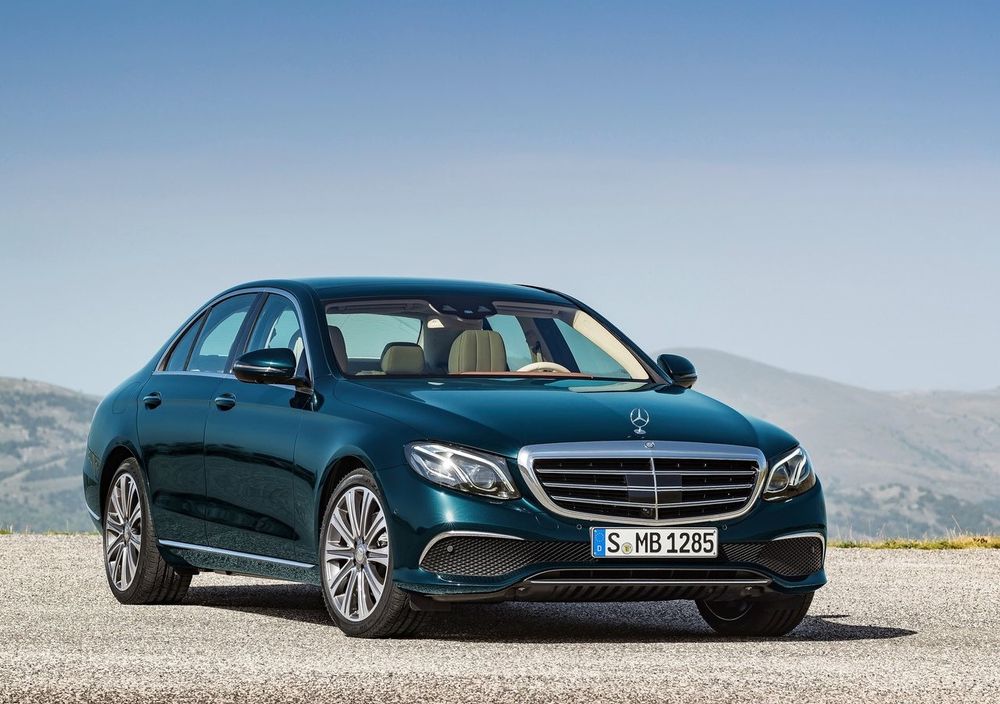
The luxury sedan segment of today hosts many big names from across the planet, which includes the Americans, Europeans, and Japanese carmakers. However, the one name that most likely pops in your mind the moment you think about a luxury car, is probably Mercedes-Benz. The Stuttgart-based luxury automaker has been in the business of producing some fantastic cars over its long and glorious history. And two of its most important and popular models of the 21st century are the C-Class and E-Class sedans. While the C-Class remains the most profitable and best-selling of all Mercedes-Benz models, the larger E-Class isn’t that far behind on either of those two counts.
Between the two, the Mercedes-Benz C-Class is a relatively-newer model and was only launched in 1993. Meanwhile, the “E-Class” nameplate has been around since 1984 and since then, there have been five generations of this mid-size luxury sedan. Similarly, the outgoing C-Class is also in its fifth generation since its inception over 25 years ago. Both of the Mercedes-Benz models are sold in many international markets in various body styles, namely as a sedan, coupe, convertible, and station wagon. However, neither the C-Class nor the E-Class is sold as station wagons in the United Arab Emirates. Externally, the two main distinguishing factors between the new Mercedes-Benz C-Class and the new E-Class have to do with their differences in size and their headlight design. The C-Class sedan measures in at 4.686 meters X 1.810 meters X 1.442 meters X 2.840 meters in length, width, height, and wheelbase, respectively. Meanwhile, the larger E-Class sedan comes in at 4.923 meters X 1.852 meters X 1.468 meters X 2.939 meters in overall length, width, height, and wheelbase. As for the other factor, head-on, you can tell the C-Class apart by its single LED daytime-running light strip, while the E-Class gets two such LED strips. Of course, being the bigger of the two, the E-Class also has a larger boot capacity of 540 liters, over the C-Class’s 481 liters.

Mechanically, both cars share a few commonalities such as a rear-wheel drive layout, petrol-only engines, and automatic transmissions. However, under the hood of the most basic variant of the C-Class (the C180) is a small 1.6-liter turbo-four with 156 hp and 250 Nm of torque on offer. Whereas, the base Mercedes-Benz E200 is powered by a 2.0-liter turbo-four with 184 hp and 300 Nm of peak torque. If it’s performance that you’re after, then both the C-Class and E-Class have their respective AMG versions to cater to your needs. Costing 420,000 dirhams, the insane C63S AMG delivers 510 hp and 700 Nm of torque out of its 4.0-liter bi-turbo V8. Meanwhile, the beastly E63S AMG 4MATIC+ produces a biblical 612 hp and 850 Nm of max torque. Performance-wise, both can do a top speed of 250 km/h; however, the volcanic E63S destroys the C63S with its 0-100 km/h acceleration time of just 3.4 seconds (compared to the C63S’s 4.0 seconds). In terms of their pricing, the 2019 Mercedes-Benz C-Class costs between AED 165,000 to AED 420,000, while the 2019 E-Class is priced between AED 205,000 to AED 510,000.
On the inside as well, the Mercedes-Benz E-Class features a far more opulent and upscale interior when compared to the C-Class. Owing to its larger dimensions and higher price tag, the E-Class obviously has a roomier, more luxurious and an even better built cabin than its younger sibling. Mercedes-Benz has also packed the new E-Class with more technology, a quieter cabin, and a suppler ride quality as well.

Editor's Pick: