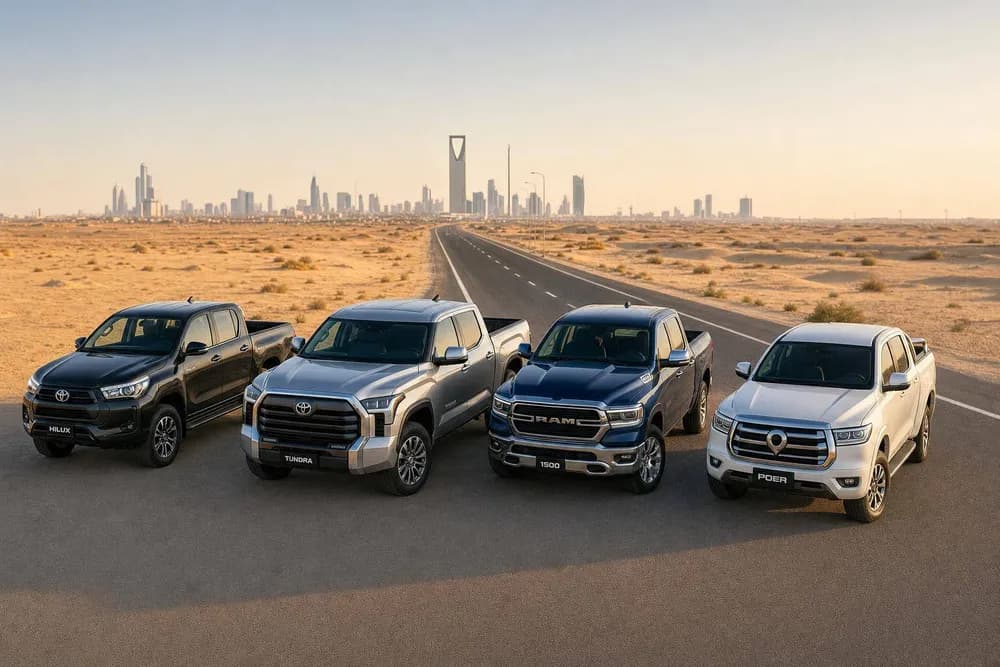
If I had to cut this list down to one line, it would be this: Hilux for resale and work, Tundra for towing and family use, Ram 1500 for comfort and power, and GWM Poer for price and features.
If you’re shopping for a pickup in Saudi Arabia in 2026, these are the four names that matter most in this comparison: Toyota Hilux, Toyota Tundra, Ram 1500, and GWM Poer. The gap is big too, from about SAR 102,235 for a Poer to SAR 423,890 for a Ram 1500 RHO. That means your choice is less about hype and more about what you want the truck to do every day.
Here’s the short version:
Toyota Hilux: best if I want strong resale, low running spend, and a pickup that can take hard use
Toyota Tundra: best if I need up to 5,443 kg towing and more rear-seat space
Ram 1500: best if I care most about ride comfort, cabin finish, and up to 540 hp
GWM Poer: best if I want more kit for less money, with items like a 12.3-inch screen and 360-degree camera
I’d also keep Saudi conditions in mind. In summer, temperatures can pass 50°C, so GCC-spec cooling and strong A/C matter just as much as towing or payload.
Quick Comparison
Model | Price in Saudi Arabia | Best For | Key Numbers | Main Trade-Off |
|---|---|---|---|---|
Toyota Hilux | SAR 109,020–189,865 | Work, resale, mixed use | Up to 3,500 kg towing, 1,130 kg payload, up to 15.9 km/L | Firmer ride, simpler cabin |
Toyota Tundra | SAR 162,000–249,000 | Family use and heavy towing | Up to 5,443 kg towing, up to 389 hp petrol | Big size, higher fuel use |
Ram 1500 | SAR 239,999–423,890 | Comfort, motorway driving, power | Up to 5,700 kg towing, up to 540 hp | High price, higher running spend |
GWM Poer | SAR 102,235–131,664 | Budget-focused buyers | Up to 3,500 kg towing, 1,000 kg payload, 181 hp/480 Nm | Weaker resale track record |
So if you want the simple answer, the Hilux is still the safe pick, the Tundra is the heavy hauler, the Ram is the plush one, and the Poer is the low-price wildcard. The rest comes down to resale, towing, comfort, and value.
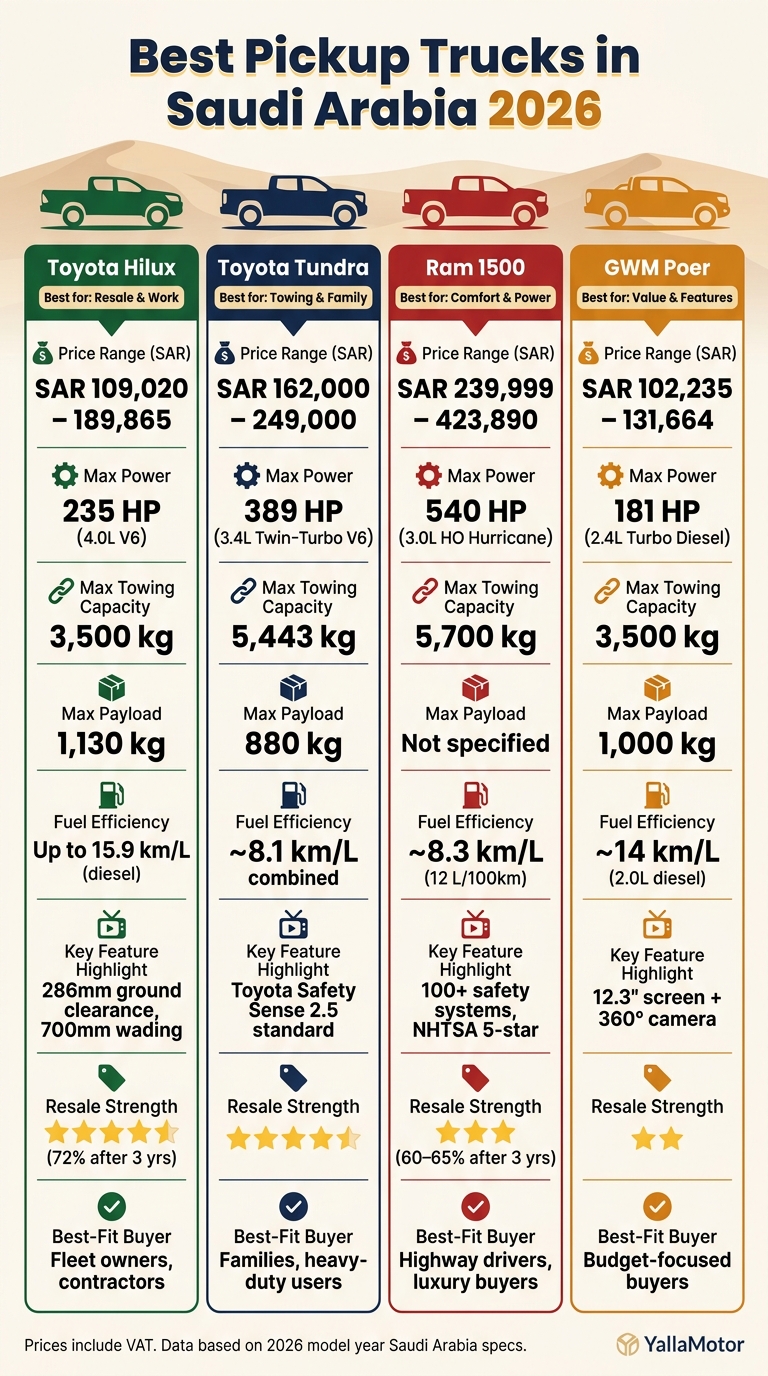
Best Pickup Trucks in Saudi Arabia 2026: Hilux vs Tundra vs Ram vs GWM Poer
2026 Toyota Hilux GLX S 2.4 Diesel 4x4 | Full Option Double Cab Pickup in Dubai
1. Toyota Hilux
The Hilux still sits at the top because it can handle job-site duty, family use, and desert driving without forcing buyers into one narrow setup. Toyota has also made the range easy to shop. GL and other GL-series trims fit work use, SGLX leans more toward private buyers, and Adventure plus GR-S target off-road use. That clear split makes it easier to match a Hilux to work, family, or dune use.
Variant | Engine | Drivetrain | Price (SAR) |
|---|---|---|---|
GL 4x2 2.4L Diesel | 2.4L Diesel | 4x2 | 109,020 – 113,850 |
GL2 4x4 2.4L Diesel | 2.4L Diesel | 4x4 | 126,845 – 132,192 |
SGLX 4x4 2.7L AT | 2.7L Petrol | 4x4 | 142,715 – 148,177 |
SGLX 4x4 2.4L Diesel AT | 2.4L Diesel | 4x4 | 159,850 – 165,312 |
Adventure 4.0L 4x4 AT | 4.0L Petrol | 4x4 | 174,455 |
GR-S 4.0L 4x4 AT | 4.0L Petrol | 4x4 | 189,865 |
Engine choice is where most buyers should focus first. The 2.4L turbo diesel is the economy pick, returning up to 15.9 km/L, so it makes the most sense if fuel spend and day-to-day running costs matter most. The 2.7L petrol is better suited to simpler use. Then there’s the 4.0L V6, which puts out 235 HP and 376 Nm. It brings much stronger performance, but fuel use drops to about 7.0–9.5 km/L, so it fits desert-focused buyers more than anyone chasing lower monthly costs.
The Hilux also backs up its name with hard numbers. Towing is rated at 3,500 kg across most 4x4 versions, while payload goes up to 1,130 kg on the Double Cab. If desert use is high on the list, the GR-S stands out. It adds up to 286 mm of ground clearance, a 700 mm water-wading depth, and a 30-degree approach angle. On soft sand and rough tracks, part-time 4WD, traction control, and a rear diff lock all help, while the ladder-frame chassis and suspension are built to deal with rough terrain.
Ownership costs are one more reason the Hilux keeps its grip on this part of the market. Routine maintenance over five years is estimated at SAR 8,000 to SAR 14,000. Abdul Latif Jameel Motors also supports it with a broad service network across Riyadh, Jeddah, Dammam, Mecca, and Medina. Resale is another strong point, and the example below sums it up well:
"A SAR 142,715 Hilux that retains 72% of its value after three years costs less to own than a SAR 115,000 rival that retains 58%."
For buyers who need more cabin room and more towing muscle, the next move is the Tundra.
2. Toyota Tundra
The Toyota Tundra is the bigger, full-size pick for buyers who’ve outgrown the Hilux’s size and payload limits. You still get that Hilux-style toughness, but with more cabin room and much better towing muscle for Saudi buyers.
Under the bonnet, the Tundra comes with a 3.4L twin-turbo V6. In the base SR trim, it makes 348 hp. Step up the range, and output rises to 389 hp. There’s also a hybrid on offer. The standard petrol version delivers about 7.2 km/L combined, while the hybrid does a bit better in city use at around 7.7 km/L, and about 8.1 km/L combined. Every version uses a 10-speed automatic gearbox.
This is where the Tundra starts to feel like a serious step up. Towing capacity goes up to 5,443 kg, while maximum payload sits at about 880 kg.
Estimated 2026 pricing in Saudi Arabia is as follows:
Trim | Price (SAR) |
|---|---|
SR Class | SAR 162,000 |
SR5 Class | SAR 182,000 |
Limited Class | SAR 213,000 |
Limited i-FORCE MAX (Hybrid) | SAR 219,600 |
Platinum Class | SAR 246,000 |
1794 Edition Class | SAR 249,000 |
Trim choice depends on what you want from the truck. The SR fits work use, while Limited and Platinum make more sense for family buyers. TRD Pro is aimed at off-road use, and the 1794 Edition leans more towards luxury.
For desert driving, the TRD Pro adds forged wheels, TRD off-road suspension, a front skid plate, and coil-spring rear suspension. The 2026 Tundra also comes with Toyota Safety Sense 2.5 as standard, along with Service Connect, which sends automated maintenance reports and vehicle status updates.
Warranty cover is solid too. The powertrain is covered for 5 years or 96,560 km, while the hybrid battery gets 10 years or 241,402 km of cover.
Next is the Ram 1500, which shifts the focus from capability to comfort and power.
3. Ram 1500
The 2026 facelift moves the Ram 1500 deeper into premium-truck space. It adds the Tungsten trim at the top end and puts the RHO forward as the off-road hero. For buyers in Saudi Arabia, the main issue is simple: does the extra spend bring enough extra truck?
Power is not the problem here. The 3.0L Hurricane twin-turbo inline-six delivers 420 hp and 635 Nm, while the High-Output version steps up to 540 hp and 706 Nm. Towing tops out at 5,700 kg, which is the best figure in this group. Fuel use for the 3.0L Hurricane sits at about 12 L/100 km.
Trim | Expected Price (SAR) | Engine |
|---|---|---|
Tradesman Night Edition | 250,415 | 3.0L Hurricane (420 hp) |
Laramie | 239,999–250,415 | 3.0L Hurricane (420 hp) |
Rebel | 296,458 | 3.0L Hurricane (420 hp) |
Limited | 342,925 | 3.0L HO Hurricane (540 hp) |
Tungsten | 374,348 | 3.0L HO Hurricane (540 hp) |
RHO | 423,890 | 3.0L HO Hurricane (540 hp) |
Prices are indicative for the 2026 model year in Saudi Arabia [3][13].
In the line-up, the Rebel at SAR 296,458 looks like the sweet spot for drivers who split time between desert tracks and daily road use. The RHO, on the other hand, is aimed at high-speed desert running. That matters, because the Ram feels more at home charging across open sand than picking its way through tight, rocky climbs. Its approach angle still sits behind the Hilux.
Running costs also shape the picture. Service centres are available in Riyadh, Jeddah, Dammam, Mecca, Medina, Al Khobar, and Buraydah. Resale is decent, but it still lags behind the Hilux, with the Ram holding about 60–65% of its value after three years.
Safety is one area where the Ram makes a strong case. It carries a five-star NHTSA rating and packs more than 100 standard and advanced safety systems, including ADAS Level 2 with adaptive cruise control and lane keep assist.
So yes, the Ram sets the premium mark in this comparison. It’s big, fast, well-equipped, and brutally strong when towing. The catch is that buyers pay for that extra polish, especially before the more budget-led GWM Poer shows up.
4. GWM Poer
After the premium Ram, the Poer plays the value card. In Saudi Arabia, Al-Qurashi sells it from SAR 102,235 for the 2.0L diesel 4x4, which puts it below the base Toyota Hilux. At the top of the range, the Super Luxury Diesel 4x4 (Individual) comes in at SAR 131,664. In this lineup, it’s the Chinese budget-minded option.
Trim | Price (SAR) | Engine |
|---|---|---|
2.0L FL LUX IND 4X4 | 102,235 | 2.0L Turbo Diesel |
2.4L FL LUX IND 4X4 | 107,985 | 2.4L Turbo Diesel (181 hp) |
2.4L FL S-LUX IND 4X4 | 114,885 | 2.4L Turbo Diesel (181 hp) |
Super Luxury Diesel 4x4 (Individual) | 131,664 | 2.4L Turbo Diesel (181 hp) |
Prices are indicative for the 2025–2026 model year in Saudi Arabia and include VAT [15].
On the mechanical side, the numbers look strong. The 2.4L turbo diesel produces 181 hp and 480 Nm, and it’s matched with a 9-speed automatic. That gives the Poer an edge over the Hilux 2.4L diesel for both output and gearbox setup. It also brings 3,500 kg of towing capacity and 1,000 kg of payload. The catch is ground clearance. The Poer sits at 230 mm, while the Hilux offers 286 mm. For fuel use, the 2.0L diesel returns about 14 km/l.
Inside, the Poer gives off a more upmarket feel than the price might suggest. Higher trims add a 12.3-inch touchscreen, 360-degree camera, Apple CarPlay, Android Auto, and Level 2 driver-assistance features like adaptive cruise control and lane keeping assist. Its 3,230 mm wheelbase also helps free up more cabin space.
On paper, the value story is easy to see. Where things get tougher is resale. Al-Qurashi supports the truck with a 6-year/150,000 km warranty and service coverage across major Saudi cities. Still, as a newer Chinese entrant, the Poer remains behind the Toyota Hilux when it comes to long-term residual value in Saudi Arabia.
Pros and Cons
The Toyota Hilux stands out for durability and resale. It has also built a strong name for handling tough desert use. The trade-off is pretty clear, though: when the tray is empty, the ride can feel firm, and the cabin is noisier and less polished than what some rivals offer.
The Toyota Tundra gives you full-size towing ability and a lot more cabin room. That makes it a strong pick for bigger jobs and family use. But there’s no getting around its size. It’s less comfortable in tight city streets, and fuel use is higher. Its twin-turbo V6 may also feel like a compromise for buyers who still want the feel of a V8.
The Ram 1500 is the pick for comfort and power. It feels more premium inside, and it’s well suited to long motorway drives. On the flip side, it costs more to fuel and run, and its size can make city driving more of a chore.
The GWM Poer makes a strong case on price and features. You get a lot for the money, which matters if you’re watching the budget. Still, resale confidence is not on Toyota’s level, and that may matter if you plan to sell after a few years.
Strip the specs back, and this choice comes down to four things: resale, towing, comfort, and value.
Model | Key Pros | Key Cons | Best-Fit Buyer |
|---|---|---|---|
Toyota Hilux | Resale, support, desert durability | Firm ride, basic lower trims | Fleet owners, contractors |
Toyota Tundra | Towing, space, safety | Large footprint, higher price | Families, heavy-duty users |
Ram 1500 | Ride comfort, power, cabin quality | Fuel use, size, resale | Highway drivers, luxury buyers |
GWM Poer | Price, tech, warranty | Brand trust, resale | Budget-focused buyers |
The next section matches each truck to the buyer it suits best.
Which Pickup Suits Which Buyer
Use this shortlist to match each truck to what you care about most: resale, towing, comfort, or value. If you want the quick answer, this is it.
Choose the Toyota Hilux if resale and low ownership cost sit at the top of your list. For fleet operators, contractors, and buyers who plan to sell after a few years, that strong residual value is often the deal-maker.
If heavy towing and family use are the main priority, look at the Toyota Tundra or the Ram 1500. Go with the Tundra for towing strength and cabin space. Pick the Ram 1500 if ride comfort and cabin finish matter more.
For buyers watching their budget, the GWM Poer makes the most sense if equipment and price matter more than resale later on.
At a glance:
Buyer Type | Best Pick | Key Reason |
|---|---|---|
Reliability & Resale | Toyota Hilux | Best residual value and lowest ownership cost |
Full-Size Towing | Toyota Tundra | Full-size towing with family space |
Comfort & Power | Ram 1500 | Best ride comfort and cabin quality |
Best Value | GWM Poer | Most equipment for the money |
Whether you want a new trim or a used Hilux, YallaMotor lets you filter new and used listings by budget, model, and spec across Saudi Arabia.
FAQs
Which pickup is cheapest to own long term?
For long-term ownership, the Toyota Hilux is still the safest bet in the region. It has a long track record for durability, holds its value well, and comes with broad parts and service support. That mix helps keep ownership risk low.
The Mitsubishi L200 is also a smart-value pick, especially for businesses watching total cost of ownership closely. Even so, the Hilux remains the benchmark for buyer confidence over time.
Which one suits desert driving best?
For desert driving in Saudi Arabia, the Toyota Hilux is a go-to pick. It has a long track record for reliability and handles harsh desert conditions well. That matters when you're dealing with deep sand, heat, and long drives far from town.
If you want more off-road-focused hardware, the Ram 1500 Warlock is another strong option. It comes with Bilstein shocks, an electronic rear differential lock, and all-terrain tyres that suit sand and rough ground.
Should I choose diesel or petrol in Saudi Arabia?
It comes down to how you plan to use your pickup in Saudi Arabia.
Diesel makes more sense for commercial work, logistics, heavy hauling, and frequent desert driving. The big reason is simple: it gives you stronger low-end torque, uses less fuel over long distances, and tends to hold its value well in the resale market.
Petrol fits family use, city driving, and anyone who wants a quieter, more car-like drive. It also works well for buyers who care more about comfort, faster throttle response, and modern cabin features than outright towing pull.