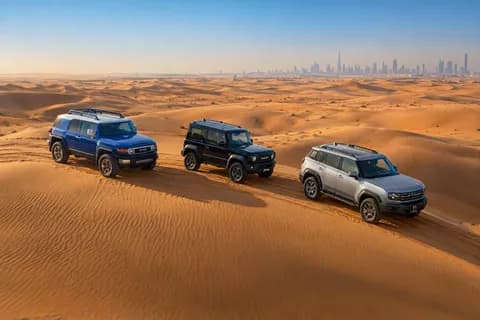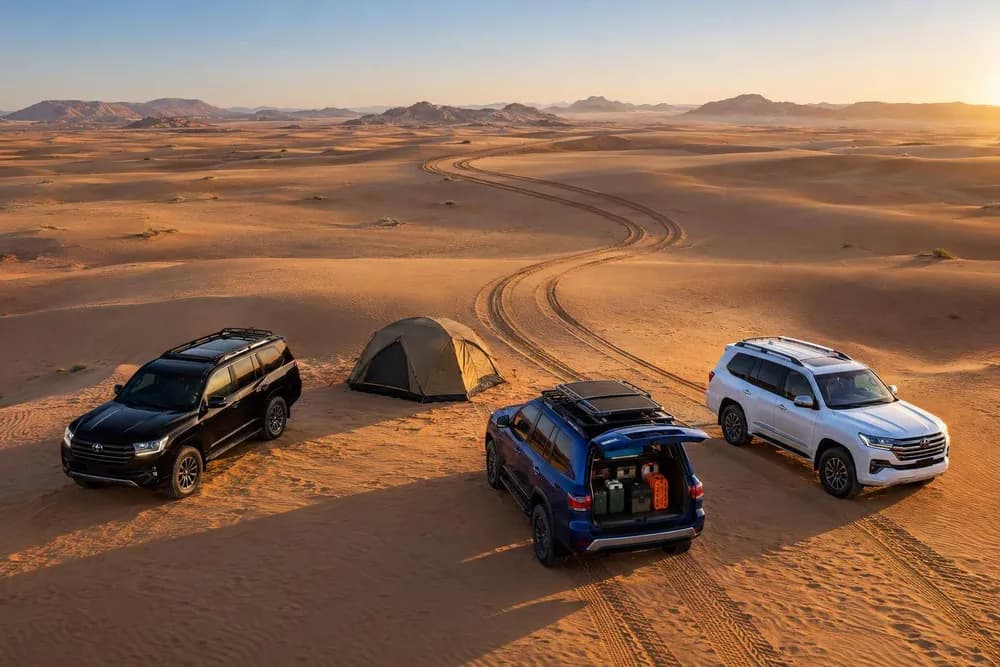
My shortlist for winter camping: Land Cruiser for loaded family trips, Patrol for cabin comfort, Wrangler for technical trails and Fortuner for lower-cost trips on easier routes. UAE starting prices listed here range from AED 128,900 to AED 276,900, with the Patrol’s price still to be confirmed.
For the 2026–27 winter season, I’d choose by passengers, camping kit and route - not seat count alone. Seven seats won’t help if there’s no room left for your water, tents and recovery gear.
Quick Comparison
SUV | My pick for | UAE starting price | Seats | Main check before buying |
Long family trips and loaded dune drives | AED 276,900 | 7 | Gear space with all seats in use | |
Roomy, comfortable desert touring | Confirm with dealer | 8 | Exact engine, suspension, price and fuel figures | |
Technical trails and smaller groups | AED 189,900 | 4 or 5 | Body length, payload and 4WD system | |
Lower-cost camping on easier routes | AED 128,900 | 7 | Choose 4WD and check luggage space |
I compare price, ground clearance, low range, passenger and cargo space, fuel range and camping comfort, with Saudi prices and equipment differences noted where available.
My rule before heading out: check the exact trim and load limits. Treat quoted fuel ranges as road estimates, carry a reserve, and confirm recovery equipment, route access and cross-border insurance before departure.
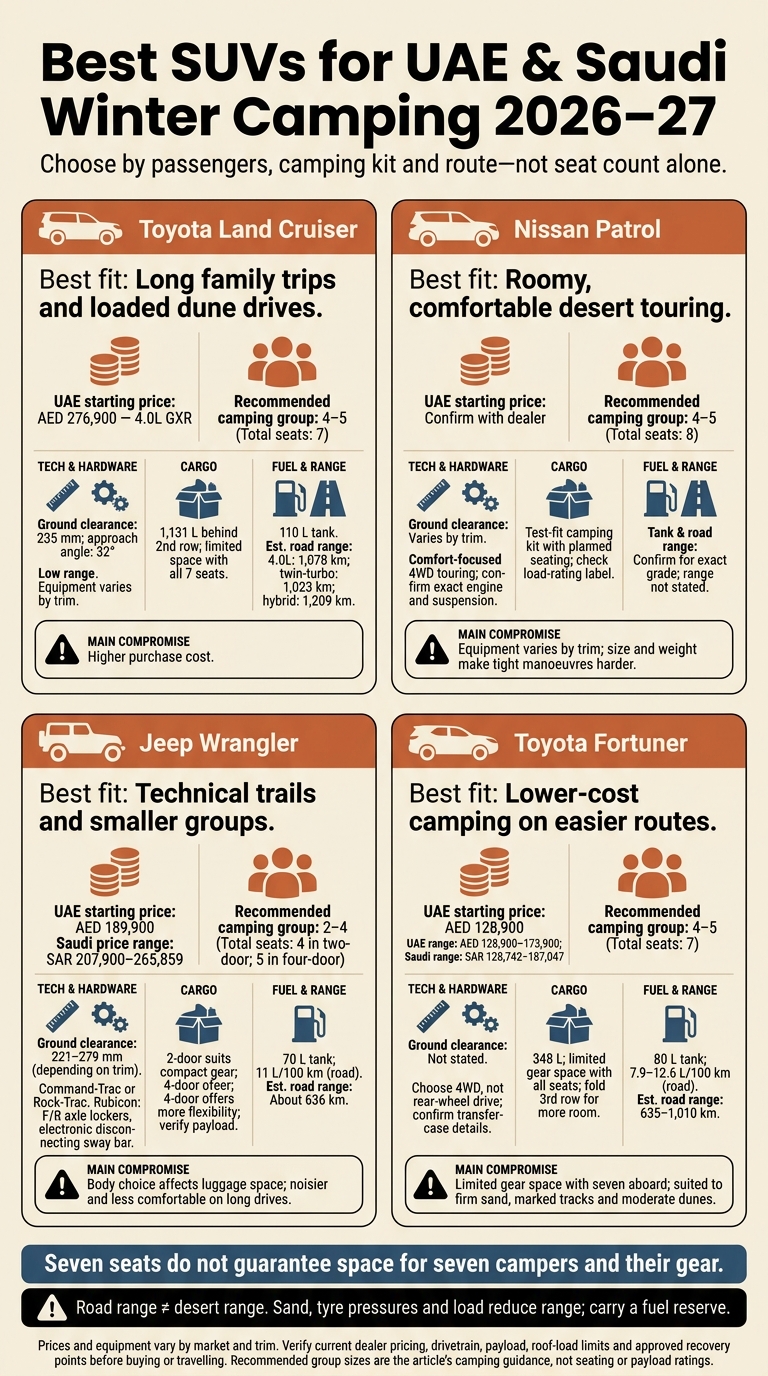
Best SUVs for UAE & Saudi Winter Camping 2026–27
1. Toyota Land Cruiser
The Land Cruiser sets the benchmark for long-distance winter camping in the Gulf.
Local price and availability
UAE prices start at AED 276,900 for the 4.0L GXR and reach AED 399,900 for the 3.5T Hybrid GR-Sport. Confirm stock with Toyota’s UAE distributor.
Desert capability
With 235 mm of ground clearance and a 32° approach angle, the Land Cruiser can tackle uneven approaches. The twin-turbo delivers 650 Nm, compared with 385 Nm from the 4.0L, making it the better choice for loaded dune trips. E-KDSS improves axle articulation on sand and stability at high speeds.
Passenger and camping capacity
The 1,131-litre boot figure measures space behind the second row. Use all seven seats, and there’s limited room left for camping gear.
Fuel range
The 110-litre tank gives a calculated full-tank range of about 1,078 km for the 4.0L, 1,023 km for the twin-turbo and 1,209 km for the hybrid. These are road estimates - not distances to expect when driving in the desert.
Next, the Nissan Patrol offers a similar full-size setup, with its own balance of price and comfort.
2. Nissan Patrol
The Patrol is the Land Cruiser’s closest rival for winter camping in the Gulf.
Local price and availability
The 2026 Patrol is a full-size SUV, but grades and stock vary by dealer. Confirm the exact trim and price before comparing it with the Land Cruiser.
Desert capability
The 2026 Patrol combines a 3.8-litre V6, a 9-speed automatic gearbox and 4WD with adaptive air suspension. It’s built more for comfortable desert touring than stripped-back trail driving.
That puts it closer to the Land Cruiser than the Wrangler, with comfort taking priority over hard-core trail use.
Camping capacity and fuel range
Test-fit your camping kit with your planned seating layout, then check the load-rating label. Before a long desert drive, confirm the fuel tank capacity and official fuel consumption for your exact grade.
The next comparison moves from full-size comfort to a smaller, trail-focused SUV.
3. Jeep Wrangler
Local price and availability
The Jeep Wrangler starts at AED 189,900 in the UAE, with prices in Saudi Arabia ranging from SAR 207,900 to SAR 265,859.
Desert capability
The Wrangler is the most agile choice in this comparison for tight tracks and technical routes. Its shorter two-door wheelbase makes manoeuvring easier, while the four-door offers more space.
Ground clearance ranges from 221 mm to 279 mm, depending on the trim. Check for Command-Trac or Rock-Trac. For demanding terrain, the Rubicon adds front and rear axle lockers and an electronically disconnecting sway bar.
Passenger and camping capacity
The two-door seats four and works well for couples travelling with compact gear. The four-door gives you more cargo flexibility, but check how much usable space remains with passengers aboard. Confirm the payload limit before adding water, recovery gear or roof loads.
The removable roof and doors are part of the appeal, though they offer less during cold, windy desert camping trips.
Fuel range
With a 70-litre tank and fuel consumption of 11 L/100 km, the stated road range is about 595–630 km. Sand driving cuts that range sharply, so keep a fuel reserve.
For a simpler desert SUV at a lower price, the Fortuner is next.
4. Toyota Fortuner
Local price and availability
UAE prices range from AED 128,900 to AED 173,900 for the 2.7L EXR, 4.0L GXR and 4.0L VXR petrol variants. In Saudi Arabia, prices run from SAR 128,742 to SAR 187,047.
Desert capability
The Fortuner is a budget-friendly pick for winter camping on easier desert routes. Choose the 4WD version, not the rear-wheel-drive model. Standard off-road kit includes a differential lock, hill assist and vehicle stability control. It suits firm sand, marked tracks and moderate dunes rather than demanding dune routes.
For families who don't need extreme dune performance, it sits a practical step below full-size SUVs.
Passenger and camping capacity
The Fortuner seats seven, but 348 litres of luggage space leaves little room for camping gear when every seat is occupied. Fold the third row when you need more space. No roof-load rating is listed, so keep roof gear light.
Fuel range
An 80-litre fuel tank and road consumption of 7.9–12.6 L/100 km give the Fortuner an estimated road range of 635–1,010 km, depending on the engine.
Compare Prices, Desert Capability, Space and Range
Compare the four SUVs below to narrow your shortlist, then weigh camping comfort and route type. Check trim-specific details before buying.
SUV | Recommended group | UAE starting price | Seats | Ground clearance | 4WD / low range | Tank / estimated road range | Cargo room | Best desert use | Main compromise |
Toyota Land Cruiser | 4–5 | AED 276,900 | 7 | 235 mm | Low range | 110 L / 1,023–1,209 km, depending on engine | 1,131 L behind second row; limited with seven aboard | Family trips with dune capability | Higher purchase cost |
Nissan Patrol | 4–5 | Not stated | 8 | Varies by trim | Comfort-focused 4WD touring | Tank size varies by trim; range not stated | Test-fit gear with planned seating | Larger groups on mixed routes | Equipment varies by trim |
Jeep Wrangler | 2–4 | AED 189,900 | 4 in two-door; 5 in four-door | 221–279 mm | Command-Trac or Rock-Trac, depending on trim | 70 L | Four-door offers more cargo flexibility | Smaller groups on technical routes | Body choice affects passenger and luggage space |
Toyota Fortuner | 4–5 | AED 128,900; VXR AED 173,900 | 7 | Not stated | Choose 4WD; transfer-case details not stated | 80 L / 635–1,010 km, depending on engine | 348 L; fold third row for more space | Lower-cost trips on easier routes | Limited gear space with all seats occupied |
Price, stock and warranty: Use the table as a starting point. Confirm final prices, stock and delivery with the dealer, and request a written quotation showing the model year, trim, VAT and warranty.
Terrain hardware and recovery: Low range matters more than Sand mode. Check the exact trim’s hardware, along with the manual’s approved recovery points and methods.
Comfort, space and load: Try the seats for comfort and compare cargo figures with the same seating layout. Before adding passengers, water, gear and accessories, check the payload and roof-load limits.
Tank size versus range: The Wrangler’s 70-litre tank and fuel consumption of 11.0 L/100 km give an estimated road range of about 636 km. Soft sand, lower tyre pressures and extra load cut that range sharply, so keep a fuel reserve.
Next, weigh each SUV’s camping pros and cons in daily use.
Camping Pros and Cons
Each SUV has its strengths - and a few trade-offs - for camping.
SUV | Camping advantages | Camping disadvantages |
Toyota Land Cruiser | Comfortable on long drives and stable on sand, even when loaded for camping. | Its size makes tighter spaces harder to navigate. |
Nissan Patrol | Best for large groups that put cabin space and comfort first. | Its size and weight make tight desert manoeuvres harder. |
Jeep Wrangler | Rubicon hardware makes it the strongest choice for technical routes and steep entries. | Noisier and less comfortable on long drives. |
Toyota Fortuner | Lowest-cost option for easier desert routes and family camping. | Less cargo space and power than the larger SUVs. |
Match the hardware to your route. Lockers and disconnecting sway bars matter most in technical wadis, rather than on easy tracks to camp.
Next, compare each SUV against your group size and route difficulty.
Choose by Group Size and Route
Use the comparison above to match your SUV to your group size, luggage and route length. Pick the Land Cruiser for long family trips or the Patrol for roomy family dune trips.
The Wrangler suits technical trails; go for the four-door if you travel light. For lower-cost camping on accessible routes, consider the Fortuner, but check that its drivetrain suits your route.
Once you’ve chosen your SUV, prepare your trip kit. Check the tyres, spare tyre, compressor, pressure gauge, rated recovery points, recovery gear, first-aid kit, offline navigation, water and emergency communications kit. There’s no single sand tyre pressure for every SUV: vehicle weight and load both matter. Avoid excessive deflation, and reinflate to road pressure before returning to tarmac.
Next, confirm route conditions and travel permissions. Travel in a convoy on remote trips. Check the weather, access permissions, protected-area rules, and local rules and customs. Take all waste home. For UAE–Saudi travel, confirm cross-border permits and insurance before departure.
Before buying, verify the exact trim, drivetrain, ground clearance, warranty, price and stock.
FAQs
How do I calculate my SUV’s safe camping payload?
Subtract your SUV’s kerb weight from its Gross Vehicle Weight Rating (GVWR) to calculate its payload allowance. This covers passengers, fuel, camping gear and aftermarket accessories.
Heavy loads affect performance and handling. Deep sand and steep dunes put extra strain on the suspension and engine. Pack light, take only what you need and stay within the manufacturer’s specified limits for safety.
How much extra fuel should I carry for dune driving?
Budget for 25–40% higher fuel consumption than standard driving. Sand resistance and frequent use of low gears increase fuel use, so calculate your needs at this higher rate rather than relying on official manufacturer figures.
Carry extra fuel in secure, approved jerry cans. This gives you a safety margin for unpredictable routes and extended trips in remote areas such as the Liwa dunes.
Does my SUV’s warranty cover desert driving?
Warranty coverage depends on the manufacturer and your warranty’s terms. Some warranties are marketed for demanding conditions, but many standard warranties may exclude off-road use or damage caused by activities such as dune bashing.
Before heading into the desert, check your warranty booklet or contact your local dealership to confirm whether off-road driving affects your cover.