Ceer is set to reveal its first two EVs on 21 September 2026, and that matters across the GCC. From what I can see, this is not just about a new sedan and SUV. It is also about price targets, production scale, Saudi-made supply chains, and whether a Gulf car brand can move from launch event to customer delivery.
If you want the short version, here it is:
Ceer launched in 2022 as a joint venture between Saudi Arabia’s PIF and Foxconn
It will show its first electric sedan and electric SUV on 21 September 2026
Production is set for Q4 2026
Ceer is targeting up to 500 km of range and 0–80% charging in under 30 minutes
The expected price band is SAR 120,000 to SAR 250,000
That is about AED 117,000 to AED 245,000, based on current exchange levelsThe company says it has grown from 20 to 2,300 employees
80% of direct roles are held by Saudis
Long-term targets include 170,000 cars a year, 45% local content by 2034, and SAR 30 billion added to GDP
For UAE readers, the main point is simple: Ceer could help set the early GCC benchmark for EV pricing, features, service access, and local production. But some buyer-focused details are still missing, including battery sizes, certified range figures, charging plug type, and UAE delivery timing.
What stands out to me is the backing. Ceer is tied to PIF, Foxconn, BMW, Rimac, Hyundai Transys, Siemens, and other suppliers. That gives it funding, factory support, powertrain input, software systems, and plant equipment before the first cars even reach customers.
Key point | What I know now |
|---|---|
Brand | Ceer |
Country | Saudi Arabia |
Reveal date | 21 September 2026 |
First vehicles | Electric sedan and electric SUV |
Production site | King Abdullah Economic City (KAEC) |
Production start | Q4 2026 |
Range target | Up to 500 km |
Charging target | 0–80% in under 30 minutes |
Price target | SAR 120,000–250,000 / about AED 117,000–245,000 |
Big unknowns | Battery size, certified range, charging standard, UAE launch timing |
So if you are watching the Gulf EV market, this reveal is worth your attention. The launch will show whether Ceer looks like a serious regional player on paper only, or in the cars themselves.
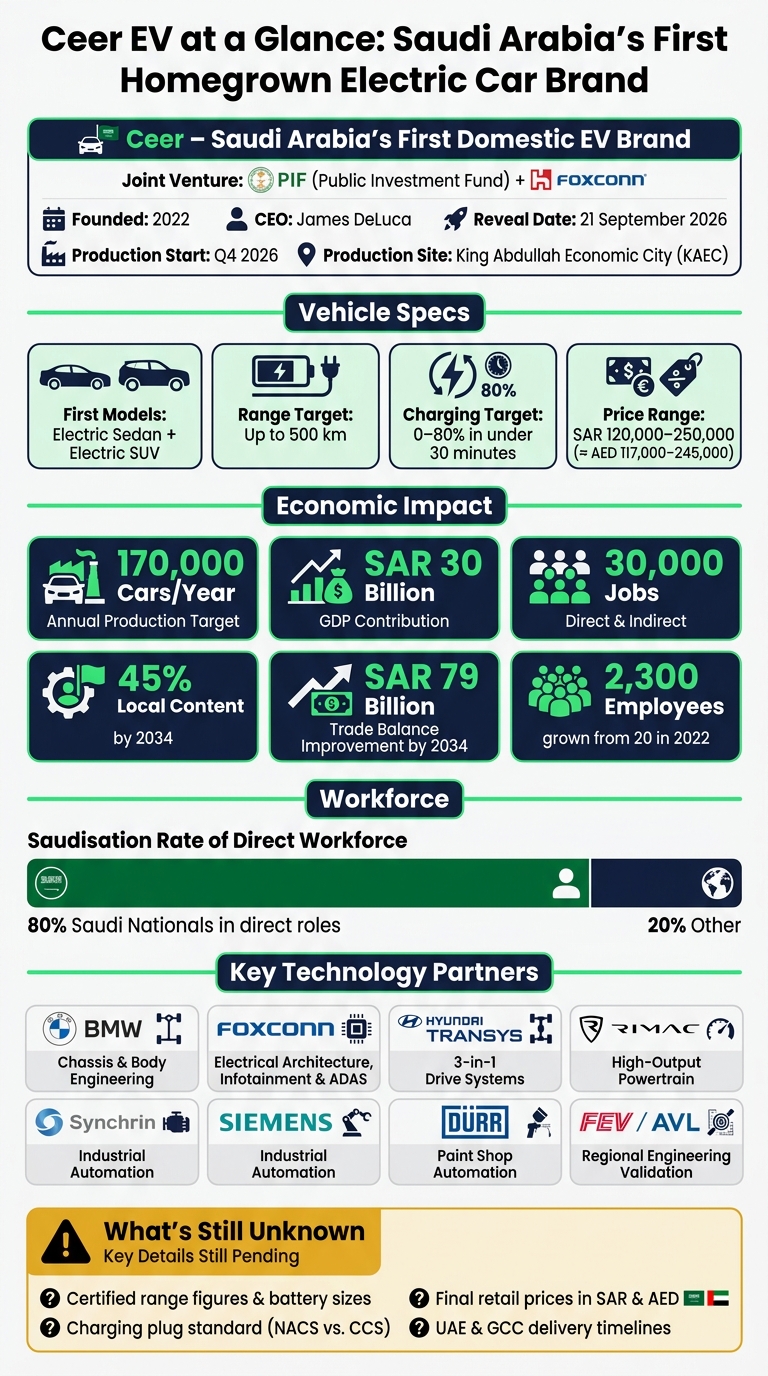
Ceer EV: Saudi Arabia's First Homegrown Electric Car Brand – Key Facts & Figures
Ceer Saudi Arabia: the country's first homegrown electric car brand
Beyond the 21 September reveal, Ceer is being built as a national industrial project. The company launched in 2022, with PIF and Foxconn joining forces to help build a domestic car industry in Saudi Arabia.
Ceer is led by CEO James DeLuca. The company now has 2,300 employees, and 80 per cent of direct roles are held by Saudi nationals.
How Ceer fits into Saudi Vision 2030
Saudi Vision 2030 is about building new industries and broadening the economy. Ceer fits that plan through the scale of what it aims to do.
It is projected to contribute SR30 billion to Saudi GDP, support around 30,000 direct and indirect jobs, and target annual production of 170,000 cars. On top of that, the brand is aiming for 45 per cent local content by 2034. That makes Ceer more than a new EV badge. It positions the company as a serious industrial play with national backing.
Why Ceer matters to UAE and GCC car buyers
For buyers in the UAE and across the GCC, Ceer brings a Saudi-made EV brand into the regional market. That matters because it shows how fast electric mobility in the Gulf is moving from talk to production.
Its backing also helps explain why these ambitions carry weight. This isn't just a new name trying to get attention. It's part of a much bigger push to build industry, jobs, and manufacturing capacity close to home.
Who backs Ceer: PIF, Foxconn and the brand's global technology partners
Ceer is a joint venture between the Public Investment Fund (PIF) and Foxconn. On paper, that gives the brand deep funding and strong manufacturing know-how. The real test, though, is simple: how that support shows up in the cars Ceer unveils on 21 September.
What PIF brings to Ceer
PIF funds Ceer’s development and industrial expansion. In plain terms, that means money for product development, factory investment, and the wider industrial build-out needed to get a car brand off the ground.
What Foxconn brings to Ceer
Foxconn brings manufacturing and electronics expertise. That matters because EVs now depend on software, electronics, and driver-assistance systems just as much as mechanical parts. A modern electric car isn’t just a machine on wheels. It’s also a rolling software product.
Partner network: BMW, Hyundai Transys, Rimac, Siemens and others
The partner list gives a clearer picture of how Ceer is putting the brand together. Instead of building everything from scratch, it is leaning on proven automotive and industrial suppliers. That’s the industrial backbone behind Saudi Arabia’s first electric car brand.
Partner | Role | Value to Ceer |
|---|---|---|
BMW | Licensed chassis and body engineering technology | Engineering quality |
Foxconn | Electrical architecture, infotainment, and ADAS | Connectivity and software-led user experience |
Hyundai Transys | 3-in-1 integrated drive systems (motor, inverter, gear) | Improved efficiency and reliability |
Rimac | High-output drive systems and powertrain components | Performance capability for premium variants |
Siemens | Industrial automation and manufacturing software | Scalable production at the KAEC plant |
Modular paint shop and automation | Premium finish quality | |
Infrared-reflective coatings for large windshields | Reduced solar heat gain and lower cooling load | |
Italian-designed sports seating | Better interior quality and safety | |
Press shop and forming technology | Structural component production | |
XYG | Automotive glass supply | Localised glazing components |
Zamil / APICO | HVAC and plastic components | Localised parts for faster servicing |
Engineering development and reliability validation | Vehicle tuning for regional conditions |
A few names stand out straight away. BMW adds licensed chassis and body engineering technology, which points to a strong engineering base. Foxconn handles electrical architecture, infotainment, and ADAS, so the cabin tech and connected features will likely matter a lot. Hyundai Transys and Rimac cover drive systems and powertrain parts, which says a lot about Ceer’s focus on efficiency, reliability, and higher-output versions.
Then there’s the factory side. Siemens, Dürr, and ANDRITZ Schuler are tied to automation, paint, and forming systems at the KAEC plant. That part is easy to overlook, but it’s where car brands either get consistency right or struggle with quality.
Some suppliers are there for a more region-specific reason. Isoclima’s infrared-reflective coatings for large windshields could help reduce solar heat gain and ease the cooling load, which matters in Gulf conditions. FEV / AVL also points to tuning and validation work for the region, not just lab-spec development.
In short, Ceer’s partner network looks less like a marketing slide and more like a map of how the cars are being assembled, engineered, and prepared for production. What matters now is what made the cut when Ceer finally shows the finished product.
What we know before the Ceer reveal: sedan, SUV, factory scale and economic targets
With the supplier base in place, Ceer now has to prove it can build at volume. On 12 September 2026, the company said it will unveil its first two vehicles - an electric sedan and an electric SUV - on 21 September 2026. These will be Saudi Arabia's first domestically designed models.
The 21 September reveal: confirmed details
Some parts are locked in. Other parts are still under wraps. Here’s what Ceer has confirmed so far.
Item | Confirmed | Not Yet Disclosed |
|---|---|---|
Reveal date | 21 September 2026 | - |
Body styles | Electric sedan and electric SUV | Official model names and trim levels |
Production start | Q4 2026 | Exact date for first customer delivery |
Range target | Up to 500 km | Final certified range and battery sizes |
Charging target | 0–80% in under 30 minutes | Charging plug standard (NACS vs. CCS) |
Pricing target | SAR 120,000–250,000 | Final retail prices in SAR and AED |
Technology base | BMW, Foxconn and Rimac partnerships | Full ADAS and software feature list |
That said, the range and charging numbers are still targets, not certified test results.
Production, localisation and jobs
The launch matters, but the bigger story is scale. Ceer’s stated targets point to a much larger plan: 170,000 cars a year, 45% local content by 2034, SAR 30 billion added to GDP, and about 30,000 jobs. Its hiring pace also gives a sense of how fast the company is trying to move.
Metric | Target / Confirmed Figure |
|---|---|
Headcount | 20 (2022) → 2,300 |
Saudisation rate | 80% of direct roles |
Annual production target | 170,000 cars |
Local content target | 45% by 2034 |
GDP contribution | SAR 30 billion |
Jobs created | Around 30,000 direct and indirect |
Trade balance improvement | SAR 79 billion by 2034 |
An annual target of 170,000 cars makes Ceer’s intent pretty clear. The 45% local content target by 2034, SAR 30 billion GDP contribution, around 30,000 direct and indirect jobs, and SAR 79 billion trade balance improvement by 2034 sit at the centre of the programme’s economic case. The 21 September reveal should give the first proper look at how much of that ambition shows up in the cars themselves.
Conclusion: what to watch after Ceer's 21 September 2026 debut
The 21 September 2026 reveal is Ceer’s first public test. The company comes in with serious backing through a PIF–Foxconn joint venture, plus a partner network that includes BMW, Rimac, Hyundai Transys, and Siemens. That gives the brand weight from day one.
But the harder part starts after the lights, cameras, and launch event. The big questions are simple: Can Ceer move from reveal to production? Can it localise at scale? Can it deliver across the region on time? That’s what matters now.
For readers in the UAE, some of the biggest details are still missing. Ceer has not yet confirmed:
Certified range figures
Battery size
Charging standard and UAE compatibility
UAE and GCC delivery timelines
That’s why this reveal matters beyond Saudi Arabia. A car brand aiming for 170,000 vehicles a year and 45% local content by 2034 is not thinking small. This has regional impact, not just local ambition.
Key takeaways for UAE readers
Ceer now has a confirmed reveal date, 2,300 employees, and a partner network filled with well-known global names. The next thing to watch is the official detail drop: specs, GCC distribution plans, warranty terms, and charging compatibility.
FAQs
When will Ceer start customer deliveries?
Ceer plans to start commercial production in Q4 2026. The first customer deliveries in Saudi Arabia are expected before the end of 2026.
For now, the company is keeping its attention on its home market. There’s still no confirmed timeline for availability in other markets, and the rollout beyond Saudi Arabia will likely become clearer once initial deliveries are underway.
Will Ceer EVs be sold in the UAE?
Not at launch. Ceer is focusing first on Saudi Arabia, where its commercial debut is expected in Q4 2026.
The UAE and other Gulf markets are set for later phases, after Ceer’s Saudi operations are in place. Details such as warranty, service, and charging may differ from the first Saudi-market versions.
What charging standard will Ceer use?
Ceer has not yet officially confirmed the charging standard for its electric vehicles.
Across Saudi Arabia and the UAE, most public chargers use Type 2 for AC charging and CCS2 for DC fast charging. That said, Ceer still hasn’t said which plug system its production models will use.