Key Takeaways
In our family-SUV example, 1,000 km costs AED 46–76 charged at home in Dubai, against AED 332.10 of Special 95 at September prices.
That makes home charging 77.1% to 86.1% cheaper than petrol, saving about AED 5,122 a year at 20,000 km even on the upper tariff slab.
Public DC charging at AED 1.20 per kWh costs AED 240 per 1,000 km, only 27.7% below petrol.
A home charger costs AED 3,000–6,200 installed and pays back in 0.9–1.9 years if you would otherwise use DC chargers.
Our owner's guide's 'AED 45 per 1,000 km' only holds for a very efficient EV or the lowest tariff slab.
What 1,000 km costs: petrol vs electric
The answer depends less on the car than on where you plug it in. We compared a mid-size petrol SUV using 9 litres per 100 km with an electric SUV using 20 kWh, at September 2026 petrol prices and the charging tariffs our guides publish.
Where you charge decides how much you save
Cost per 1,000 km for a family SUV at September 2026 prices: petrol against an EV charged at home, on public AC, or on DC.

Charging method | Cost per 1,000 km |
|---|---|
Petrol SUV (Special 95) | AED 332.10 |
EV on public DC | AED 240.00 |
EV on public AC | AED 140.00 |
EV at home (upper slab) | AED 76.00 |
EV at home (lower slab) | AED 46.00 |
Source: Tariffs from YallaMotor's August 2026 EV guides; Special 95 from the UAE Fuel Price Committee via WAM. Energy use is illustrative (20 kWh and 9 L per 100 km).
At Dubai's home rates, 1,000 km costs AED 46 on the lower slab and AED 76 on the upper slab. The same distance in the petrol SUV costs AED 332.10 of Special 95 at AED 3.69 a litre.
The gap is similar for smaller cars. A compact EV using 15 kWh per 100 km costs AED 34.50–57 per 1,000 km at home, against AED 258.30 for a compact petrol car using 7 litres.
Home, public AC or DC: what you pay per kWh
Public charging costs the same in Dubai and Abu Dhabi. DEWA and Charge AD both charge AED 0.70 per kWh on AC and AED 1.20 on DC, and ADNOC Distribution's highway DC chargers are around AED 1.20.
What charging costs per kWh in the UAE
Where you charge | Rate (AED/kWh) | Note |
|---|---|---|
Home, Dubai (lower slab) | 0.23 | Residential rate; rises with household use |
Home, Dubai (upper slab) | 0.38 | Residential rate at higher use |
DEWA public AC (Dubai) | 0.70 | Quoted plus VAT |
Charge AD public AC (Abu Dhabi) | 0.70 | Matches Dubai's public AC rate |
DEWA public DC (Dubai) | 1.20 | Quoted plus VAT |
Charge AD public DC (Abu Dhabi) | 1.20 | Matches Dubai's public DC rate |
ADNOC Distribution DC (highways) | 1.20 | Around this rate; up to 350 kW |
Published charging rates per kWh. DEWA quotes its public rates plus VAT; home rates are Dubai's residential slabs.
At home in Dubai you pay about AED 0.23 to AED 0.38 per kWh. DEWA's residential tariff is slab-based, so charging an EV can push part of your household's use into a pricier tier.
Is DEWA charging free? Check before you plan on it
One of our guides says DEWA charging is free for registered users, but the same guide and our owner's guide list AED 0.70 per kWh on AC and AED 1.20 on DC. Check the current rate in the DEWA app before you count on free charging.
Your yearly bill at 20,000 km
Over a year of commuting the difference becomes real money. At 20,000 km the petrol SUV burns AED 6,642 of fuel. The electric SUV costs AED 920–1,520 charged at home, AED 2,800 on public AC, or AED 4,800 on DC alone.
At 20,000 km a year, home charging saves about AED 5,000
Yearly energy cost for a family SUV at 20,000 km, September 2026 prices.

Charging method | Yearly energy cost |
|---|---|
Petrol SUV (Special 95) | AED 6,642 |
EV on public DC only | AED 4,800 |
EV on public AC only | AED 2,800 |
EV at home (upper slab) | AED 1,520 |
EV at home (lower slab) | AED 920 |
Source: YallaMotor calculation from published tariffs and September 2026 fuel rates; illustrative energy use and distance.
Charge at home and fuel stops being a major running cost
Home charging saves about AED 5,122 a year against petrol in our SUV example, even on Dubai's upper tariff slab. Rely only on DC fast chargers and the saving falls to AED 1,842, because DC costs AED 240 per 1,000 km, just 27.7% below petrol.
DEWA quotes its public rates plus VAT, so a driver who only uses DC chargers saves less than these figures show.
Ready to compare the electric models on sale in the UAE?
Is a home charger worth it?
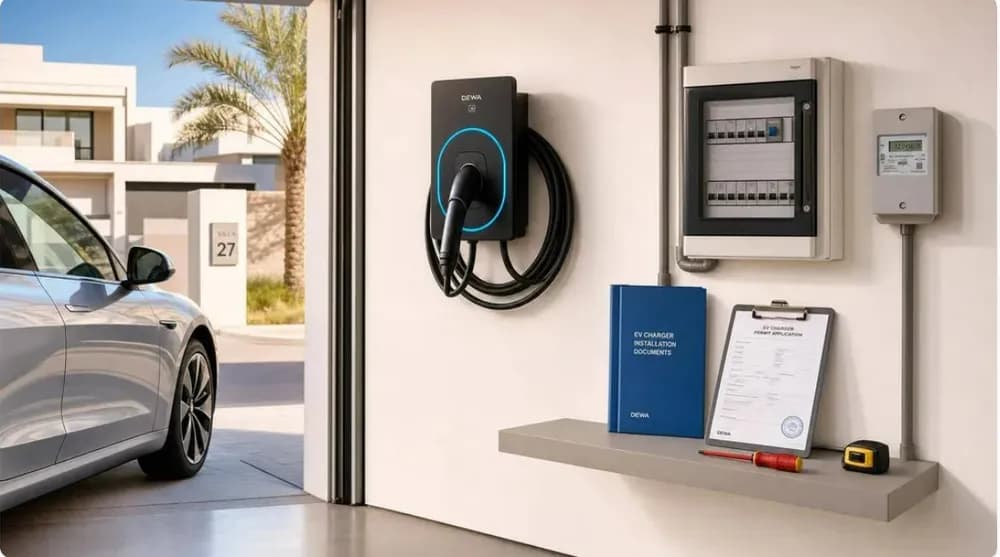
Wallbox hardware costs about AED 1,700 to AED 3,200, and installation about AED 1,300 to AED 3,000 depending on the cable run, distribution board work and access. A standard installation costs AED 1,300–1,425. That puts the installed total at AED 3,000–6,200.
A home charger pays back fastest if you'd otherwise use DC
Years to recover AED 3,000–6,200 of charger hardware and installation, family-SUV scenario.

Charging alternative | Low installed cost | High installed cost |
|---|---|---|
Instead of DC charging | 0.9 years | 1.9 years |
Instead of public AC | 2.3 years | 4.8 years |
Source: Installation and hardware costs from YallaMotor's home charger guide; YallaMotor calculation.
If you would otherwise use DC chargers: home charging saves AED 3,280 a year, so the charger pays back in 0.9–1.9 years.
If you would otherwise use public AC: it saves AED 1,280 a year and pays back in 2.3–4.8 years.
Size the charger to your daily distance
A 7 kW wallbox adds roughly 35–45 km of range per hour of charging, and an 11 kW unit about 60–70 km. Match that to how far you drive each day before paying for a bigger unit.
Summer heat, and why headline savings mislead
GCC summer heat and highway speeds can cut an EV's range by 10% to 25%. A 25% cut means about 33.3% more energy for every kilometre.
Even if that penalty applied all year, home charging in our SUV example would cost about AED 2,026, still AED 4,616 less than petrol. This harsh case applies the heat penalty to the EV only.
Treat single savings figures with care
Our owner's guide says home charging costs about AED 45 per 1,000 km against AED 275–280 for petrol, up to 84% less. That AED 45 implies 19.6 kWh per 100 km on the lower slab but just 11.8 kWh on the upper slab, and the guide states neither assumption. Your tariff slab and your car's efficiency move the answer more than any headline number.
FAQs
Is it cheaper to run an EV than a petrol car in the UAE?
Usually, if you charge at home. In our SUV example, home charging costs AED 46–76 per 1,000 km against AED 332.10 for petrol. Relying only on DC fast chargers narrows the saving to 27.7%
How much does public EV charging cost in Dubai?
DEWA charges AED 0.70 per kWh on AC and AED 1.20 on DC, quoted plus VAT. Charge AD in Abu Dhabi uses the same rates.
How much does a home EV charger cost in the UAE?
Expect about AED 1,700–3,200 for the hardware and AED 1,300–3,000 for installation, or AED 1,300–1,425 for a standard job. The installed total ranges from AED 3,000 to AED 6,200.
Will charging at home push my DEWA bill into a higher tier?
It can. DEWA's residential tariff is slab-based, so extra use for charging may fall into a higher tier, between about AED 0.23 and AED 0.38 per kWh. Even on the upper slab, home charging stays far cheaper than public DC.
How much range do EVs lose in a UAE summer?
Our guides put the loss at 10% to 25%, depending on speed and conditions. At the top of that range, an EV needs about a third more energy per kilometre.
How We Worked This Out
We compared energy costs only, using the UAE Fuel Price Committee's September 2026 Special 95 rate (AED 3.69 a litre) and the home and public charging rates in YallaMotor's August 2026 EV guides. Energy use is illustrative: 9 litres or 20 kWh per 100 km for a mid-size SUV, and 7 litres or 15 kWh for a compact car. Yearly figures assume 20,000 km. Home rates are Dubai's residential slabs, and public rates exclude VAT. Charger payback divides the installed cost by the yearly saving against public charging. Purchase price, insurance, servicing and depreciation are not included.
Assumptions used in our calculations
Annual distance: 20,000 km — A round figure for a daily UAE commute, used for illustration.
Compact EV energy use: 15 kWh per 100 km — Illustrative figure for an efficient compact EV.
Compact petrol car fuel use: 7 litres per 100 km — Illustrative figure for a compact petrol car, paired with the compact EV.
Electric family SUV energy use: 20 kWh per 100 km — Illustrative figure for a mid-size electric SUV, set deliberately above the range our owner's guide implies (C01, C02) so the comparison does not flatter the EV.
Petrol family SUV fuel use: 9 litres per 100 km — Illustrative figure for a mid-size petrol SUV, paired with the electric SUV.