If I’m driving an EV from Dubai to Riyadh in 2026, I need to plan for more than charger location. I need the right apps, a card that works across the border, and a route built around DC charging. In the UAE, public rates are mostly AED 0.70/kWh for AC and AED 1.20/kWh for DC. In Saudi Arabia, most DC charging sits around SAR 2.00–3.00/kWh, while E-FILL at SAR 0.99/kWh is the low-price option listed.
Here’s the short version:
Dubai: DEWA is the main city network, with 1,270+ charging points
Abu Dhabi and highways: Charge AD and ADNOC cover most day trips and intercity runs
Saudi Arabia: EVIQ is the main national network, with Electromin, Shell Recharge, E-FILL and Tesla filling key gaps
Best setup for long drives: use DC fast charging, not AC
Before I leave: install each network app, save a bank card, and check station status
For cross-border trips: charge before the UAE border and keep a backup stop for each long leg
Connector check: CCS2 is still the main public fast-charging standard on this route
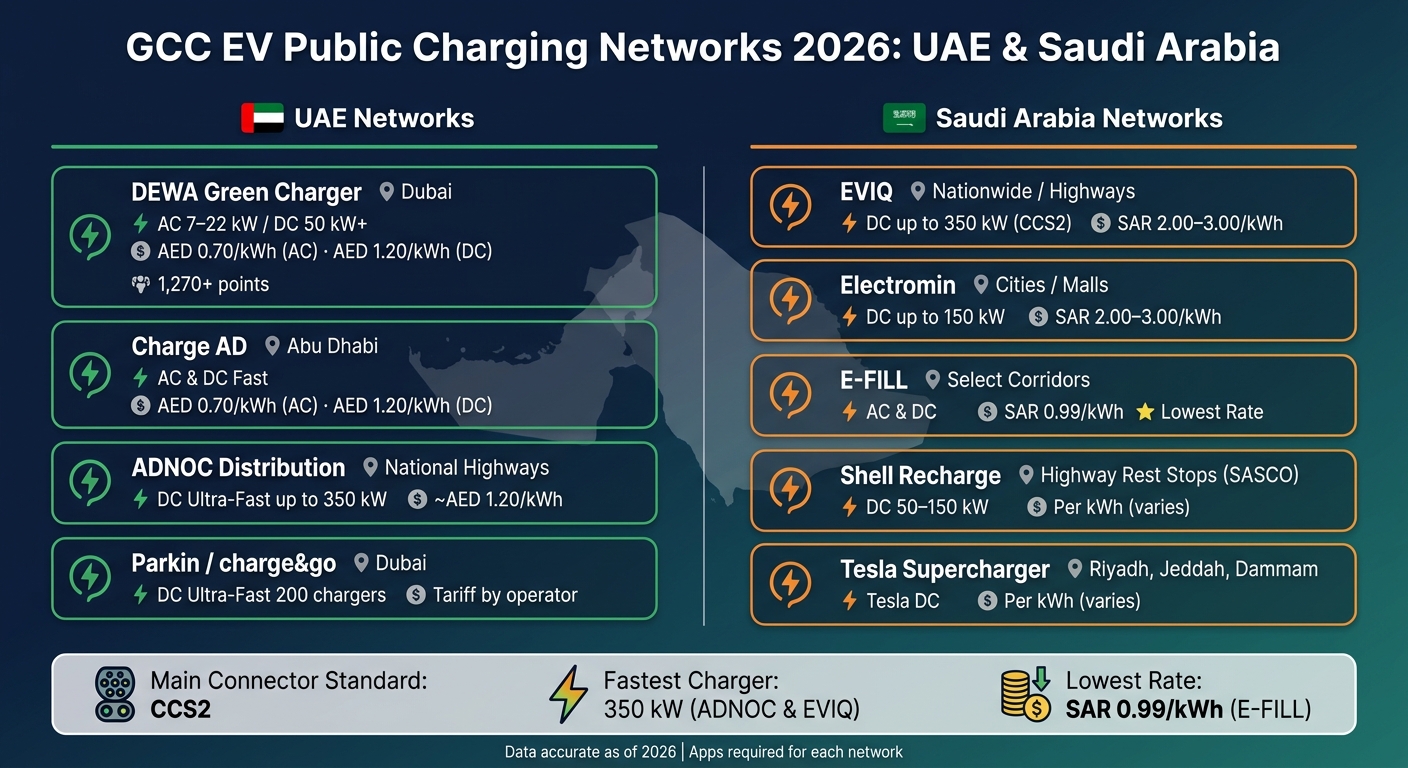
GCC EV Charging Networks 2026: UAE vs Saudi Arabia at a Glance
Quick comparison
Network | Main market | Charger focus | Price |
|---|---|---|---|
DEWA Green Charger | Dubai | AC 7–22 kW, DC 50 kW+ | AED 0.70/kWh AC, AED 1.20/kWh DC |
Charge AD | Abu Dhabi | AC and DC | AED 0.70/kWh AC, AED 1.20/kWh DC |
ADNOC Distribution | UAE highways | DC up to 350 kW | Around AED 1.20/kWh |
Parkin / charge&go | Dubai | Ultra-fast DC | Price listed by operator |
EVIQ | Saudi Arabia | DC up to 350 kW | SAR 2.00–3.00/kWh |
Electromin | Saudi cities | DC up to 150 kW | SAR 2.00–3.00/kWh |
E-FILL | Saudi select routes | AC and DC | SAR 0.99/kWh |
Shell Recharge | Saudi highway stops | DC 50–150 kW | Varies by site |
Riyadh, Jeddah, Dammam | Tesla DC charging | Varies by site |
My takeaway is simple: city charging in the UAE is fairly easy, but a Dubai-to-Riyadh trip still needs route planning, app setup, and a battery buffer for heat and long highway sections.
UAE public charging in 2026: Networks, charger types and tariffs
In 2026, the main UAE public charging networks are DEWA Green Charger in Dubai, Charge AD in Abu Dhabi, and ADNOC Distribution along national highways. For drivers, the main difference isn't just where chargers are placed. It’s also about how each network handles access, payment, and highway travel.
Dubai: DEWA Green Charger network, coverage and access

DEWA runs the largest public charging network in Dubai, with more than 1,270 charging points as of mid-2025. You’ll see them at malls, government car parks, and other public locations.
The network includes AC chargers rated at 7–22 kW and DC fast chargers at 50 kW+. That gives drivers two clear use cases: slower urban top-ups when the car is parked for longer, and faster charging when time is tight.
Tariffs are set at AED 0.70/kWh for AC and AED 1.20/kWh for DC. Drivers can start and pay for charging sessions through the DEWA app.
Since October 2025, Parkin and e& subsidiary charge&go have also been installing 200 ultra-fast DC chargers across Dubai. These are aimed at making fast charging easier to access in busy parts of the city. One detail matters here: the bay stays reserved only while the vehicle is actively charging, and this is managed through the Parkin app.
Abu Dhabi and the wider UAE: Charge AD and ADNOC Distribution

Outside Dubai, the charging setup shifts most in Abu Dhabi and on inter-emirate roads.
Charge AD is Abu Dhabi’s main public charging network. Its tariffs match Dubai’s public rates at AED 0.70/kWh for AC and AED 1.20/kWh for DC. For day-to-day driving in Abu Dhabi, or trips out toward Al Ain, it’s the main public option.
For longer highway journeys, ADNOC Distribution tends to be the more practical pick. Its ultra-fast DC chargers can deliver up to 350 kW and are placed along major routes, including the Dubai–Abu Dhabi corridor, at around AED 1.20/kWh. On long drives, that speed can make a big difference. A stop that feels manageable is often about charging power as much as location.
Beyond those two main networks, UAEV operates as the federal network and EtihadWE covers parts of the Northern Emirates. That extends public charging access beyond Dubai and Abu Dhabi.
UAE charging cost comparison by network and charger speed
Network | Emirate / Coverage | Charger Type | Tariff (AED/kWh) | Best For |
|---|---|---|---|---|
DEWA Green Charger | Dubai | AC (7–22 kW), DC (50 kW+) | 0.70 (AC) / 1.20 (DC) | Daily city charging |
Charge AD | Abu Dhabi | AC, DC Fast | 0.70 (AC) / 1.20 (DC) | Abu Dhabi commuting, Al Ain travel |
ADNOC Distribution | National highways | DC Ultra-Fast (up to 350 kW) | ~1.20 (DC) | Dubai–Abu Dhabi highway top-ups |
Parkin / charge&go | Dubai | DC Ultra-Fast | Tariff announced separately | Residential hubs, leisure areas |
For cross-emirate and cross-border travel, charger speed is only part of the story. The other part is more practical: which app you need, and which payment method each network accepts.
Saudi Arabia public charging in 2026: Networks, tariffs and apps
Saudi Arabia works a bit differently from the UAE. There are fewer charging networks, longer gaps between highway sites, and more app-based access. Public charging is centred in Riyadh, Jeddah and Dammam, with highway coverage on key intercity routes. For longer drives, planning ahead matters a lot more.
EVIQ and the main Saudi charging networks
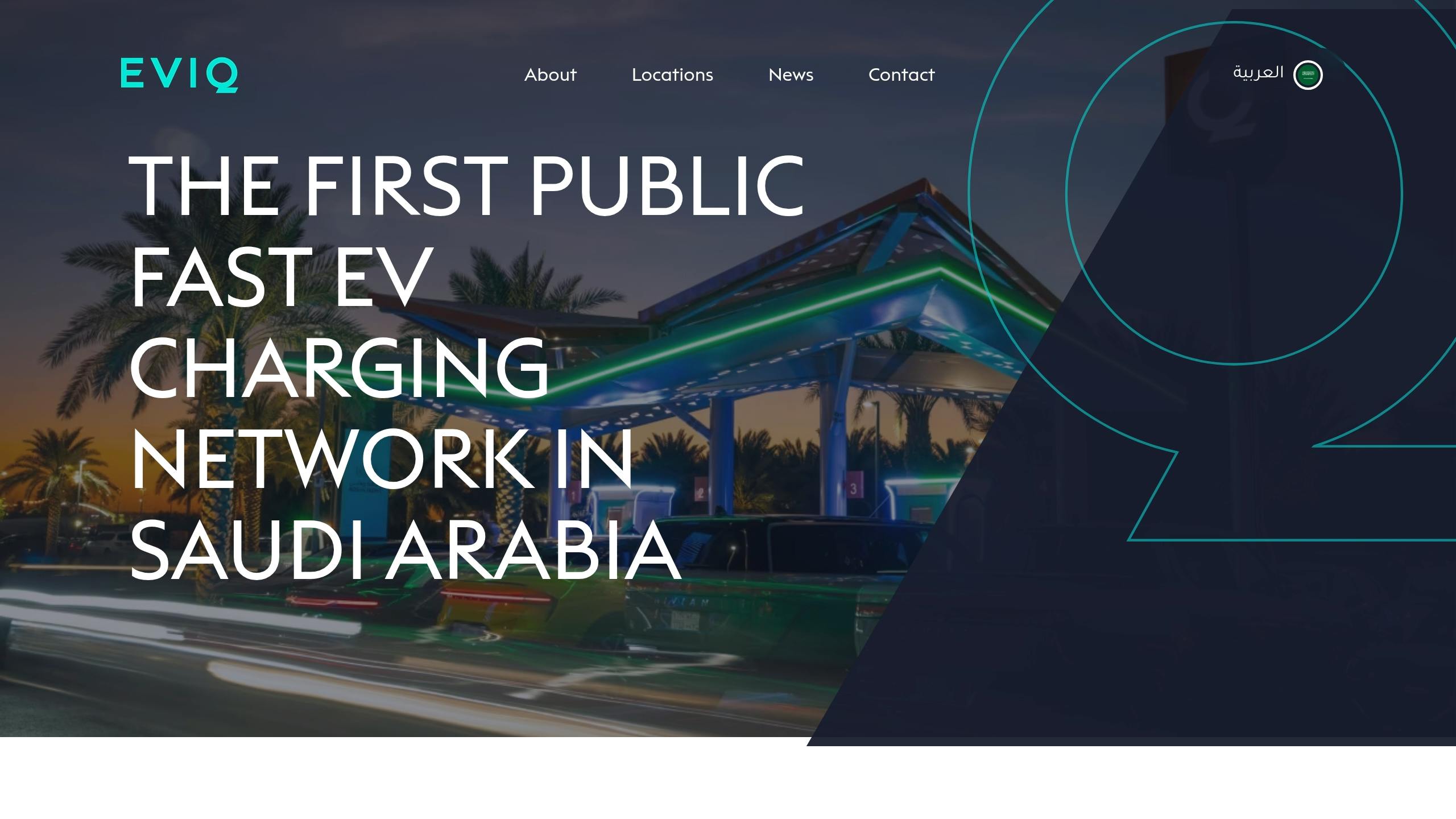
EVIQ is the main nationwide network, including highway locations, with DC fast chargers of up to 350 kW.
Electromin focuses on major cities and malls, with DC fast chargers of up to 150 kW. Shell Recharge places 50–150 kW DC chargers at highway rest stops, including SASCO stations, which makes it a solid pick for long-distance travel. E-FILL charges SAR 0.99/kWh, the lowest rate listed here. Tesla Superchargers are available in Riyadh, Jeddah and Dammam for Tesla drivers.
Tariff models in Saudi Arabia and how to pay
In Saudi Arabia, charging is usually priced per kWh in SAR. EVIQ and Electromin both sit in the SAR 2.00–3.00/kWh range for DC fast charging. E-FILL charges SAR 0.99/kWh, which makes it the lowest-cost option in this list. Shell Recharge also charges per kWh, but rates vary by location.
The bigger issue, though, is access. In Saudi Arabia, payment setup matters almost as much as charger location. Most networks need their own app, so it helps to register, add a bank card, and test activation before crossing the border. That small step can save a lot of hassle when you're standing at a charger on a long highway run.
Saudi charging comparison by operator, speed and app
The table below shows the main operators, speeds and apps at a glance.
Operator | Region | Charger Type | Tariff Model | App Needed | Typical Use Case |
|---|---|---|---|---|---|
EVIQ | Nationwide / highways | DC Fast (up to 350 kW, CCS2) | SAR 2.00–3.00/kWh | EVIQ | Highway travel |
Electromin | Cities / malls | DC Fast (up to 150 kW) | SAR 2.00–3.00/kWh | Electromin | City charging |
E-FILL | Select corridors | AC & DC | SAR 0.99/kWh | E-FILL | Budget-conscious long-distance |
Tesla | Riyadh, Jeddah, Dammam | Supercharger | Per kWh (varies) | Tesla | Tesla drivers |
Shell Recharge | Highway rest stops | DC Fast (50–150 kW) | Per kWh | Shell Recharge | Highway travel via SASCO stations |
Drivers should expect to install more than one app to cover both city charging and highway travel.
Apps, payment setup and roaming: What to prepare before you plug in
Once you know the tariffs, the next step is making sure the right app and card are ready before you plug in. In GCC charging, app access is often the main pain point. So if you're planning a Dubai-to-Riyadh drive, install the operator apps for every network on your route and verify each account in advance.
Which apps to install before driving in the UAE and Saudi Arabia
In Dubai, the DEWA app covers the city’s 1,270+ Green Charger points. Parkin lets Dubai drivers reserve slots, monitor sessions, and pay in-app. For Abu Dhabi, keep Charge AD installed. Once you cross into Saudi Arabia, EVIQ is the main app to have on hand.
The key thing here is simple: don’t assume one app will cover every network. It usually won’t. Keep the operator apps for the chargers on your route, even if that feels a bit clunky.
After the apps are sorted, the next place things tend to go wrong is payment access.
Payment cards, account setup and session checks
Most failed charging sessions happen because accounts aren’t verified or because the saved card isn’t enabled for cross-border payments. It’s a small step, but it can save a lot of hassle on the road.
Set up each app at home first. Then check that your card is enabled before you drive into Saudi Arabia. Before you arrive at a charger, check the station status in the app and confirm that your plug matches the charger.
If a session doesn’t start, try the basics first:
Replug until it locks
Refresh the app
Check that your saved payment method is still active
For a Dubai-to-Riyadh drive, the safest habit is pretty straightforward: pre-load the route’s apps, verify payment, and check each station before departure.
Planning a Dubai to Riyadh EV trip: Costs, stops and checklist
How to estimate charging stops by battery size and consumption
Once you’ve sorted your apps and charging networks, the next job is planning the drive itself. For a Dubai to Riyadh EV trip, it helps to work in usable battery capacity and motorway consumption, not the range printed in the brochure.
That brochure figure can look good on paper. On a long highway run in GCC heat, it often tells only part of the story.
Hot weather can eat into efficiency because the car uses more energy for cabin and battery cooling. So give yourself a larger buffer than you might on a mild day. It’s smarter to reach each stop with some charge left, rather than rolling in almost empty.
Dubai to Riyadh charging corridor: Route segments and planning notes
The Dubai–Riyadh route is much easier to plan in sections instead of treating it like one long stretch.
Route Segment | Recommended Charger Type | Main Networks | Planning Notes |
|---|---|---|---|
Dubai → Abu Dhabi | AC top-up or DC fast charging | DEWA, Charge AD, ADNOC | Top up before the intercity leg. |
Abu Dhabi → UAE border | DC fast charging | Charge AD, ADNOC | Charge before crossing; options thin out near the border. |
UAE–Saudi border → Riyadh corridor | DC fast charging | EVIQ, SASCO, Electromin | Expect wider gaps on remote stretches. |
For GCC road trips, route planning matters just as much as charger access. In the UAE, coverage is strongest in cities and improving along highways. In Saudi, coverage is strongest in major cities, with fewer options on remote roads.
Before you leave, check the full route inside your charging app and mark a backup stop for every long leg. If one charger is busy, offline, or awkward to reach, that extra stop can save you a lot of stress.
Key takeaways for choosing and using an EV in the GCC
Public charging across the GCC still depends heavily on the network available on your route. For intercity driving, DC fast charging is the practical option, especially once you move beyond dense city areas.
If you’re buying an EV for cross-border driving, focus on usable battery capacity first. It also makes sense to confirm the car supports CCS2, which is still the main regional standard for public fast charging.
FAQs
Can I use one app for all chargers from Dubai to Riyadh?
No. There isn’t a single app that works with every public charger from Dubai to Riyadh. Different GCC charging networks run on their own platforms, so access can vary from one country, city, or operator to another.
In the UAE, you may need apps such as DEWA, Parkin, or Charge AD. In Saudi Arabia, you’ll mainly use EVIQ. For trip planning, tools like PlugShare can help you check charger locations and status alongside the official apps.
How much should I budget for public charging on this route?
It comes down to where you charge and which charger you use.
In Dubai, DEWA Green Charger is free for registered users. If you’re not registered, the rate is AED 0.29 per kWh.
In Abu Dhabi, Charge AD charges:
AED 0.70 per kWh for AC charging
AED 1.20 per kWh for DC charging
In Saudi Arabia, E-FILL charges SAR 0.99 per kWh. EVIQ fast charging usually falls between SAR 2.00 and SAR 3.00 per kWh.
So yes, prices vary a fair bit from one network to another. But in most cases, public charging still costs less than petrol.
What EV specs matter most for GCC road trips?
For GCC road trips, pay close attention to the specs that affect range, charging, and performance in the heat.
What looks good on paper can fall apart once you're driving long highway stretches in summer. That’s why these points matter most:
Real highway range of at least 480 km
800-volt battery architecture for faster DC charging
Compatibility with CCS2 or SAE J3400 (NACS)
Liquid-cooled battery thermal management for extreme summer temperatures