If I’m installing a home EV charger in the UAE in 2026, I need to check three things first: my home type, my power supply, and the approval path. That one check can save me from buying the wrong wallbox or paying for work that cannot be approved.
Here’s the short version:
Most UAE homes use a Type 2 AC wallbox
7 kW usually suits single-phase homes
11 kW and 22 kW usually need three-phase
A 22 kW charger will not charge faster if my EV only accepts 11 kW AC
Hardware often costs about AED 1,700 to AED 3,200
Installation often costs about AED 1,300 to AED 3,000, depending on cable run, DB work, and access
Villa installs are often simpler
Apartment installs usually need a building NOC, parking approval, and utility sign-off
Home EV charging can cost about AED 45 per 1,000 km, versus about AED 275–280 per 1,000 km for petrol
Before I buy anything, I’d make sure the charger matches:
my car’s AC charging limit
my car’s connector
my home’s single-phase or three-phase supply
my parking layout and cable route
the rules set by DEWA, ADDC, or AADC, plus building management if I live in an apartment
The main cost trap is simple: the wallbox price is only part of the bill. I also need to budget for cabling, isolator, breaker, labour, and any panel or routing work.
The main approval trap is also simple: apartments often take more steps than people expect.
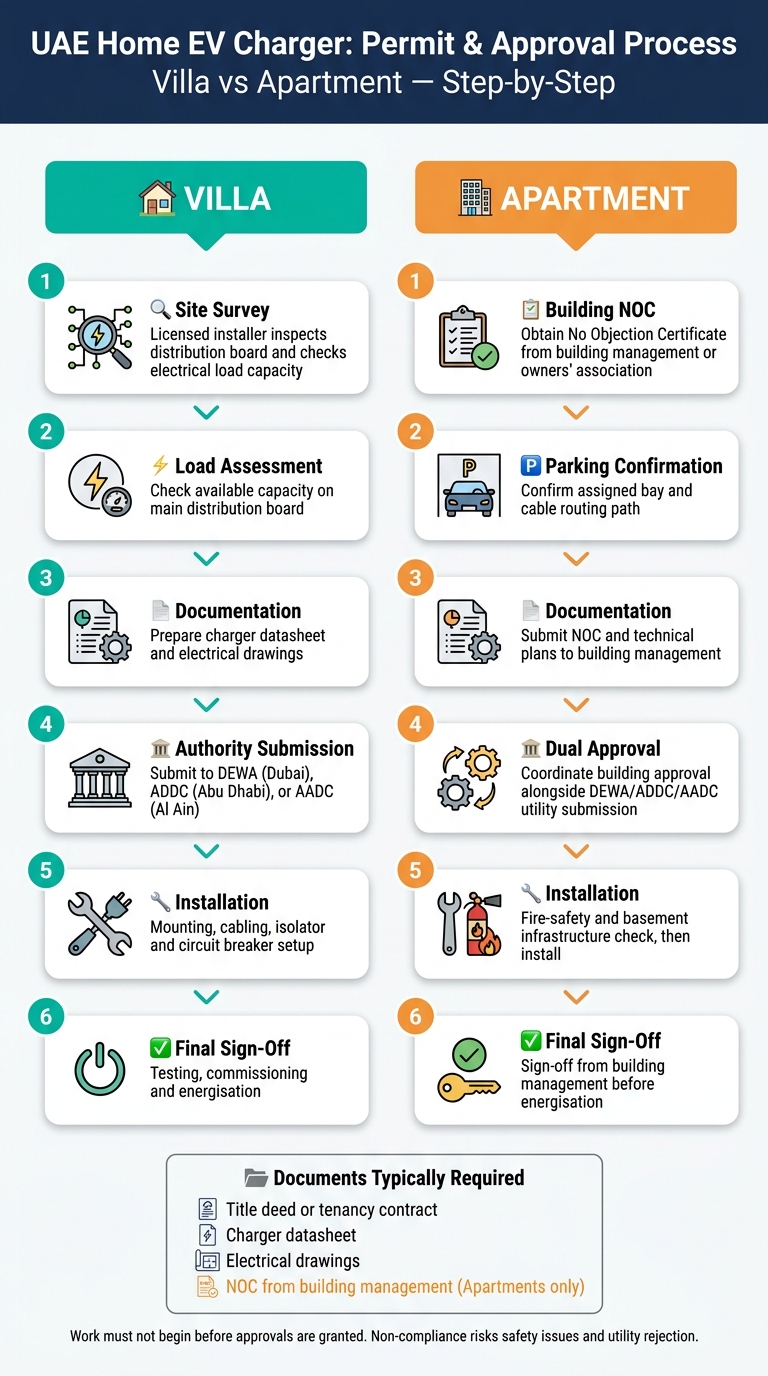
UAE Home EV Charger Installation: Approval Steps for Villas vs Apartments
Quick comparison
Item | What I should know |
|---|---|
Common charger type | Type 2 AC wallbox |
Power choices | 7 kW, 11 kW, 22 kW |
Best fit for single-phase | 7 kW |
Best fit for three-phase | 11 kW or 22 kW |
Hardware price | About AED 1,700–3,200 |
Installation price | About AED 1,300–3,000 |
Villa process | Site survey, load check, utility submission, install, energisation |
Apartment process | Building NOC, parking check, cable route review, approvals, install |
Common brands named | Wallbox, ABB, Schneider Electric, Zaptec, Kempower |
So if I want the short answer, it’s this: I should pick a Type 2 charger that matches my EV and home supply, get a load check first, and sort approvals before ordering the unit.
1. How to Choose the Right Home EV Charger Available in the UAE
Choosing the right home EV charger comes down to three things: your car’s onboard AC charging limit, your home’s electrical supply, and the connector you need. In plain terms, the charger should match the EV’s AC limit, connector, and home setup.
Connector Compatibility and Adapter Checks in the UAE
In the UAE, home chargers are usually Type 2. Before you buy, check that the charger connector matches your car’s AC inlet. That sounds obvious, but it’s where many buyers trip up.
If you have a NACS-equipped EV, set aside about AED 500 for a CCS2/Type 2 adapter.
Once the connector is sorted, the next thing to check is charging power.
Approved and Commonly Installed Charger Brands in the UAE
Several brands are approved and commonly installed in UAE villas and apartments. The table below gives you the main specs worth comparing before you spend your money.
Brand | Power Options | Smart Features | IP Rating | Approx. AED Price |
|---|---|---|---|---|
7 kW / 22 kW | App control, load balancing, scheduling | IP54 | AED 1,800–2,500 | |
7 kW / 22 kW | OCPP, remote monitoring, access control | IP54 | AED 2,200–3,200 | |
7 kW / 22 kW | App control, RFID, scheduling | IP54 | AED 1,900–2,800 | |
7 kW / 22 kW | Dynamic load balancing, app control | IP54 | AED 2,000–2,900 | |
7 kW / 11 kW | App control, scheduling, energy monitoring | IP55 | AED 1,700–2,400 |
Prices are indicative. Confirm current availability and pricing with a UAE-approved supplier before purchasing.
7 kW vs 11 kW vs 22 kW: Which Power Level Suits Your EV and Home
A lot of people assume a charger with a higher rating will always charge faster. That’s not how it works. If your EV is capped at 11 kW, a 22 kW charger will not make it charge any faster.
For most homes, 7 kW works well on a single-phase supply. 11 kW and 22 kW chargers need a three-phase supply. And if you’re thinking about 22 kW, get a load check done first. It needs a lot of spare electrical capacity.
After you’ve matched the plug, compare the charger output with your home supply and how much you drive each day.
Charger Power | Typical Home Supply | Range Added per Hour | Best Fit |
|---|---|---|---|
7 kW | Single-phase | ~35–45 km | Overnight charging for smaller batteries and daily commutes |
11 kW | Three-phase | ~60–70 km | Standard for many modern premium EVs in villas |
22 kW | Three-phase | ~100+ km | High-use vehicles or EVs with large onboard AC chargers |
As a rough guide, home charging usually adds about 35–45 km of range per hour at 7 kW, 60–70 km at 11 kW, and 100+ km at 22 kW.
Once you’ve locked in the connector and power level, it makes sense to compare brand features and price in AED.
2. What a Home EV Charger Installation Costs in the UAE
A charger’s purchase price is separate from installation. So when you set your budget, don’t stop at the unit itself. You also need to allow for labour, cabling, protection devices, and any electrical work that may be needed.
Typical 2026 Cost Ranges for Hardware, Labour and Electrical Upgrades
For a standard installation, expect AED 1,300–1,425, which usually includes a 5 m cable, isolator, and circuit breaker, with on-site work taking around 2–3 hours. If the job is more involved, an AC wallbox installation can cost AED 1,500–3,000. That usually happens when the cable run is longer, the DB needs work, or extra containment is required.
What Makes a Villa Installation Cheaper or More Expensive
In most villas, the biggest factor is simple: distance. The farther the distribution board is from the parking area, the more cable, labour, and materials the installer will need.
Other things can push the price up too:
conduit or trenching across the property
breaker additions or DB upgrades in older villas
weatherproofing for outdoor mounting points
That’s why a site survey matters before you lock in an installer. Two homes can look similar on the surface, but the wiring path can change the price quite a bit.
Cost Breakdown Table: Basic Villa, Complex Villa and Apartment Basement Setup
Setup Type | Typical Installation Budget (AED) | Typical Inclusions |
|---|---|---|
Basic villa (DB close to parking, short cable run) | 1,300–1,425 | 5 m cable, isolator and circuit breaker, 2–3 hours on-site labour |
Complex villa (long cable run, DB upgrade, conduit or trenching) | 1,500–3,000 | Longer runs, electrical upgrades and extra containment |
Apartment basement (shared parking, access constraints) | 1,500–3,000 | Costs rise when parking access is tight or shared infrastructure needs extra cabling or metering |
Figures are indicative 2026 installation estimates. Get a site survey and written quote before committing to any installation.
Once you know the likely cost range, the next step is to check the approval process for your home type before you book the installer.
3. Permit and Utility Approval Steps for Villas and Apartments
A home charger needs approval before energisation. After you’ve picked the charger and set the budget, this is the next step that matters.
The process changes based on where you live. Villas are usually more straightforward. Apartments, on the other hand, need more back-and-forth because shared parking, cable routes, and building rules come into play.
Villa Process: Site Survey, Load Check, Utility Submission and Final Sign-Off
For villa owners, the process usually moves through four stages. First, a licensed installer visits the property to inspect the distribution board and check available electrical load capacity. After that, the installer prepares the charger datasheet and electrical drawings for approval.
Those documents are then sent to the relevant utility: DEWA in Dubai, ADDC in Abu Dhabi, or AADC in Al Ain. Once approval comes through, the installer carries out the installation and commissioning, and only then is the charger energised.
Apartment Process: Building NOC, Parking Approval and Shared Infrastructure Checks
Apartments need more coordination from the start. Before anything goes to the utility, you need a No Objection Certificate (NOC) from your building management. In many cases, that step decides whether the project can move ahead at all, so it makes sense to start early.
Once the NOC is in place, the installer checks the assigned parking bay, cable routing, and fire-safety rules linked to shared infrastructure. From there, building approval is coordinated alongside the utility submission before the charger can be energised.
Permit Process Table: Documents, Authorities and Approval Sequence by Home Type
Step | Villa | Apartment |
|---|---|---|
1. Initial step | Engage licensed installer for site survey | Obtain NOC from building management or owners' association |
2. Technical check | Load assessment of the main distribution board | Confirm assigned parking bay and cable routing path |
3. Documentation | Charger datasheet and electrical drawings | Submit NOC and technical plans to building management |
4. Authority approval | Submit to DEWA, ADDC, or AADC | Coordinate building approval alongside utility submission |
5. Installation | Mounting, cabling, isolator and breaker setup | Fire-safety and basement infrastructure check |
6. Final step | Testing, commissioning and energisation | Final sign-off from building management before energisation |
Documents typically required include your title deed or tenancy contract, charger datasheet, and electrical drawings. Apartment residents also need the NOC from building management.
With approvals sorted, the next step is to match the charger to your EV, home type, and daily driving needs.
4. Match the Charger to Your EV, Property and Ownership Plan
With permits and costs sorted, it’s time to pick the charger that fits your EV’s charging limit, your home power supply and how much you drive each day. From there, narrow it down based on your parking setup, supply type and day-to-day use.
Best Fit by Use Case: Apartment Commuter, Single-EV Villa or Two-EV Household
Start with your EV’s onboard AC charging limit. That part matters more than many people think. An 11 kW or 22 kW wallbox won’t charge your car any faster if the car itself can’t accept that speed.
If you live in an apartment and drive around 40–60 km a day, a 7 kW smart wallbox is usually enough for overnight charging. Simple, practical, and a good fit for regular commuting.
For a single-EV villa home covering 60–150 km a day, 11 kW tends to make more sense, especially if the property has a three-phase supply.
If your home has two EVs, don’t just think about charger speed. Think about how both cars will charge at the same time. In that case, load management is the key feature. It lets both chargers share the available power without tripping the main breaker.
How UAE Climate and Parking Conditions Affect Charger Choice
The charger itself is only part of the decision. Where it will be installed matters too.
For outdoor villa parking, go with a weather-rated charger and keep it in the shade where possible. Dubai and the rest of the UAE can be brutal in summer, and heat exposure is no small thing. If your parking bay is tandem or a long way from the distribution board, check cable length before you order. Standard UAE installation packages usually include a 5 m cable.
For apartment basement parking, the main points are less about weather and more about logistics. Focus on building approval, the cable route and whether the bay is easy to access.
Decision Table: Home Type, Daily Driving, Recommended Charger and AED Budget
Use the table below to line up your home type, driving needs and budget in one go.
Home Type | Daily Driving | Recommended Charger | Key Feature | Indicative Total Budget |
|---|---|---|---|---|
Apartment | 40–60 km | 7 kW Smart Wallbox | App scheduling | AED 4,000 – 6,000 |
Single-EV Villa | 60–150 km | 11 kW Wallbox | Three-phase supply | AED 5,000 – 7,500 |
Two-EV Home | High / mixed | Dual 11 kW with Load Management | Load balancing, smart controls | AED 9,000 – 12,000 |
Once the charger size is fixed, the next move is to book a licensed installer and confirm the approved scope.
Conclusion: How to Plan a Home EV Charger Installation in the UAE
Once you’ve picked the right charger, sort out the budget and approvals before ordering any hardware.
Start with your EV’s AC charging limit. Your wallbox should match what the car can actually take. There’s no point paying for more charging power if the vehicle won’t use it. Also check the connector type before you buy. Most home chargers in the UAE use Type 2, and some EVs need an adapter.
Then look at the full installed cost. Don’t focus only on the price of the wallbox. Plan for the total installed price. In the UAE, a standard home installation usually costs AED 1,300–1,425, not including the hardware.
Approvals need to be done before any installation work begins. For villas, that usually means a site survey, a load check, and utility submission. For apartments, you’ll need a Building No Objection Certificate (NOC) and parking approval. If work starts before approval, you risk safety problems and non-compliance with the relevant utility and building rules.
The cost difference can be hard to ignore. In the UAE, charging an EV at home costs about AED 45 per 1,000 km, while running a petrol car costs about AED 275–280 for the same distance. That’s a drop of up to 84%.
FAQs
How do I check if my home has single-phase or three-phase power?
Check your electrical distribution board, also called the circuit breaker panel. A three-phase setup usually has a larger, wider main breaker with three poles or three linked switches. A single-phase setup, on the other hand, tends to have a narrower main breaker.
That said, don’t rely on a quick visual check alone. Before you install a home charger, ask a licensed electrical professional to confirm your power supply and whether it has enough capacity for the charger you plan to use.
Can I take my home charger with me if I move house?
Yes, but you’ll need a professional to handle it.
A home charger is wired into your property’s electrical system, so a certified specialist should remove it from your current home and install it again at the new one. That keeps the job safe and helps make sure everything meets the required electrical standards.
There’s also a cost angle to think about. You’ll usually pay extra labour fees for both the removal and the new installation. On top of that, your new home needs enough electrical capacity to support the charger.
How long do villa and apartment approvals usually take?
The available information does not give a set timeline for villa or apartment permit or utility approvals for home EV charger installation.
What it does confirm is the on-site installation itself usually takes 2 to 6 hours.
For the latest approval timelines, check with your local utility provider or an authorised installer.