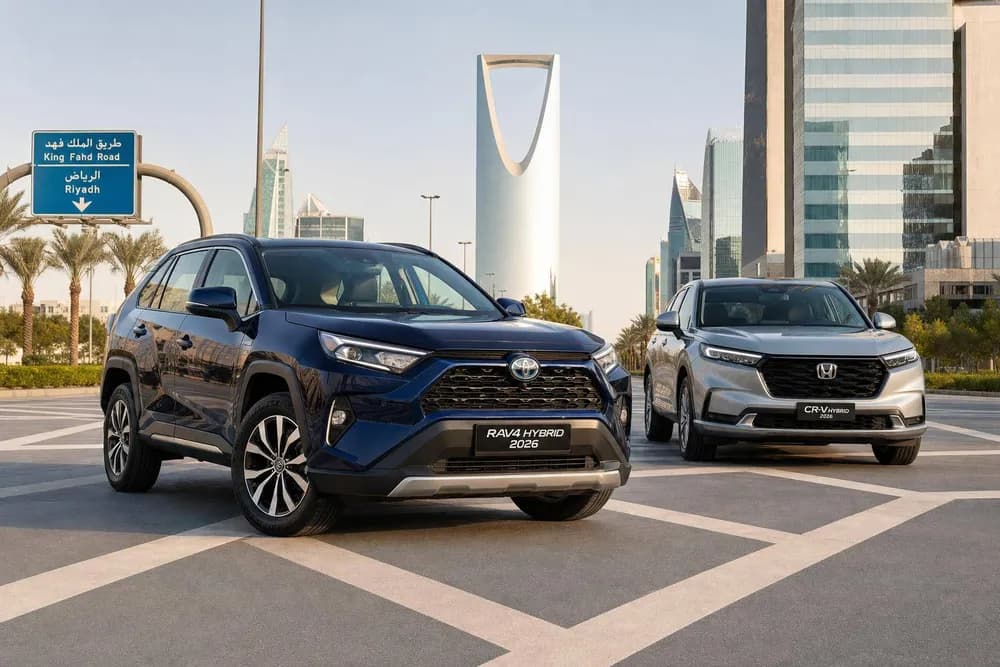
If I had to give a short answer: yes, for most KSA buyers I’d pick the 2026 Toyota RAV4 Hybrid over the Honda CR-V Hybrid.
It starts lower at SAR 111,377, has a stronger mid-range buy in the RAV4 XLE 4X4 HEV at SAR 138,862, uses less fuel on paper and in day-to-day driving, and comes with stronger aftersales reach in Saudi Arabia. The Honda CR-V Hybrid still makes sense if I want a more polished cabin feel, more standard safety at the lowest trim, and easy wireless phone pairing.
Here’s the full picture in simple terms:
-
Best value pick: Toyota RAV4 XLE 4X4 HEV
-
Lowest starting price: RAV4 Hybrid
-
More power: RAV4 Hybrid, up to 239 hp
-
Lower fuel use: RAV4 Hybrid, 24.8–26.6 km/l official
-
More cabin and boot room: Honda CR-V Hybrid
-
Better phone connectivity out of the box: Honda CR-V Hybrid
-
Better dealer and parts support in KSA: Toyota
-
Better long-term resale outlook: Toyota
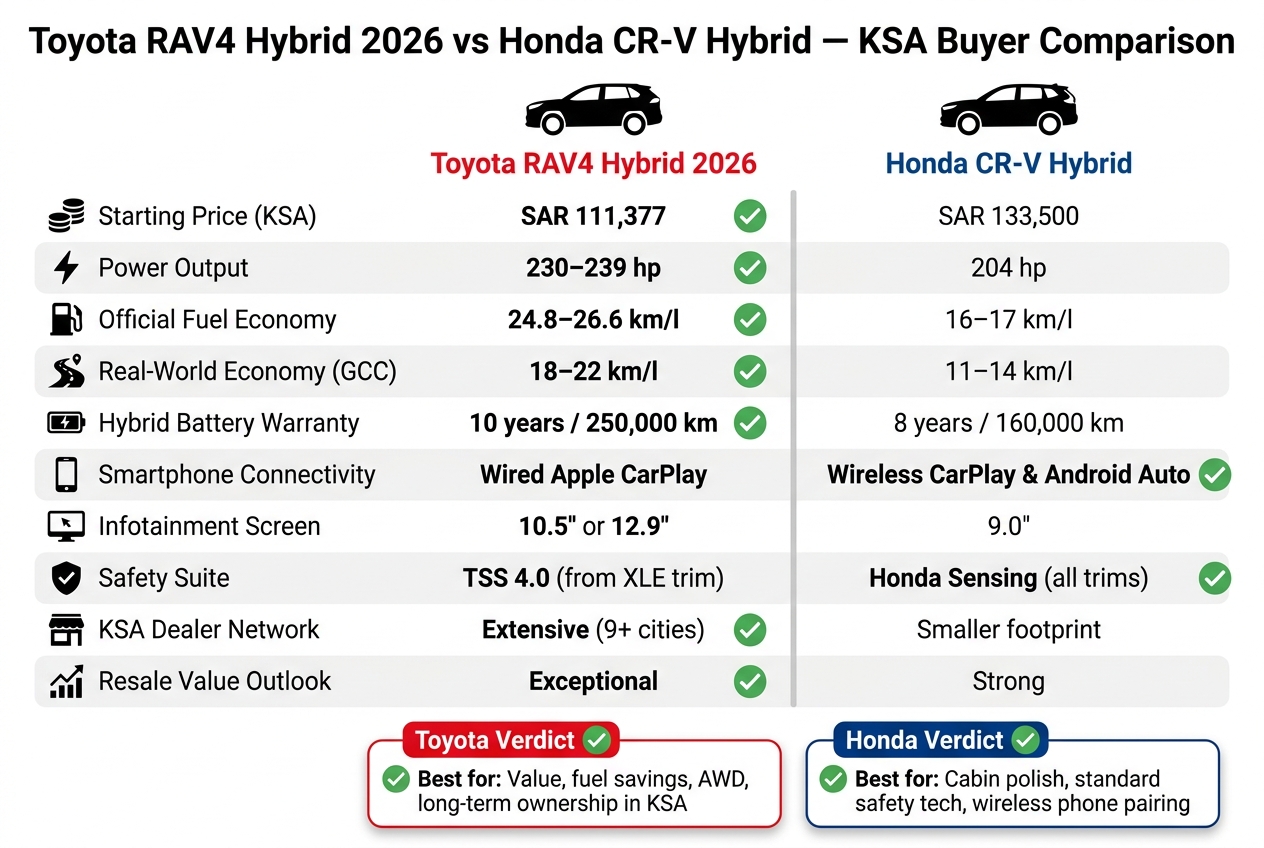
Toyota RAV4 Hybrid 2026 vs Honda CR-V Hybrid: Full KSA Comparison
2026 Toyota RAV4 vs Honda CR-V Hybrid: Two Great Crossovers, One Clear Winner
Quick Comparison
| Point | Toyota RAV4 Hybrid 2026 | Honda CR-V Hybrid |
|---|---|---|
| KSA launch | On sale from 17 February 2026 | Already on sale |
| Starting price | SAR 111,377 | SAR 133,500 |
| Mid-spec value | XLE 4X4 HEV at SAR 138,862 | Base trim close in price |
| Power | 230–239 hp | 204 hp |
| Fuel economy | 24.8–26.6 km/l official | 16–17 km/l official |
| Drivetrain | FWD or AWD | FWD/AWD |
| Safety | Full Toyota safety kit from XLE up | Honda Sensing standard |
| Space | Good | More rear and boot room |
| Ownership in KSA | Strong resale, parts, and service reach | Good, but behind Toyota |
My take is simple: if you care most about price, fuel spend, AWD value, and ownership peace of mind in Saudi Arabia, the RAV4 Hybrid is the one I’d wait for. If you care more about cabin polish and standard safety from the entry trim, the CR-V Hybrid still has a good case.
That sets up the key choice: better value and lower running costs versus more cabin polish at the base level.
Price and trim value in Saudi Arabia
KSA pricing, finance options, and trim line-up
In Saudi Arabia, the RAV4 Hybrid is sold in five trims. The CR-V Hybrid shown here is listed in base and Sport Touring AWD form.
| Model & Trim | KSA Price (SAR) | Approx. (AED) |
|---|---|---|
| Toyota RAV4 LE 4X2 HEV | SAR 111,377 | ~AED 109,150 |
| Toyota RAV4 LE 4X4 HEV | SAR 117,357 | ~AED 115,010 |
| Toyota RAV4 XLE 4X4 HEV | SAR 138,862 | ~AED 136,085 |
| Toyota RAV4 XSE 4X4 HEV | SAR 161,977 | ~AED 158,735 |
| Toyota RAV4 LTD 4X4 HEV | SAR 165,542 | ~AED 162,230 |
| Honda CR-V Hybrid Base | SAR 133,500 | ~AED 130,830 |
| Honda CR-V Hybrid Sport Touring AWD | ~SAR 163,875 | ~AED 160,595 |
AED figures are approximate equivalents based on current SAR-to-AED parity.
Looking at those numbers, the RAV4 XLE 4X4 HEV is the trim that makes the most sense to examine closely.
Toyota also lists finance from about SAR 1,545 per month, based on a 20% down payment over 60 months. That matters, because the lower LE trims miss out on Toyota Safety Sense 4.0. It starts from the XLE 4X4 HEV. So while the LE gets you into the range for less money, the XLE is where the package starts to feel more complete.
Mid-trim value verdict
At SAR 138,862, the RAV4 XLE 4X4 HEV sits only a little above the CR-V Hybrid base at SAR 133,500. For that extra spend, you get AWD, a moonroof, wireless charging, a power tailgate, and Toyota Safety Sense 4.0.
That’s the main reason this trim stands out. It doesn’t just split the range in the middle; it gives buyers a stronger mix of kit and price without pushing into the much higher XSE and LTD territory. For many KSA buyers, the RAV4 XLE 4X4 HEV looks like the sweet spot for value.
Price is only part of the story. Next up is efficiency and how these two feel in daily driving.
Performance, fuel economy, and daily drivability
Toyota RAV4 Hybrid 2026: powertrain and efficiency
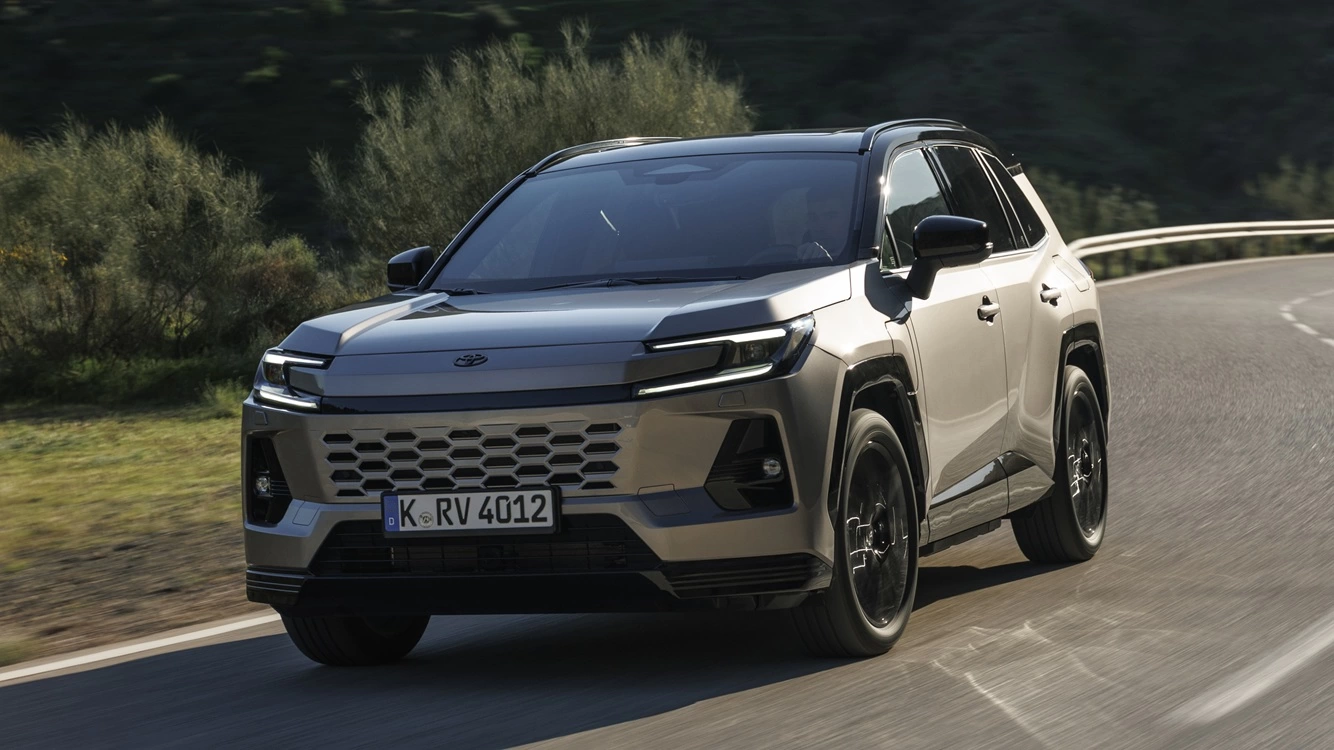
The RAV4 Hybrid uses a 2.5L Atkinson-cycle four-cylinder engine with Toyota’s fifth-generation hybrid system and an e-CVT. Total output stands at 230 hp in FWD models and 239 hp in AWD versions.
Go for E-Four, and you get a rear electric motor plus Trail Mode for sand and loose ground. That makes it a good fit for light off-road trips in KSA.
Official fuel economy in KSA reaches 26.6 km/l for the LE 4X2 HEV and 24.8 km/l for AWD trims. In day-to-day KSA driving, a more likely figure is around 18–22 km/l. For a family SUV, that’s still a very solid result.
Compared with that, the CR-V gives up some power for a calmer hybrid feel.
Honda CR-V Hybrid: powertrain and efficiency
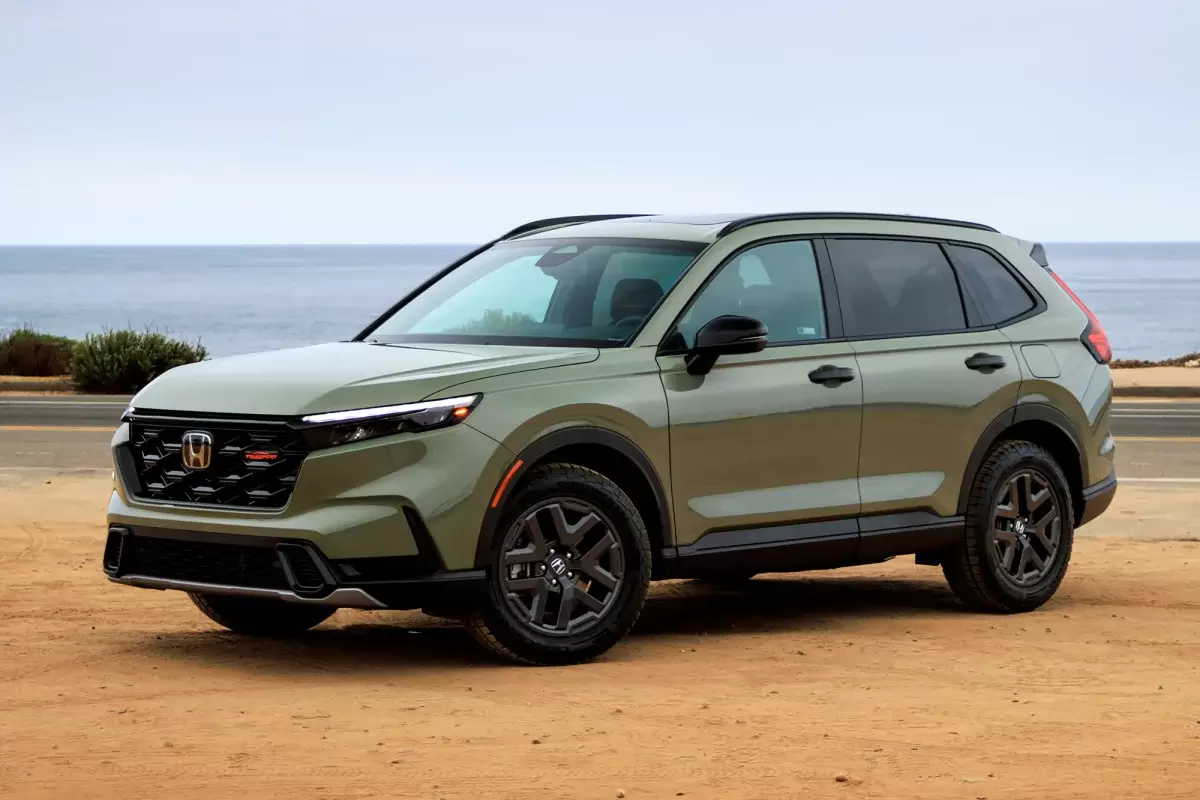
The CR-V Hybrid pairs a 2.0L engine with a dual electric motor setup and its own e-CVT. Total output is 204 hp.
Official fuel economy is about 16–17 km/l. In mixed GCC use, expect around 7–9 L/100 km. In traffic, the CR-V feels smoother and less eager, but it also trails the Toyota on outright power.
On paper, the gap looks big. On the road, it mostly shows up in throttle response and fuel spend.
Head-to-head driving verdict
| Specification | Toyota RAV4 Hybrid 2026 | Honda CR-V Hybrid |
|---|---|---|
| Engine | 2.5L Atkinson-cycle | 2.0L |
| Combined Output | 230–239 hp | 204 hp |
| Transmission | e-CVT | Dual-motor e-CVT |
| Official Fuel Economy | 24.8–26.6 km/l | ~16–17 km/l |
| Real-World GCC Economy | 18–22 km/l | 11–14 km/l |
| AWD System | E-Four with Trail Mode | FWD/AWD available |
The RAV4 Hybrid comes out ahead for straight-line pace and official fuel economy. On long highway runs between cities, that extra 35 hp helps when overtaking, even if the e-CVT can feel a bit reluctant when you push hard.
The CR-V Hybrid feels more polished in slow city traffic and leans more toward comfort. Still, the RAV4 answers back with hot-weather extras that matter in the Gulf. XSE and LTD trims get remote engine start, so you can pre-cool the cabin before stepping in. In summer, that’s not a small perk. It gives the RAV4 a clear edge for daily use in high heat.
Next, space, tech, and safety decide whether the Toyota keeps its lead.
Cabin space, technology, and safety
Passenger room, seating comfort, and boot space
For most family buyers, the first thing that matters is simple: space. Room for passengers, room for bags, and enough comfort to make long drives less of a chore.
The Honda CR-V is a bit roomier overall. It has a longer wheelbase and a larger boot, which helps on airport runs or family trips when the luggage starts piling up. It gives away less in day-to-day practicality, while the Toyota RAV4 tends to offer more kit for the money in higher trims.
The RAV4 still does well here. Its boot grows to around 1,800 litres with the rear seats folded. On the comfort side, the LTD trim adds ventilated front seats and heated rear seats, which makes a lot of sense in Saudi Arabia’s intense summer heat.
In feel, the two cars take slightly different paths. The CR-V comes across as more polished. The RAV4 feels more use-first. If cabin finish matters to you, it’s worth looking at mid-range RAV4 trims and above, since lower trims use more basic plastics.
Infotainment, connectivity, and GCC-spec features
This is where the gap becomes easier to spot.
The RAV4 comes with bigger displays. All KSA-spec hybrid trims get a 12.3-inch digital cluster, while infotainment is a 10.5-inch screen on LE, XLE, and ADV trims and a 12.9-inch unit on XSE and LTD. The CR-V counters with a 9-inch touchscreen and either a 7-inch or 10.2-inch digital cluster, depending on trim.
Honda has an edge on phone pairing. It offers wireless Apple CarPlay and Android Auto, while Toyota lists wired Apple CarPlay in KSA. Honda also keeps physical controls simpler, whereas Toyota shifts more climate functions into the screen.
For family use in hot weather, though, the spec sheet matters in more practical ways than screen size alone. Things like wireless charging, rear USB-C ports, and a power tailgate make a bigger difference when you’re loading shopping bags, charging devices, or dealing with kids in the back.
The RAV4 includes four USB-C ports across all trims, with 45W fast charging on the LTD, and it gets a power tailgate from XLE upward. The CR-V makes wireless charging standard across all hybrid trims, but keeps the power tailgate for Sport trims.
The 2026 RAV4 also adds Toyota’s Arene software platform, which allows over-the-air updates for infotainment and driver-assistance systems.
| Feature | Toyota RAV4 Hybrid 2026 | Honda CR-V Hybrid |
|---|---|---|
| Infotainment Screen | 10.5-inch or 12.9-inch | 9.0-inch |
| Digital Cluster | 12.3-inch (standard) | 7.0-inch or 10.2-inc |
| Smartphone Link | Wired Apple CarPlay (KSA) | Wireless Apple CarPlay & Android Auto |
| USB-C Ports | 4 × USB-C (15W–45W) | USB-A and USB-C available |
| Wireless Charging | XLE and above; dual pad on LTD | Standard on all hybrid trims |
| Power Tailgate | XLE trim and above | Sport trims |
| Rear AC Vents | Standard across all trims | Standard |
Safety equipment and family-use verdict
On safety tech, trim level matters a lot in the RAV4.
The RAV4 Hybrid gets Toyota Safety Sense 4.0 (TSS 4.0) from the XLE HEV trim upward. This setup brings updated camera and radar hardware for faster processing, plus added recognition for motorcycles, road edges, and guardrails. It also includes Proactive Driving Assist and a multi-camera Drive Recorder on GCC-spec models.
That said, the base LE HEV trims do not include TSS 4.0. So if safety tech is high on your list, XLE is the lowest RAV4 trim worth shortlisting.
The CR-V Hybrid takes a simpler route. Honda Sensing comes standard across all trims, including adaptive cruise control and lane-keeping assist. Above the RAV4’s LE trim, TSS 4.0 gives Toyota a broader set of functions.
From here, the choice starts to move away from features on paper and more toward long-term ownership value.
Ownership costs, resale, availability, and final verdict
Maintenance, reliability, and fuel-cost savings
Once price and features are locked in, day-to-day ownership is what separates one SUV from another in KSA.
Toyota has the upper hand here. In Saudi Arabia, the 2026 RAV4 Hybrid uses less fuel, tends to hold its value better, and comes with broader service support. In real-world KSA driving, it returns 18–22 km/L, while the CR-V Hybrid manages 16–17 km/L in combined driving. That may not look huge at first glance, but over years of driving, the savings add up.
Warranty support also leans in Toyota's favour. The RAV4 Hybrid comes with a 3-year factory warranty, backed by Abdul Latif Jameel's (ALJ) 7-year extended care programme. That gives owners up to 10 years or 250,000 km of hybrid battery coverage. The CR-V Hybrid offers 8 years or 160,000 km. That's still decent, just not as long.
Resale value, dealer reach, and launch timing
Warranty is one part of the story. Resale and service access matter just as much in Saudi Arabia, especially if you plan to keep the car for years or sell it on without a headache.
ALJ's service network reaches major cities such as Riyadh, Jeddah, Dammam, Medina, Tabuk, Al Khobar, Taif, Buraydah, and Mecca. If you live outside the biggest urban centres, that extra reach can make ownership much easier. Honda's network is dependable, but Toyota still looks like the safer pick for coverage and parts supply in KSA.
The 2026 RAV4 Hybrid is already on sale in Saudi Arabia. Some higher trims may still come with waiting periods of three to six months.
| Factor | Toyota RAV4 Hybrid 2026 | Honda CR-V Hybrid |
|---|---|---|
| Hybrid battery warranty | Up to 10 years / 250,000 km | 8 years / 160,000 km |
| Service network in KSA | Extensive; major-city coverage | Smaller footprint |
| Resale outlook | Exceptional; market leader | Strong, but below Toyota |
| Fuel economy (real-world) | 18–22 km/L | ~16–17 km/L |
Conclusion: Which hybrid SUV suits most KSA buyers?
Put it all together, and the ownership picture is pretty straightforward. For most KSA buyers, the 2026 RAV4 Hybrid makes more sense, even if you need to wait a bit for the trim you want.
FAQs
Which RAV4 Hybrid trim is best for families in KSA?
For families in Saudi Arabia, the XLE 4x4 HEV trim is the pick that makes the most sense. It strikes a strong balance between comfort, day-to-day ease, and the features most families will use.
You get all-wheel drive, a broad safety package, a moonroof, wireless charging, and a power tailgate. That mix covers the basics and adds a few nice extras without going overboard.
It also brings the comfort and practicality that matter in daily family life. And because it uses a hybrid powertrain, it can help cut fuel costs over time while also supporting long-term dependability.
Is the lower RAV4 price worth missing safety features on the base trim?
It comes down to what matters most to you. An entry-level Toyota RAV4 will usually cost less up front, but base trims can leave out some advanced driver-assistance features that show up on higher grades like the GXR or Adventure.
If safety tech is high on your list, a mid-range trim such as the XLE or GXR often hits the sweet spot. You get a more complete safety package, plus a few extra convenience features, while still holding onto good long-term value.
How much could I really save on fuel with the RAV4 Hybrid?
The 2026 Toyota RAV4 Hybrid can cut your fuel bill in a way you’ll actually notice. Official figures reach up to 23.8 km/L, though in day-to-day driving across this region, most drivers will likely see about 17–22 km/L.
Against petrol-only models, that can add up to AED 5,000 or more per year in fuel savings if you cover a moderate to high annual mileage.