In the UAE, driving an unregistered vehicle is illegal, and registering your car is mandatory. This guide simplifies the process, covering new registrations, ownership transfers, and renewals. Here's what you need to know:
-
Registration Validity: One year; renew before expiry to avoid fines.
-
New Cars: Dealers handle registration; AED 400 base fee.
-
Used Cars: Requires a technical inspection, AED 420 registration fee, and AED 350 ownership transfer fee.
-
Renewals: Costs AED 350–380; late penalties include AED 20/month, AED 500 fine after 3 months, and 4 black points.
-
Documents: Emirates ID, insurance, technical inspection (if required), and clearance of all fines.
Start by ensuring your car is insured and, if over three years old, passes a technical inspection. Registrations can be completed online or at service centres, with digital and physical Mulkiya options available. Follow these steps to stay compliant and avoid penalties.
Car Renewal Process In UAE | Tips To Follow For Smooth Car Renewal In UAE | Car Inspection | ANOC
Types of Vehicle Registration in the UAE
In the UAE, vehicle registration falls into three main categories, each with its own procedures and requirements. Knowing which category applies to your situation ensures you're prepared with the right documents and budget for the associated fees. These categories cover new vehicles, used vehicles, and registration renewal, each tailored to specific needs.
New Vehicle Registration
If you're buying a brand-new car from an authorised dealership, the registration process is typically handled by the dealer. They submit a Vehicle Clearance Certificate (VCC) to the appropriate authority - either the RTA in Dubai or the MOI in other emirates - and arrange for the initial Mulkiya (vehicle registration card) to be issued in your name.
New vehicles are exempt from technical inspections for the first three years, making the process much simpler. The base registration fee for a new light vehicle is AED 400, though additional charges may apply. Most dealerships complete this process within a few days, providing you with your Mulkiya and number plates when you collect your car.
Used Vehicle Registration and Ownership Transfer
For used cars, both the buyer and seller must visit an RTA or MOI service centre to complete the ownership transfer. Before proceeding, any outstanding fines must be cleared, and a technical inspection is required to confirm the vehicle's roadworthiness. First-time buyers will also need to open a new traffic file, which costs AED 220.
The ownership transfer fee is AED 350, while the base registration fee for a used light vehicle is AED 420. Technical inspections generally cost between AED 150 and AED 170, but vehicles less than three years old are usually exempt. After completing these steps, the buyer receives the updated Mulkiya.
Vehicle Registration Renewal
Your Mulkiya is valid for one year and must be renewed before the grace period expires. For vehicles older than three years, a technical inspection is mandatory, and the resulting Technical Inspection Certificate remains valid for 30 days. Make sure your insurance is current and settle any outstanding fines before renewal.
The renewal fee for a light vehicle ranges from AED 350 to AED 380, with an additional AED 20 knowledge and innovation fee. Late renewals incur a penalty of AED 20 per month, while delays exceeding three months result in a AED 500 fine and 4 black points.
Renewals can be completed online through platforms like the RTA Dubai App, Dubai Now, or MOI services. The digital Mulkiya (e-Mulkiya) is fully recognised by authorities, and if renewing online, you can print a temporary registration card while waiting for the permanent one to be delivered by courier.
Required Documents for Car Registration
When registering a car in the UAE, having the correct documents ready is key to a smooth process. Whether you're registering a new vehicle, transferring ownership of a used car, or renewing your registration, the requirements differ slightly. Here's what you need to know for each scenario, including corporate and diplomatic cases.
For new vehicles, you'll need an Electronic Customs Certificate or a Vehicle Clearance Certificate (VCC) from the dealership, along with the sale and purchase agreement. If this is your first vehicle registration, you'll also need to provide a copy of your passport and an eye test report to open a traffic file.
For used vehicle transfers, both the buyer and seller must present their Emirates IDs, passport copies, and valid residency visas. The seller is required to provide the original Mulkiya (vehicle registration card), while the buyer must obtain a new insurance policy in their name with a 13-month validity. If the vehicle is over three years old, a passing Technical Inspection Certificate from an authorised centre like Tasjeel or Shamil is essential - this certificate is valid for 30 days. For financed vehicles, a No Objection Certificate (NOC) from the bank is required. Additionally, all outstanding traffic fines and Salik or Darbi debts must be cleared before the transfer can be completed.
For registration renewal, you'll need your Emirates ID and a valid electronic insurance policy. Vehicles older than three years also require a current Technical Inspection Certificate. It's important to settle any outstanding traffic fines, as these can block the renewal process. If your vehicle is mortgaged, ensure the bank has updated the mortgage status electronically in the system.
For corporate registrations, additional documents are necessary. These include a copy of the company’s trade licence, an Arabic letter signed and stamped by the company, and the Emirates ID of the authorised representative.
Diplomats must present a diplomatic ID and obtain a No Objection Certificate (NOC) from the Ministry of Foreign Affairs if they require consulate plates. GCC nationals can use their Emirates ID or provide proof of employment, property ownership, or study within the emirate if they don’t have an Emirates ID.
Having these documents prepared in advance will save you time and ensure a hassle-free registration process.
Step-by-Step Car Registration Process
Ready to register your car in the UAE? Here's a straightforward guide to help you through the process. Whether you prefer handling it online or visiting a service centre, the system is designed to accommodate both options. Start by ensuring your vehicle is inspected and insured before proceeding with registration.
Vehicle Inspection and Insurance Requirements
If your car is more than three years old, a technical inspection at an authorised centre is required before you can register or renew it. Centres like Tasjeel, Shamil, and Wasel offer this service, which typically takes 30 to 60 minutes and costs between AED 170 and AED 200. Keep in mind, the inspection certificate is valid for only 30 days.
If the inspection reveals any issues, the centre will provide a detailed report outlining the necessary repairs. Once the repairs are complete, you can schedule a re-test. To avoid delays, ensure your car is clean and meets all safety standards before the inspection.
Having valid insurance is also mandatory. At the time of registration, your vehicle must have a policy active for at least 12 months. UAE law requires at least third-party liability insurance, covering damages to others' property or injuries. If your car has modifications like tinted windows, upgraded exhaust systems, or performance enhancements, you must declare these to your insurer. Failing to do so could void your policy. Thanks to digital systems, your insurance details are automatically linked to the traffic system, so there's no need to carry paper copies when registering.
Registration Through RTA, MOI, or Online Platforms
For new cars, authorised showrooms often handle the entire registration process. Once you've purchased the vehicle, arranged insurance, and paid the necessary fees, simply visit the showroom with your Emirates ID to collect your plates and registration card.
If you'd rather manage the process yourself, you can use the RTA website or its smart apps like RTA Dubai or Drivers & Vehicles. Log in with UAE Pass, upload your documents, choose your plate and delivery method, make the payment, and receive your Mulkiya either digitally or by courier.
For renewals or transfers, additional options are available on platforms like the Dubai Now app, MOI website and app, Emirates Vehicle Gate, and Abu Dhabi Police portals. UAE Pass makes identity verification fast and easy. If you're a resident of another emirate, you can still register a vehicle in Dubai if you own property there, work for a company with a branch in Dubai, or are an investor or partner in a Dubai-based business. Imported vehicles can also be registered for up to three years, provided the insurance matches the registration period.
Once you've completed the online registration, the next step is fee payment and collecting your Mulkiya.
Fee Payment and Mulkiya Collection
You can pay your registration fees through various channels, including the RTA website, RTA smart apps, Dubai Now app, MOI platforms, Emirates Vehicle Gate, or in person at Customer Happiness Centres, Vehicle Registration and Inspection Centres (like Tasjeel or Shamil), and RTA-authorised showrooms. Payment methods include cash, credit cards, and Apple Pay.
A Knowledge and Innovation Fee of AED 20 is added to all registrations. If you're transferring a vehicle to a new owner, a Selling Fee of AED 50 applies.
After payment, you have several options for receiving your Mulkiya. You can pick up the physical card from a service centre or have it delivered by courier. For instant access, the Ownership e-Card is available in the RTA Dubai App under the "My Docs" section and can even be added to your Apple Wallet. This digital version is identical to the physical card and is officially recognised by police and licensing authorities. Alternatively, you can print your Ownership Card at RTA smart service kiosks. If renewing online, a temporary registration card can be printed immediately after payment while waiting for the permanent card to arrive by courier.
Need physical plates quickly? Visit centres with on-site plate factories, such as Al Qusais Tasjeel, Barsha Tasjeel, or Al Mutakamela. Once payment is confirmed, your Vehicle Licence - detailing expiry, mortgage, and insurance information - is issued in a printable format.
2026 Registration Fees by Vehicle Type and Emirate
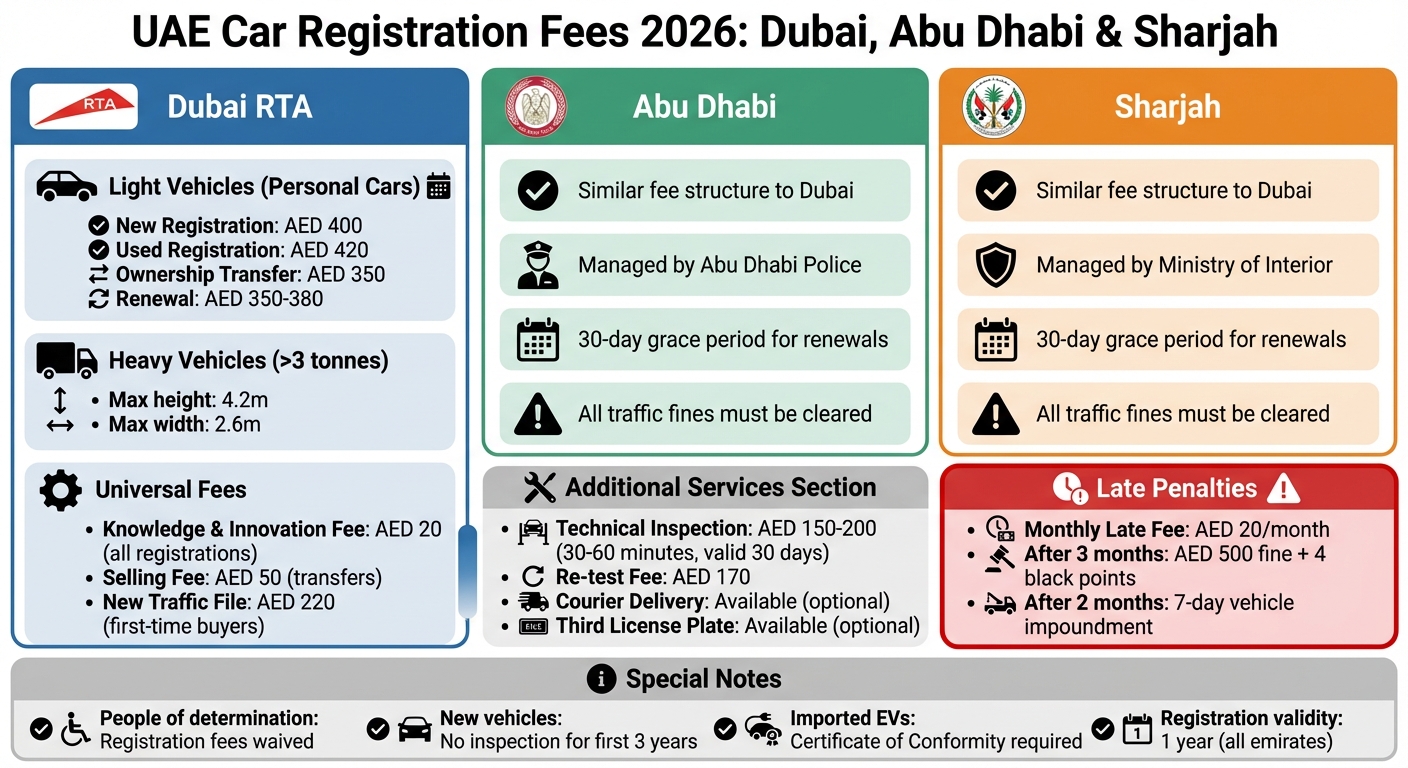
UAE Car Registration Fees by Vehicle Type and Emirate 2026
Knowing the exact costs for car registration helps you plan your budget effectively. Fees differ based on the emirate where you register and the type of vehicle. In Dubai, every registration transaction includes a mandatory Knowledge and Innovation Fee of AED 20, while ownership transfers come with an extra Selling Fee of AED 50. For individuals with determination, registration fees are waived. This waiver may also extend to one vehicle owned by a first-degree relative if the individual with determination does not own a vehicle. Below, we break down the fees for Dubai, Abu Dhabi, and Sharjah, highlighting the key differences.
Dubai RTA Fees
Dubai's registration fees vary depending on the vehicle type. For light vehicles, which include most personal cars, the costs differ compared to heavy vehicles exceeding 3 tonnes. Heavy vehicles must meet specific size limits - a maximum height of 4.2 metres and a width of 2.6 metres. If your vehicle is mortgaged, an electronic mortgage fee will apply during registration. For imported electric vehicles, a Certificate of Conformity from the Ministry of Industry and Advanced Technology is required.
Optional services are available for an additional cost. These include courier delivery of your Mulkiya and licence plates or obtaining a third licence plate for a bicycle rack. If you purchase a new vehicle from an authorised dealer, the technical inspection requirement is waived for the first three years.
Abu Dhabi and Sharjah Fees
Abu Dhabi and Sharjah follow a similar fee structure to Dubai but with slight variations. Registration in these emirates includes all standard requirements, and the one-year registration period applies uniformly. A 30-day grace period is provided for renewals. However, you must settle all traffic fines and Salik charges before completing the registration process, whether you're registering a new vehicle or renewing an existing one.
If you’re transferring a vehicle from another emirate to Dubai, you’ll need the original emirate’s Possession Certificate. For newly imported vehicles, you can choose a registration period of one, two, or three years, provided your insurance policy covers the selected duration.
Registration Differences Across Emirates
When it comes to vehicle registration in the UAE, the process can vary depending on the emirate. Each emirate operates its own system and uses specific digital platforms for managing registrations. In Dubai, the Roads and Transport Authority (RTA) oversees registrations through the RTA website, the RTA Dubai App, and the Dubai Now app. Meanwhile, Abu Dhabi handles registrations via the Abu Dhabi Police and the TAMM platform. For Sharjah and the Northern Emirates, the Ministry of Interior (MOI) systems work in conjunction with Sharjah Police and the Emirates Vehicle Gate (EVG) to facilitate the process.
Residency requirements also play a key role in determining the registration process. In Dubai, residents with visas issued by other emirates need to establish a connection to Dubai. This can include owning property (supported by an Ejari certificate), working for a company with a Dubai branch, or being an investor or partner in a Dubai-based business. On the other hand, Abu Dhabi and Sharjah generally require you to hold a visa issued by the respective emirate or maintain an active traffic file with the local authority.
Document requirements also differ between emirates, and these are not interchangeable. For instance, a Possession Certificate issued in Abu Dhabi or Sharjah cannot be used for registration in Dubai. Instead, you’ll need to obtain a new certificate from the RTA. However, technical inspection results are more flexible - Dubai typically accepts inspection results from other emirates for registration and renewal purposes.
For those under 18 registering a vehicle in Dubai, a guardian must accompany you with their original passports and Emirates IDs. While certain conformity requirements remain consistent across the UAE, the specific registration procedures and rules vary by emirate.
Common Mistakes and How to Avoid Them
Steer clear of these common errors to ensure your car registration process goes off without a hitch.
One of the most frequent issues is uncleared traffic fines. These can include speeding tickets, parking violations, or Salik charges. Remember, fines incurred in other emirates must also be settled before you can proceed. To avoid surprises, check the RTA or MOI apps at least two weeks before your registration expires.
Technical issues are another common stumbling block. Failing the inspection often catches car owners off guard. Some of the usual culprits? Tyres with a tread depth below 1.6 mm, headlights that don’t meet the 800–2,000 lumens range, or window tints that block more than 70% of light. If your car doesn’t pass, you’ll need to pay a re-test fee of AED 170. Save yourself the hassle by checking your tyres, lights, and tints before heading to the testing centre.
Don’t ignore deadlines, either. Missing the 30-day grace period will cost you AED 25–35 in monthly late fees, plus an extra AED 10 from the Ministry of Interior. Let it slide for more than two months, and you’re looking at a hefty AED 500 fine, 4 black points on your driving record, and a 7-day vehicle impoundment. A good tip? Set a reminder 45 days before your registration expires to allow time for inspections or repairs.
Administrative hiccups can also delay your application. Forgetting essential documents like bank clearance or company authorisation letters can grind the process to a halt. Make sure to request these from your bank or employer at least three days in advance. Also, if you’re trying to register in an emirate where you don’t hold a residency visa, you’ll need proof like an Ejari certificate or Trade Licence - otherwise, your application will be rejected.
For a smoother experience, use the Chrome browser (version 85 or later) for online applications. If you’re visiting a service centre, aim for Friday mornings or weekdays between 10:00 and 11:30 to avoid long queues.
Conclusion
Get your documents in order and follow the steps to register your vehicle without hassle. Having your Emirates ID, electronic insurance, and all necessary certificates ready before starting the application can help you avoid delays. Keep in mind, procedures and fees may differ slightly depending on the emirate.
Knowing the specific fees and timelines for your emirate can save both time and money. Digital platforms make the process even easier - whether it’s Dubai’s RTA, Abu Dhabi Police, or the Ministry of Interior portals, using UAE Pass ensures quick identity verification and instant service when used properly.
Don’t forget to clear all traffic fines across all emirates before applying. This single step is crucial to avoid registration delays. For non-Dubai visa holders registering in Dubai, ensure you have proof of connection to the emirate, such as an Ejari-attested tenancy contract or a Dubai trade licence.
Skip the queues by using the smart apps from RTA or MOI. With proper preparation and by following these steps, you’ll stay legally compliant and enjoy a smooth driving experience throughout the year.
FAQs
What are the consequences of missing the car registration renewal deadline in the UAE?
If you miss the deadline for renewing your car registration in the UAE, don’t panic just yet - you’re granted a 30-day grace period to renew without incurring penalties. However, if you let this period slip by, a monthly late fee (such as AED 500 in Dubai) will kick in. Things can escalate further, with fines reaching up to AED 3,000, black points added to your driving record, and even the risk of vehicle impoundment if the delay extends beyond three months.
Driving with an expired registration comes with another serious consequence: your insurance may become invalid. This means you’d be left without coverage in the unfortunate event of an accident. To steer clear of these complications, make it a priority to renew your registration on time and adhere to UAE traffic rules.
Can I register a car in Dubai if my residency visa is from another emirate?
Yes, you can register a car in Dubai even if your residency visa was issued by a different emirate. In the UAE, car registration is tied to your federal traffic file number, not the emirate listed on your visa.
Here’s how you can register your car in Dubai:
-
Vehicle inspection: Have your car inspected at an authorised testing centre (this step is skipped for brand-new vehicles).
-
Motor insurance: Get a UAE-compliant motor insurance policy under your name.
-
Required documents: Gather the necessary paperwork, including:
-
Emirates ID
-
Passport copy
-
Visa copy
-
Vehicle inspection certificate
-
Insurance certificate
-
Sale agreement (if applicable)
-
No-Objection Certificate (NOC) from the bank if the car is financed
-
-
RTA registration: Log in to the RTA portal or RTA Dubai app using UAE Pass or your login credentials.
-
Submit documents and pay fees: Upload the required documents, pay the fees (e.g., AED 20 for knowledge/innovation fees and AED 400 for light vehicle transfer), and complete the process.
-
Receive your Mulkiya: Collect your new Mulkiya (registration card) and number plates at the service centre, or opt for delivery.
As long as you have a valid federal traffic file, you can register your vehicle in Dubai using the same process as Dubai residents, regardless of where your visa originates.
What documents are required to transfer ownership of a used car in the UAE?
To transfer ownership of a used car in the UAE, make sure you have the following documents ready:
-
Emirates ID for both the buyer and seller
-
The original vehicle registration card (Mulkiya)
-
The vehicle's licence plates
-
A cleared traffic file
-
The buyer’s valid UAE driving licence
-
A current car insurance policy
-
An RTA traffic inspection certificate
-
A signed sale and purchase agreement
-
If applicable, a Power of Attorney if the seller is represented by someone else
It’s crucial to double-check that all documents are accurate and up-to-date to avoid any unnecessary delays. The transfer process must be completed at an authorised RTA service centre or via approved online platforms.
Looking for a used car in Dubai or new car deals? Explore YallaMotor’s verified listings today.