Key Takeaways
-
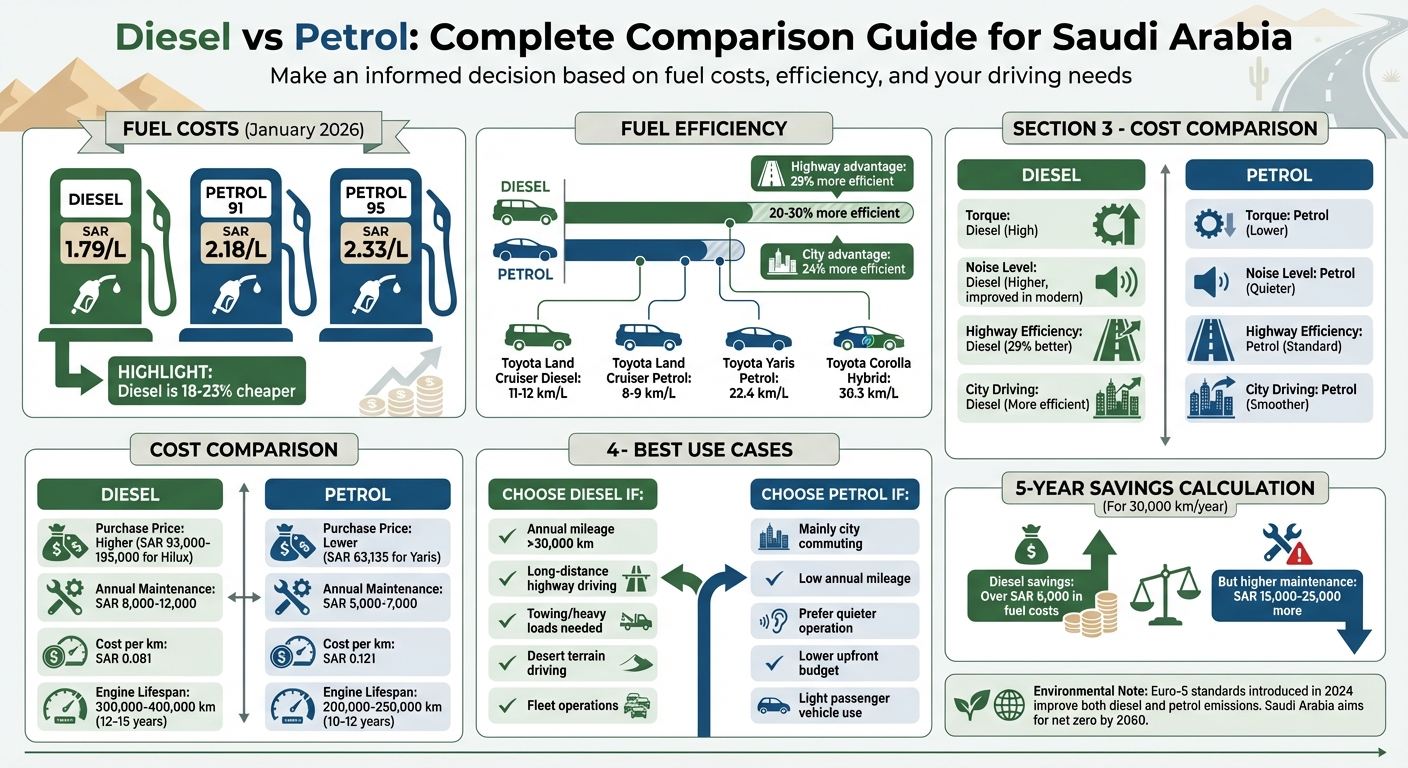
Fuel Costs (Jan 2026): Diesel is cheaper at AED 1.79/L, compared to Petrol 91 (AED 2.18/L) and Petrol 95 (AED 2.33/L).
-
Fuel Efficiency: Diesel engines are 20–30% more efficient than petrol, especially on highways.
-
Purchase Price: Diesel vehicles cost more upfront but save money over time for high-mileage drivers.
-
Maintenance: Diesel engines are costlier to maintain but last longer, handling 300,000–400,000 km vs petrol's 200,000–250,000 km.
-
Driving Style: Diesel suits long-distance and heavy-duty use, while petrol is better for city driving and quieter operation.
-
Environmental Standards: Euro-5 fuels introduced in Saudi Arabia improve emissions and fuel efficiency.
Quick Comparison
|
Factor |
Diesel |
Petrol |
|---|---|---|
|
Fuel Price |
AED 1.79/L |
AED 2.18–2.33/L |
|
Fuel Efficiency |
20–30% better for long trips |
Lower, but hybrids excel |
|
Best Use Case |
Long-distance, towing |
City commuting, low mileage |
|
Purchase Cost |
Higher upfront |
Lower upfront |
|
Maintenance |
Higher cost, longer lifespan |
Lower cost, shorter lifespan |
|
Driving Experience |
More torque, noisier |
Smoother, quieter |
Diesel cars are ideal for drivers covering long distances or needing power for towing. Petrol cars are more affordable initially and better for urban use. Choose based on your driving habits and priorities.
Diesel vs Petrol Cars in Saudi Arabia: Cost, Efficiency & Performance Comparison
PETROL vs DIESEL:KEY DIFFERENCES AND BEST ENGINE FOR YOU #car #engine
Fuel Efficiency Comparison
Diesel engines make better use of fuel, extracting 10–15% more energy per litre compared to petrol. This efficiency translates into diesel vehicles offering 20–30% better fuel economy than their petrol counterparts. On highways, the gap becomes even more noticeable - diesel engines are about 29% more efficient, while in city driving, they maintain a 24% advantage.
In Saudi Arabia, with its extensive 75,000 km road network connecting cities like Riyadh, Jeddah, and Dammam, this efficiency can mean substantial savings. Take the example of the Toyota Land Cruiser V6: the diesel version averages 11–12 km/L, whereas the petrol variant achieves only 8–9 km/L. These numbers highlight the practical benefits of diesel in long-distance driving, setting the stage for further comparisons in real-world mileage performance.
Mileage Analysis
The mileage advantage of diesel engines is particularly noticeable in larger vehicles like SUVs and pickups. For instance, while petrol sedans such as the Toyota Yaris deliver solid fuel economy - about 21.7 km/L in the city and 25.6 km/L on highways - diesel engines in larger vehicles often surpass these figures. This is thanks to the compression ignition system in diesel engines, which delivers higher thermal efficiency.
For drivers covering over 30,000 km annually, diesel's superior mileage can offset its higher initial cost. However, in urban environments, frequent stops and challenges like diesel particulate filter (DPF) clogging can reduce the advantage.
Impact of Fuel Standards
Fuel standards play a crucial role in improving efficiency. The introduction of Euro-5 compliant petrol and clean diesel in Saudi Arabia has significantly enhanced both fuel efficiency and emissions performance. These advancements have transformed diesel engines, once known for their noise and smoke, into a cleaner and more refined option that aligns with Saudi Arabia's Vision 2030 environmental goals. Cleaner diesel now burns more thoroughly, reducing soot and particulate emissions, while Euro-5 petrol improves engine performance and lowers harmful emissions. These developments not only boost efficiency but also support the Kingdom’s sustainability efforts.
Here’s a quick look at some key fuel economy figures:
|
Vehicle Model |
Fuel Type |
Average Fuel Economy (km/L) |
|---|---|---|
|
Toyota Land Cruiser (V6) |
Petrol |
8–9 |
|
Toyota Land Cruiser (V6) |
Diesel |
11–12+ |
|
Toyota Yaris (1.3L) |
Petrol |
22.4 |
|
Hybrid |
30.3 |
Cost Analysis: Purchase, Fuel, and Maintenance
Purchase Price Differences
Diesel vehicles typically come with a higher upfront cost due to their advanced components like turbochargers, high-pressure fuel injection systems, and reinforced parts. These features, designed to handle higher compression levels, increase manufacturing costs. In the 2024 Saudi market, this price difference is clear. For example, the Toyota Hilux diesel is priced between SAR 93,000 and SAR 195,000, whereas more economical petrol models like the Toyota Yaris start at approximately SAR 63,135. Similarly, the Mitsubishi L200 diesel starts at around SAR 81,000, while a petrol alternative like the MG5 begins at about SAR 50,485. While diesel cars require a larger initial investment, they often offer savings over the long term, particularly for frequent drivers.
Fuel Costs Over Time
Diesel's lower price per litre - SAR 1.79 - translates into notable savings over time. As of January 2026, diesel is about 18% cheaper than Gasoline 91 (SAR 2.18 per litre) and 23% cheaper than Gasoline 95 (SAR 2.33 per litre). For those covering substantial distances, such as over 1,500 km monthly, the cost advantages are significant. A diesel vehicle with a fuel efficiency of 22 km/L costs SAR 0.081 per km, while a petrol vehicle averaging 18 km/L costs SAR 0.121 per km. Over five years, assuming an annual mileage of 30,000 km, the savings can exceed SAR 6,000 - a meaningful offset to the higher purchase price for high-mileage drivers.
That said, diesel prices have been climbing steadily. In 2024, diesel saw a 53% increase, followed by a 44% rise in early 2025, reaching SAR 1.66 before settling at SAR 1.79 in January 2026. Saudi Aramco’s annual diesel price adjustments, introduced in 2022, have consistently driven up costs, while petrol prices have remained relatively steady. This narrowing price gap makes it important to weigh diesel's longevity and maintenance costs when evaluating total ownership expenses.
Maintenance and Durability
Maintaining a diesel vehicle is more expensive, with annual servicing costs ranging from SAR 8,000 to SAR 12,000, compared to SAR 5,000 to SAR 7,000 for petrol vehicles. Diesel engines require larger quantities of heavy-duty oil - up to 8 quarts versus 5 quarts for petrol - and more frequent replacement of parts like fuel filters. Diesel oil and filters can cost 20% to 50% more than their petrol equivalents.
"The only differences are oil changes will cost more on a diesel vehicle due to a higher oil capacity and fuel filters have to be changed more often than on a gas vehicle." – L.G. Brandon
Diesel engines also incorporate specialised components such as turbochargers, high-pressure injectors, and diesel particulate filters (DPF), all of which are costly to repair or replace. Additionally, modern diesel engines often require Diesel Exhaust Fluid (AdBlue) to comply with emissions standards, adding another recurring expense.
However, diesel engines are built to last. While petrol engines typically run for 10–12 years and cover 200,000 to 250,000 km, diesel engines can last 12–15 years and handle 300,000 to 400,000 km. For those planning to keep their vehicles long-term, this durability can make the higher maintenance costs worthwhile. That said, resale trends are shifting. In 2025, petrol and hybrid vehicles gained traction as emissions regulations tightened, potentially impacting the resale value of diesel cars.
Performance and Driving Experience
Torque and Towing Capability
Diesel engines excel when it comes to generating low-end torque, which is crucial for towing and hauling heavy loads. This makes them a go-to option for drivers who frequently transport heavy cargo or tackle Saudi Arabia's rugged desert landscapes. Vehicles like the Toyota Hilux and Mitsubishi L200 are specifically designed to handle challenging towing tasks and off-road conditions. Meanwhile, the Toyota Fortuner stands out as another diesel-powered favourite, pairing its high ground clearance with a capable four-wheel-drive system that takes full advantage of diesel torque for adventurous terrains.
One of diesel’s key strengths is its ability to deliver substantial power with smaller engine displacement. For instance, to match the output of a 6-litre diesel engine, a petrol engine would typically need to be around 8 litres. While petrol engines perform adequately in lighter passenger vehicles, they fall short in delivering the low-end pulling power that diesel engines provide. This difference highlights the unique advantages of diesel, especially for demanding tasks, compared to petrol engines, which are better suited to urban settings.
Urban vs. Highway Driving
Petrol cars shine in busy city environments like Riyadh and Jeddah, where stop-and-go traffic requires smooth and quick acceleration. Compact models such as the Toyota Yaris (starting at SAR 63,135) and Mitsubishi Space Star are perfect for navigating narrow city streets. Their lighter build offers effortless handling, especially during rush hour.
On the other hand, diesel vehicles dominate on Saudi Arabia’s extensive 75,000 km road network, where highway efficiency is a priority. Diesel engines are 29% more fuel-efficient on highways and 24% more efficient in city driving compared to petrol engines. For drivers who frequently travel long distances between provinces, diesel provides a winning combination of better highway mileage and lower running costs, translating to noticeable savings. With SUVs making up 35% of vehicle sales in the Kingdom, many drivers are drawn to diesel for its long-distance reliability and cost-effectiveness. While performance is crucial, comfort also plays a significant role in the driving experience.
Noise and Vibration
Comfort is another factor that can influence the choice between diesel and petrol. Petrol engines, which use spark plug ignition, tend to run quieter and smoother at idle and low speeds compared to diesel engines, which rely on a high-compression process. For commuters navigating busy city centres, this quieter operation can make a significant difference in overall cabin comfort.
That said, advancements in diesel technology have significantly reduced the noise and vibration associated with older diesel engines. Modern "clean diesel" engines now offer a driving experience that’s much closer to that of petrol vehicles. While early diesel models were often criticised for their loud, clattering sounds, today’s diesel vehicles provide a level of refinement that’s acceptable for daily use. Ultimately, the choice between diesel and petrol comes down to your driving habits - whether you prioritise urban smoothness or highway efficiency with the added benefit of towing capability.
|
Feature |
Diesel Engines |
Petrol Engines |
|---|---|---|
|
Torque |
High (great for towing/off-road) |
Lower (better for light acceleration) |
|
Best Use Case |
Long-distance, towing, desert terrain |
Urban commuting, city driving |
|
Highway Efficiency |
29% higher than petrol |
Standard |
|
Driving Experience |
Higher vibration (improved in modern models) |
Smoother and quieter, ideal for cities |
|
Fuel Cost (Jan 2026) |
SAR 1.79/litre |
SAR 2.18 - SAR 2.33/litre |
Environmental and Regulatory Factors in Saudi Arabia
In Saudi Arabia, environmental regulations are becoming a key factor in shaping vehicle choices, alongside fuel efficiency and cost. As part of the Vision 2030 sustainability agenda, the Kingdom is taking strides to promote cleaner transportation. In February 2024, the Ministry of Energy introduced Euro-5 compliant gasoline and clean diesel to the Saudi market. These fuels aim to significantly cut emissions, aligning with the Kingdom's goal of achieving net zero by 2060.
The transportation sector, which accounts for 21% of Saudi Arabia's CO2 emissions, is a major focus for these reforms. Such measures not only improve air quality but also impact the long-term cost-effectiveness and practicality of petrol and diesel vehicles. To tackle this, the Kingdom has rolled out Corporate Average Fuel Economy (CAFE) standards for light-duty vehicles, with the third phase set to begin in 2024. Since their introduction, these standards have improved fuel economy by about 16%. Additionally, the Saudi Label and Standard (SL&S), mandatory since 2014 and updated in 2018, helps consumers make informed choices by identifying vehicles that meet national fuel efficiency criteria.
In a noteworthy move, Red Sea Global (RSG) became the first Saudi company to fully transition its land delivery fleet to electricity or low-carbon biofuel derived from used cooking oil in January 2024. This shift reduced emissions from 2.7 kg CO2e per litre to just 0.17 kg CO2e per litre. While diesel remains vital for heavy-duty logistics - especially in the desert where it performs reliably under extreme heat and dusty conditions - the push for cleaner alternatives is evident.
For consumers and fleet operators, the message is clear: prioritising vehicles that meet the latest Euro-5 standards ensures lower emissions and compliance with regulations. For those managing long-haul transport in remote areas, diesel's reliability remains a strong advantage. However, keeping an eye on new aerodynamic device specifications for highway trucks - designed to further cut fuel consumption - will be essential. These evolving standards are reshaping vehicle performance expectations and influencing purchasing decisions across the Kingdom.
Which to Choose?
When deciding between diesel and petrol, consider your driving habits and needs. If you cover long distances or frequently haul heavy loads, diesel is the way to go. At AED 1.66 per litre, compared to AED 2.18–2.33 per litre for petrol, diesel offers noticeable savings for high-mileage drivers. Plus, diesel's higher energy density means fewer stops for refuelling during extended trips.
For city drivers, the story changes. Here, petrol vehicles shine with lower upfront costs and quieter engines. If your annual mileage is low and your drives are mainly urban, petrol is the practical choice. Compact petrol models like the Toyota Yaris deliver about 22.4 km per litre, while hybrids like the Toyota Corolla Hybrid can push efficiency up to 30.3 km per litre - helping to balance out the higher fuel price for those who drive less.
Here’s a quick breakdown of the important differences:
|
Factor |
Diesel |
Petrol |
|---|---|---|
|
Fuel Price (Jan 2026) |
AED 1.66/L |
AED 2.18–2.33/L |
|
Best For |
Long-distance driving, towing, fleets |
City commuting, low annual mileage |
|
Key Advantage |
Lower fuel cost and high torque |
Lower initial purchase price and quieter operation |
|
Typical Efficiency |
Better highway mileage |
Up to 30.3 km/L (in hybrids) |
|
Starting Price Range |
AED 74,000–98,000 (pickups/SUVs) |
AED 49,200–68,800 (sedans) |
Diesel vehicles are built for endurance and power. Models like the Toyota Hilux (starting at AED 93,000) and Mitsubishi L200 (from AED 81,000) are ideal for towing and heavy-duty tasks. On the other hand, petrol cars are better suited for short commutes and daily errands. They’re easier on the wallet upfront and offer smoother performance in city traffic, without some of the extra maintenance that comes with diesel engines.
Whichever you choose, keeping your vehicle well-maintained and monitoring fuel consumption are key to getting the most out of your investment. Use this guide alongside the detailed efficiency and cost analyses above to make an informed decision.
FAQs
What are the long-term cost advantages of owning a diesel car in Saudi Arabia?
Owning a diesel car in Saudi Arabia can be a smart financial move, especially when you look at the numbers. Diesel fuel is priced at around 1.66 SAR per litre, which is noticeably cheaper than gasoline, typically ranging between 2.18 and 2.33 SAR per litre. Combine this with the fact that diesel engines generally offer better fuel efficiency, and you’ve got a recipe for cutting down on fuel costs in the long run.
But the benefits don’t stop there. Diesel engines are known for their durability and often require less frequent refuelling, which is a huge plus for those who drive long distances or rely on their vehicles for heavy-duty tasks. That said, it’s worth taking a closer look at your own driving habits and maintenance preferences to determine if a diesel car is the right fit for your needs.
How do environmental regulations in the GCC affect the choice between diesel and petrol vehicles?
Environmental regulations in the GCC significantly influence the choice between diesel and petrol vehicles, as both must adhere to stringent emission standards. Light vehicles are required to meet Euro 5 standards, while heavy-duty diesel engines face even stricter Euro V limits. To comply, diesel cars often need advanced systems like diesel particulate filters and catalytic converters. While these technologies help reduce emissions, they also increase the upfront price and ongoing maintenance costs compared to petrol vehicles.
Diesel engines do offer an advantage by producing about 20% less CO₂ than petrol engines. However, they face tougher restrictions on nitrogen oxides (NOx) and particulate matter, making them less appealing unless equipped with expensive clean technologies. Recent efforts across the GCC to promote cleaner, lower-emission fuels further shape these dynamics, often making petrol vehicles the more budget-friendly option for many buyers. These regulations not only steer manufacturers in vehicle design but also play a big role in shaping consumer decisions by weighing environmental priorities against cost considerations.
What should city drivers in the UAE consider when choosing between diesel and petrol cars?
When choosing between a diesel or petrol car for city driving in the UAE, it's essential to think about fuel cost and efficiency. Diesel is usually less expensive per litre locally and offers about 15-20% better fuel efficiency. That said, petrol engines - especially in smaller cars - still deliver great mileage for shorter trips. Plus, they tend to be quieter, which many city drivers appreciate.
Your performance needs are another key factor. Diesel engines excel in providing strong low-end torque, making them perfect for carrying heavy loads or handling frequent stop-and-go traffic. On the other hand, petrol engines offer smoother acceleration, making them a better fit for lightweight or sporty city cars. They also generally come with lower maintenance costs, whereas diesel vehicles may need pricier servicing as they age.
By considering fuel prices, how you drive, and the long-term costs of upkeep, you can pick the car type that aligns best with your city lifestyle and budget.
Looking for a used car in KSA or new car deals? Explore YallaMotor’s verified listings today.