If I were buying my first EV in the UAE or Saudi Arabia today, I’d check three things first: approval, home charging cost, and how the battery will cope with summer heat. That’s the part that shapes daily use far more than the car brochure.
Here’s the short version:
In Dubai, I need a DEWA-approved contractor before home charger installation.
In Saudi Arabia, I need to apply through SEC and use a qualified installer.
Home charging is far cheaper than public charging in the UAE:
Home: AED 0.23–0.38/kWh
DEWA public AC: AED 0.70/kWh + VAT
DEWA public DC: AED 1.20/kWh + VAT
A 60 kWh battery costs about AED 13.80–22.80 to charge at home in the UAE.
A standard socket is slow and suits light use only.
A 7–11 kW wallbox is the setup most first-time owners will want for overnight charging.
Summer heat can cut range by 10%–25%, depending on speed and conditions.
Shade, pre-cooling while plugged in, and sensible A/C use help limit heat strain.
If I had to sum up the article in one line, it would be this: get permission first, pick the right charger for your parking and power supply, know your tariff, and treat summer heat as part of EV ownership in the GCC.
A few numbers stand out:
Home charging in the UAE costs about AED 45 per 1,000 km
A petrol car for the same distance costs about AED 275–280
That’s up to 84% less
Installation in the UAE often starts from around AED 1,300, before any extra wiring work
A wallbox installation in Dubai usually takes about 2–3 hours for a standard setup
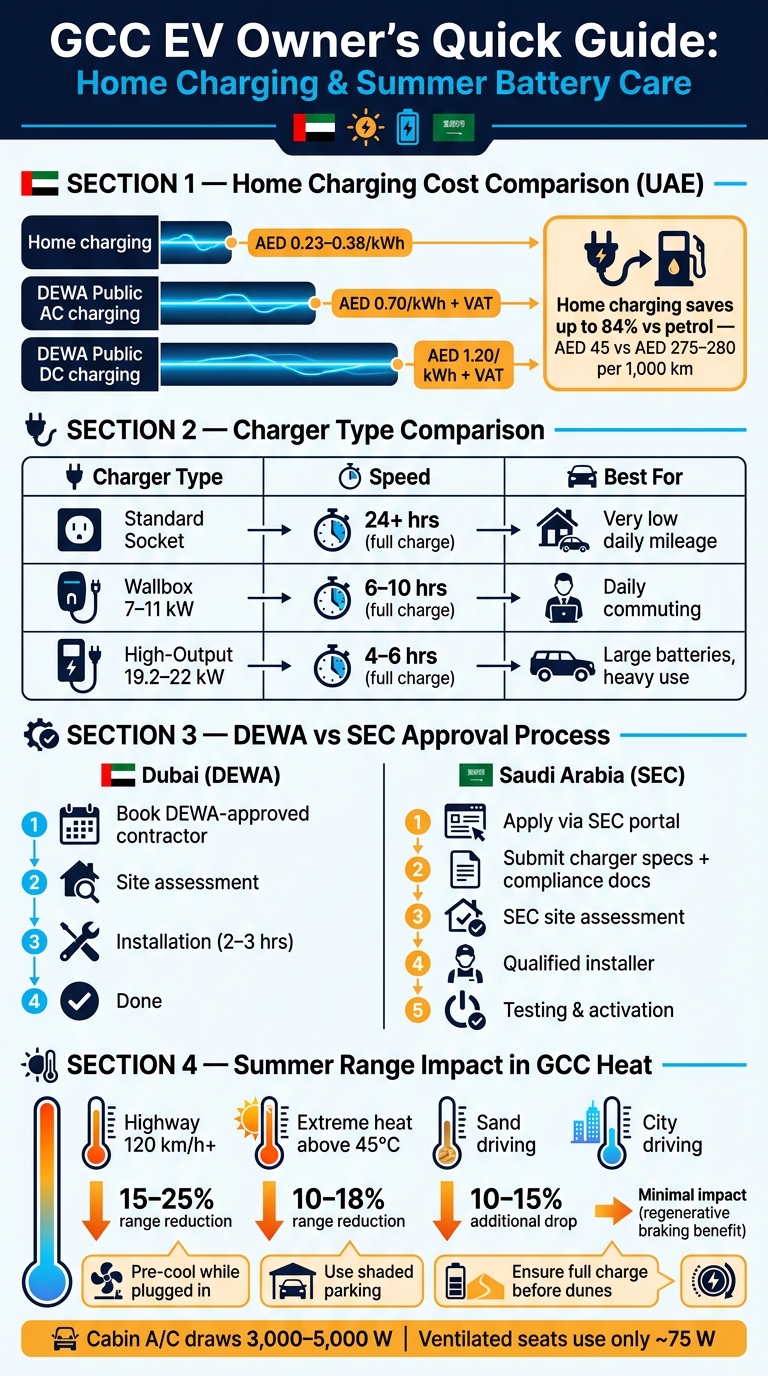
GCC EV Home Charging: Costs, Charger Types & Summer Range Impact
Quick comparison
Topic | Dubai (DEWA) | Saudi Arabia (SEC) |
|---|---|---|
Approval route | Through approved contractor | Through SEC customer portal |
Installer rule | DEWA-approved contractor | Qualified installer |
Typical home charging cost | AED 0.23–0.38/kWh | Depends on local tariff |
Public charging reference in article | AED 0.70/kWh AC, AED 1.20/kWh DC + VAT | Not covered in the same way |
Likely first charger choice | 7–11 kW wallbox for most homes | 7–11 kW wallbox for most homes |
Main summer concern | Tariff slab + A/C load + heat | Heat + home electrical capacity |
That’s the full picture in simple terms. If I’m planning my first EV setup in the GCC, these are the checks I’d make before I buy the charger or book the installer.
DEWA and SEC home charger setup: approvals, documents, and installation steps

Before you order a charger or book an electrician, you need utility approval. In Dubai and Saudi Arabia, the route is different, but the logic is the same: get clearance first, then install. For first-time EV owners, this is the point where home charging moves from a rough idea to a plan you can actually act on.
Here’s how the process works in each market.
How to set up a home charger with DEWA in Dubai
DEWA requires all home EV charger installations to be carried out by a DEWA-approved contractor. So before you buy a charger, check that your installer is on DEWA’s approved list. That small check can save you time, money, and a fair bit of back-and-forth later.
The process usually starts with a site assessment. This helps confirm what the job includes and whether anything extra is needed. In Dubai, a standard installation usually includes a 5 m cable, isolator, and circuit breaker. The on-site work usually takes about 2 to 3 hours, so it’s smart to make sure your quote includes those core items from the start.
How to set up a home charger with SEC in Saudi Arabia
In Saudi Arabia, the application goes through the SEC customer portal. You’ll need to submit your site details along with the technical specifications of the charger you plan to install. You may also need to upload compliance documents to show that the charger meets local standards.
After SEC reviews the application, it arranges a site assessment. The physical installation must be done by a qualified installer, so self-installation is not allowed. If you live in a villa, there’s a chance your electrical panel may need an upgrade to handle the extra load before the charger can be connected. Once the installation is done, SEC carries out testing and activation.
DEWA vs SEC process: side-by-side comparison
Feature | DEWA (Dubai, UAE) | SEC (Saudi Arabia) |
|---|---|---|
Primary authority | Dubai Electricity and Water Authority (DEWA) | Saudi Electricity Company (SEC) |
Application route | Through a DEWA-approved contractor | Through the SEC customer portal |
Contractor requirement | Must use a DEWA-approved contractor | Must use a qualified installer |
Required information | Property/site details and contractor approval | Site details, charger technical specifications, compliance documents |
Site assessment | Included in the contractor's installation process | Arranged by SEC after application review |
Final step | Installation completed by the DEWA-approved contractor | Testing and activation after installation |
Once you have approval sorted, the next move is picking the charger type that matches your parking setup and electrical load.
Choosing a home charger: socket charging, wallbox specs, and installation decisions
With approval sorted, the next step is choosing the charger.
Standard socket vs dedicated wallbox: what to know
The right setup comes down to three things: how much you drive each day, where you park, and how fast you need the car ready again.
A standard household socket works for light overnight top-ups. But let's be honest: it’s slow. It suits low daily mileage and little else.
A dedicated wallbox changes the picture. A standard 7–11 kW unit can usually deliver a full charge in about 6–10 hours, which makes overnight charging easy while you sleep. Higher-output wallboxes are faster again, but they need a stronger power supply and proper installation.
The main trade-off is simple: speed, safety, and what your building can support.
Charging Method | Speed | Safety | Best For |
|---|---|---|---|
Standard household socket | Very slow (24+ hours for a full charge) | Low – cable heat/overload risk | Very low daily mileage or temporary use |
Wallbox (7–11 kW) | Fast (6–10 hours for a full charge) | High – dedicated circuit | Daily commuting, villa or apartment with permission |
Higher-output wallbox (19.2–22 kW) | Very fast (4–6 hours for a full charge) | High – three-phase supply | Large batteries and heavy daily use |
Villa parking, apartment bays, and shared-residential constraints
Villa parking is usually the simplest case. In many homes, you can install a wallbox directly, assuming the electrical setup can handle it.
Apartment parking and shared bays are a different story. You’ll often need building approval, checks on cable routing, and permission for any work that touches shared areas. That can slow things down, even when the charger itself is straightforward.
Once the charger type is fixed, the next question is what it will cost to run.
Electricity tariffs and home charging costs in the UAE and Saudi Arabia
Once you've picked the charger, the next thing most people look at is the monthly bill. And that makes sense. Home charging shows up on your residential electricity bill, so the total cost depends on two things: how often you charge and which usage band your home falls into.
How residential tariffs affect your EV charging bill
Residential tariffs can have a big effect on what you pay to charge an EV at home. If your household electricity use goes up, your account may move into a higher tariff slab. That matters even more in summer, when air-conditioning is already pushing consumption up.
In Dubai, residential rates can shift from about AED 0.23 per kWh to AED 0.38 per kWh as usage rises. So before installing a charger, it's worth checking your recent DEWA or SEC bills. That gives you a clearer picture of where your home sits now and how much extra load the EV is likely to add.
Worked examples: full-charge cost and cost per 100 km
In the UAE, home charging costs about AED 45 per 1,000 km, while a petrol car costs roughly AED 275–280 for the same distance. That works out to savings of up to 84%.
For a 60 kWh battery, a full home charge costs about AED 13.80–22.80, depending on the tariff slab.
Home charging cost by battery size
These are indicative figures only. Actual costs change based on tariff band and total household usage.
The same battery-size method can be used for Saudi Arabia, though the final bill will depend on the local tariff and usage level.
Battery Size | Est. Full Charge Cost - UAE Home (AED) | Est. Full Charge Cost - KSA Home (SAR) |
|---|---|---|
40 kWh | AED 9.20 – 15.20 | SAR 6.98 |
60 kWh | AED 13.80 – 22.80 | SAR 10.46 |
80 kWh | AED 18.40 – 30.40 | SAR 13.95 |
In GCC summer, heat can shape charging habits just as much as price.
Summer battery care in GCC heat: charging habits, parking, and long-term battery health
Heat affects both range and charging efficiency, so your summer routine matters just as much as what you pay to charge.
Charging habits to follow during summer
Pre-cool the cabin while the car is plugged in.
Parking, pre-conditioning, and managing heat exposure
Shade or covered parking can make a clear difference. Direct sun heats the cabin fast, which puts more strain on the cooling system and cuts into usable range. In plain terms, the hotter the car gets while parked, the more energy it needs later just to get back to a safe and comfortable temperature.
Set a departure time in the app so the cabin starts cooling while the car is still plugged in. That way, the battery is not doing all the heavy lifting once you begin driving. On the road, it also helps to ease off extreme cabin cooling when possible. Ventilated seats can take some pressure off the A/C system and use far less power. Cabin A/C can draw 3,000 W–5,000 W; ventilated seats use about 75 W.
These are the summer conditions GCC owners notice most.
Condition | Range Impact (GCC Summer) | Recommended Action |
|---|---|---|
City driving | Minimal / Positive (Regen) | Standard charging habits |
Highway at 120 km/h+ | 15%–25% Reduction | Lower speed; pre-cool while plugged in |
Extreme heat above 45 °C | 10%–18% Reduction | Use shaded parking; pre-condition cabin |
Sand driving | 10%–15% Additional Drop | Ensure full charge before entering dunes |
You may also notice slower fast-charging sessions in peak heat, along with a sharp drop in estimated range when the A/C first kicks in.
Conclusion: key checks before you buy and plug in
These habits help protect range, cut heat strain, and keep home charging more predictable.
FAQs
Do I need landlord or building approval for a home charger?
It’s not stated outright here, but installing a home EV charger usually means making changes to the electrical setup. So, it’s smart to check with your landlord or building management first.
You should also confirm any installation rules or formal approvals with your utility provider, such as DEWA in the UAE or local service providers in Saudi Arabia.
Will EV charging push my home into a higher tariff slab?
Yes. In the UAE, DEWA residential electricity follows a slab-based tariff. That means adding a home charger can push your monthly electricity use higher, and part of that extra use may fall into a more expensive tier.
Even with that, charging at home is still usually the lowest-cost option compared with public charging. In many cases, it costs about AED 0.23 to AED 0.38 per kWh.
Should I charge my EV to 100% every day in summer?
No. Don’t charge your EV to 100% every day, especially during the GCC’s harsh summer heat.
A full charge gives you the most range, sure. But leaving the battery at 100% for long periods isn’t great for battery health.
For day-to-day driving, it’s better to charge to a lower level that suits your routine instead of filling it up every time. And once it reaches full charge, unplug it rather than leaving it connected.