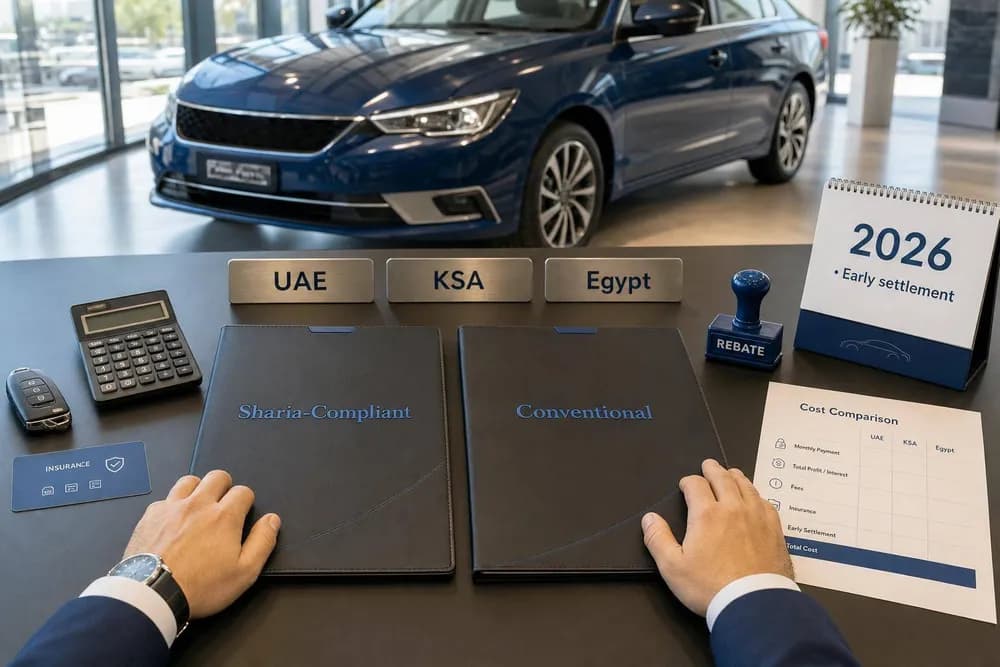
The short answer: I would not judge car finance by the monthly instalment. I would judge it by the total amount payable. In 2026, that means adding the down payment, bank fee, insurance or takaful, settlement charges, and any rate gap across the full term in the UAE, KSA, and Egypt.
Here’s the core takeaway in plain terms:
In the UAE, both Islamic and conventional offers can look almost the same on paper. On a AED 100,000 car over 60 months, the monthly instalment may match, but upfront cash, insurance, and settlement terms still change the final bill.
In KSA, Islamic car finance can sometimes price lower than conventional, especially with salary transfer and lower admin fees.
In Egypt, even a 3% rate gap on EGP 800,000 over 48 months can add about EGP 55,200 to the total cost.
With Murabaha, profit is fixed from day one. With Ijara, the bank owns the car during the lease. With a conventional loan, you borrow cash and pay interest on the balance left.
Early settlement rules matter. In the UAE, conventional settlement is often capped at 1% of the balance, while some Islamic banks charge 1.05% of principal outstanding.
Insurance is a big cost. On a AED 100,000 car, 2%–4% a year can mean up to AED 20,000 across 5 years.
If I were comparing offers, I would check these points first:
Total amount payable
Down payment
Flat rate vs reducing rate
Bank or admin fee
Insurance / takaful cost
Early settlement terms
Late-payment charges
Used-car fees, if the car is not new
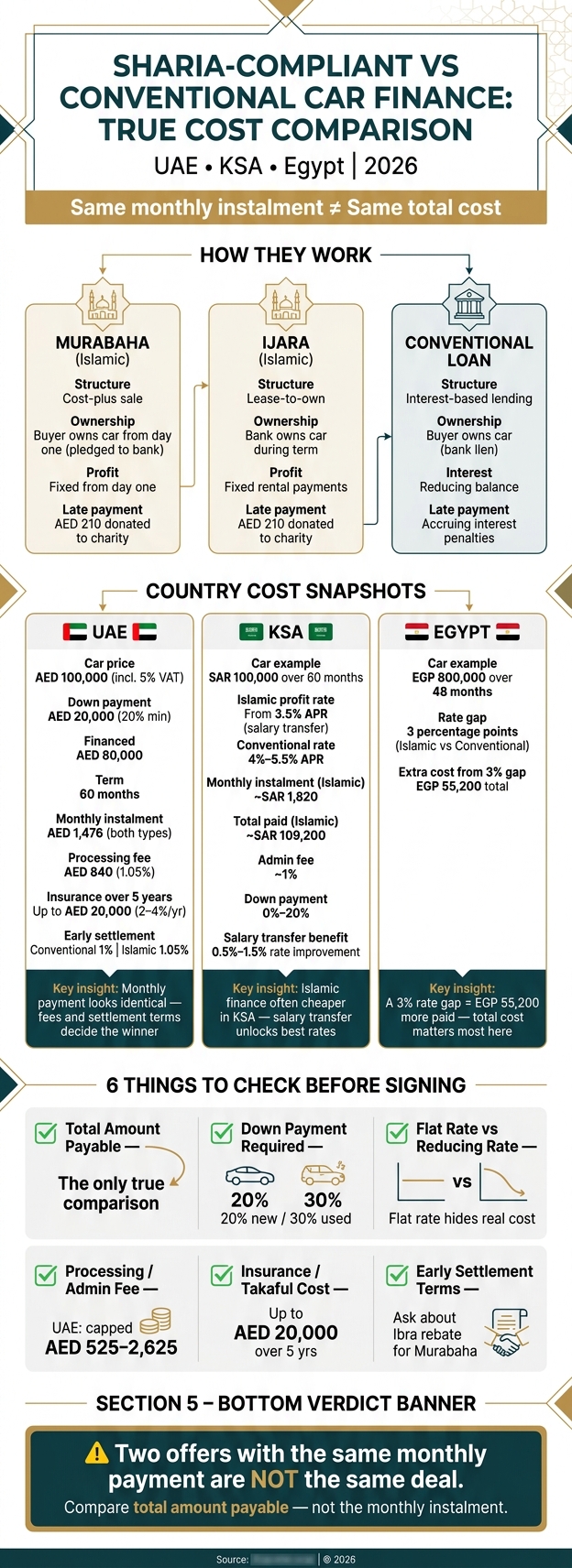
Sharia-Compliant vs Conventional Car Finance: True Cost Comparison UAE, KSA & Egypt 2026
Is Car Financing Halal or Haram? A DETAILED Breakdown
Quick Comparison
Market / Finance Type | Main thing I would watch | Cost pressure point |
|---|---|---|
UAE Islamic | Profit rate, processing fee, takaful, Ibra on early closure | Fees and settlement terms |
UAE Conventional | Reducing-rate math, processing fee, insurance, early settlement cap | Rate format and insurance |
KSA Islamic | Salary transfer, admin fee, down payment | Deal setup can shift final cost |
KSA Conventional | APR, admin fee, debt-burden rule | Rate plus eligibility |
Egypt Islamic / Conventional | Rate spread over full term | Total paid can move fast with small rate gaps |
My view is simple: if two offers have the same monthly number, they are still not the same deal. I would line up every charge, convert rates to the same basis, and pick the eligible option with the lowest total payable.
How Sharia-compliant and conventional car finance work
The main difference comes down to structure. Islamic car finance is based on an asset deal, while a conventional car loan is a borrowing deal. That affects who owns the car, how payments are handled, and what happens if you pay late. And yes, that structure can change your total cost, not just your monthly instalment.
Murabaha and Ijara explained plainly
Murabaha is a cost-plus sale. The bank buys the car first, then sells it to you at an agreed profit that is fixed from day one.
With Murabaha, you usually become the owner of the car straight away. But the car stays pledged to the bank as collateral until you make the final payment. Once the finance is settled, that pledge is removed and the car is fully yours without restriction.
Ijara takes a different route. The bank buys the car and leases it to you for rent, while staying the legal owner during the finance term. The bank keeps the title until the last payment is made. Ownership then moves to you at the end of the lease, usually for a nominal fee.
Those setup differences are what shape the total amount you pay. Here’s how that plays out in the points most buyers compare.
Feature | Murabaha | Ijara | Conventional loan |
|---|---|---|---|
Legal basis | Cost-plus sale | Lease-to-own | Interest-based lending |
Who owns the car during the term | Buyer, with the car pledged to the bank | Bank (lessor) | Buyer, with a bank lien |
Ownership transfer | Pledge released at final payment | Title transferred at end of lease | Lien removed at full settlement |
How profit/interest is calculated | Fixed profit margin on the original cost | Fixed rental payments | Interest on a reducing balance |
Late payment treatment | Late charge is donated, not kept by the bank | Late charge is donated, not kept by the bank | Late fees stay with the lender, and unpaid balances keep accruing interest |
Conventional fixed-rate and reducing-balance loans
A conventional car loan gives you the money to buy the vehicle, and you own it from the start while the car is registered as security. Interest is usually charged on a reducing-balance basis. That means it is worked out each month on the amount you still owe, so the interest part of each instalment gets smaller as the balance comes down.
One thing worth checking: ask if the quote is shown as a flat rate or a reducing rate. A flat-rate headline can make the deal look cheaper than it is.
Table 1: Upfront costs, monthly instalments and total amount paid
The tables below compare the costs that change the final bill.
In the UAE, you need to convert flat-rate quotes to a reducing-rate equivalent before you compare offers. That matters more than many buyers think. The Central Bank requires a minimum 20% down payment for new cars and 30% for used cars, with maximum tenures of 60 months and 48 months respectively. Processing fees are usually 1.05% of the financed amount, capped between AED 525 and AED 2,625. On top of that, plan for about AED 400–700 in registration costs upfront.
UAE example: new car finance benchmark
| Conventional loan | |
|---|---|---|
Vehicle price (incl. 5% VAT) | AED 100,000 | AED 100,000 |
Down payment | AED 20,000 (20%) | AED 20,000 (20%) |
Financed amount | AED 80,000 | AED 80,000 |
Profit / interest rate | 2.134% flat p.a. | 2.134% flat p.a. |
Term | 60 months | 60 months |
Processing fee | AED 840 (1.05%) | AED 840 (1.05%) |
Registration | AED 400–700 | AED 400–700 |
Monthly instalment | AED 1,476 | AED 1,476 |
Total profit / interest paid | AED 8,536 | AED 8,536 |
Total finance paid | AED 88,536 | AED 88,536 |
Total upfront cash required | AED 21,240–21,540 | AED 21,240–21,540 |
These UAE figures are based on the Central Bank's down-payment and tenure rules, along with the processing-fee structure commonly used in local car finance.
That’s why the monthly instalment on its own is not enough. Two offers can show the same monthly payment and still leave you paying a different amount overall once fees and approval rules are added in.
The same idea applies in KSA and Egypt. The difference is that fees and eligibility rules can shift the final cost even more than the headline rate.
KSA and Egypt examples using the same comparison logic
Once the UAE picture is clear, the next step is to see how local pricing and approval rules change the total in KSA and Egypt.
In KSA, Islamic finance profit rates can start from about 3.5% APR for salary-transfer customers, while conventional offers are often around 4% to 5.5% APR. Banks usually charge about 1% admin fees, and 0% to 20% down may be possible depending on the customer profile. Total monthly debt must also stay below 45% of salary. In Egypt, the rate gap has a much bigger effect on the final bill: on EGP 800,000 financed over 48 months, a 3-point spread between Islamic and conventional products can mean roughly EGP 55,200 more in total interest.
Market | 2026 benchmark | What to check |
|---|---|---|
KSA | Islamic finance profit rates from 3.5% to 7% APR, with conventional offers around 4% to 5.5% APR; admin fees generally about 1%; 0% to 20% down depending on profile; up to 60 months; total monthly debt must stay below 45% of salary | Salary transfer, fee bundle and down payment often matter as much as the headline rate. |
Egypt | On EGP 800,000 financed over 48 months, a 3-point spread between Islamic and conventional products can mean roughly EGP 55,200 more in total interest | In Egypt, the rate gap has a much larger impact on the final bill than many buyers expect. |
A KSA benchmark example uses SAR 100,000 over 60 months at 3.5% APR, with a monthly instalment of about SAR 1,820 and a total amount paid of SAR 109,200.
So what should you compare? Focus on the numbers that shape the full cost:
Effective annual profit or interest rate
Admin fee
Required down payment
Settlement terms
Those figures determine what you actually pay, not the headline monthly instalment alone.
The next step is checking which extra charges can wipe out a lower headline rate.
Table 2: Insurance or takaful, settlement charges and late-payment impact
Post-signing charges often change the final bill. In the UAE and KSA, comprehensive insurance is required for the full finance term.
If you're dealing with an Islamic bank, you may see Takaful instead. That's the Sharia-compliant option, and in some cases it's bundled at a sharp rate. Still, don't take the bank's quote at face value. If insurance is bundled, compare it with an independent policy.
The numbers add up fast. On a car worth AED 100,000, insurance at 2%–4% of vehicle value per year means AED 2,000–4,000 annually. Over a 60-month term, that can reach AED 20,000.
Used cars bring extra charges too. In the UAE, a valuation fee of AED 500–1,500 may apply. There's also a vehicle lien registration fee of about AED 200.
In Egypt, check the offer line by line. Insurance, settlement charges, and late-fee charges may be bundled into the deal, and that can change the total payable in a big way. In practice, these are the charges most likely to shift the final bill after signing.
When a lower rate still becomes the more expensive option
Early settlement is where the gap between the two models becomes easiest to spot.
For conventional finance in the UAE, Central Bank rules cap the early settlement fee at 1% of the outstanding balance, up to AED 10,000. Emirates Islamic, by contrast, charges 1.05% of the principal outstanding for partial or early settlement.
With Murabaha, the profit is fixed upfront. That sounds simple, but early settlement usually depends on a discretionary rebate, or Ibra. So before signing, ask one direct question: what happens if I want to close the finance early? The answer matters.
Late payments also work in different ways. Conventional lenders use interest-based penalties that can keep building over time. Islamic banks use a "Commitment to Donate" model instead. In this setup, around AED 210 per missed instalment is charged, and that amount goes to charity.
As Emirates Islamic states in its product terms:
"The Bank shall pay any such amounts [late fees] for and on behalf of the customer to a charity approved by the bank's Internal Shariah Supervision Committee."
Cost item | Conventional finance | Sharia-compliant (Murabaha / Ijara) |
|---|---|---|
Comprehensive insurance | Standard policy, often bank-packaged | Takaful; sometimes bundled competitively |
Annual insurance cost (UAE) | 2%–4% of vehicle value | 2%–4% of vehicle value (Takaful rates vary) |
Used-car valuation fee (UAE) | AED 500–1,500 | AED 500–1,500 |
Lien registration fee (UAE) | ~AED 200 | ~AED 200 |
Early settlement charge | UAE: 1% of outstanding balance, capped at AED 10,000 | UAE: 1.05% of principal outstanding |
Early settlement charge | KSA: may apply, depending on lender | KSA: often no penalty at Islamic banks |
Late payment charge | Interest-based penalty, accrues | Fixed AED 210 "Commitment to Donate" to charity |
A lower headline rate doesn't always mean a lower total cost. Insurance, settlement charges, and late-payment rules can change the result depending on whether you're in the UAE, KSA, or Egypt.
Country-by-country verdict and how to choose
UAE: lowest-cost buyers vs Sharia-first buyers
The cost drivers are already on the table. In the UAE, the better pick usually comes down to what kind of buyer you are.
If your main goal is the lowest headline rate, conventional promos often come out cheaper. Sharia-compliant promos usually sit a bit higher, but not by much. In many cases, the gap is only 0.25% to 0.5%, which means Murabaha can still make sense for buyers who want a Sharia structure without taking on a much bigger cost.
For Sharia-first buyers, that small gap may be worth it if the structure fits the budget and the repayment terms work better.
One more thing: used-car finance is often more expensive. So don’t compare random offers across different cars. Compare only cars that meet the lender’s rules, then look at the full amount payable.
Once you move outside the UAE, the result can shift more because local fee rules and vehicle checks are different.
KSA and Egypt: how local fees, market norms and vehicle eligibility affect the final cost
In Saudi Arabia, Sharia-compliant finance is often the more competitive option. Profit rates can start as low as 3.5% for salary-transfer customers, while conventional offers often sit higher. Salary transfer can improve the offer by 0.5% to 1.5%. If you can repay within 24 months, a shorter instalment plan may also cost less overall.
Used cars in KSA need a closer look. Older vehicles are more likely to face rejection or come with higher profit rates.
In Egypt, even a small gap in rate can change the final bill in a noticeable way. That’s why the total amount payable matters more than the monthly instalment.
Conclusion: the key numbers to check before signing
After local pricing, fees, and eligibility checks are applied, the decision is simple: judge the deal by total cost, not by the monthly figure.
Use the monthly instalment to see whether the payment fits your budget. Use the total payable to see what the car finance will actually cost.
Then check the rest of the terms before signing:
What to check | Why it matters |
|---|---|
Total amount payable | The only true cost comparison across both finance types |
Upfront cash required | UAE generally requires 20% down; KSA varies more widely by lender and structure |
Early settlement terms | Conventional loans usually charge 1% of the remaining principal in the UAE; for Murabaha, ask about the Ibra rebate |
Pick the eligible offer with the lowest total payable, then confirm the settlement rules and insurance or takaful terms before you sign.
FAQs
Which is cheaper overall in 2026?
Not always. Sharia-compliant finance can be just as competitive as a conventional car loan, so the total cost often comes down more to your financial profile than to the finance model itself.
To work out which option costs less overall, compare the reducing profit or interest rate, processing fees, any mandatory insurance costs, and the total payable amount.
How do I compare flat and reducing rates?
Compare every offer using the same measure. A flat rate is charged on the original loan amount for the full tenure. A reducing rate is charged only on the outstanding balance.
Because flat rates can look lower than they are, ask the bank or dealer for the reducing rate or APR for each quote. That gives you a fairer view of the total cost, not just the monthly payment.
What happens if I settle early?
Early settlement is usually allowed for both conventional and Sharia-compliant car finance, but the terms can differ from one provider to another.
In many cases, you’ll need to pay an administrative fee. This is often charged as a small percentage of the outstanding principal.
With Islamic finance, you may also receive ibra - a rebate on the remaining markup or profit. Before you go ahead, check your contract for any early settlement charges and any proof of funds the provider may ask for.