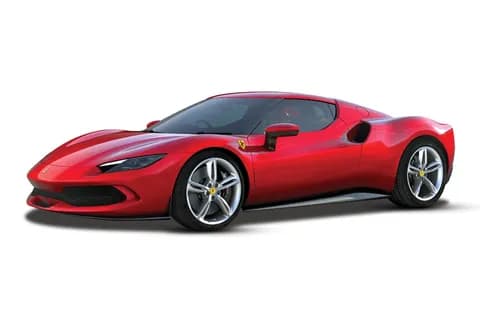





The Ferrari CZ26 has been revealed as a one-off supercar created through Ferrari's Special Projects programme for a US client. Based on the Ferrari SF90 Stradale, the CZ26 keeps the donor car's plug-in hybrid powertrain and core performance hardware while receiving a completely bespoke exterior, interior and aerodynamic package.
Ferrari Design Studio developed the car under the direction of Flavio Manzoni, transforming the familiar SF90 architecture into a much more horizontal, technical-looking berlinetta. The project also draws inspiration from Italian industrial design of the 1970s, giving the CZ26 a character that differs sharply from the production Ferrari on which it is based.
Only one CZ26 exists, and Ferrari has not announced a production run or a public price. Like other Special Projects creations, it was developed around the individual requirements of its customer rather than as a new series-production model.
What is the Ferrari CZ26?
The Ferrari CZ26 is a bespoke one-off supercar commissioned by a US customer through Ferrari's Special Projects programme. It uses the SF90 Stradale's plug-in hybrid mechanical package but replaces the production car's exterior and interior design with a unique interpretation created by Ferrari's own design team.
Ferrari positions the CZ26 as a new interpretation of the high-performance berlinetta rather than a conventional SF90 variant. The project focuses heavily on proportion, surface treatment and aerodynamic function, allowing the underlying technology of the SF90 to support a completely different visual identity.
The development process reportedly took around two years, with the client involved throughout the design and verification stages. That approach is central to Ferrari's Special Projects philosophy, where the customer provides the initial idea and Ferrari turns it into a fully engineered one-off.
Ferrari CZ26 design: A radical departure from the SF90
The Ferrari CZ26 adopts a completely different visual identity from the SF90 Stradale, using strong horizontal lines, a two-box silhouette and a capsule-like central body. Ferrari surrounds this central volume with pronounced wheel arches, creating a muscular stance without relying on excessive decorative detailing.
The front end is the most obvious departure. Instead of the SF90's familiar nose, the CZ26 features a wide functional grille extending across the front, with ultra-slim lighting elements integrated into the design. The grille also accommodates brake-cooling openings, sensors and other technical components.
A distinctive vertical leading edge gives the front of the car a more upright appearance. Ferrari also reshaped the hood and surrounding surfaces to reinforce the car's horizontal proportions.
At the rear, the CZ26 uses a short, sharply truncated tail with thin cantilevered taillights. A wide diffuser and carbon-fibre elements around the rear arches emphasize the car's width, while the overall treatment recalls some of the clean geometric forms associated with 1970s Italian industrial design.
The black roof and pillars create a visual contrast with the main body, making the cockpit appear almost like a separate capsule placed within the surrounding bodywork.
Ferrari finished the car in Argento Veloce silver with Rosso Lampante accents. The colour combination extends to selected carbon-fibre components, while bespoke gloss-black wheels feature a shot-peened surface treatment. Natural-finish titanium exhaust tips complete the exterior.
Ferrari CZ26 interior gets a bespoke treatment
The Ferrari CZ26 interior continues the one-off approach with exclusive materials, colours and manufacturing techniques. Ferrari retains the underlying cabin architecture of the SF90 but changes the visual treatment to create an environment specific to this individual car.
A bespoke black technical fabric covers much of the cabin, while the seats receive specially manufactured inserts produced using additive manufacturing. Red details in Rosso Lampante connect the cabin to the exterior colour scheme.
The interior also features a CZ26 logo and several carbon-fibre surfaces. Ferrari uses both satin-finish carbon fibre and a special glossy carbon-fibre treatment incorporating metallic filaments into the weave.
Body-coloured elements appear on the door panels and upper section of the dashboard, creating a stronger visual connection between the exterior and interior. Rather than simply changing trim colours, Ferrari has used the project to experiment with different textures and production methods.
Ferrari CZ26 aerodynamics were redesigned
The Ferrari CZ26 is not simply an SF90 underneath a new set of body panels. Ferrari revised several aerodynamic and cooling systems to work with the bespoke body, including the front cooling layout, underbody, vortex generators, air curtains, rear spoiler and diffuser.
At the front, Ferrari reoriented the central radiator assembly and added dedicated bypass ducts. The changes improve airflow management around the cooling system while helping generate additional downforce over the front axle.
The outer sections of the front bumper incorporate air curtains designed to control turbulence created around the front wheels. This matters on a car capable of approaching 330 km/h, where small changes in airflow can significantly affect stability and aerodynamic efficiency.
Ferrari also redesigned the underbody and vortex-generator arrangement. These components work together to manage airflow beneath the car and maintain aerodynamic balance as the vehicle accelerates.
At the rear, a large upper spoiler works with a dedicated diffuser to increase downforce. Ferrari also added additional ventilation to the engine cover to help extract heat from the engine compartment.
The result is an aerodynamic package developed specifically around the CZ26's new body rather than simply adapted from the production SF90.
Ferrari CZ26 engine and performance
The Ferrari CZ26 retains the SF90 Stradale's 4.0-litre twin-turbocharged V8 plug-in hybrid system. Three electric motors work with the combustion engine, producing a combined output of around 986 hp, or 1,000 CV, while maximum torque reaches 804 Nm.
The hybrid system uses a 7.9 kWh battery and can provide up to 25 km of electric driving according to the specifications associated with the SF90 architecture. Power reaches all four wheels through Ferrari's E4WD system and an eight-speed dual-clutch transmission.
The CZ26 is capable of accelerating from 0 to 100 km/h in 2.5 seconds and from 0 to 200 km/h in 6.7 seconds. Ferrari quotes a top speed of 328 km/h.
The car measures approximately 4,762 mm in length, 2,005 mm in width and 1,189 mm in height, with a 2,650 mm wheelbase. Its weight distribution is biased toward the rear, with 45 percent over the front axle and 55 percent over the rear.
These figures underline an important point about the CZ26: despite the dramatic redesign, Ferrari did not turn the project into a completely new mechanical model. The emphasis remains on giving the SF90's existing performance technology a unique physical identity.
Ferrari Special Projects creates one-off cars for individual clients
Ferrari's Special Projects programme sits at the extreme end of automotive personalisation. Instead of selecting options from a standard catalogue, a customer can work directly with Ferrari's design and engineering teams to create a vehicle that exists as a single example.
The process begins with the client's concept before Ferrari's designers develop the proportions and styling. Detailed design work and engineering follow, with the customer remaining involved during key development and verification stages.
Ferrari says projects of this type typically take around two years to complete. The CZ26 demonstrates the extent of that process, combining a production-based technical foundation with a new body, bespoke cabin and revised aerodynamic systems.
The programme has previously produced other highly individual Ferrari creations, but the CZ26 stands out for the scale of its visual transformation. Rather than making subtle changes to an existing Ferrari, the project effectively gives the SF90 a new design identity.
Will the Ferrari CZ26 go into production?
The Ferrari CZ26 will not enter regular series production. Ferrari created the car as a single Special Projects commission for one US customer, making it fundamentally different from limited-production models that Ferrari offers to a selected group of buyers.
Ferrari has not disclosed the identity of the owner or the price paid for the project. The lack of a public price is unsurprising given the bespoke nature of Special Projects cars and the extensive design and engineering work involved.
There is also no indication that Ferrari intends to sell a CZ26-inspired production model. The car instead demonstrates what the manufacturer can create when a customer commissions a completely individual interpretation of an existing Ferrari platform.
How the CZ26 fits into Ferrari's supercar lineup
The Ferrari CZ26 does not directly compete with another production model because Ferrari built only one example. Its closest technical reference remains the SF90 Stradale, while Ferrari's other high-performance models occupy different positions within the range.
The distinction becomes particularly important when comparing the CZ26 with cars such as the SF90 XX Stradale. The latter represents a limited special series engineered around enhanced performance, whereas the CZ26 prioritizes individual design and customer commissioning while retaining the SF90's core technical specification.
That makes the CZ26 less about creating a new performance benchmark and more about demonstrating Ferrari's ability to reinterpret an existing supercar at an almost unlimited level of personalization.
Ferrari CZ26 verdict
The Ferrari CZ26 shows what happens when Ferrari applies its Special Projects philosophy to the SF90 Stradale without changing the car's fundamental performance architecture. The result is a one-off supercar with radically different styling, bespoke materials and a revised aerodynamic package.
Its significance lies less in outright performance than in the freedom Ferrari gives a single customer to shape the design of a road-going supercar. With its horizontal proportions, 1970s-inspired references and heavily reworked bodywork, the CZ26 looks nothing like a conventional SF90.
At the same time, the familiar plug-in hybrid powertrain keeps the car firmly connected to Ferrari's modern performance technology. With around 986 hp, a 328 km/h top speed and a 0-100 km/h time of 2.5 seconds, the CZ26 has the numbers expected from an SF90-based supercar.
Ultimately, the Ferrari CZ26 is best understood as a rolling design commission rather than a new Ferrari model. Its value to Ferrari's portfolio comes from demonstrating the breadth of what the marque can create for a customer who wants something that cannot simply be ordered from a showroom.
FAQs
What is the Ferrari CZ26?
The Ferrari CZ26 is a one-off supercar developed through Ferrari's Special Projects programme. It is based on the Ferrari SF90 Stradale and was commissioned by a US customer.
How much horsepower does the Ferrari CZ26 have?
The CZ26 retains the SF90's plug-in hybrid powertrain, producing around 986 hp, equivalent to 1,000 CV, from a twin-turbocharged V8 and three electric motors.
What is the Ferrari CZ26 top speed?
The Ferrari CZ26 has a quoted top speed of 328 km/h.
How fast is the Ferrari CZ26 from 0 to 100 km/h?
Ferrari's SF90-based performance specification gives the CZ26 a 0-100 km/h acceleration time of 2.5 seconds.
Is the Ferrari CZ26 available to buy?
No. The CZ26 is a single customer commission and is not planned as a series-production model. Ferrari has not announced a public price.
Is the Ferrari CZ26 based on the SF90 Stradale?
Yes. The CZ26 uses the Ferrari SF90 Stradale as its technical foundation while receiving completely bespoke exterior and interior styling and a revised aerodynamic package.
Who designed the Ferrari CZ26?
The Ferrari Design Studio developed the CZ26 under the direction of Flavio Manzoni as part of the Special Projects programme.
How long did it take to create the Ferrari CZ26?
The Special Projects development process for a one-off typically takes around two years, with the customer involved throughout the design and verification stages.