Buying a used car in the UAE? Vehicle testing at Tasjeel or Shamil is mandatory for registration or ownership transfer. These centres inspect critical systems like brakes, tyres, emissions, and lights to ensure road safety. Around 25% of cars fail the first test, often due to worn tyres, faulty lights, or fluid leaks. Preparing your car beforehand can save you time and money.
Key Takeaways:
-
Documents Needed: Emirates ID, Vehicle Registration Card (Mulkiya), valid insurance, and other required papers.
-
Common Failures: Tyres older than 3 years, burnt-out lights, fluid leaks, excessive window tint.
-
Costs: AED 170 for light vehicle testing in Dubai; AED 150 in Sharjah. Retests cost AED 35–50.
-
Tips to Pass:
-
Check tyres, lights, and fluid levels.
-
Ensure window tint is within limits (50% max for side/rear, none on the windscreen).
-
Pay traffic fines before testing.
-
Plan ahead by booking online, inspecting your car, and resolving issues before testing. A pass certificate is valid for 30 days, so complete your registration promptly to avoid extra fees.
Documents and Preparations Needed for Testing
Before heading to a Tasjeel or Shamil centre, make sure you have the right documents and that your vehicle is in good condition. Forgetting paperwork or neglecting maintenance can delay the process or lead to a failed inspection, so being ready is crucial.
Documents Required for Tasjeel/Shamil Testing
The documents you’ll need are quite straightforward. Bring along the original Vehicle Registration Card (Mulkiya) and your original Emirates ID for identification purposes. Your insurance policy must also be electronic and valid for at least six months, as it’s directly linked to the RTA system for registration renewal.
If you’re transferring ownership, you’ll need colour photocopies of both the buyer’s and seller’s passport and visa pages. For vehicles owned by companies, include a photocopy of the Trade Licence and an official request letter in Arabic on the company’s letterhead. Lost or damaged licence plates? Bring the original or electronic police report.
|
Document |
Format Required |
Purpose |
|---|---|---|
|
Vehicle Registration Card (Mulkiya) |
Original |
Required for all test types |
|
Emirates ID |
Original |
Verifies the presenter’s identity |
|
Passport & Visa Page |
Photocopy (Colour preferred) |
Needed for ownership transfers or new residents |
|
Insurance Policy |
Electronic/Digital |
Must be valid for at least 6 months for registration |
|
Trade Licence |
Photocopy |
Mandatory for company-owned vehicles |
|
Police Report |
Original/Electronic |
Needed for lost or damaged licence plates |
While having the correct documents is essential, ensuring your vehicle is in good shape is just as important for a smooth testing experience.
How to Prepare Your Vehicle Before Testing
Taking care of your vehicle beforehand can save you from the hassle of re-tests or extra fees. Start by clearing any unpaid traffic and Salik fines, as these must be settled before you can renew your registration. Check your tyres for their age using the four-digit code on the sidewall - tyres older than three years (or five years in Sharjah) will automatically fail the test, even if the tread looks fine.
Inspect all exterior lights, including headlights, brake lights, indicators, reverse lights, and the licence plate bulb. Even a single faulty light can result in a failed inspection. Ensure that window tinting doesn’t exceed 50% on side and rear windows, and that there’s no tint on the front windscreen. Additionally, check for fluid leaks, cracks in the windscreen, and ensure that your horn, wipers, and mirrors are in working order. Don’t forget to remove any personal items from the car before handing it over to the testing staff.
A standard inspection for light vehicles typically takes about 15 minutes, with the entire process lasting 20–40 minutes depending on how busy the centre is. To save time, consider booking an appointment through the RTA website or their smart app.
The Testing Process: Step-by-Step
Understanding the vehicle testing process helps you feel more prepared and reduces any unease about the steps involved.
Arrival and Registration at the Testing Center
Plan to arrive at the testing centre no later than 15 minutes before your scheduled appointment. At the registration desk, present your Emirates ID, the original vehicle registration card (Mulkiya), and your car keys. If you don’t have an appointment, you might face an additional AED 100 optional service fee at most Dubai centres.
At Shamil centres, you'll receive a token number and wait in the designated seating area while an inspector moves your car to the testing bay. It's important to stay out of the testing bay and avoid interacting with the inspector during the inspection. For light vehicles, the entire process typically takes between 20 and 40 minutes .
Once your car is in the testing bay, the inspector will begin a detailed examination of key systems.
Inspection Stages and What Gets Checked
The inspection focuses on six critical areas: braking system, exhaust emissions, lighting, suspension, chassis, and tyres. Inspectors use a combination of visual checks, automated tools, and diagnostic scans to ensure your vehicle meets safety and performance standards.
-
The braking system is checked for stopping power and fluid levels.
-
The suspension undergoes a road-test simulation to detect wear or damage .
-
Emissions testing ensures exhaust gases comply with environmental guidelines.
-
Lighting systems - including headlamps, indicators, brake lights, and reflectors - are thoroughly tested for proper functionality.
-
Additional checks ensure you have essential safety items, such as a warning triangle, a working spare tyre, and a fire extinguisher.
Getting Your Test Results: Pass or Fail
Once the inspection is complete, you can collect your report immediately. Results are also sent via SMS or email, allowing you to proceed with registration renewal right away if your vehicle passes. A passing certificate is valid for 30 days, giving you ample time to finalise the renewal process.
If your vehicle fails, you’ll have 30 to 31 days to address the listed issues and return for a retest at the same centre . Keep in mind that only one retest is permitted. Failing the retest or missing the deadline means you’ll need to pay for a full inspection again. Passing the test on your first or second attempt ensures smooth registration renewal and avoids extra costs. Following these steps can help you save time and money.
Why Vehicles Pass or Fail and What It Costs
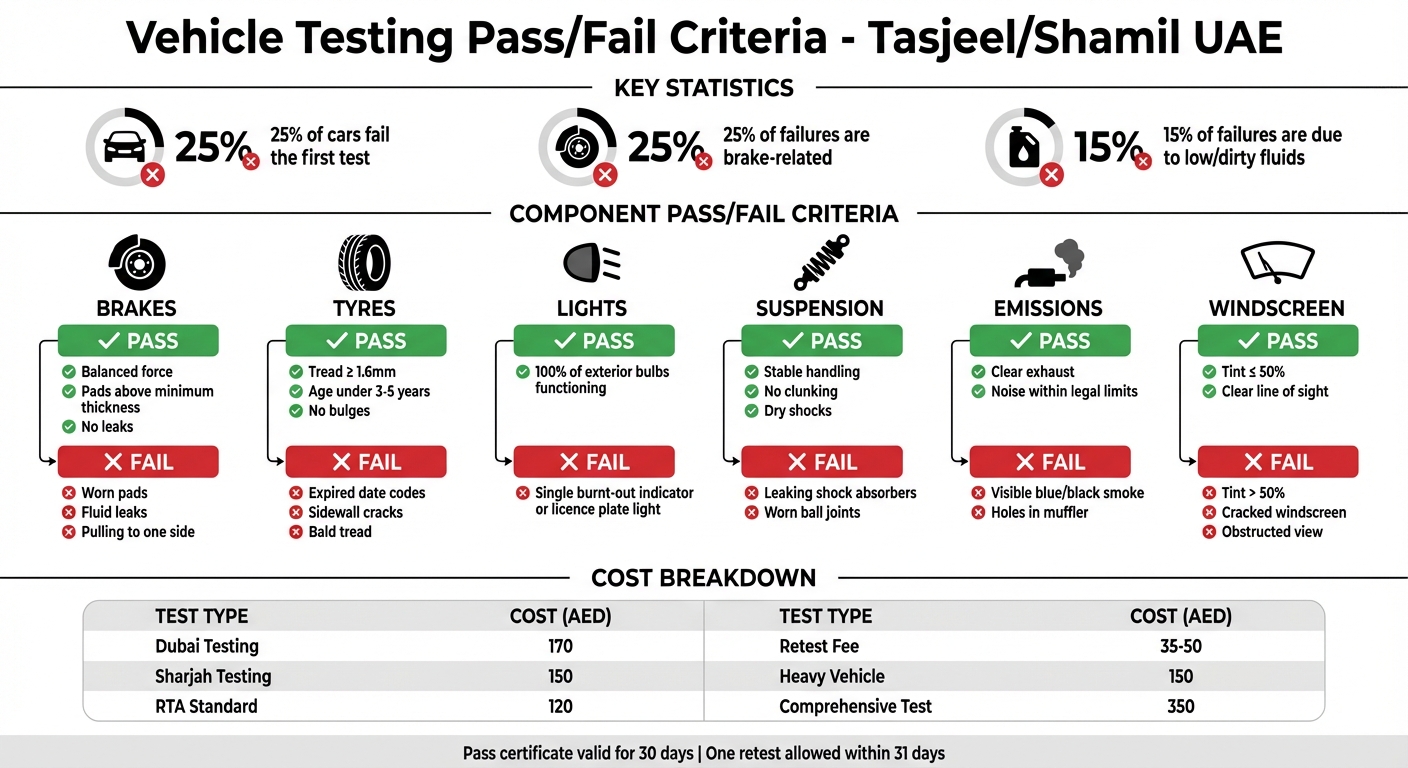
UAE Vehicle Testing Pass/Fail Criteria and Common Failure Points
Understanding why vehicles pass or fail inspections - and the costs involved - can save you from unnecessary retests and expenses.
Inspectors focus on critical areas like brakes, tyres, lights, emissions, suspension, and the windscreen. Interestingly, brake-related problems cause about 25% of inspection failures, while issues like low or dirty fluids account for 15%.
Pass/Fail Criteria for Main Vehicle Components
Each vehicle component has specific requirements to meet. For example:
-
Tyres: They need a tread depth of at least 1.6 mm and must not be older than 3 years in Dubai or 5 years in Sharjah. You can check the tyre's manufacturing date on its sidewall .
-
Brakes: Inspectors look for even braking force, sufficient pad thickness, and no fluid leaks. A worn pad or any fluid leak results in failure .
-
Lights: Every external bulb must work - headlights, indicators, brake lights, reverse lights, and licence plate lights. Even one burnt-out bulb leads to an automatic fail.
-
Emissions: Your vehicle must not emit visible smoke, and exhaust noise has to stay within legal limits.
-
Suspension: Components like shock absorbers and ball joints must function properly, with no leaks or excessive wear.
-
Windscreen: It should be clear of major cracks, and window tint cannot exceed 50%.
|
Component |
Pass Requirements |
Common Fail Reasons |
|---|---|---|
|
Brakes |
Balanced force; pads above minimum thickness; no leaks |
Worn pads; fluid leaks; pulling to one side |
|
Tyres |
Tread ≥ 1.6 mm; age under 3–5 years; no bulges |
Expired date codes; sidewall cracks; bald tread |
|
Lights |
100% of exterior bulbs functioning |
Single burnt-out indicator or licence plate light |
|
Suspension |
Stable handling; no clunking; dry shocks |
Leaking shock absorbers; worn ball joints |
|
Emissions |
Clear exhaust; noise within legal limits |
Visible blue/black smoke; holes in muffler |
|
Windscreen |
Tint ≤ 50%; clear line of sight |
Tint > 50%; cracked windscreen; obstructed view |
Knowing these criteria can help you prepare your vehicle better and avoid failing due to preventable issues.
Testing and Retest Costs by Location
The cost of vehicle testing depends on your location and service provider. For light vehicles, renewal tests cost AED 170 at Tasjeel and Shamil centres in Dubai, while the same test is AED 150 in Sharjah and the Northern Emirates. If your vehicle fails, retests range from AED 35 to AED 50, and they must be done at the same centre or within the same company as the original test .
|
Service Type |
Location/Provider |
Fee (AED) |
|---|---|---|
|
Light Vehicle Renewal Test |
Tasjeel Dubai |
170 |
|
Light Vehicle Renewal Test |
Tasjeel Sharjah |
150 |
|
Light Vehicle Renewal Test |
Shamil Dubai |
170 |
|
Light Vehicle Renewal Test |
Shamil Northern Emirates |
150 |
|
Light Vehicle Renewal Test |
RTA Standard |
120 |
|
Retest (Light Vehicle) |
General/Shamil |
50 |
|
Retest (Light Vehicle) |
RTA Standard |
35 |
|
Heavy Vehicle Test |
Various |
150 |
|
Comprehensive Test |
Tasjeel (Select sites) |
350 |
You have 30 days from the failure date to make repairs and return for a retest . If you miss this deadline, you'll need to pay the full inspection fee again. Additionally, you're only allowed one retest - failing a second time means starting over with a new full-price inspection.
How to Avoid Retesting
Passing your vehicle inspection on the first try saves both time and money. Many inspection failures stem from easily preventable issues. A little preparation can go a long way in avoiding costly retests. Here's how to address common problems before heading to the testing centre.
Pre-Test Maintenance Checklist
Start with a quick, five-minute walkaround of your vehicle. Check all exterior lights, including headlights, brake lights, indicators, reverse lights, and the licence plate light. Even a single faulty bulb can lead to failure. Enlist a friend to help test the lights while you operate the switches.
Next, inspect the tyre date codes on the sidewalls. For example, "3523" means the tyre was manufactured in the 35th week of 2023. Look for cracks or bulges on the sidewalls and confirm the tyres are not too old or damaged.
Check under your vehicle for any fluid leaks. Leaks from engine oil, coolant, or brake fluid can result in automatic failure. If you notice smoke from the exhaust or hear unusual noises, it's best to consult a mechanic before booking your test.
Lastly, review your vehicle's window tint. Side and rear windows should have no more than 50% tint, and the front windscreen must remain completely clear.
Getting a Professional Pre-Inspection
If your walkaround reveals potential issues, consider a professional pre-inspection. A qualified mechanic can identify and fix problems in one visit, saving you from learning about them during the test itself. Some services even offer mobile inspection teams that come to your location, which is especially helpful when purchasing from private sellers.
While official Tasjeel inspections cost AED 150–170, a thorough pre-inspection typically costs between AED 250 and AED 1,000, depending on the provider and vehicle type. This upfront investment can save you from paying re-test fees later.
Scheduling Your Test Within Validity Periods
Once you've addressed any issues, book your test 1–2 weeks before your registration renewal date. This timing gives you the full 30-day window to make repairs if your vehicle fails, avoiding late renewal penalties.
Keep in mind, the pass certificate is valid for 30 days. If you don't complete your registration renewal within this period, you'll have to pay for a new inspection. Make sure all your paperwork is ready before heading to the test centre.
Tasjeel and Shamil Testing Center Locations and Hours
Tasjeel runs a network of 32 vehicle inspection and registration centres across Dubai and the Northern Emirates. Their operating hours differ by location. Some branches open as early as 7:00 AM and stay open late, while others have shorter schedules.
Tasjeel Testing Centers
Many Tasjeel centres in Dubai offer extended hours to suit different schedules. For instance, the Al Barsha centre is open from 7:00 AM to 12:00 AM, making it a great choice for late-evening visits. Other locations, such as Al Aweer, Al Twar, Warsan, Discovery Gardens, and Motorcity, generally operate from 7:00 AM to 9:30 PM. The JAFZA centre in Jebel Ali Free Zone has shorter hours, running from 7:00 AM to 4:30 PM.
In addition to Dubai, Tasjeel has centres in Sharjah, Ras Al Khaimah, Khor Fakkan, Al Dhaid, Hatta, and Kalba. For those buying used cars, the Al Barsha and Al Qusais locations offer specialised services like the Comprehensive Vehicle Test (AED 350) and Car Valuation Certificate (AED 250). To avoid any inconvenience, it's best to confirm branch-specific hours by calling 800 ENOC, especially during public holidays.
Now, let’s take a look at Shamil centres for a complete view of your options.
Shamil Testing Centers
Shamil centres generally operate from 9:00 AM to 6:00 PM, but some locations have extended hours. For example, the Qusais centre in Al Qusais Industrial Area 3 runs from 7:00 AM to 10:30 PM, Monday through Thursday. On Fridays, it operates from 7:00 AM to 12:00 PM and then reopens from 3:00 PM to 10:30 PM. Other key Shamil locations include Nad Al Hamar, Al Muhaisinah, and Al Adhed in Bur Dubai.
These flexible hours make it easier to fit vehicle testing into your schedule, especially if you're in the process of purchasing a used car. Both Tasjeel and Shamil also offer the convenience of online booking through their official websites, allowing you to secure a time slot at least 24 hours in advance and avoid long queues. For added convenience, both providers have VIP services. Tasjeel’s VIP service, priced at AED 150, includes vehicle collection and return.
Conclusion
Preparation is the cornerstone of a hassle-free vehicle test. The Tasjeel/Shamil process is straightforward when you’re ready ahead of time. A simple five-minute walkaround before your appointment can save you from the inconvenience and cost of a re-test.
Check your tyres, lights, horn, and look for any fluid leaks. In Dubai, tyres older than three years automatically fail the test, no matter the tread condition. Look for the four-digit manufacturing code on the tyre’s sidewall to confirm their age. Ensure all lights are functional, your horn works, and there are no fluid leaks beneath your vehicle.
Keep in mind, your test certificate is valid for 30 days. If you don’t complete your registration within this period, you’ll need to repeat the inspection and pay the full fee again. Also, settle any outstanding traffic or Salik fines beforehand, as unpaid fines can delay your registration renewal. If your vehicle requires repairs, follow the specific guidelines for re-testing below.
In case of a failed test, make the necessary repairs and return to the same testing centre within 31 days. Re-test fees range between AED 35 and AED 75, which is far more economical than starting the process over.
FAQs
Can I test the car before buying it?
Yes, taking the car for a test drive before purchasing is an option. This gives you the chance to evaluate its performance, comfort, and overall condition, ensuring you're confident in your decision.
What happens if I miss the retest deadline?
If your vehicle fails its test and you miss the retest deadline, you’ll need to complete the required repairs and have it retested within 31 days. Delaying beyond this period could lead to extra fees or complications. It’s a good idea to handle the repairs and retest quickly to keep everything running smoothly.
Does a failed test affect the ownership transfer?
If a vehicle fails a test, it doesn’t immediately affect the transfer of ownership. However, the necessary repairs must be completed, and the vehicle must pass a retest within the specified timeframe. Until the issues are resolved and the vehicle passes, it cannot be registered or used, which could lead to delays in the process.
Looking for a used car in Dubai or new car deals? Explore YallaMotor’s verified listings today.