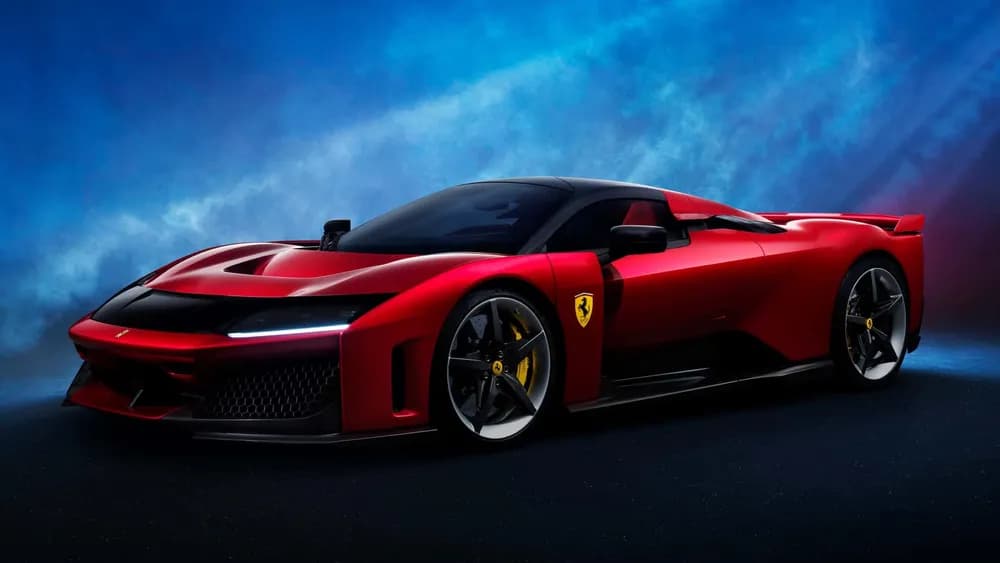

McLaren P1. Porsche 918 Spyder. Ferrari LaFerrari. THIS is the original holy trinity - the three cars which showed the true power of hybrid engines. Now, it looks like a new holy trinity is coming up. With the McLaren W1 launched a few weeks ago, Ferrari is also coming into the act of launching a successor to its member of the holy trinity. Meet the Ferrari F80.
A Revolutionary Powertrain: Turbocharged Hybrid V6
At the heart of the Ferrari F80 lies a 3.0-liter, twin-turbo V6 hybrid powertrain that may initially seem like a departure from Ferrari’s traditional naturally aspirated V12 engines. However, this engine is no ordinary V6; It's a heavily modified version of the one that powered the Ferrari 499P to consecutive victories at the Le Mans 24 Hours.

This V6 engine produces an astounding 888 hp on its own, which is 234 bhp more than the V6 found in the 296 GTB. Paired with a trio of electric motors (two on the front axle and one attached to the engine), the F80’s combined power output reaches an earth-shattering 1,183 bhp. Not only does this make it the most powerful road-going Ferrari ever built, but it also sets a new standard for hybrid hypercars.
Performance Numbers That Stun
The F80’s performance is nothing short of extraordinary. Ferrari claims the car will accelerate from 0-62 mph in just 2.15 seconds and hit 124 mph in 5.75 seconds. For comparison, it is even faster than the McLaren W1 (Ferrari already winning the top trumps game), which boasts rear-wheel drive but can’t match the F80’s off-the-line speed.

Top speed? A blistering 217 mph. But perhaps more impressive is the F80’s new Fiorano lap record of 1 minute, 15.3 seconds—4.4 seconds faster than the LaFerrari. WOW
Advanced Aerodynamics: Downforce and Design
The F80’s design is not just about aesthetics but function. The car generates an incredible 1,050 kg of downforce at 155 mph, allowing it to corner at mind-bending speeds. This is achieved through a combination of active aerodynamic elements.

The underbody features advanced bargeboards, a deployable front flap to reduce drag when needed, and a large rear diffuser. The rear wing is another highlight, capable of rising by 200 mm to act as an air brake or tilting for reduced drag during high-speed runs.
The exterior design, while brutal in its aerodynamic intent, also features signature Ferrari elements like the S-duct, which channels air from under the car to the top, helping reduce turbulence and increasing downforce.
Chief designer Flavio Manzoni has described the F80’s front end as "mysterious" with its visor-like nose, reminiscent of sci-fi vehicles. It’s not necessarily love at first sight, but the more you understand the tech and engineering beneath the surface, the more the design makes sense.
Hot Take: We reckon the F80 looks better than the W1, but none can match the sheer class of the design of their predecessors.
A Technological Marvel
Ferrari didn’t just focus on raw power and aerodynamics. The F80 is a technological showcase, with its active suspension system designed to maintain a consistent ride height and counteract squat, dive, and roll during aggressive driving.

The 800V battery system is race-bred, ensuring rapid charging and discharging, making the most of the hybrid setup without the need for an electric-only mode. This system is further enhanced by Ferrari’s SSC 9.0 (Side Slip Control) software, which gives the F80 controlled oversteer and playful handling at the limits.
Interestingly, the F80 incorporates no fewer than 13 electric motors, including two more on the e-turbos for instant spool-up and motors for active suspension and aerodynamics. The result is a car that not only excels on the track but is also well-suited for spirited road driving, as Ferrari insists their cars should not just be "track toys with number plates."
Lightweight Carbon Tub and Precision Engineering
Ferrari’s attention to detail extends to the F80’s chassis. The carbon tub is five percent lighter than that of the LaFerrari and offers 50 percent more torsional rigidity. The asymmetric design allows for a narrow cockpit, contributing to better aerodynamics. The driver’s seat is adjustable, while the passenger seat is fixed to the tub, a clear sign that the F80 is very much driver-focused.

Ferrari has also equipped the F80 with a new eight-speed dual-clutch transmission (DCT), paired with Michelin Pilot Sport Cup 2 tires for optimal grip. The car rides on the first five-spoke carbon rims Ferrari has ever produced, combining both lightness and strength.
Inside the F80: The Driver is King
Inside, Ferrari has opted for a 1+1 seating arrangement, meaning the passenger seat is set slightly farther back than the driver’s. This design keeps the cockpit narrow and maximizes space for aerodynamic components.

The driver-centric interior features a “squircle” steering wheel (basically a two-spoke wheel), complete with physical buttons and switches for key drive modes. The manettino dial on the right allows for quick toggling between modes like Wet, Sport, and Race, while the left side controls the powertrain, with Hybrid, Performance, and Qualify modes available.
A particularly clever feature is the track optimization system, which learns the layout of a racetrack after a few laps and then provides an automatic power boost in key sections for better lap times. It’s a sign that Ferrari is leaving nothing to chance in their pursuit of ultimate speed.
The Future Holy Trinity?
The Ferrari F80 is already generating buzz, not just for its own merits but for what it represents in the hypercar arms race. Its main competitor, the McLaren W1, already has a formidable reputation, but the F80’s four-wheel drive and hybrid powertrain give it a unique edge.
Now only Porsche is left. We wish the German carmaker could mate a petrol engine to its already ballistick electric powertrain found in the Mission X. Pretty please, Porsche!