


If I had to sum it up in one line: the Cybertruck can work well in the UAE, but only if I have easy charging and I accept that heat and high-speed driving cut range hard.
For AED 404,900 to AED 454,900, this truck is less about hype and more about daily use. From the first batch on UAE roads, the pattern is clear: city use is fine, Dubai–Abu Dhabi trips are fine, summer is usable, but motorway speeds and public charging change the ownership picture fast.
Here’s the short version:
-
Range: I can expect about 420–450 km in mixed UAE driving, not the full claimed figure.
-
Highway use: At 120–130 km/h, range drops to around 420 km in the AWD.
-
Heat: In 40–45°C, cabin cooling holds up well if I pre-cool before driving.
-
Charging: Home charging makes the biggest difference to cost and ease.
-
Costs: Tyres, tinting, and minor service are the main early spend items.
-
Best fit: Owners with villas, fixed routines, and mixed city/highway use.
-
Harder fit: Apartment residents who depend on public chargers.
Quick Comparison
| Area | What owners are seeing in the UAE |
|---|---|
| Price | AED 404,900 AWD / AED 454,900 Cyberbeast |
| Mixed-use range | 420–450 km |
| Highway range | Around 420 km at 120–130 km/h |
| Desert use | Around 350–380 km |
| Summer heat | Cabin stays under 25°C with pre-cooling |
| Home charging | Lowest running cost |
| Public charging | Higher cost and less convenience |
| Tyres | AED 6,000–8,000 per set |
| Routine service | About AED 2,000 per year |
So if I were buying one in the UAE, I’d check four things first: where I charge, how often I drive at 120–140 km/h, whether I need public chargers, and whether I’m fine with early depreciation.
Who Owns the First 100 Cybertrucks and How They Use Them
About 65% of the first 100 buyers are enthusiasts and early adopters, while 20% are commuters, 10% are inter-city drivers, and 5% are business users. That split helps explain why range and charging results can look so different from one owner to another in the UAE.
Common Driving Patterns Among UAE Cybertruck Owners
Usage is all over the map. One early owner covered more than 12,000 km in four months, which works out to about 100 km per day. Heavier-use owners tend to do about 160 km on weekdays and 190 km on weekends.
A common long run is the Dubai Marina to Abu Dhabi round trip, at roughly 240 km. For many enthusiasts, weekends also mean heading to Liwa Oasis, Hatta, and the Rub al Khali, where the truck’s 17-inch ground clearance and off-road modes get used for more than just show.
City use brings a different set of demands. Tight car parks at Dubai Mall and Mall of the Emirates come up often, and many owners point to rear-wheel steering as the feature that makes day-to-day urban driving far easier. At 192 cm wide, the truck fits most Dubai Mall parking spaces. So yes, size matters in the desert, but it matters in mall parking too.
That blend of commuting, highway miles, and weekend drives shapes the charging setup owners lean on every day.
How Owners Charge at Home, Work and on the Road
Home charging does most of the heavy lifting. Owners living in villas usually install an 11.5 kW wallbox, enough for a full overnight charge in about 8–10 hours. With DEWA residential rates at around AED 0.23–0.38 per kWh, daily charging stays fairly low-cost and easy to plan.
For inter-city driving, the ADNOC Saih Shuaib hub on the E11 is a major stop. It has 60 high-speed charging points and can take the battery from 0–80% in about 20 minutes. Tesla Superchargers at places like Yas Island and Dubai Hills Mall usually deliver a 10–80% charge in 30–35 minutes at about AED 1.40 per kWh.
Apartment residents have a tougher setup. They depend more on public charging, which means higher costs and less certainty in the daily routine. And that difference in charging access plays a big part in the range figures owners report.
| Charging Method | Cost per kWh | Charge Time (10–80%) | Best use |
|---|---|---|---|
| Home Wallbox (DEWA) | AED 0.23–0.38 | 8–10 hrs (full) | Daily commuting, lowest cost |
| DEWA Public DC Fast | AED 0.48–0.55 | 30–35 mins | Quick top-ups, inter-emirate travel |
| ADNOC Saih Shuaib Hub | AED 0.48–0.55 | ~20 mins | Dubai–Abu Dhabi corridor |
| Tesla Supercharger | AED 1.40 | 30–35 mins | Long-distance trips, ease of use |
Real-World Range in UAE Heat and High-Speed Driving
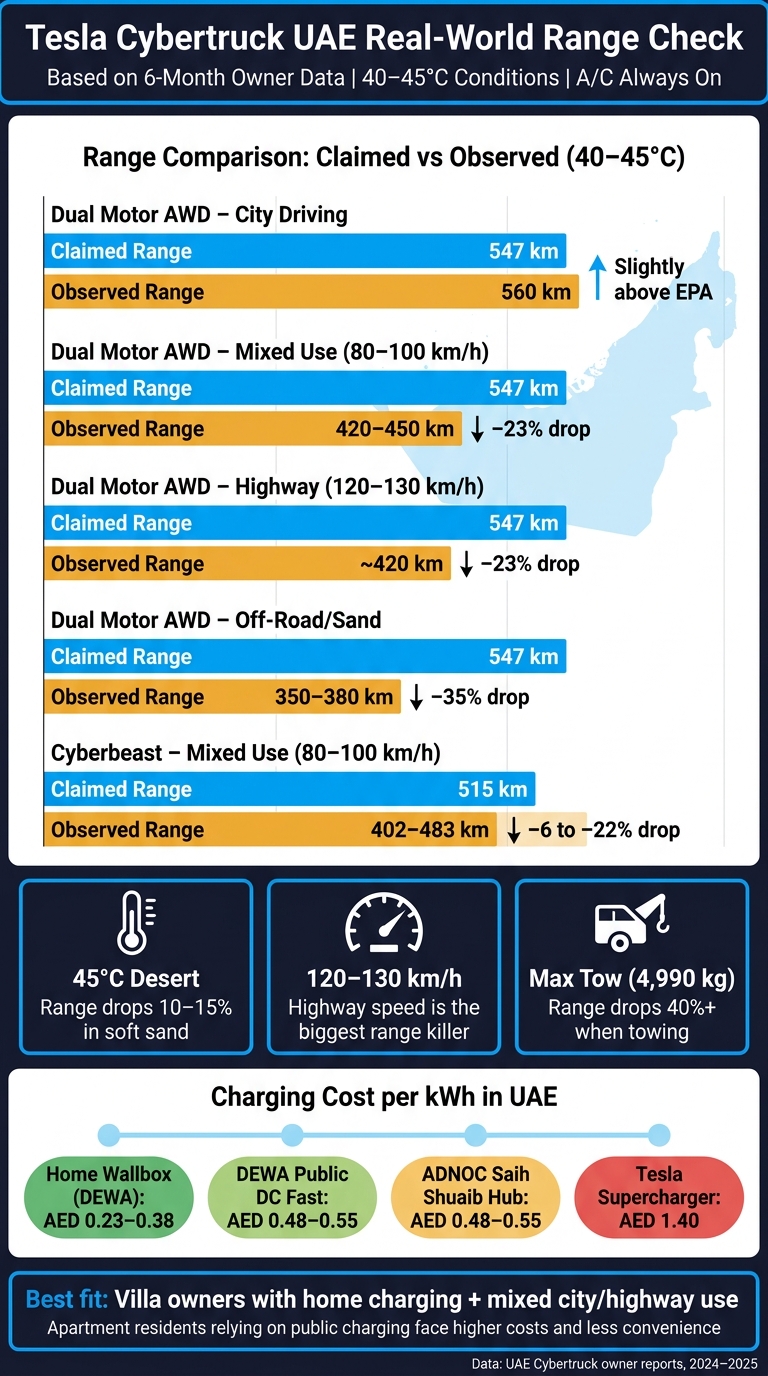
Tesla Cybertruck UAE Real-World Range vs Claimed Range (2024–2025)
EPA-rated range stands at 547 km for the Dual Motor AWD and 515 km for the Cyberbeast. On UAE roads in summer, those numbers can shrink fast, especially once you settle into high motorway speeds. The six-month owner data makes one thing clear: the biggest gap shows up between city driving, long highway runs and desert use.
City, Highway and Mixed-Use Range
In city traffic, the picture looks strong. With stop-start driving, the Dual Motor returns about 560 km in real-world use. That’s slightly above its EPA figure, which can happen when speeds stay low and braking helps feed energy back into the battery.
Things change on the motorway. At 120–130 km/h, the Dual Motor drops to around 420 km. The Cyberbeast comes in at roughly 402 km at sustained high speed. That’s the trade-off: once you push a large EV through hot air at motorway pace, range takes a hit.
For mixed city and highway driving, owners report about 420–450 km. So if your week includes school runs, Sheikh Zayed Road traffic and a couple of longer inter-city trips, that’s the band most drivers are likely to care about.
Range on Common UAE Routes
For daily UAE use, route type matters as much as the battery figure on paper. Dubai–Abu Dhabi is a one-charge trip from full, which is what most buyers will want to know first.
Desert driving pushes consumption higher. In April 2026, UAE owner Ahmed Al-Mansoori took his Cybertruck into the Liwa Oasis dunes for a full day in 45°C heat. He reported a 10–15% drop, leaving about 350–380 km in soft sand. That makes sense in practice. Sand adds drag, heat keeps the cooling system working, and the truck has to work harder almost all the time.
Towing is tougher still. At maximum load of 4,990 kg, range drops by more than 40%. In plain terms, heavy towing isn’t something to wing. It needs charging stops mapped out in advance.
Claimed vs Observed Range: Comparison Table
| Variant | Use Case | Temp Band (°C) | Avg Speed (km/h) | A/C Usage | Claimed Range (km) | Observed Range (km) |
|---|---|---|---|---|---|---|
| Dual Motor AWD | Highway | 40–45 | 120–130 | Always On | 547 | ~420 |
| Dual Motor AWD | Mixed Use | 40–45 | 80–100 | Always On | 547 | 420–450 |
| Cyberbeast | Mixed Use | 40–45 | 80–100 | Always On | 515 | 402–483 |
| Dual Motor AWD | Off-Road (Sand) | 40–45 | 20–40 | Always On | 547 | 350–380 |
Range is only one piece of the puzzle. The next part is how the truck deals with cooling, battery strain and charging in 40°C to 45°C heat.
Heat Performance, Charging Behaviour and Repair Costs in the UAE
Cabin Cooling and Battery Behaviour in 40°C to 45°C Heat
Range only tells part of the story. In the UAE, what matters just as much is whether the truck stays cool and steady in brutal summer heat.
So far, owner reports are strong. In 45°C heat, the cabin can stay below 25°C when the truck is pre-cooled while still plugged in through the Tesla app. That makes a big difference when you’re getting into the vehicle after it’s been parked outside.
Many owners also tint the glass roof soon after delivery to reduce heat coming into the cabin. It’s one of those early upgrades that seems less like a nice extra and more like a smart move for local driving.
The stainless-steel body has also held up well. Owners report no heat warping, along with strong resistance to sand, stone chips and coastal corrosion. On the battery side, the liquid-cooled pack has remained stable during fast charging and motorway driving, even when temperatures go past 45°C.
Minor Repairs, Parts Availability and Service Wait Times
Heat itself hasn’t turned into a major repair bill. The bigger costs come from normal wear items.
At the six-month mark, the main non-charging expenses are tyres and routine service. A full set of 35-inch tyres costs around AED 6,000–8,000 and usually takes one to two days. Routine service comes to about AED 2,000 per year, mostly covering filters and inspections.
Parts access has also improved. Most Cybertruck parts now arrive from UAE warehouses within one to two weeks. And when the issue is software rather than hardware, the fix is often much easier: software problems are usually sorted remotely at no cost.
Cost and Downtime Snapshot: Comparison Table
Here’s the six-month cost and downtime picture.
| Item / Issue | Approx. Cost (AED) | Est. Downtime | Warranty Status | Owner Impact |
|---|---|---|---|---|
| Annual Routine Service | ~2,000 | 1 day | Out-of-pocket | Low; mostly filters and inspections |
| 35-inch Tyre Replacement (Set of 4) | 6,000–8,000 | 1–2 days | Out-of-pocket | Moderate; weight accelerates wear |
| Glass Roof Tinting | 1,500–3,000 | 1 day | Out-of-pocket | Essential for summer heat management |
| Software / OTA Fixes | 0 | Minutes | Covered | Low; updates delivered remotely |
| Stainless Steel Panel Dings | Variable | 1–2 weeks | Out-of-pocket | Low; highly dent-resistant |
Verdict: Does the Cybertruck Make Sense for UAE Buyers at This Price?
Which Buyer Types Get the Most from the Cybertruck
The Cybertruck makes the most sense for buyers who have home charging and a fairly predictable daily routine.
At this point, the big question isn't just range or summer heat. It's simpler than that: where will you charge, and what does your usual driving look like?
| Buyer Type | Suitability | Key Drawback |
|---|---|---|
| City commuter | High; daily running costs are lowest with home charging | Requires a dedicated home or workplace charger |
| Inter-city driver | Moderate; E11 charging coverage makes Abu Dhabi–Dubai trips workable | Range drops noticeably at sustained 120–140 km/h speeds |
| Business or utility user | Moderate; the 1,134 kg payload suits light commercial work | Public charging dependence adds cost and unpredictability |
| Enthusiast / Statement buyer | High; standout design and 2.7-second 0–100 km/h performance | Less suited to owners without home charging or fixed routes |
For city commuters, the case is pretty strong. If you can plug in at home or at work, the truck is cheap to run day to day. That changes fast if you rely on public charging.
Inter-city drivers sit somewhere in the middle. Abu Dhabi–Dubai trips are workable thanks to charging coverage on the E11, but steady 120–140 km/h driving eats into range in a noticeable way.
Business users may like the 1,134 kg payload for light-duty work. Still, if the truck spends most of its life depending on public chargers, ownership becomes less predictable and more expensive.
Then there are buyers who simply want the thing because it's a Cybertruck. Fair enough. The design stands out, and 2.7 seconds from 0–100 km/h is no joke. But even for this group, charging access still matters.
Apartment residents without a dedicated charger face the least convenient setup.
That same divide carries over into parking, charging, and repairs.
Pros and Cons for UAE Ownership
| Area | Pro | Con |
|---|---|---|
| City parking | Rear-wheel steering tightens the turning radius | Its length makes tight parking awkward |
| Long-distance driving | E11 charging coverage makes inter-city trips workable | Highway speeds cut range noticeably |
| Summer comfort | Pre-cooling via the app reduces cabin heat | Glass roof should be tinted early [1] |
| Body repair | Stainless-steel body resists sand and sun damage | Dent repair requires specialist handling |
| Running costs | Annual energy costs are roughly AED 1,000–1,500 versus about AED 4,300 for petrol | - |
| Service ecosystem | OTA updates keep routine maintenance low | Service centres and parts are still limited |
A few of these points matter more in the UAE than they might elsewhere.
In the city, rear-wheel steering helps more than you'd think. It makes a big truck feel less clumsy. Even so, the Cybertruck is still long, and that can make basement parking or tight mall spaces awkward.
On longer drives, the charging network keeps the truck usable between emirates. But there is a trade-off: faster highway driving cuts range in a way you can't ignore.
Summer comfort looks manageable on paper. App-based pre-cooling helps bring cabin temperatures down before you get in. Still, the glass roof is one of those things you'd want to tint early rather than leave for later.
The stainless-steel body should hold up well against sun and sand. The catch is repair work. If it gets dented, you're not dealing with a simple panel fix at any random workshop.
Running costs are one of the strongest parts of the Cybertruck story. Annual energy costs sit at about AED 1,000–1,500, compared with roughly AED 4,300 for petrol. That's a meaningful gap.
The weak spot is the after-sales side. OTA updates help keep routine upkeep low, but service centres and parts are still limited.
Key Takeaways and What to Check Before Buying
The short verdict is simple: the Cybertruck fits some UAE buyers very well, and makes far less sense for others.
Before you sign anything, check these four points:
-
Charging access: Home or workplace charging is a must. Without it, daily use gets less convenient and costs more.
-
Route type: City driving and mixed-use trips suit the truck well. If you spend a lot of time cruising at 120–140 km/h, real-world AWD range can fall to around 420–450 km.
-
Heat management: Summer heat is manageable with pre-cooling, but it still affects day-to-day ease and range. Budget for early glass roof tinting.
-
Resale risk: Early 2024–2025 models have seen a 30–40% value drop within the first year as the market settles. That needs to be part of your total cost of ownership from day one.
FAQs
Can I live with a Cybertruck in the UAE without home charging?
Yes - you can live with a Cybertruck in the UAE without home charging.
Home charging is often the lowest-cost option, but the UAE has a large and growing public charging network. There are more than 1,860 DEWA Green Charger points, along with high-speed chargers at major malls, highway rest stops, and fuel stations.
That makes day-to-day charging much more workable than many people expect. And when you're in a hurry, the Cybertruck can fast-charge to 80% in about 30–35 minutes.
How much range should I realistically expect in summer?
In the UAE, expect your summer driving range to come in 10% to 18% below the official figure.
Here’s why. In peak heat, the car has to work harder from the moment you get in. The AC pulls power to bring the cabin down from 50°C to 22°C. At the same time, the battery management system uses energy to keep the battery cool. That extra load eats into range.
So if you’re checking the official number, treat it as more of a best-case summer figure than an everyday result.
What should I budget for beyond the purchase price?
Beyond the sticker price, set aside more for insurance. In many cases, it can be 50% to 70% higher than what you'd pay for a conventional car, mainly because parts and repairs often need specialist work.
It also helps to budget for a few extra running costs that can creep up on you:
-
Faster tyre wear
-
Home charging setup
-
Public DC fast charging
-
Higher body repair bills in some cases
That said, the overall cost picture isn't all one-way traffic. You can still save money on fuel and routine servicing, and in Dubai, perks like registration fee and Salik toll exemptions can help trim day-to-day spending.