If you want the short answer: BYD looks easier for more Saudi buyers right now, while Tesla sits higher on price and brand pull.
I see this race coming down to four simple things: showroom reach, price, charging, and aftersales. BYD already has more physical locations, starts from about SAR 85,000 to SAR 112,500 depending on model, and adds plug-in hybrid options for people worried about long trips. Tesla starts at SAR 154,990, has a smaller retail footprint, and leans more on its Supercharger network and mobile service.
Here’s the full picture at a glance:
-
BYD entered Saudi Arabia first and built out more locations across key cities
-
Tesla launched in Saudi Arabia in April 2025 and opened its Riyadh centre in June 2026
-
BYD offers BEVs and PHEVs, which matters in a market with only about 101 fast chargers by mid-2025
-
Tesla has 48 chargers across four cities as of March 2026
-
EVs are still just over 1% of car sales in Saudi Arabia, but buyer interest is much higher
-
Saudi buyers now have a clearer split: BYD for lower entry price and more access, Tesla for a more premium EV setup
Quick Comparison
| Factor | BYD | Tesla |
|---|---|---|
| Retail reach | More showrooms across Saudi Arabia, with 10 planned by late 2026 | Smaller footprint, centred on Riyadh and Jeddah |
| Starting price | From SAR 85,000 / Atto 3 around SAR 112,500 | Model 3 from SAR 154,990 |
| Model mix | BEVs + PHEVs | BEVs only |
| Charging angle | Helps offset charger gaps with hybrid options | Uses its own Supercharger rollout |
| Best fit | Buyers focused on budget, access, and long-distance peace of mind | Buyers who want a higher-end EV brand and software-led feel |
So if I had to sum up the article in one line: BYD is pushing scale and lower pricing, while Tesla is betting on premium demand as Saudi Arabia’s EV market starts to grow.
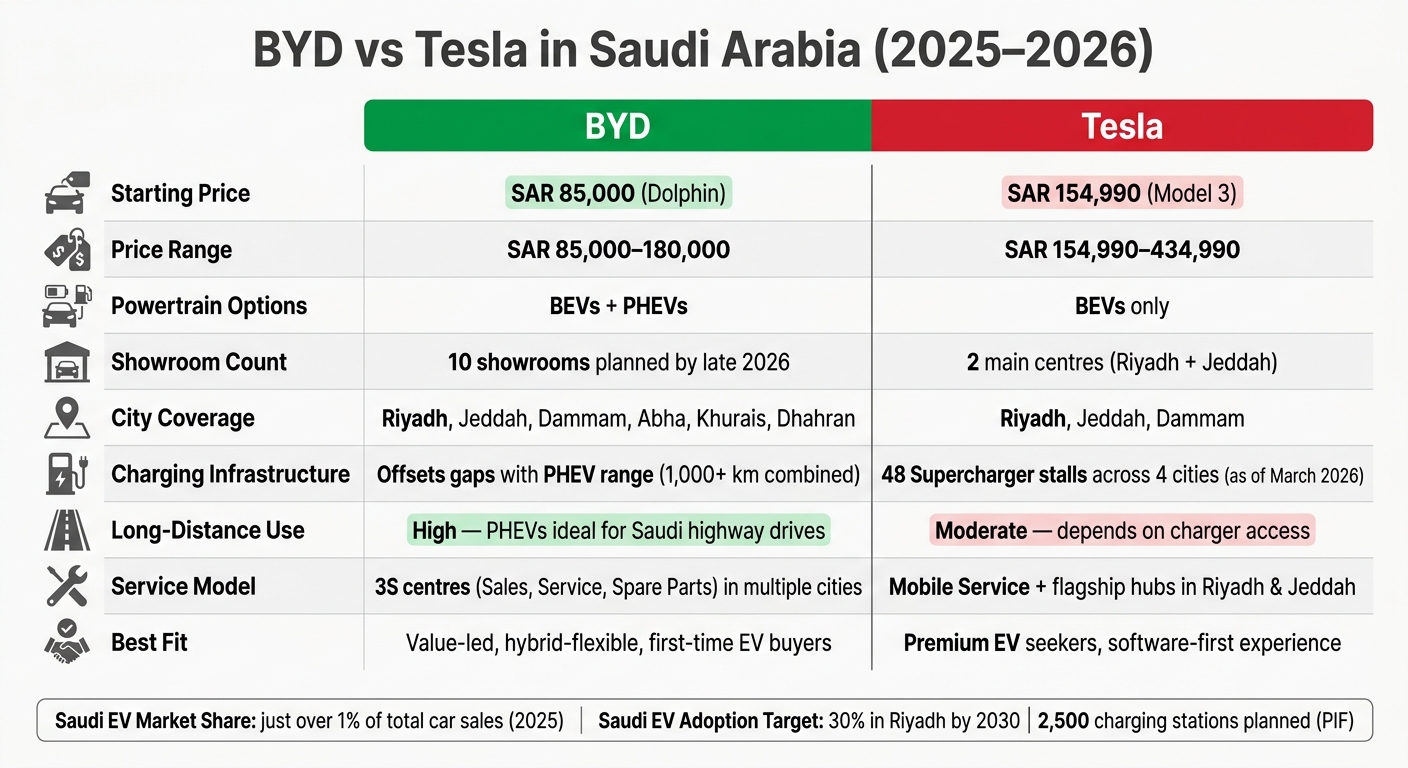
BYD vs Tesla in Saudi Arabia: Price, Reach & Charging Compared (2025–2026)
BYD Triples Saudi Showrooms as Tesla Arrives: Inside the Race
1. BYD Saudi Arabia
BYD entered Saudi Arabia in May 2023. By early 2025, it had opened showrooms in Riyadh, Jeddah, and Dammam, and later expanded to Abha, Khurais, and the Mall of Dhahran - the Kingdom's first in-mall EV showroom. That gives BYD a much broader physical footprint than Tesla's single Riyadh launch site.
Each location follows BYD's 3S model: sales, service, and spare parts in one place. For buyers, that matters. It means certified servicing and spare-parts support are available where the car is sold, which helps ease one of the biggest concerns around EV ownership in the Kingdom: dependable aftersales support.
BYD is also giving buyers more choice across price points and powertrains. The Atto 3 starts at about SAR 112,500, while the Seal and HAN move into higher-priced battery-electric options. Buyers who want extra range confidence can look at the Song Plus and Qin Plus plug-in hybrids, which offer more than 1,000 km of combined range.
That mix makes sense in Saudi Arabia. Long drives between cities are common, and the charging network is still limited, with about 101 fast-charging stations as of mid-2025. So BYD isn't just selling pure EVs. It's also giving cautious buyers a halfway step with plug-in hybrids.
Al-Futtaim says BYD's tech-led positioning fits Saudi's young, early-adopter buyers.
The brand is set up to appeal to first-time EV buyers as well as more established car shoppers. That includes younger drivers, families, and people who spend a lot of time on the road. The survey data points in the same direction: 81% are considering an EV, and 62% say BYD's tech-first design is a main reason for their interest. For Saudi buyers who want in-person reassurance, a lower starting price, and the option of hybrid range backup, BYD comes across as the easier entry point.
2. Tesla Riyadh Launch
Tesla began its Riyadh rollout with a launch event on 10 April 2025. Its main retail hub, the Tesla Center on Takhassousi Road, opened on 26 June 2026 and brings sales, service, and brand displays together in one place. In March 2026, Tesla also opened a centre at Jeddah Auto Mall, giving it a permanent base outside Riyadh as well.
That gives Tesla a premium retail setup. But compared with BYD’s growing network, its footprint is still much smaller.
Tesla’s current line-up in the Kingdom focuses on three models:
| Model | Starting Price (SAR) |
|---|---|
| Model 3 | 154,990 |
| Model Y | 189,990 |
| Cybertruck | 434,990 |
For buyers, that price difference matters just as much as the badge on the bonnet.
Deliveries for Model 3 and Model Y start after the Riyadh centre opens, while Cybertruck deliveries are due by the end of 2026.
Charging is another part of the picture. Tesla launched 24 Supercharger stalls across Riyadh, Jeddah, and Dammam on 11 April 2025. By March 2026, it had expanded that to 48 operational chargers across four cities, including Taif. That said, access is still concentrated in the biggest urban areas.
On the service side, Tesla is rolling out Mobile Service for maintenance at home or at work. That helps fill some of the gaps for owners outside the main city hubs.
Full Self-Driving (Supervised) is being shown locally and is still waiting for regulatory approval before launch.
Put simply, Tesla’s Saudi model is led by Riyadh. It leans on one flagship hub, direct sales, and mobile support for customers beyond the main cities. Tesla is going after the premium end of the market, while BYD is pushing a broader, lower-cost, easier-to-reach offer.
BYD vs Tesla: Pros and Cons for Saudi Buyers
As both brands grow their on-the-ground presence, Saudi buyers are left with a pretty practical choice: which one matches their budget and the way they actually drive? For most people, it comes down to four things - price, reach, charging, and day-to-day use.
The price gap stands out straight away. BYD's Dolphin starts at SAR 85,000, while Tesla's Model 3 starts at SAR 154,990. That's a big jump, especially in a market where EVs still make up just over 1% of total car sales. For buyers watching costs, BYD lands in a far easier range.
Access matters too. BYD's broader footprint gives it an edge beyond the main metros. That can make ownership feel less like a leap of faith. Its PHEVs also ease range concerns for people who do long highway trips across Saudi Arabia. Tesla brings strong range, no doubt, but the ownership experience still leans more heavily on charger access.
At the same time, Tesla's growing visibility is helping put EVs on more buyers' radar. That, in turn, also helps BYD win over shoppers looking for lower-cost options with more flexibility.
Here’s how the two brands stack up on the things that shape daily ownership:
| Factor | BYD | Tesla |
|---|---|---|
| Purchase Budget | SAR 85,000 – SAR 180,000 | SAR 154,990 – SAR 434,990 |
| City Access | Excellent - 10 showrooms planned by late 2026 | Moderate - mainly limited to Riyadh, Jeddah, and Dammam |
| Long-Distance Use | High - PHEVs suit long Saudi drives | Moderate - strong BEV range, but depends on charger access |
| Service Convenience | Broad - 3S facilities across more cities | Centralised - focused on Riyadh, Jeddah, and Dammam |
| Best Fit | Value-led, hybrid-flexible buyers | Premium EV experience seekers |
So the split isn't just about badge appeal. It's more about how the car fits into daily life. BYD suits value-led buyers and people who do longer drives. Tesla suits buyers chasing a premium EV experience. In simple terms, each brand is serving a different kind of Saudi buyer.
Conclusion
Saudi buyers are the clear winners in the BYD-Tesla race. More competition means more choice, easier access, and better pressure on pricing and service across the market.
BYD is still the value-and-scale option - about SAR 112,500 for the Atto 3, plug-in hybrid choices with more than 1,000 km of combined range, and a goal of 10 showrooms by late 2026. Tesla is still the premium pick, with a stronger software feel and more status appeal, but also a higher starting price and a physical footprint that is still focused on its Riyadh flagship.
Saudi Arabia’s target of 30% EV adoption in Riyadh by 2030 and the Public Investment Fund’s plan for 2,500 charging stations across the Kingdom give both brands more room to grow. BYD is pushing from the mass-market side, while Tesla is pushing from the premium end.
So the question has shifted. It’s no longer just about going electric. It’s about which brand suits your driving needs and your budget. And at the moment, buyers come out on top.
FAQs
Which brand is better for first-time EV buyers in Saudi Arabia?
For first-time EV buyers in Saudi Arabia, the decision usually comes down to price and powertrain choice.
BYD is the easier entry point. It offers both fully electric and plug-in hybrid models, with starting prices below Tesla’s more premium lineup. That gives new buyers a bit more room, especially if they’re not ready to spend at the top end of the market.
Its growing network of integrated 3S facilities could also appeal to buyers who want aftersales support, expert advice, and local servicing as they move to electric driving.
Are BYD plug-in hybrids better for long drives?
Yes. BYD plug-in hybrid electric vehicles are a strong fit for long drives in Saudi Arabia.
Models like the BYD Song Plus and Qin Plus offer over 1,000 km of combined range from a full charge and fuel tank. That gives drivers the sort of distance that makes sense for Saudi Arabia’s long highway routes.
How much does showroom access matter after buying?
Showroom access plays a big part in long-term ownership. It gives owners one clear place to go for aftersales support, technical help, and specialist advice.
That matters more than many buyers expect. When sales, servicing, and parts are easy to access, ownership tends to feel simpler and less stressful.
Facilities such as 3S centres bring sales, service, and spare parts together in one place, which makes maintenance and repairs easier. Nearby showrooms also give customers convenient access to certified technician support.