The Egyptian car market in 2026 is seeing major changes due to customs adjustments, favoring locally assembled cars over imports. Here's what you need to know:
-
Customs Duties: Imported cars face high tariffs (40%–135%), while local assembly inputs now enjoy reduced tariffs (2%–5%).
-
Price Trends: Locally assembled cars like the BYD F3 start at EGP 590,000, while imported luxury models like the BMW X7 can cost up to EGP 10.2 million.
-
Market Shift: Local cars are outselling imports due to affordability, better availability, and stable pricing.
-
Electric Vehicles: EVs now face duties unless imported from EU or Agadir Agreement countries.
-
Popular Models: Affordable options under EGP 1 million include the Suzuki S-presso (EGP 630,000) and Nissan Sentra (EGP 999,000).
These changes make locally assembled vehicles a more practical choice for buyers in Egypt this year.
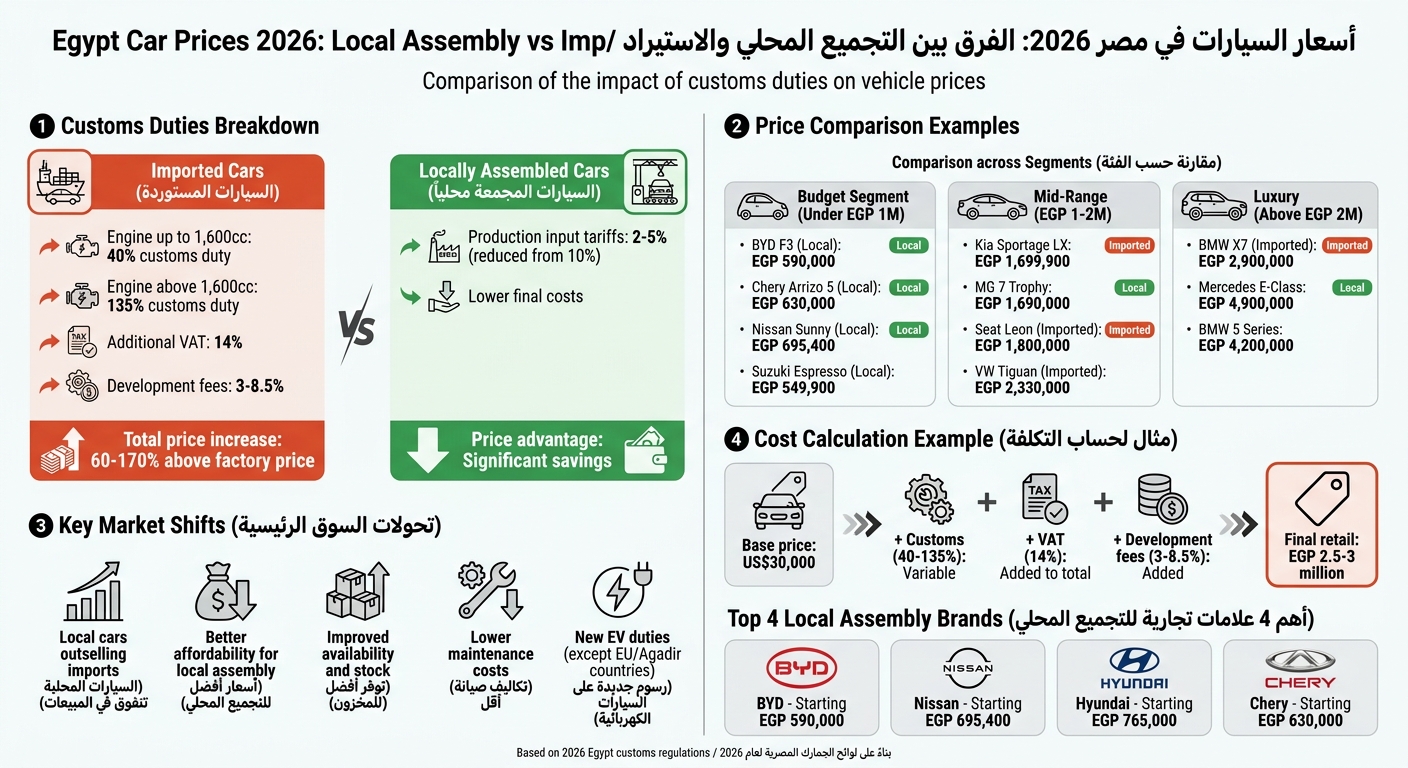
Egypt Car Prices 2026: Customs Duties Impact on Locally Assembled vs Imported Vehicles
اكثر وافضل سيارات مبيعا في مصر 2026 مع أسعار الأشهر أحدث تقرير شهر فبراير الأجمل
How Customs Duties Affect Car Prices
Customs duties play a big role in determining car prices, especially in Egypt. The government uses a tiered system based on engine size: vehicles with engines up to 1,600cc are hit with a 40% customs duty, while those with larger engines face a hefty 135% duty. These duties alone can significantly inflate the price of imported vehicles, even before additional taxes are applied.
Egypt calculates these duties using the CIF (Cost, Insurance, and Freight) method, which includes the vehicle's total landed cost. On top of this, a 14% VAT is added to the combined value of the vehicle, customs duties, and other fees. Development and service fees - ranging between 3% and 8.5%, depending on engine size - further add to the final price. These layers of taxation create a noticeable difference in pricing across various vehicle categories.
Price Changes Across Vehicle Categories
For economy cars, the final price can rise by 60–65% over their base price. Mid-range and luxury vehicles, however, can see their costs soar to more than 170% of the factory price. This significant price jump has made locally assembled models, such as the BYD F3 (starting at EGP 590,000), increasingly attractive to buyers. For instance, a vehicle with a factory price of US$30,000 could end up retailing for EGP 2.5–3 million once all duties and fees are factored in.
Understanding Import Costs and Duties
To better grasp how these taxes influence prices, it’s important to understand the breakdown of import costs. Policies planned for 2026 aim to differentiate more clearly between imported vehicles and locally assembled ones. While fully imported cars will still face duties ranging from 40% to 135%, tariffs on production inputs have been reduced to 2–5%, down from the previous 10%.
"A large portion of the production inputs is currently subject to the same customs category imposed on imported final products, which represents a 'tax distortion' that the government is working to correct." – Government Official
This change gives locally assembled vehicles a pricing edge, as manufacturers benefit from reduced tariffs on their inputs. As a result, they can offer more competitive prices. Interestingly, electric vehicles are also subject to duties now, except for those imported from countries under the EU or Agadir Agreement.
Locally Assembled Cars: What You Need to Know
High import duties have made locally assembled cars an attractive option for buyers. These vehicles dominate Egypt's market by sidestepping hefty import taxes. With the government reducing tariffs on production components to as low as 2–5% from the previous 10%, manufacturers can price these cars more competitively than imports. Locally assembled cars start at around EGP 590,000, far below the 1 million EGP price tag often associated with imported models. Additionally, maintenance costs are lower, thanks to the easy availability of locally produced spare parts.
Main Brands and Models Assembled in Egypt
Four major brands lead the economy segment in Egypt: BYD, Nissan, Hyundai, and Chery. Here’s a closer look at some of their popular models:
-
BYD F3: Priced between EGP 590,000 (manual) and EGP 680,000 (automatic), this model features a 1.5L engine delivering 108 hp.
-
Chery Arrizo 5: Available from EGP 720,000 to EGP 805,000, it offers a 1.5L engine with CVT transmission and 114 hp.
-
Nissan Sunny 2026: Ranging from EGP 745,000 to EGP 835,000, it comes with a 1.5L engine producing 108 hp and averages 6.9 litres per 100 km.
-
Hyundai Accent RB: Priced between EGP 729,900 and EGP 840,000, this model runs on a 1.6L engine with 125 hp.
Local Assembly vs. Imported Cars: Price and Features
The price difference between locally assembled and imported cars is striking. For instance, the locally assembled Chery Arrizo 5 starts at EGP 630,000, while imported cars like the Seat Leon and VW Tiguan are priced at EGP 1.5 million and EGP 2.33 million, respectively. This affordability makes locally assembled cars more appealing to budget-conscious buyers.
Imported models often feature advanced specs and luxury finishes, but locally assembled cars focus on practical features better suited to local conditions. They offer improved fuel efficiency, reliable performance, and lower maintenance costs.
Another advantage of locally assembled vehicles is their availability and price stability. Imported cars frequently face stock shortages, delivery delays, and price markups due to limited supply. In contrast, locally assembled options are readily available, with consistent pricing. Brands like Nissan and Hyundai also tend to hold their value better in Egypt's used car market, making them a smart choice for buyers prioritising dependability and resale value.
This combination of affordability, practicality, and availability positions locally assembled cars as a strong contender in Egypt’s automotive market.
Affordable Cars Under 1 Million EGP
Thanks to customs duty adjustments and the advantages of local assembly, cars in the sub-1 million EGP range remain an appealing choice for buyers in 2026. Local production helps keep prices competitive, while Chinese brands have gained traction by offering feature-packed models at attractive prices. The market, however, is in a "cautious balance", with some manufacturers holding prices steady while others apply modest increases to cover rising production costs. Below, we explore some of the best entry-level cars available in this price range for 2026.
Best Entry-Level Cars for 2026
For those on a budget, the Suzuki S-presso starts at EGP 549,900, offering a compact hatchback design that suits city driving. If you're leaning towards sedans, the Renault Logan is priced at EGP 470,000, providing a straightforward, practical option - though its availability may be limited.
Chinese automakers dominate the budget-friendly segment with modern features and competitive pricing. The JAC S2, a small crossover, is available for EGP 739,900, while the BAIC U5 Plus ranges between EGP 724,900 and EGP 854,900. Another popular choice is the MG 5, priced from EGP 924,990 to EGP 1,024,990, offering exceptional value for money.
Locally assembled models also shine in this category, combining affordability with dependable performance. The Nissan Sentra, priced at EGP 999,000, delivers 118 hp from its 1,600cc engine and remains one of Egypt's most popular sedans. For hatchback fans, the Hyundai i20, at EGP 900,000, boasts excellent fuel efficiency, consuming just 5.8 litres per 100 km. If you're considering an SUV, the Chery Tiggo 4 Pro is priced between EGP 895,000 and EGP 1,000,000, making it a solid choice for those willing to stretch their budget.
For buyers needing financial flexibility, the market offers a variety of financing options to make purchasing easier.
Payment Plans and Financing for Budget Buyers
Egypt's vehicle production is expected to reach around 165,000 units during the 2026–2027 period. If you're looking for the best deals, waiting for year-end stock clearance sales could save you tens of thousands of EGP.
For buyers struggling with down payments on new cars, the used market offers alternatives like the 2022 BYD F3, which costs around EGP 550,000. Financing is often more accessible for locally assembled vehicles due to their lower maintenance costs.
"The market remains at a delicate balance point between supply and demand, with a state of anticipation continuing, making the purchase decision linked to actual need." – Al-Ain News
Experts suggest purchasing a new car only if it's a necessity, as prices are likely to fluctuate in the near term. With exchange rates stabilising, more buyers are focusing on economy cars that deliver the best "value for money".
Mid-Range and Luxury Cars: 1-2 Million EGP and Above
While budget-friendly cars serve entry-level buyers, the mid-range and luxury segments cater to those looking for more advanced features, better performance, and added prestige. In the 1-2 million EGP price range, SUVs and high-trim sedans from brands like Kia, Hyundai, MG, and Geely dominate the market. Recent customs adjustments have made locally produced vehicles more competitive, while tariffs on finished imported cars, especially from China, are expected to rise. Additionally, the Egyptian government has begun imposing customs duties on imported electric vehicles.
Top Mid-Range Cars (1-2 Million EGP)
The mid-range category offers a mix of affordability and premium features. For SUV enthusiasts, the Kia Sportage LX starts at EGP 1,699,900, providing a dependable and safety-focused option. Sedan lovers might consider the MG 7 Trophy, priced at EGP 1,690,000, which combines high performance with a tech-forward interior.
Hybrid and electric vehicles are gaining popularity in this segment. The Dongfeng Huge Hybrid (EGP 1,695,000) stands out for its fuel-efficient hybrid engine, appealing to buyers mindful of rising fuel prices. Similarly, the Geely Geometry C Comfort (EV), priced at EGP 1,699,900, highlights the growing demand for electric cars. For those drawn to European engineering, the Skoda Octavia A8 Loft (EGP 1,700,000) and the Citroen C5 Aircross Shine Entry (EGP 1,720,000) offer refined designs and advanced features.
Other notable options include the Hyundai Tucson Blaze at EGP 1,749,000 and the sporty Kia K4 GT-line Black Edition for EGP 1,749,900. Buyers seeking all-wheel-drive capability might opt for the Mitsubishi Eclipse Cross Instyle TL, priced at EGP 1,660,000.
Premium and Luxury Models Available in Egypt
Stepping beyond mid-range vehicles, premium and luxury cars deliver unmatched performance and sophistication. German brands like BMW, Mercedes-Benz, and Audi dominate this market, though high-end electric vehicles and Asian brands such as Genesis and Zeekr are gaining traction. The Mercedes-Benz E-Class starts at EGP 4,900,000, while the BMW 5 Series begins at EGP 4,200,000, offering a blend of prestige and cutting-edge technology.
For those seeking ultimate luxury, the Mercedes Maybach S 680 4M Saloon (4,000cc) is priced at EGP 22,800,000, making it one of the priciest vehicles available. Performance enthusiasts can explore the BMW X7 M60i and BMW X6 M60i (4,400cc), priced between EGP 9,250,000 and EGP 10,200,000.
The luxury electric segment is also thriving, with options like the BMW i7 xDrive60 at EGP 11,000,000 and the Audi RS e-tron at approximately EGP 7,900,000. For buyers seeking high-tech features at a competitive price, the Kia EV9 (EGP 3,700,000) offers a seven-seat luxury electric SUV experience that rivals costlier European models. The Zeekr 001 Performance AWD, priced at EGP 3,050,000, delivers acceleration and technology on par with European vehicles priced over EGP 6,000,000.
"The move, aimed at correcting tax distortions, seeks to lower local manufacturing costs and position Egypt as a competitive regional industrial hub." – Asharq Business
How to Buy a Car in Egypt: Step-by-Step Guide
Buying a car in Egypt involves navigating several steps, especially with the customs changes in 2026. Customs duties and local assembly affect car prices, making it essential to understand the process thoroughly. From choosing financing options to finalising paperwork, following these steps can make your car-buying experience much smoother in today’s market.
Vehicle Inspection and Warranty Checks
Before committing to a car purchase, conduct a detailed inspection of the vehicle. For new cars, ensure all promised features are included and verify the manufacturer's warranty. If you're buying a used car, note that most financing institutions require an inspection at an authorised centre to determine the car's market value. Additionally, financing for used vehicles is typically restricted to cars manufactured within the past 10 years.
When inspecting a used car, pay close attention to the following:
-
Body Panels: Ensure uniform gaps and consistent welding. A magnet can help detect hidden body filler, as it won’t stick to repaired areas.
-
Suspension: Push down on each corner of the car; it should stabilise quickly without excessive bouncing.
-
Tyres: Check for a tread depth of at least 1.6 mm and look for sidewall bulges or cracks.
-
Cabin Condition: A burnt plastic smell could indicate electrical issues, while a musty odour may signal water leaks.
-
Test Drive: Drive the car for at least 15 minutes to assess engine acceleration, transmission smoothness, and braking performance.
These steps help protect your investment, especially in a fluctuating market. If financing the car, remember that most programmes in 2026 require insurance coverage for the entire instalment period. Always review the warranty terms carefully to ensure they align with what the dealer has promised, including the duration and the list of authorised service centres.
Choosing Dealers and Completing Paperwork
Once the vehicle inspection is complete, the next step is to choose a reliable dealer and prepare the necessary paperwork. Working with a trustworthy dealer can make a significant difference in your overall experience. In 2026, reputable options include El Masria Auto, Auto Samir Rayan, and El Lithy, along with official brand dealers like Toyota Egypt and Hyundai Egypt. These dealers are known for transparent pricing and reliable support with documentation.
For financing, you’ll need to gather the following documents:
-
Valid National ID: For identity verification.
-
Salary Slip or Income Proof: To demonstrate your ability to repay.
-
Recent Utility Bill: Serves as proof of residence (must be less than three months old).
-
Six-Month Bank Statement: Shows your financial history.
-
Price Offer (Arz Se’r): An official quote from the dealer for bank processing.
-
Down Payment Receipt: Confirms your initial payment to the dealer.
| Required Document | Purpose |
|---|---|
| Valid National ID | Identity verification for Egyptians |
| Salary Slip / Income Proof | Verification of repayment ability |
| Recent Utility Bill | Proof of residence (max 3 months old) |
| 6-Month Bank Statement | Financial history for the lender |
| Price Offer (Arz Se'r) | Official quote from the dealer for the bank |
| Down Payment Receipt | Proof of initial payment to the showroom |
Additionally, ensure you have a valid car licence or a recently issued Data Certificate (Shahadat Bayanat), no older than a month. A Certificate of Violations (Shahadat Mokhalafat) is also required to confirm that all traffic fines have been cleared. During the ownership transfer, the traffic department will verify the car's chassis and engine numbers. Don’t forget to obtain compulsory insurance papers.
Finally, compare fixed interest and diminishing interest options to find the most cost-effective financing plan. Increasing your down payment can also help reduce the overall interest you’ll pay over time.
What to Expect: Market Trends Beyond 2026
Expected Price Changes in Coming Years
Egypt's automotive market is heading toward significant changes, with pricing dynamics between locally assembled and imported vehicles poised for a shake-up. The upcoming customs reforms, set for a parliamentary vote in March 2026, will create a clear divide in costs. Locally assembled vehicles are expected to benefit from reduced input costs, as tariffs on production components will drop sharply - from 10% to as low as 2–5%. This reduction aims to make local production more competitive and affordable for buyers.
On the other hand, imported vehicles, especially those coming from China, will face higher tariffs. This move is part of a protectionist strategy to boost domestic production and is aligned with the government's industrial goals, which include achieving an industrial output of EGP 2.9 trillion by 2026. As a result, prices for imported models are likely to rise significantly in the coming years, further encouraging a shift toward locally assembled options.
Another major change involves electric vehicles (EVs). For the first time, Egypt plans to impose customs duties on imported EVs, ending the current duty-free status. Buyers considering EVs might find it advantageous to make their purchases before these duties are implemented. However, the exact timeline for this change will depend on parliamentary decisions.
How Policy Changes May Affect the Market
The government's broader strategy aims to address what officials call "tax distortion", where production inputs were previously taxed at the same rate as finished products. Speaking on the matter, one official noted:
"The plan involves cutting tariffs on 60 to 70 categories of industrial components... while the government simultaneously plans to hike tariffs on finished products, specifically those imported from China"
Interestingly, free trade agreements with the EU and Agadir will remain intact, ensuring vehicles from these regions retain their competitive edge in pricing. This policy shift underscores the government's push to prioritise local assembly, which has already shown growth in non-oil manufacturing sectors.
For buyers, this means locally assembled cars will likely offer better value in the near future. The government's National Strategy for Localising the Automotive Industry will continue to provide incentives such as tax breaks and customs exemptions to manufacturers that achieve higher local component percentages. These measures will further widen the price gap between domestic and imported vehicles, making locally assembled options increasingly appealing.
Conclusion: Making Smart Car Buying Decisions in 2026
The Egyptian car market in 2026 offers a clear advantage for those who focus on locally assembled vehicles. With customs duties on production components reduced to as low as 2–5% from the previous 10%, cars from brands like BYD, Nissan, and Hyundai stand out as cost-effective choices. For instance, the BYD F3 starts at EGP 590,000, making it a more affordable option that’s also readily available.
When evaluating options, it's essential to consider the total ownership costs rather than just the sticker price. Locally assembled cars come with the benefit of extensive service networks and easily accessible spare parts - key factors that help keep maintenance and repair costs manageable over time. This comprehensive perspective ensures long-term savings.
Timing your purchase can also make a big difference. For electric vehicles, buying before customs duties increase could save you money. Meanwhile, for petrol-powered cars, waiting until the end of the year might secure better deals, as dealers often offer discounts to clear inventory. Using online platforms to compare technical specifications can also help you find models with advanced features at competitive prices.
Before making a final decision, check warranty terms and the availability of local support. Established assembly operations by brands like Toyota, Nissan, and Hyundai often provide greater reliability and easier access to service. Additionally, with the government aiming for an industrial output of EGP 2.9 trillion by 2026, locally assembled cars are likely to become even more appealing as supportive policies continue to develop.
For added savings, explore the "broken zero" market for near-new 2026 models, which could save you up to EGP 170,000. Whether you’re eyeing an economy sedan under EGP 1 million or a mid-range SUV, the same principles apply: prioritise local assembly, ensure parts availability, and account for total ownership costs. By keeping these factors in mind, you’ll be well-equipped to make a smart and informed car-buying decision in this dynamic market.
FAQs
How do I calculate the final on-road price after customs and VAT?
To figure out the final on-road price of a car in Egypt for 2026, here's what you'll need to do:
-
Start with the base price: This is the car's cost before any taxes or duties are added.
-
Add customs duties: Multiply the base price by the duty rate applicable at the time (e.g., 5%).
-
Factor in VAT: Once customs duties are added, calculate VAT on the resulting amount.
Make sure to double-check the latest customs duty and VAT rates, as these can change over time.
Is a locally assembled car better for resale and spare parts in Egypt?
Locally assembled cars often hold an edge in Egypt when it comes to resale value and maintenance. Thanks to government incentives like reduced customs duties on industrial components, manufacturers can keep prices competitive. These vehicles usually come with lower maintenance costs, easily accessible spare parts, and greater acceptance in the used car market, making them a practical choice for many buyers.
Will EV prices rise in 2026, and which imports will remain exempt?
EV prices are projected to increase in 2026, largely due to manufacturers potentially passing higher tariffs onto consumers. That said, some imports might remain unaffected, depending on the trade agreements and policies in effect at the time.