Dubai has officially launched fully driverless Uber rides through a collaboration between WeRide, Uber, the RTA, and Tawasul. Starting from 31 March 2026, residents can book autonomous taxis via the Uber app, marking a major step in the UAE's mobility transformation. With Level 4 autonomous vehicles now operating in key areas like Jumeirah and Umm Suqeim, Dubai aims to make 25% of all trips autonomous by 2030.
Key Points:
-
Driverless Operations: No human intervention, powered by WeRide's advanced AI.
-
Booking: Select "Autonomous" in the Uber app for a seamless experience.
-
Expansion: Plans include 1,200 robotaxis covering Dubai, Abu Dhabi, and Riyadh by 2027.
-
Impact on Car Ownership: Cost-effective robotaxis may reduce the need for private cars, especially for urban commutes.
For UAE residents, this shift could mean lower car ownership costs, fewer second vehicles, and a focus on cars with advanced tech features. However, robotaxis currently operate in limited zones, making them a complement rather than a full replacement for private vehicles.
Uber And WeRide Launch Driverless Robotaxis In Dubai
How WeRide's Driverless Uber Service Works in Dubai
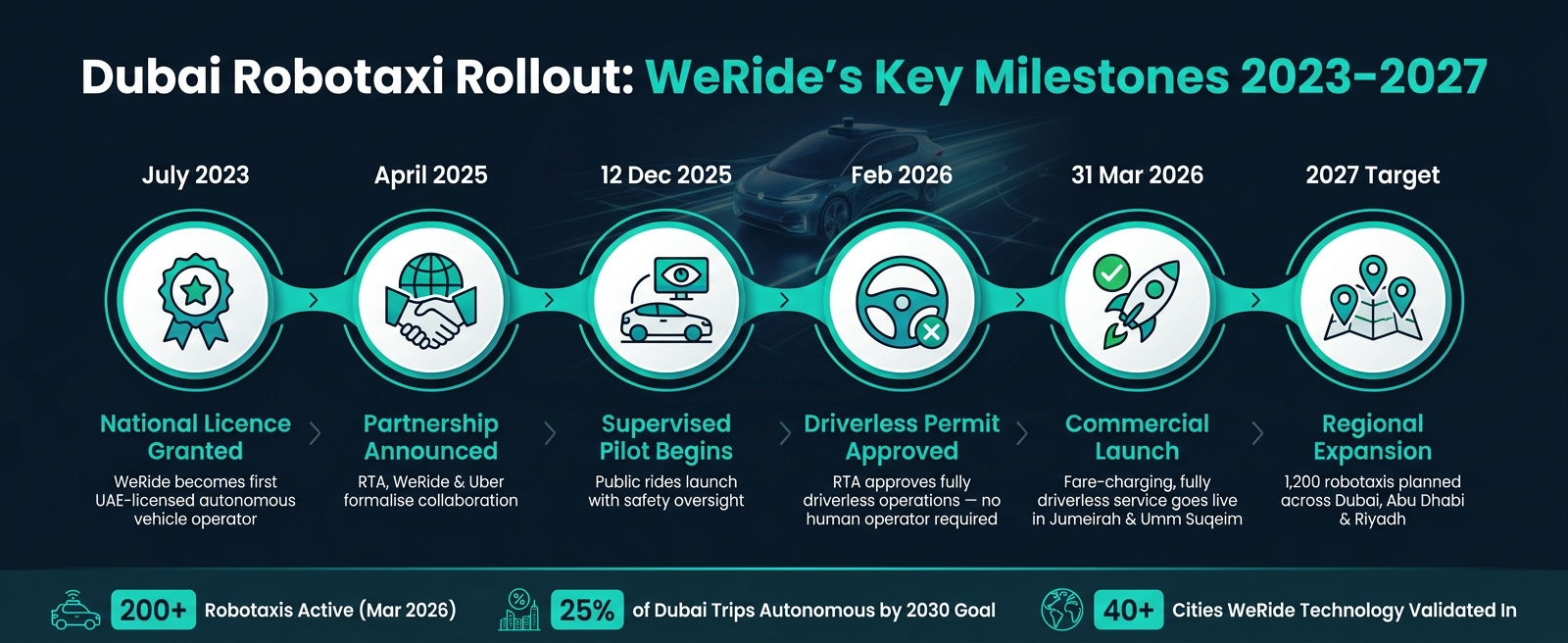
Dubai Robotaxi Rollout: WeRide's Key Milestones 2023–2027
Launch Timeline and Key Milestones
WeRide's introduction of driverless taxis in Dubai followed a carefully organised timeline. In July 2023, the company made history by becoming the first in the UAE to secure a national licence for self-driving vehicles, allowing autonomous testing on public roads across the country. By April 2025, a formal partnership was established between the RTA, WeRide, and Uber, setting the stage for the rollout of public trials.
The supervised trial phase began on 12 December 2025, offering public rides under safety oversight. After a successful pilot, the RTA granted a driverless vehicle trial permit in February 2026, eliminating the need for a human operator inside the vehicles. By 31 March 2026, full commercial operations were underway, with fare-charging services officially launched. Looking ahead, WeRide and Uber plan to have at least 1,200 robotaxis operating across Dubai, Abu Dhabi, and Riyadh by 2027. As of March 2026, over 200 WeRide robotaxis were already serving the Middle East.
| Milestone | Date | What Happened |
|---|---|---|
| National Licence | July 2023 | WeRide becomes the first UAE-licensed autonomous vehicle operator |
| Partnership Announced | April 2025 | RTA, WeRide, and Uber formalise collaboration |
| Supervised Pilot | 12 December 2025 | Public rides begin with safety oversight |
| Driverless Permit | February 2026 | RTA approves fully driverless operations |
| Commercial Launch | 31 March 2026 | Fare-charging, fully driverless service goes live |
| Regional Target | 2027 | 1,200 robotaxis planned across the Middle East |
This phased approach has set the foundation for expanding autonomous services across the region.
Service Areas and How to Book a Ride
WeRide's driverless taxis currently serve key coastal districts, starting with an initial fleet of 100 autonomous vehicles. Expansion plans are already in motion, with services expected to include areas such as Dubai Silicon Oasis, Dubai Investment Park, Jabal Ali, and suburban districts like Nad Al Sheba and Ras Al Khor.
Booking a ride couldn't be easier. Simply open the Uber app, select the "Autonomous" option when choosing your ride type, and you'll be matched with a WeRide GXR model robotaxi. There are no additional steps, making the process as straightforward as booking a regular Uber ride. This simplicity, paired with robust safety measures, aligns with the goal of integrating futuristic transport into daily life in Dubai.
What the Ride Feels Like and How Safety Works
Stepping into a WeRide GXR robotaxi is an experience in itself. The empty driver's seat is the first indicator of its autonomous nature. The vehicle operates using the WeRide One platform, which supports Level 4 driving capabilities and has been validated in over 40 cities worldwide.
"Our progress in Dubai is enabled by our autonomous driving technology that has been tested and validated worldwide. We are expanding rapidly across the Middle East and globally, driven by our vision to deploy tens of thousands of Robotaxis by 2030." - Jennifer Li, CFO and Head of International, WeRide
Safety is a top priority. The system combines high-definition digital maps, real-time data processing, and advanced AI to respond instantly to traffic signals, pedestrians, and intersections. While the car operates without a driver, Tawasul, the local fleet operator, provides remote monitoring and operational support for every trip, ready to step in if needed. These measures are part of Dubai's broader vision to ensure autonomous mobility is both safe and widely accessible.
"Bringing fully driverless vehicles to Dubai is an important milestone in making autonomous mobility a global reality. This launch underscores our deep commitment to the UAE and our vision for a hybrid world - where drivers and AVs operate side-by-side to create a more resilient network." - Sarfraz Maredia, Global Head of Autonomous Mobility and Delivery, Uber
How Robotaxis Could Change Car Ownership in the UAE
Shifts in How People Get Around Dubai
In 2024, Dubai saw over 153 million trips across public transport, taxis, and shared mobility services. Shared mobility alone grew by 28% compared to the previous year. This impressive growth happened even before the commercial rollout of fully driverless robotaxis. Now, with WeRide's service expanding beyond coastal areas into suburban and industrial zones - like Nad Al Sheba, Dubai Silicon Oasis, and Jabal Ali - robotaxis are becoming a practical choice for daily commutes. This development is starting to reshape how residents think about transportation.
Dubai has set an ambitious goal: by 2030, 25% of all journeys in the city should be autonomous. For urban commuters who primarily use private cars for short trips, this government-backed initiative is prompting a rethink of car ownership. The convenience and cost-effectiveness of autonomous transport could make owning a car less appealing.
What This Means for Private Car Demand
As ride-hailing services become more efficient, the impact on private car ownership is becoming clearer. However, the effects vary depending on the demographic. Urban commuters may find robotaxis so convenient and cost-effective that they reconsider owning a car altogether.
For families, though, the story is different. School runs, weekend outings, and the need for extra space for children and luggage mean that robotaxis might not entirely replace the family car. Instead, families might phase out their second car, holding on to their primary vehicle for specific needs.
Dr. Tony Han, CEO of WeRide, highlighted the company’s long-term vision:
"WeRide is committed to long-term operations in Dubai and will continue expanding our local fleet... ensuring our Robotaxis continue to deliver safe, dependable mobility for residents."
With plans to deploy at least 1,200 vehicles across Dubai, Abu Dhabi, and Riyadh by 2027, the current limitations in robotaxi availability are expected to diminish steadily.
Effects on Used Car Prices and Buyer Preferences
The rise of robotaxis is also expected to influence the used car market. As shared mobility grows, demand for compact urban cars - primarily used for commuting - may decline in areas with strong robotaxi coverage. This could lead to a slight drop in used car prices for these models over the medium term.
At the same time, buyers will likely prioritise vehicles equipped with advanced connectivity and driver assistance features. These preferences reflect the broader shifts in mobility, as UAE residents increasingly favour cars that align with the technological advancements shaping their daily transportation options.
Cost and Lifestyle Factors for UAE Residents
Cost Breakdown: Car Ownership vs. Robotaxi Use
Owning a car in Dubai comes with more than just the upfront cost of buying or financing. You’ll need to account for insurance premiums, Salik tolls, fuel or charging expenses, and paid parking, all of which add up significantly. In contrast, robotaxis operate on a per-trip charge. This means no upfront purchase, no annual insurance payments, and no parking fees.
WeRide achieved unit economics breakeven in October 2025, largely due to eliminating in-vehicle safety officer costs. Additionally, the launch of the HPC 3.0 platform in July 2025, featuring NVIDIA DRIVE AGX Thor chips, helped reduce autonomous driving hardware costs by 50%. These advancements are making robotaxi fares increasingly competitive with traditional ride-hailing services.
| Factor | Private Car Ownership | WeRide Robotaxi (via Uber) |
|---|---|---|
| Upfront Cost | High (purchase or financing) | Zero |
| Maintenance | Owner's responsibility | Managed by fleet operator Tawasul |
| Insurance | Annual premium required | Included in fare |
| Parking | Paid in most areas | No parking fees for passengers |
| Fuel / Charging | Ongoing expense | Covered within fare |
| Availability | 24/7 in your driveway | 24/7 via app in supported zones |
Jennifer Li, CFO and Head of International at WeRide, highlighted this progress:
"Our international footprint grows – particularly in regions like Abu Dhabi – we are seeing clear signs of improved unit economics and growing commercial viability."
These cost advantages align closely with Dubai's broader urban mobility goals.
How Robotaxis Fit Into Dubai's Urban Plans
Robotaxis are a cornerstone of Dubai's Self-Driving Transport Strategy, which aims to make 25% of all journeys autonomous by 2030. This vision is transforming Dubai's urban landscape, leading to reduced parking demand in busy areas, expanded EV charging networks for autonomous fleets, and the creation of AV-compatible road corridors.
Sarfraz Maredia, Global Head of Autonomous at Uber, emphasised:
"This launch in Dubai is a testament to our ongoing commitment to the UAE's vision for the future of mobility, and contributes directly to Dubai's goal of achieving 25% autonomous journeys by 2030."
For Dubai residents, this means the city’s infrastructure is evolving to accommodate autonomous mobility, making robotaxis increasingly practical rather than just a futuristic concept.
Day-to-Day Benefits and Limits of Robotaxi Use
Robotaxis offer more than just cost savings; they simplify daily commutes within supported zones like Jumeirah and Umm Suqeim. No more worrying about parking, refuelling, or maintenance. Booking is seamless through the Uber app - just select the "Autonomous" option.
However, there are limitations. As of March 2026, fully driverless operations are restricted to specific areas due to geofencing. This means cross-city travel or trips to zones outside the permitted regions still require a private car or traditional ride-hailing. For families and long-distance commuters, robotaxis serve as a complementary option rather than a full replacement - at least until expansions into areas like Dubai Silicon Oasis, Dubai Investment Park, and Al Hamriya Port are completed.
How UAE Residents Can Prepare for Autonomous Vehicles
Reviewing Whether You Still Need a Car
Take a moment to assess whether owning a car still makes sense for your lifestyle. Compare your daily travel routes with the active Level 4 autonomous zones, like Jumeirah and Umm Suqeim, or areas set for expansion, such as Dubai Silicon Oasis, Dubai Investment Park, Jabal Ali, and Al Hamriya Port. With shared mobility growing by 28% in 2024 and over 153 million trips recorded, owning an extra vehicle might not be the most cost-effective choice for many urban residents. However, for cross-emirate commutes, family outings, or trips beyond these zones, keeping a private car could still be practical. This evaluation helps you decide on the best vehicle options in a market increasingly shaped by autonomous technology.
Picking a Car That Works in an AV-Driven Market
If you're in the market for a new car, focus on models equipped with V2X connectivity and advanced driver assistance systems. Features like automated emergency braking, adaptive cruise control, and lane-keeping are becoming essential as the UAE progresses towards its goal of 25% autonomous journeys by 2030. Cars without these technologies may lose value faster in this evolving landscape. Tools like YallaMotor's AI-powered car valuation service can help you understand your current vehicle's market value and spot trends before making a purchase. These factors align with the cost and infrastructure changes transforming Dubai's transport scene.
Using Robotaxis Alongside Your Own Car
Many residents are already embracing a mix of private and shared mobility. Sarfraz Maredia, Global Head of Autonomous Mobility and Delivery at Uber, describes this as a "hybrid world" where human-driven and autonomous vehicles coexist to create a more flexible transport network. For instance, you could use the "Autonomous" option on the Uber app for short trips in busy areas like Jumeirah Beach, where parking is scarce, while reserving your private car for longer journeys or destinations outside the current autonomous zones. If you're thinking about reducing from two cars to one, YallaMotor's valuation tools can help you estimate your car's worth and track market demand. Selling before robotaxi coverage expands might even help you secure a better price.
Conclusion: What the Robotaxi Era Means for UAE Car Owners
Dubai's robotaxi era is no longer a concept - it's a reality. Since March 2026, fully driverless rides have been traversing the streets of Jumeirah and Umm Suqeim, thanks to WeRide and Uber operating through the Uber app, with Tawasul managing the fleet on the ground. With plans to roll out at least 1,200 robotaxis across Dubai, Abu Dhabi, and Riyadh by 2027, the transformation is well underway.
This shift signals a potential rethinking of car ownership in the UAE. The question isn't whether autonomous transport will change daily life, but how quickly and deeply it will impact. Shared mobility saw a 28% year-on-year increase in 2024, and with Dubai aiming for 25% autonomous journeys by 2030, owning multiple household vehicles might soon feel less necessary.
For those navigating this transition, tools like YallaMotor's AI-powered car valuation and detailed reviews can be invaluable. Whether you're deciding to keep your car, sell it, or invest in a new one, staying updated on market trends and understanding how your car's value shifts in this evolving landscape will help you make informed decisions.
Ultimately, the rise of robotaxis doesn't mean the end of private vehicles - it means smarter mobility decisions. Knowing when to drive your own car, when to tap "Autonomous" in the Uber app, and how to maintain or enhance your car's value will be key to thriving in this new era.
FAQs
Are robotaxis allowed to pick up and drop off anywhere in Dubai?
Robotaxis in Dubai are allowed to operate in specific areas, including Umm Suqeim and Jumeirah, for picking up and dropping off passengers. This initiative is part of a pilot and commercial programme approved by Dubai’s Roads and Transport Authority (RTA).
What happens if the robotaxi faces an emergency during my trip?
In the event of an emergency during your journey, the robotaxi's self-driving system will automatically initiate its safety protocols. On top of that, the service provider will step in to offer assistance, ensuring passenger well-being. While exact procedures might differ, the system is built to keep your safety as the top priority at all times.
Will robotaxis make my car’s resale value drop in the UAE?
The rise of robotaxis in the UAE might impact your car's resale value. As autonomous vehicles gain popularity, fewer people may feel the need to own private cars. This shift in preferences towards ride-sharing and driverless options could lead to a drop in demand for personal vehicles, potentially affecting resale prices.