


Looking for the best car in 2026? Here's the breakdown: With petrol prices in the UAE remaining affordable, choosing between a hybrid (HEV), plug-in hybrid (PHEV), or fully electric vehicle (BEV) depends on your lifestyle and driving habits. Each option has its strengths:
-
Full EVs (BEVs): Great for city drivers with home charging and annual mileage over 20,000 km. They have the lowest running costs and benefit from UAE perks like free parking and toll exemptions. However, long trips require planning due to limited fast chargers on highways.
-
Hybrids (HEVs): Ideal for long-distance drivers or those without home charging. They offer the easiest refuelling and the best resale value (60–65% after 3 years). But, petrol costs remain a factor.
-
Plug-in Hybrids (PHEVs): Best for short daily commutes under 100 km if charged nightly. They combine electric and petrol power, reducing range anxiety. However, they cost more upfront and have lower resale value (45–50%).
Quick Comparison
| Factor | Hybrid (HEV) | Plug-In Hybrid (PHEV) | Full EV (BEV) |
|---|---|---|---|
| Upfront Cost | AED 124,800 | AED 145,000 | AED 139,500 |
| Running Cost (per 100 km) | AED 30–50 | AED 15 (charged) / AED 35–50 (uncharged) | AED 11–14.70 |
| Maintenance (5 years) | 8 visits | 9 visits | 4 visits |
| 3-Year Resale Value | 60–65% | 45–50% | 50–55% |
| Best For | Long-distance drivers without charging | Suburban drivers with regular charging | City drivers with home charging |
Key takeaway: If you drive a lot and can charge at home, go for a BEV. For convenience and resale value, hybrids are a safe bet. PHEVs suit those who drive short distances and charge daily. Choose based on your driving habits and access to charging.
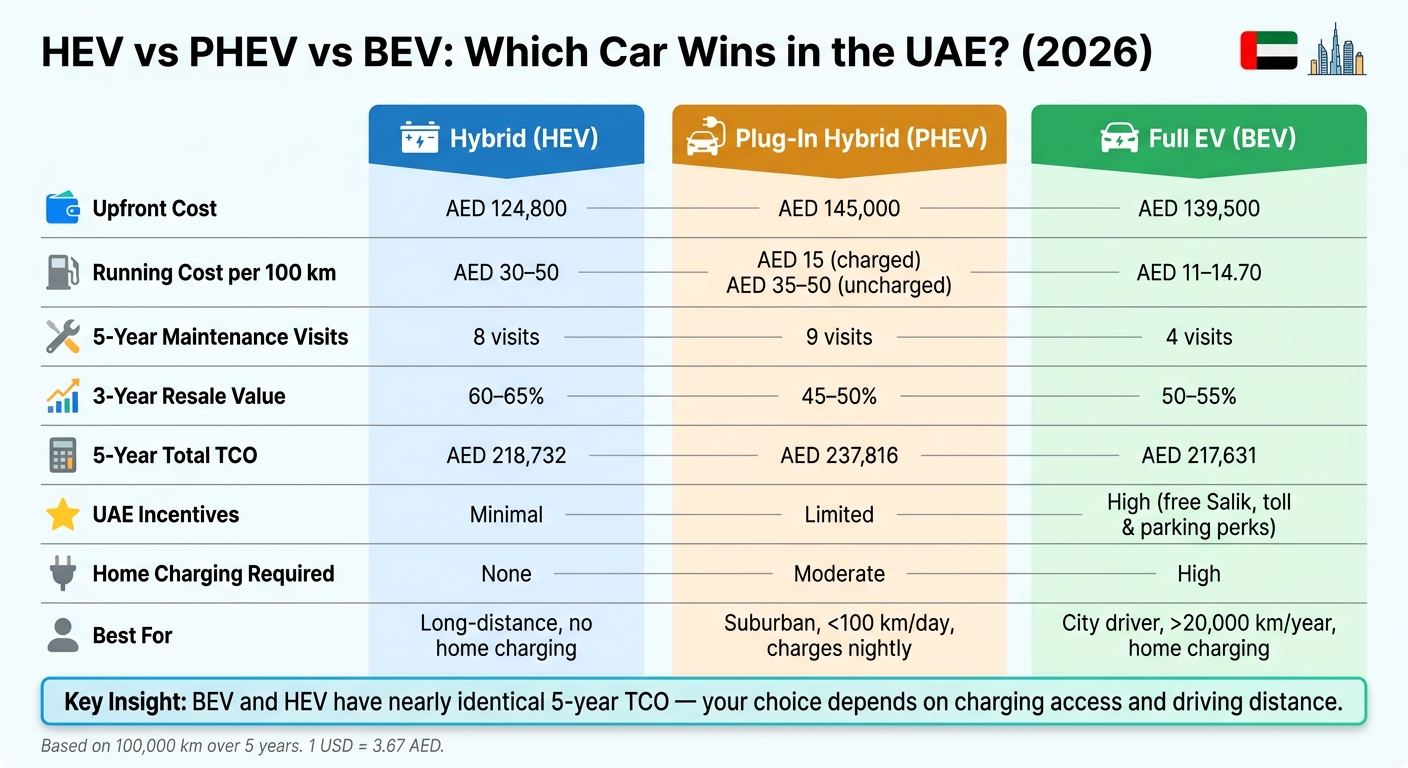
HEV vs PHEV vs BEV: Total Cost of Ownership in the UAE (2026)
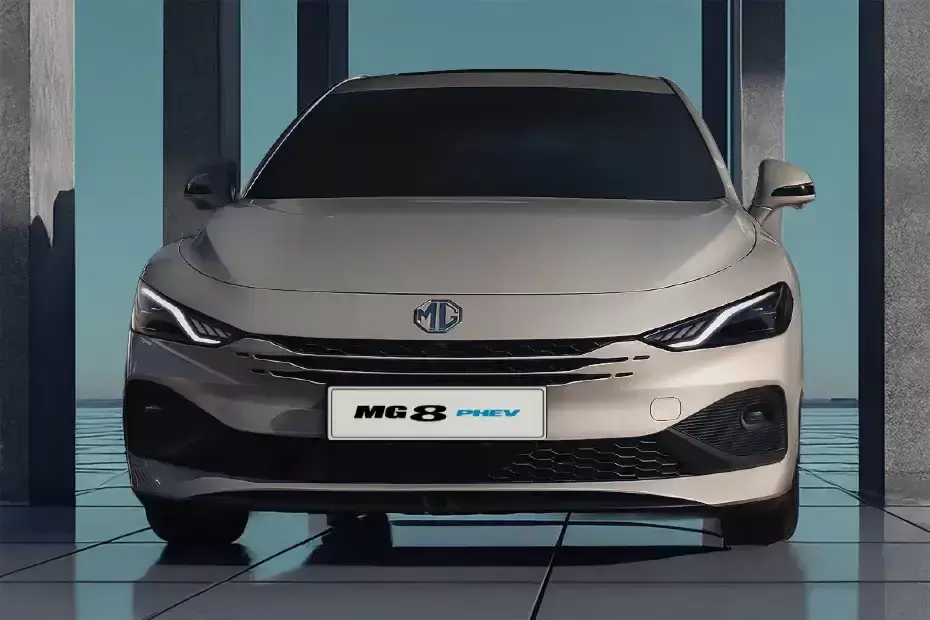
The Best PHEV for the Middle East? 2026 MG 8 PHEV Tested in Dubai
Cost of Ownership: Purchase Price, Depreciation, and Running Costs
In the UAE, mid-sized SUVs dominate the market, and when it comes to powertrain options, the upfront cost differences are relatively small. A standard hybrid (HEV) starts at approximately AED 124,800, while a fully electric vehicle (BEV) is priced at around AED 139,500. Plug-in hybrids (PHEVs) are the priciest, starting at AED 145,000, mainly because they combine two complete power systems into one vehicle.
When you look at running costs, the story changes. BEVs are the most economical, costing between AED 11 and AED 14.70 per 100 km. PHEVs, when charged daily, are slightly higher at AED 15 per 100 km, while standard hybrids average AED 30 per 100 km. Conventional petrol vehicles are the most expensive, running between AED 36.70 and AED 44 per 100 km. Over a distance of 100,000 km, these differences can have a noticeable impact on your budget. On top of that, depreciation also plays a key role in the long-term cost of ownership.
One important point about PHEVs is that they only deliver their promised efficiency if charged daily. Without regular charging, the unused battery adds roughly 300 kg of extra weight, which increases fuel costs by about 15% compared to a standard hybrid. This is a detail that many buyers might not consider.
In terms of resale value after three years, HEVs retain 60–65% of their original value. BEVs hold slightly less at 50–55%, while PHEVs trail behind at 45–50%, largely due to the complexity of their dual power systems.
When you factor in the purchase price, energy costs, maintenance, and depreciation, the five-year total cost of ownership (TCO) for these powertrains is surprisingly close:
| Cost Category | Hybrid (HEV) | PHEV (Charged Daily) | BEV (Home Charged) |
|---|---|---|---|
| Purchase Price | AED 124,800 | AED 145,000 | AED 139,500 |
| Fuel / Energy (5 yrs) | AED 30,094 | AED 15,047 | AED 11,744 |
| Maintenance (5 yrs) | AED 16,515 | AED 15,414 | AED 6,606 |
| Depreciation Loss | ~38% | ~43% | ~43% |
| Total TCO (approx.) | AED 218,732 | AED 237,816 | AED 217,631 |
These calculations are based on 100,000 km over five years, with a conversion rate of 1 USD = 3.67 AED [1].
For drivers who can charge at home and cover about 20,000 km annually, BEVs slightly edge out hybrids in terms of overall cost. However, for those who drive less, the better resale value of hybrids can make them the more cost-effective choice.
Charging and Refuelling Infrastructure Across the GCC
When considering the total cost of ownership for your vehicle, assessing the availability of local charging and refuelling facilities is just as important as factoring in costs like depreciation and running expenses. The ability to recharge or refuel your vehicle depends heavily on the type of powertrain you choose and where you live within the GCC.
The UAE leads the region in charging infrastructure development. For instance, Dubai alone boasts over 1,270 public charging points as of 2025, managed by operators such as DEWA, ADNOC (E2GO), UAEV, and Tesla. Abu Dhabi has ambitious plans to install 70,000 charging points by 2030. Meanwhile, Saudi Arabia commands the largest share of the GCC charging market at 63.22%, with its EVIQ initiative targeting 5,000 chargers across 1,000 locations by 2030. Qatar, on the other hand, is experiencing rapid growth, already equipped with over 300 charge points and projecting a compound annual growth rate (CAGR) of 52.14% through 2030.
For owners of fully electric vehicles (BEVs), urban centres in the UAE offer plenty of public charging options. However, long-distance travel still requires careful planning due to limited ultra-fast DC chargers on highways. In fact, 43% of GCC EV drivers have expressed the need for more of these high-speed chargers, particularly on routes like Dubai–Fujairah or Abu Dhabi–Al Ain. Retail centres host 79% of public charging sessions in the UAE, making them convenient for daily errands. Pricing varies significantly: fast DC public charging costs AED 1.26 per kWh (including VAT), while home charging in Dubai is much cheaper, ranging from AED 0.23 to AED 0.48 per kWh. This cost difference makes a home wallbox charger - priced at AED 2,000–5,000 - a practical investment for BEV owners.
Plug-in hybrid vehicles (PHEVs) offer a balanced solution, combining access to charging networks for short-distance trips with petrol for longer journeys, thus reducing range anxiety. On the other hand, hybrid electric vehicles (HEVs) require no charging at all. With a range of 600–800 km and the ability to refuel at any petrol station in just five minutes, HEVs are the most straightforward option for long-distance travel.
"The next phase of EV expansion for the GCC will depend on scaling ultra-fast charging, standardising digital locator tools and diversifying charging locations." - Arvind CJ, Partner, Roland Berger
Here’s a quick comparison of how different vehicle types fare in terms of refuelling ease, suitability for long-distance travel, and reliance on home charging:
| Vehicle Type | Ease of Refuelling | Long-Distance Suitability | Dependence on Home Charging |
|---|---|---|---|
| Full EV (BEV) | Moderate - planning required, relies on apps | Moderate - gaps in highway fast chargers | High - crucial for cost savings |
| Plug-In Hybrid (PHEV) | High - uses both petrol and electric power | High - effectively eliminates range anxiety | Moderate - for maximising EV mode |
| Hybrid (HEV) | Very High - refuels like a petrol vehicle | Very High - 600–800 km range | None |
Pros and Cons of Each Powertrain in the GCC
Choosing the right powertrain for your vehicle in the GCC means weighing the benefits and trade-offs of each option. Here's a breakdown to help you decide which one aligns best with your driving needs and lifestyle.
The full EV (BEV) is perfect for city dwellers who drive long distances and have access to home charging. These vehicles boast the lowest running costs and come with enticing UAE perks like free Salik tags, toll exemptions, and parking privileges. Plus, regenerative braking can extend brake life up to 150,000 km. However, BEVs typically cost 10–20% more upfront than ICE or hybrid models, and long inter-emirate drives require careful planning until fast-charging networks are more widespread.
For those who don’t have home charging but frequently drive long distances, the standard hybrid (HEV) is a strong contender. With a range of 600–800 km, HEVs also maintain the highest resale value after three years, at about 60–65%. On the downside, their electric-only range is limited to 1–2 km at low speeds, meaning drivers miss out on most UAE EV incentives. Additionally, fuel costs remain a factor over the long term.
The plug-in hybrid (PHEV) strikes a middle ground. Newer models in 2026 offer an electric-only range of 80–120 km, making them suitable for most daily GCC commutes on electric power. However, studies show that 40% of corporate fleet PHEVs are not regularly charged, which significantly reduces fuel efficiency from around 40 MPG to 28 MPG. PHEVs also involve higher mechanical complexity and have a lower resale value of 45–50% after three years.
To help you evaluate these options, here's a table summarising the key factors:
| Factor | Hybrid (HEV) | Plug-in Hybrid (PHEV) | Full EV (BEV) |
|---|---|---|---|
| Upfront Cost | Lowest | Highest | Mid-to-high |
| Running Cost (per 100 km) | AED 35–50 | AED 35–50 (without charging) / Lower when charged | AED 20–30 |
| Maintenance (5 years) | 8 visits | 9 visits | 4 visits |
| 3-Year Resale Value | 60–65% | 45–50% | 50–55% |
| UAE Incentives | Minimal | Limited | High |
| Best For | Drivers without home charging covering long distances | Those with home charging who commute shorter distances daily | City drivers with home charging who cover >20,000 km/year |
Conclusion
Your driving habits play a huge role in deciding the best powertrain for 2026.
If you drive over 20,000 km annually and have access to home charging, a full EV is your best bet. With lower running costs, fewer service requirements, and UAE-specific incentives, battery electric vehicles (BEVs) typically break even by the fourth or fifth year.
For those who don’t have reliable home charging - like apartment residents or long-distance commuters - standard hybrids (HEVs) are a more practical choice. They offer ease of use, solid resale values (around 62% after three years), and eliminate the worry of running out of charge.
Plug-in hybrids (PHEVs) suit a more specific group. They’re ideal if your daily driving is under 100 km and you’re disciplined about charging nightly. Without regular charging, their fuel efficiency drops significantly - from 17 km/L to 12 km/L - resulting in a 15% increase in fuel costs. These distinctions help pinpoint the right powertrain for your driving habits.
| Driving Profile | Best Choice | Key Reason |
|---|---|---|
| Urban commuter, home charging, >20,000 km/year | Full EV (BEV) | Lowest total cost of ownership (TCO), UAE incentives |
| Apartment dweller or long inter-emirate driver | Standard Hybrid (HEV) | Strong resale value, no charging reliance |
| Suburban driver, <100 km daily, charges nightly | Plug-in Hybrid (PHEV) | Electric-like experience for daily trips, petrol backup |
Interestingly, 2026 marks the year when entry-level BEVs reach price parity with internal combustion engine (ICE) sedans, with prices ranging from AED 95,000 to AED 110,000 before subsidies. Factors like subsidised petrol and the UAE’s rapidly growing charging network - on track to hit 50,000 public stations by 2030 - are making the shift to electric vehicles more accessible. Ultimately, understanding your driving needs is the key to choosing the right powertrain.
FAQs
How many km/year do I need to drive for an EV to pay off?
To figure out how many kilometres you need to drive annually for an electric vehicle (EV) to make financial sense, you’ll need to look at the total cost of ownership (TCO) and the savings on fuel. In the UAE, if you’re driving more than 25,000 km a year, EVs usually become the better option. Why? Because they come with lower maintenance expenses and electricity costs that are far cheaper than petrol. This mileage threshold helps balance out the higher upfront cost of EVs, especially given the region’s relatively high petrol prices.
Can I own a BEV in the UAE without home charging?
Yes, owning a BEV in the UAE without a home charging setup is entirely possible. The country boasts a robust network of public charging stations, making it convenient to recharge your vehicle as needed. With charging points readily available in many locations, you can easily keep your car powered up for daily use, even without a private charger at home.
When is a PHEV actually cheaper than a hybrid?
Plug-in hybrids (PHEVs) can actually be more cost-effective than standard hybrids (HEVs) if you charge them daily and primarily use them for short trips. Regular charging means you’ll rely more on the electric motor, which helps cut down on fuel consumption. However, if you skip frequent charging, PHEVs can end up being about 15% more expensive in fuel costs. This happens because their extra weight and less efficient use of the electric motor come into play. So, to truly save money with a PHEV, keeping it charged consistently is key.