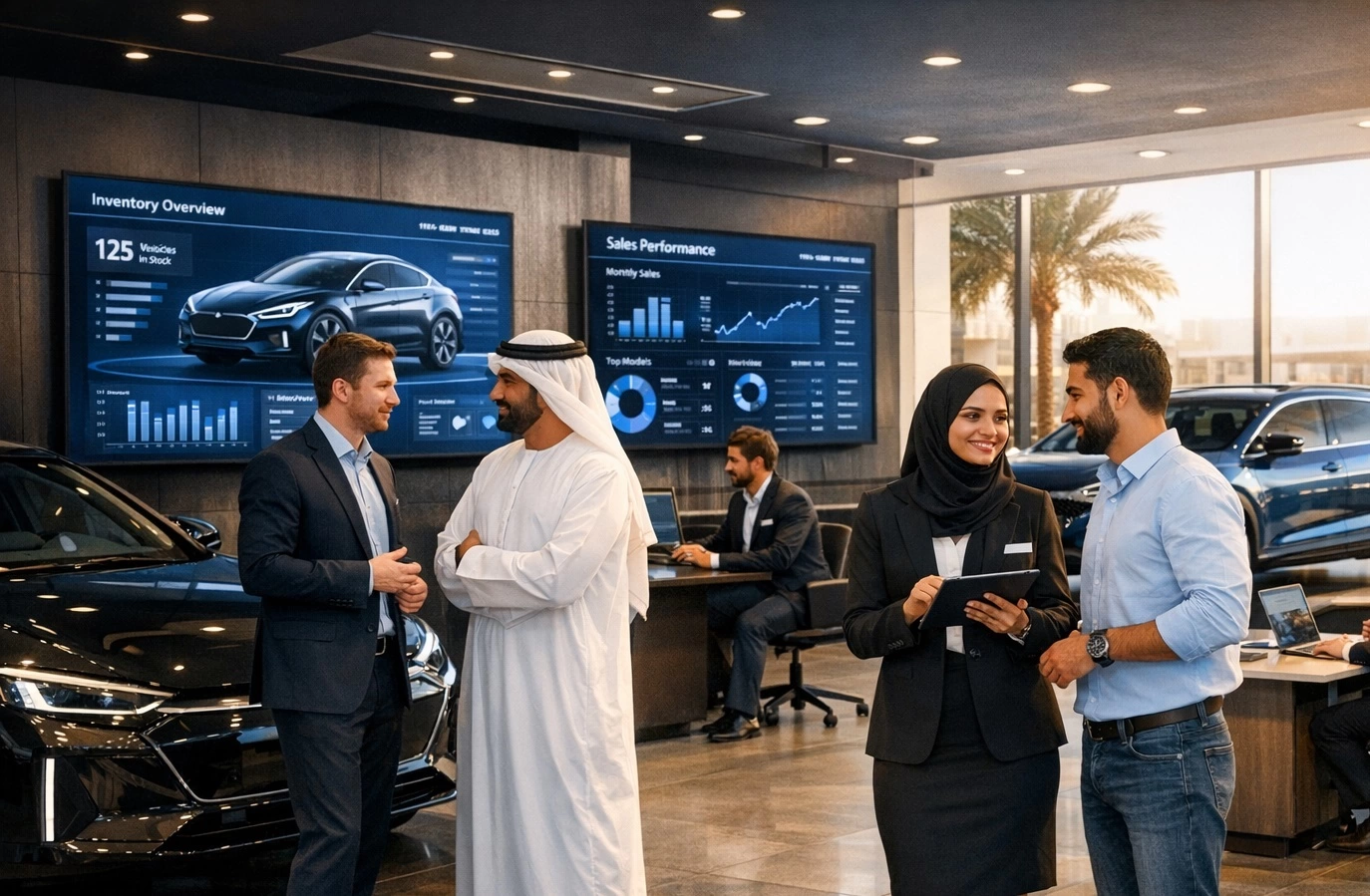
The automotive industry in the MENA region is facing rapid shifts. With 96% of buyers in the UAE and Saudi Arabia starting their car search online, dealerships must rethink how they operate. Electric vehicles (EVs) are gaining popularity, requiring 50% less after-sales service, and the used car market outpaces new car sales by 5:1. Meanwhile, competition is heating up with the entry of affordable Chinese brands.
To stay ahead, dealerships need to focus on four key areas:
-
Staff Training: Equip teams with EV expertise, digital tools, and customer service skills.
-
Digital Transformation: Implement Dealer Management Systems, AI-driven tools, and omnichannel strategies.
-
Inventory Management: Use data analytics for forecasting, diversify suppliers, and streamline stock processes.
-
EV Adoption: Expand EV offerings, partner on charging infrastructure, and train sales teams on EV features.
These strategies can help dealerships navigate challenges and meet rising customer expectations in a fast-evolving market.
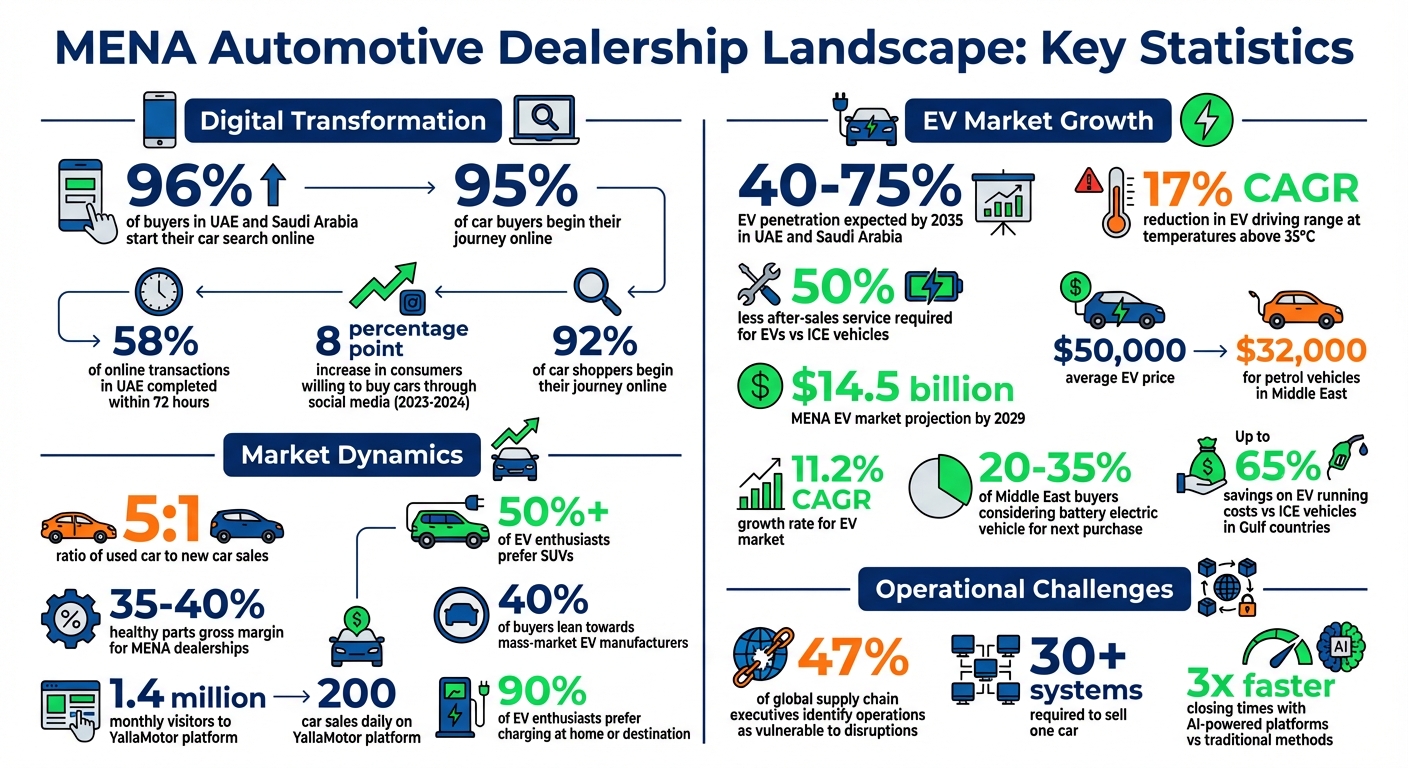
MENA Automotive Market Statistics and Dealership Challenges 2024-2035
Staff Training Checklist
Evaluate Current Skill Levels
Start by taking stock of your team's current abilities. Use key performance indicators (KPIs) like labour efficiency, revenue per employee, and customer satisfaction metrics such as the Net Promoter Score (NPS) and Customer Satisfaction Index (CSI) to pinpoint areas needing improvement. These metrics can uncover gaps in both technical expertise and customer service capabilities.
Assess how well your technicians handle digital tools like EVHC systems on tablets. In the parts department, track "turnover per employee" to gauge sales performance. High levels of lost sales or backorders often signal issues in inventory management or demand forecasting skills.
Considering the UAE’s hot climate, ensure your technical staff can carry out region-specific tests like AC vent temperature checks and cooling system pressure tests. Create feedback mechanisms that allow employees to highlight their own skill gaps.
These evaluations will lay the groundwork for training programs that address the specific needs of your team.
Implement Targeted Training Programs
Once you've identified skill gaps, focus on tailored training solutions. Equip your team with expertise in EV diagnostics, battery handling, and charging solutions - essential as EV adoption grows across the region. Strengthen their knowledge of Dealer Management Systems and enhance soft skills like communication and problem-solving. For service advisors, training on interpreting EVHC data and using visual aids to explain repairs can improve transparency and boost service acceptance rates.
Cross-training employees in roles like parts sales, inventory management, and customer service can help your workforce adapt during peak times. Tie training results to KPIs such as NPS and labour efficiency to keep employees engaged and ensure progress is measurable.
"A well-trained team can handle customer queries more effectively, upsell products, and meet sales targets." – AMENA Media
Regular workshops on new technologies can ensure your team stays up to date.
Partner with OEMs for Certifications
Collaborating with OEMs can take your team's skills to the next level. With EV penetration expected to reach 40–75% by 2035 in markets like the UAE and Saudi Arabia, OEM-specific training in areas like battery handling, charging infrastructure, and software-defined vehicle systems is becoming increasingly important.
Work with OEMs to certify staff in Electronic Vehicle Health Check (EVHC) systems, helping transition from paper-based processes to modern, transparent reporting methods. For example, Al-Futtaim Automotive’s 2025 migration from SAP ECC to SAP S/4HANA on RISE - supported by IBM Consulting - required significant staff training to adapt to the new ERP system.
Additionally, partner with software providers to refine omnichannel sales strategies, especially since 96% of buyers in the UAE and Saudi Arabia begin their shopping journey online. Link these certifications to performance goals like labour efficiency and the CSI score, ensuring the training translates into tangible improvements on the dealership floor.
Digital Transformation Checklist
Upgrade Digital Infrastructure
In today’s market, having a strong digital backbone isn’t just an option - it’s a necessity. With 95% of car buyers beginning their journey online, investing in the right tools and systems is key to staying competitive.
Start by implementing a Dealer Management System (DMS) that automates essential tasks like stock management, advertising on classified platforms, and generating business reports. Look for systems that include compliance features tailored to regional needs, such as automatic VAT calculations and RTA-compliant reporting in the UAE. For inspections, replace outdated paper processes with EVHC systems. These tools allow technicians to use tablets to capture diagnostics and share evidence directly with customers, fostering transparency and increasing service acceptance rates - which, in turn, boosts revenue for your service department.
Integrating digital financing platforms into your sales process can also make a big difference. Tools like YallaMotor Finance (powered by FinMart) enable customers to compare loan offers and apply online, smoothing the financing process. With 58% of online transactions in the UAE completed within 72 hours, removing friction at this stage can significantly speed up your sales cycle.
Automating advertising is another must. Use a DMS to push vehicle listings to multiple classified sites simultaneously, reducing manual errors. And don’t forget to future-proof your systems for upcoming 2025 RTA regulations in Dubai, which will require features like chassis number anti-counterfeiting scans and airbag effectiveness checks during ownership transfers.
Once your digital foundation is solid, you can use advanced AI tools to further optimise your inventory and customer strategies.
Adopt AI for Inventory and Customer Insights
AI tools are transforming how dealerships manage stock and understand customer behaviour. For example, leveraging data analytics within your DMS can help you predict demand for parts based on historical sales, seasonal trends, and vehicle recalls. This enables just-in-time (JIT) inventory management, where you order parts as needed rather than overstocking, improving cash flow and cutting waste.
Organise your inventory using ABC classification. This method categorises items by movement rates, ensuring frequently sold "A-class" items are always accessible, while slow-moving "C-class" items are carefully monitored to prevent obsolescence. You can also set up software to automatically reorder stock when levels dip, keeping service levels consistent. For dealerships in the MENA region, maintaining a healthy parts gross margin - typically between 35% and 40% - is critical, and AI-driven inventory systems help sustain these margins.
Cloud-based tools can streamline processes like appraisals, acquisitions, and reconditioning, reducing errors and lead times. Leading Gulf dealerships, including Al Futtaim Automotive and Emil Frey, use platforms like Autorola to digitise these workflows, seamlessly integrating them with existing CRM and ERP systems.
Breaking down silos between departments - such as used cars, parts, and service - is another game-changer. By ensuring data flows freely across teams, you can maximise profitability. Equip your staff to interpret digital reports effectively, guiding customers through repairs and identifying upselling opportunities.
Develop Omnichannel Strategies
With robust AI insights in place, the next step is to unify your digital and physical channels. When 92% of car shoppers begin their journey online, creating a seamless experience across platforms is no longer optional. Whether customers interact with your website, WhatsApp for Business, or social media, their information should be immediately accessible to staff at your physical showroom or service desk.
Use a single enterprise-grade platform to manage the entire customer lifecycle - from marketing and sales to operations and service. This eliminates reliance on disconnected tools like Excel and ensures consistency across all locations. Considering it can take more than 30 systems to sell one car, consolidating your processes is essential for efficiency.
"Digital transformation isn't just about adopting new technologies - it's about aligning your systems with strategic business goals, enhancing visibility, enabling innovation, and building resilience for the future." – Stewart Zellars and Jonah Hohner, Plante Moran
AI agents can handle routine enquiries 24/7, collecting data for human sales reps to focus on warm leads and scheduled appointments. With an 8 percentage-point increase in consumers willing to buy cars through social media platforms from 2023 to 2024, integrating these channels into your strategy is more important than ever.
Offer tools like soft-pull credit pre-qualification online to build trust and structure deals before customers visit your dealership. AI-powered platforms can reduce closing times by up to threefold compared to traditional methods. Start your transformation by digitising a few processes or focusing on a single department to establish best practices before scaling across your entire dealership group. Finally, set clear standard operating procedures (SOPs) to help staff integrate these tools into daily operations seamlessly.
Inventory Management Checklist
Conduct Regular Inventory Audits
Switching to digital checklists for inventory control is a game-changer for the fast-paced operations of MENA dealerships. Mobile audits provide real-time stock updates, eliminating the delays and mistakes often associated with paper-based systems. This digital approach is especially helpful for dealership groups managing multiple branches across the Emirates or the Gulf, ensuring seamless compliance.
During audits, focus on tracking key metrics like Inventory Turnover (how often stock is sold and replenished), Fill Rate (percentage of orders immediately fulfilled), and Days on Hand (average time parts remain in stock). Pay close attention to lost sales and backorders, as these highlight stockout patterns, helping you fine-tune procurement schedules with suppliers. Use ABC classification to manage inventory efficiently: "A-class" items with high turnover need frequent monitoring and easy access, while "C-class" slower-moving items should be limited to avoid tying up capital. For MENA dealerships, maintaining a parts gross margin between 35% and 40% is a healthy benchmark.
Given the region's intense climate, audits should include checks for heat-related wear on rubber seals and chassis bushings. Implement FIFO (First-In, First-Out) practices to sell older stock first, reducing the risk of obsolescence. To maintain optimal stock levels, set automatic replenishment triggers based on real-time inventory, sales forecasts, and supplier lead times.
Effective audits lay the groundwork for accurate demand planning.
Use Data Analytics for Demand Forecasting
Your Dealer Management System (DMS) can be a powerful tool for predicting seasonal trends, such as increased service bookings before Ramadan travel or spikes in demand during vehicle recalls. Using historical and regional data, you can forecast demand more precisely. Analysing lost sales and backorders further reveals unmet demand patterns, enabling proactive procurement adjustments.
With EV sales projected to account for 40-75% of new car purchases by 2035 in the UAE and Saudi Arabia, parts inventory strategies need to evolve. EVs require about 50% less aftersales service compared to internal combustion engine vehicles, which will significantly shift spare parts demand. Use ABC analysis to prioritise high-demand items and adopt Just-In-Time (JIT) inventory practices, which optimise cash flow by ordering based on actual demand rather than overstocking. As EV adoption grows, consider stocking value-added items like EV charging equipment and connectivity hardware.
Robust forecasting ensures a supply chain that can adapt to market changes.
Diversify Supplier Relationships
Relying on a single supplier or region is risky, especially as 47% of global supply chain executives identify their operations as vulnerable to disruptions. A "Country Plus-One" strategy - adding secondary suppliers from regions like Vietnam, India, or Mexico - can safeguard your supply chain against delays.
Start by mapping out supply dependencies to identify areas reliant on a single supplier, facility, or region. For high-turnover "A-class" items, establish multiple suppliers to ensure redundancy, while keeping a close eye on slow-moving "C-class" items to avoid overstocking. Regular quarterly business reviews and automated replenishment systems with multiple vendors can streamline collaboration across your supplier network. Additionally, sourcing from regional suppliers can reduce exposure to international shipping risks. Initiatives like Saudi Arabia's "Made in Saudi" and the UAE's "Operation 300bn" provide incentives for local sourcing.
"Supply chain resilience has become more than a competitive advantage - it's a strategic necessity." – Team Omniful
Use supplier risk scoring to evaluate vendors on factors such as reliability, compliance, lead times, and financial stability. This approach helps allocate contracts wisely and establish backup options. Unified platforms offering real-time visibility into shipments can further enhance supplier performance comparisons and enable quick responses to potential bottlenecks.
EV Adoption and Infrastructure Checklist
Expand EV Product Line
The MENA region's electric vehicle (EV) market is projected to hit $14.5 billion by 2029, with a steady growth rate of 11.2% CAGR. To align with this momentum, it's essential to tailor your inventory to local preferences. For instance, SUVs dominate the market, with over 50% of enthusiasts favouring this category. Including Plug-in Hybrid Electric Vehicles (PHEVs) in your lineup can also help address concerns about transitioning from internal combustion engine (ICE) vehicles.
While luxury brands have traditionally led the EV segment, 40% of buyers in the region now lean towards mass-market manufacturers. This shift suggests an opportunity to diversify offerings beyond premium models.
Recent trends, such as the launch of EV-specific showrooms and discovery centres by major brands, underscore the importance of creating dedicated spaces for customers to explore and test EVs. Extended test drives and hands-on experiences in these zones are proving to be effective strategies.
Given the region's climate, EVs must be equipped with advanced cooling systems and heat-resistant battery technology. Studies show that temperatures above 35°C can reduce an EV's driving range by up to 17%. Flexible ownership options, such as trade-in programmes for older ICE vehicles and buy-back guarantees, can further ease adoption concerns. These initiatives are especially relevant when the average EV price in the Middle East stands at $50,000, significantly higher than the $32,000 average for petrol vehicles.
With the right mix of vehicles in your portfolio, the next step is to focus on building a robust charging infrastructure.
Establish Charging Infrastructure Partnerships
Expanding your EV lineup is just the beginning - charging solutions are the next key piece of the puzzle. Since 90% of EV enthusiasts prefer charging at home or at their destination, consider bundling home charger installation with vehicle purchases. Showrooms can also evolve into experience centres equipped with charging facilities, offering customers a one-stop solution.
Strategic partnerships with charging service providers can help install facilities at high-traffic areas like malls and dealership locations, ensuring convenience for customers. Additionally, with 96% of auto buyers in the UAE and Saudi Arabia starting their purchase journey online, integrating tools like charging station locators and real-time availability into your website and mobile apps can bridge the gap between digital research and in-person visits.
EVs require around 50% less aftersales service compared to ICE vehicles, making charging infrastructure a valuable way to maintain customer engagement and diversify revenue streams beyond traditional maintenance services. This approach not only simplifies the ownership experience but also builds long-term loyalty.
With charging infrastructure in place, the focus can shift to equipping sales teams with the knowledge they need to guide customers effectively.
Train Sales Teams on EV-Specific Features
As operations become more streamlined with digital tools and inventory analytics, specialised training for sales teams is crucial to meet the needs of EV buyers. Equip your staff with a deep understanding of EV technology, including safety features for extreme heat and battery durability. For example, modern EVs typically offer ranges between 400km and 600km - more than enough for daily driving needs in the region.
"The total cost of owning an EV is now approaching parity in the Middle East, which basically means it is equally affordable to drive an EV compared to an internal combustion engine car." - Heiko Seitz, Global eMobility Leader and Partner, PwC
Sales teams should also be trained to highlight financial benefits, such as the up to 65% savings on running costs that EVs offer compared to ICE vehicles in Gulf countries, even with subsidised fuel prices. With 20% to 35% of buyers in the Middle East considering a battery electric vehicle for their next purchase, it’s important to focus on long-term value. This includes emphasising software updates, connectivity features, and lower maintenance needs over traditional metrics like service schedules.
Finally, align sales incentives with new performance metrics like Net Promoter Score (NPS) and Customer Satisfaction Index (CSI). These measures can help motivate teams to adapt to the evolving demands of the EV market.
Conclusion
Operating a successful dealership in the MENA region demands keeping pace with the region's rapidly evolving market dynamics. Key focus areas include staff training, embracing digital transformation, effective inventory management, and adopting electric vehicles (EVs). The ability to seamlessly blend digital and in-person experiences has become a cornerstone of success in today’s automotive landscape.
A strong emphasis on digital transformation is crucial. Tools like Electronic Vehicle Health Checks (EVHC) not only improve operational transparency but also build trust with customers. Meanwhile, Just-In-Time (JIT) inventory strategies can minimise excess stock, enhancing cash flow efficiency. Additionally, as EVs require significantly less after-sales service - about 50% less compared to traditional vehicles - dealerships must pivot towards offering value-driven services such as charging solutions, connectivity options, and specialised financing packages to sustain revenue streams.
Digital platforms also play a pivotal role in expanding market reach. For example, YallaMotor attracts over 1.4 million monthly visitors and offers integrated tools like AI-powered car valuations and unified financing solutions, enabling dealerships to streamline their operations and connect with a broader audience.
The growing used car market in the Gulf region provides another avenue for growth. With a striking 5:1 ratio of used-to-new car sales, formalising pre-owned car operations through certified programmes and online marketplaces can lead to healthier margins. Platforms like YallaMotor, which facilitate over 200 car sales daily, demonstrate how digital solutions can improve inventory turnover and reduce depreciation risks.
Staying adaptable is the key to long-term success. By implementing these strategies, dealerships can not only meet changing customer expectations but also secure a competitive advantage in the ever-evolving MENA automotive market.
FAQs
What steps can MENA dealerships take to train staff for the growing electric vehicle (EV) market?
To prepare your team for the growing EV market in the MENA region, dealerships should prioritise a mix of structured learning and hands-on experience. Begin by evaluating your staff's current understanding of EV technology, safety standards, and local specifics like UAE-approved charging tariffs and government incentives. Use this evaluation to define clear training objectives for each role.
Collaborate with OEMs or certified EV academies to provide practical training. Focus on technical areas such as battery diagnostics and high-voltage systems. For sales teams, ensure they can effectively communicate EV advantages, including lower operating costs in AED and the expanding UAE charging network. Safety training is non-negotiable, with emphasis on handling high-voltage systems and adhering to regulatory standards.
Encourage continuous improvement by leveraging digital tools like e-learning platforms and AI-driven insights for local pricing and inventory trends. Regularly monitor performance, celebrate milestones, and organise refresher courses to keep your team skilled and confident in meeting the demands of the region’s evolving EV market.
What are the key digital tools for improving dealership operations in the MENA region?
To improve dealership operations across the MENA region, leveraging the right digital tools is key to simplifying workflows and elevating customer experiences. Here are some practical solutions that can make a difference:
-
Online sales platforms: A responsive digital showroom lets customers explore inventory, book test drives, and even kick off the purchase process online. This is especially important in the UAE, where most buyers start their car search on the internet.
-
AI-powered pricing tools: Real-time valuation systems analyse market trends and vehicle conditions to deliver transparent and competitive pricing in AED, helping build trust with customers.
-
Integrated CRM systems: Centralised customer relationship tools streamline interactions, automate personalised follow-ups, and fine-tune marketing efforts for better engagement.
-
Inventory management systems: Cloud-based solutions offer real-time stock updates and automated re-order alerts, ensuring dealerships maintain efficient inventory control without overstocking or running out of popular models.
Adopting these tools can help dealerships operate more efficiently, improve customer satisfaction, and stay ahead in the fast-changing automotive market in the region.
What steps can dealerships in the UAE take to effectively manage inventory and capitalise on the growing demand for used cars?
Dealerships in the UAE can optimise profits from the growing used car market by taking a smart approach to inventory management. Start by leveraging data insights to pinpoint which makes, models, and price ranges are in high demand. This ensures your inventory aligns with what customers are actively looking for. To maintain the right balance, establish minimum stock thresholds that provide variety without overloading your lot. Aim for an inventory turnover rate of at least 12 vehicles per year, adjusting your stock mix regularly based on updated sales data.
Streamlining your operations with digital tools is equally important. A cloud-based dealership management system can help you synchronise your inventory with platforms like YallaMotor, providing real-time updates and smooth tracking from purchase to sale. These systems also make it easier to monitor costs, calculate margins, and adjust prices swiftly and transparently.
Another key element is staff training. Equip your team with the skills they need for accurate vehicle appraisal, effective use of digital tools, and improved customer interaction. Hold regular workshops on pricing strategies, valuation techniques, and financing options. Combine this with periodic audits of your stock’s condition and pricing to ensure your inventory remains competitive, accurate, and ready to meet the demands of your customers.
Looking for a used car in Dubai or new car deals? Explore YallaMotor’s verified listings today.