An EREV is an electric car where the wheels are driven by electric motors, while a petrol engine only makes electricity when the battery gets low. That’s the short answer.
If I had to sum up this guide in a few lines, I’d put it like this:
EREV = EV drive feel + petrol backup
The engine does not drive the wheels
It sits between a full EV and a plug-in hybrid
It suits Gulf drivers who do city trips during the week and long highway runs some weekends
New examples in the region include the Li Auto L9, Deepal G318, and iCAUR V27
This matters more in the Gulf because charging is growing, but long intercity routes can still leave gaps once you get outside main urban areas. The article also points to 740+ EV Green Charger points in Dubai by late 2024, while showing why many buyers still want petrol backup for longer runs.
What I like about the piece is that it keeps the buyer question simple: when battery charge drops, does the engine power the wheels or not? In an EREV, it does not. In many hybrids and PHEVs, it can.
Quick Comparison
Type | What drives the wheels? | What the petrol engine does | Best fit |
|---|---|---|---|
EREV | Electric motor only | Generates electricity | City use plus long Gulf drives |
Hybrid (HEV) | Engine and motor | Helps move the car | Fuel saving without plugging in |
PHEV | Motor at first, engine can take over | Can generate power and drive wheels | Short daily trips with charging |
The model examples in the article make that easier to picture:
Li Auto L9 (UAE): from AED 319,900, up to 350 km electric range and 1,370 km combined range
Deepal G318 (Qatar): 138 km electric range and 848 km combined range
iCAUR V27 (Egypt): about 1,000 km total range on NEDC
There are trade-offs too. An EREV can cut charger stress on long trips, but it is also heavier than a full EV and still needs engine-related servicing. If you charge often, day-to-day running can stay low. If you rely on the generator most of the time, fuel use starts to look more like a petrol SUV.
So if you’re asking me for the plain-English takeaway, it’s this: an EREV is for someone who wants electric driving most of the time without planning every long trip around charging stops. That’s why these new launches are getting attention across the Gulf.
What an Extended-Range EV Is and How the Powertrain Works
An EREV follows one simple idea: the electric motors drive the wheels, while a petrol generator makes electricity on board when the battery gets low. The petrol engine does not connect to the wheels in any mechanical way. Its only job is to spin a generator and make power. That one difference is the big separating line between an EREV and a hybrid or PHEV.
EREV Meaning in Plain English
The system has four main parts: a battery, electric motors, a petrol generator, and power-control electronics. Take the Li Auto L9 as an example. It combines a 72.7 kWh battery with motors that produce 563 hp and 710 Nm, all through electric drive. The petrol engine does not send that output to the wheels. It only supplies electricity when the system needs it.
How Energy Flows During Daily Driving
Most day-to-day use comes down to three common situations.
In the city with a charged battery, the petrol engine stays off. The battery powers the motors, and the car feels just like a pure EV: instant torque, a quiet cabin, and zero tailpipe emissions. For plenty of commuters in Dubai or Abu Dhabi, the generator may not switch on at all during the working week.
On a longer highway run, the setup changes once the battery falls to a preset level. The petrol engine starts on its own and begins making electricity. Since the engine is only generating power, it can run at steady revs instead of constantly moving up and down with road speed. That often makes it quieter and more fuel-efficient than a normal hybrid engine in the same sort of trip. In the Gulf, that matters. Long drives between cities can eat through battery range long before the next charger appears.
During braking and deceleration, the motors send energy back into the battery. In stop-start traffic on Sheikh Zayed Road or around Doha's ring roads, that can stretch electric-only driving distance and cut how often the petrol generator has to step in.
That layout is why EREVs sit in the middle ground between pure EVs, hybrids, and PHEVs. The next part makes that line easier to see by comparing them side by side.
EREV vs Hybrid vs PHEV: Key Differences for Buyers
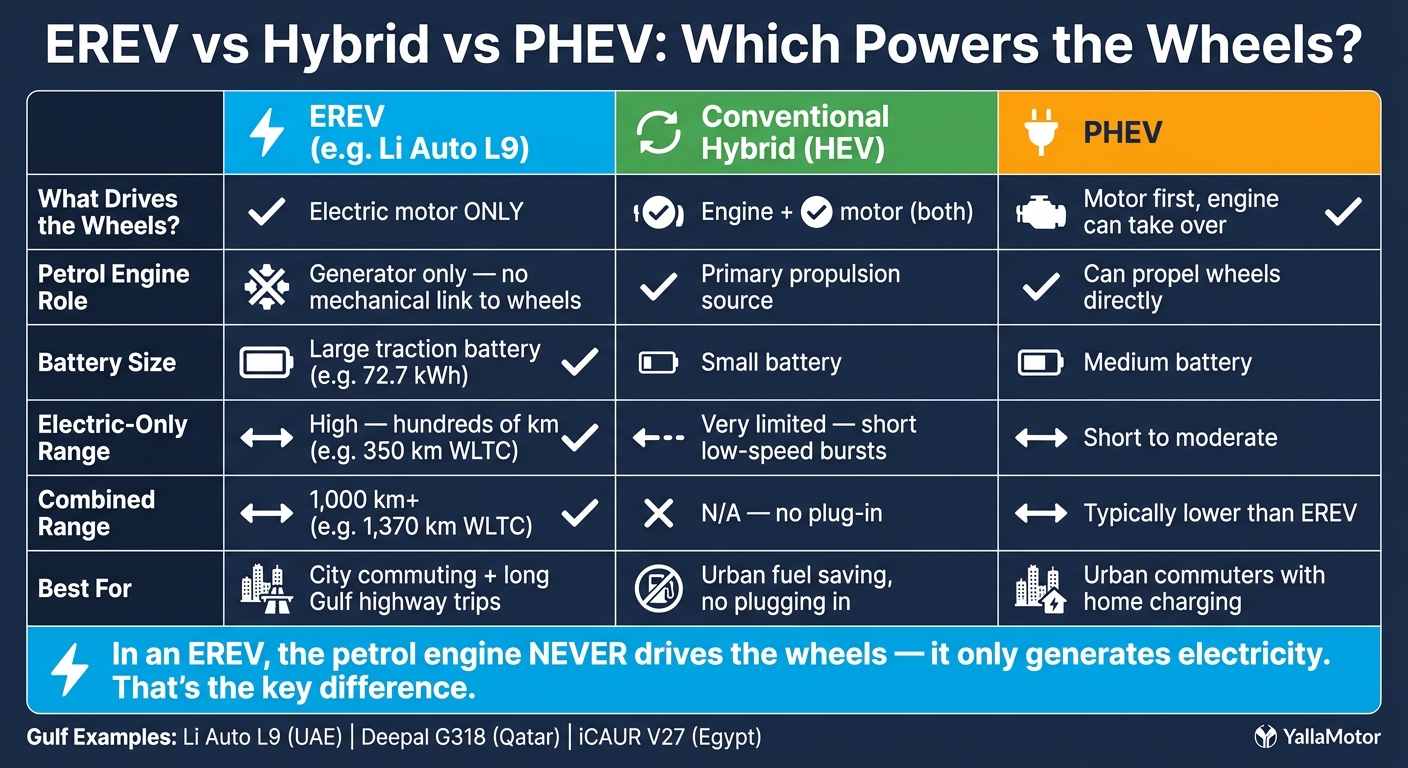
EREV vs Hybrid vs PHEV: Key Differences Explained
For most buyers, the main thing to look at is simple: does the range-extender engine ever drive the wheels?
In a conventional hybrid, and in many plug-in hybrids, the answer is yes. In an EREV, the answer is no. The wheels are always driven by the electric motor, while the petrol engine acts only as a generator. That difference matters a lot in the Gulf, where long intercity drives are common and charging coverage can still be patchy.
EREV vs Hybrid
A conventional hybrid (HEV) keeps the combustion engine mechanically linked to the drivetrain. The electric motor helps out, but the engine still does much of the work. Because the battery is small, electric-only driving is limited to short bursts, usually at low speeds. Once you are on the highway, the engine takes over most of the drive.
An EREV works the other way around. The petrol engine does not power the wheels at all. It only generates electricity. So the car keeps that EV-style feel all the time: instant torque, no gear changes, and a quiet cabin, whether you are doing a short school run or heading from Dubai to Abu Dhabi.
The difference becomes easier to see when you put the layouts next to each other.
Feature | EREV (e.g., Li Auto L9) | Conventional Hybrid (HEV) |
|---|---|---|
Powertrain layout | Series: engine powers a generator; the motor drives the wheels | Engine and motor can both drive the wheels |
Engine role | Electricity generator only | Primary propulsion source |
Battery size | Large traction battery | Small battery |
Electric-only driving | High - enough for many daily journeys | Very limited - short low-speed operation |
Best use case | Long-distance travel with EV-like driving and backup range | Urban fuel saving without plugging in |
EREV vs PHEV
This is where many buyers get mixed up. Both EREVs and PHEVs can be plugged in. On paper, they can look similar. But the big difference shows up once the battery starts running low.
Many PHEVs can switch over and let the engine drive the wheels directly. When that happens, the car starts to feel more like a normal petrol vehicle. Their electric-only range is often short, enough for daily city use, but not much beyond that.
An EREV does not make that switch. Even on a long drive between emirates, the electric motor stays in charge the whole time. If the battery needs support, the generator runs in the background and tops it up. From the driver’s seat, it still feels like an EV.
That’s the real split once battery charge drops.
Feature | EREV (e.g., iCAUR V27) | PHEV |
|---|---|---|
Electric range | Long - often in the hundreds of kilometres | Short to moderate |
Combined range | About 1,000 km or more | Typically lower than an EREV |
Engine role | Generator only - no mechanical link to wheels | Can propel the wheels directly |
Charger dependence | Low - petrol backup is always available | Moderate - frequent charging improves EV benefits |
Running behaviour | Always feels like an EV | Transitions to petrol-car feel when battery is low |
Ideal owner profile | Families driving regularly between emirates or into Saudi Arabia | Urban commuters with home charging and short daily trips |
Pros and Trade-offs of the Range-Extender Approach
The appeal of an EREV in the Gulf is pretty clear: you get the EV experience in the city, and the range security of a petrol car on long trips. Models like the Li Auto L9 show why this setup makes sense for the region. Intercity travel becomes much less tied to finding a fast charger at the right time.
There is a catch, though. An EREV carries both a large battery and a petrol generator. That makes it heavier and more mechanically complex than a pure battery EV. You still have an engine, exhaust, and cooling system to look after, along with the high-voltage EV parts.
Running costs can stay low if you charge often at home or at work. But if you rarely plug in and depend mostly on the generator, fuel use will start to look much closer to that of a conventional SUV. That’s why this format fits drivers who want electric commuting during the week, without the stress of relying only on chargers for longer Gulf trips.
Factor | EREV impact on Gulf drivers |
|---|---|
Range flexibility | 1,000 km+ combined range reduces reliance on charging stops between emirates |
Emissions | Zero tailpipe emissions in city driving; fuel-dependent on long highway runs |
Charger dependence | Low - petrol refuelling works as a full backup where chargers are scarce |
Drivetrain complexity | Higher than a pure BEV - engine, exhaust and EV components all require servicing |
Running costs | Very low for daily city use on electricity; rises on long trips using the generator |
Li Auto, Deepal and iCAUR: EREV Models Now on Sale in the Gulf
Extended-range EVs are no longer just something people read about online. In the Gulf, they’re starting to show up in showrooms. The Li Auto L9 in the UAE, Deepal G318 in Qatar, and iCAUR V27 in Egypt are among the first officially launched models in the region, giving buyers a new option between a full EV and a petrol SUV.
Li Auto L9 in the UAE
The Li Auto L9 is a six-seat extended-range electric SUV launched in the UAE through Al Fahim Motors, with pricing starting from AED 319,900 for the Ultra trim. It offers up to 350 km of electric range and 1,370 km combined range, with 0–100 km/h in 4.9 seconds.
That setup makes sense for long drives between emirates and cross-border trips, where charging points outside the main cities can still be limited. For many buyers, that’s the big draw: you get daily electric driving, but you’re not boxed in on longer runs.
Deepal G318 in Qatar and iCAUR V27 in Egypt
The Deepal G318 is sold in Qatar through Masar Motors as a range-extended electric SUV with all-wheel drive. Its battery is built for thermal stability in Qatar’s hot climate. The G318 offers 138 km of electric range and 848 km combined range, which fits day-to-day Doha driving as well as longer Gulf trips.
In Egypt, GB Auto sells the iCAUR V27, a range-extender SUV with about 1,000 km total range under NEDC.
Put side by side, these three launches show how the same setup can be pitched in different markets. Some lean harder into long-distance touring. Others focus more on city use with backup range for weekend travel. One thing is worth noting: WLTC and NEDC figures are not directly comparable.
Li Auto L9 | Deepal G318 | iCAUR V27 | |
|---|---|---|---|
Market / distributor | UAE - Al Fahim Motors | Qatar - Masar Motors | Egypt - GB Auto |
Battery capacity | 72.7 kWh | 35.07 kWh LFP | Not confirmed |
Power / torque | 563 hp / 710 Nm | 572 Nm system torque | Not confirmed |
Electric range (cycle) | 350 km (WLTC) | 138 km (WLTC) | Not stated separately |
Combined range (cycle) | 1,370 km (WLTC) | 848 km (WLTC) | ~1,000 km (NEDC) |
Drivetrain | Dual-motor AWD | AWD | Range-extender SUV |
What matters next is whether that quoted range lines up with the way you actually drive during the week and on weekends.
Is an EREV a Good Fit for Gulf Drivers?
Yes - especially if your week is mostly city driving, but your month includes highway runs too.
An EREV gives you the feel of EV driving for day-to-day use, with petrol backup when the trip gets longer. That means you don't have to map every drive around charger access. Public charging is growing across the Gulf, but outside major cities there are still gaps. For longer drives, that petrol backup can make a big difference.
Also, check for liquid battery cooling. In Gulf heat, that matters.
The main issue isn't whether EREVs work here. It's which drivers get the most out of them.
Who Benefits Most from an EREV in This Region
EREVs make the most sense for drivers who can charge at home overnight or plug in at work, and who also travel beyond the big cities on a regular basis.
If you can charge often, most daily trips can happen on electricity. The petrol generator stays off until the battery needs support - like on a Dubai-to-Abu Dhabi drive, a long weekend away, or any highway trip where you'd rather not rely on finding a fast charger.
They're also a strong match for families who do frequent highway travel. The Li Auto L9's 1,370 km combined WLTC range shows how an EREV can cut down trip-planning hassle on long drives.
For buyers who aren't ready to go all-in on a charge-only setup, an EREV eases that pressure without pushing them back to a standard petrol SUV. That's why comparing specs side by side matters.
How YallaMotor Helps Buyers Compare EREVs
On YallaMotor, you can browse new and used listings and compare full specs side by side, including:
Battery capacity
Electric-only range
Combined range
Asking prices in AED, QAR, and EGP, depending on your market
You can also use car valuation, inspection, insurance, and financing tools to get a clearer view of the full cost of ownership before you buy.
Conclusion: The Short Answer on What an EREV Is
An extended-range EV is, put simply, an electric car with a petrol generator that adds extra range. The engine does not drive the wheels directly. That point matters in the Gulf. Long road trips are common, and charger coverage outside major cities can still be patchy, so petrol backup gives drivers a lot more freedom when planning a trip.
That’s a big reason the Li Auto L9, Deepal G318 and iCAUR V27 are getting attention across the Gulf. They pair EV-style driving with the kind of long-range flexibility that petrol backup brings. If your routine is daily city driving in Dubai or Doha, with the odd highway run farther out, an EREV handles both comfortably.
FAQs
Do EREVs need charging?
Yes. EREVs are built to be plugged in, so you can use electric-only driving for your day-to-day commute.
On longer trips, the onboard petrol engine can step in as a generator to recharge the battery and extend the car’s range. That gives you more room to move when charging points are limited or not easy to reach.
How efficient is an EREV on long drives?
EREVs make a lot of sense for long drives. You get the smooth feel of an electric motor, plus a petrol generator in the background that helps ease range anxiety.
On longer trips, the petrol engine produces electricity to keep the battery topped up. That means fewer charging stops along the way. Some models, such as the Li Auto L9, offer a combined range of up to 1,370 km.
Are EREVs good in Gulf heat?
Yes. EREVs are generally a good fit for Gulf heat, as car makers build them to handle high temperatures and dusty conditions.
For example, Li Auto points to heat- and UV-insulating glass, cabin refrigeration, and strong air conditioning. Deepal puts the focus on battery thermal management to support safety and steady performance.