The cheapest monthly instalment is not always the cheapest car finance deal. If I were comparing offers in the UAE or across the GCC, I would check five things first: the monthly instalment, the total amount paid, the down payment, any final balloon payment, and all fees and insurance costs.
Here’s the short version:
Balloon finance gives me the lowest monthly payment, but I still face a large final payment, often around 20% to 35% of the car price.
Islamic finance uses Murabaha or Ijara instead of interest, so I need to check the profit amount, ownership terms, and settlement rules.
Conventional car loans usually work on a reducing-balance basis, but some banks still quote flat rates, which can make offers look cheaper than they are.
In the UAE, I should also factor in processing fees of about 1%, mandatory car insurance, and early settlement charges that can reach 1% of the outstanding balance or AED 10,000, whichever is lower.
For used cars, I also need to watch vehicle age limits, bank valuation gaps, and transfer costs like AED 170 for inspection and around AED 350 to AED 570 for ownership transfer.
If I only compare instalments, I can miss thousands of dirhams in extra cost. The right way is simple: compare every offer on the same car price, same term, and same end-of-term cost.
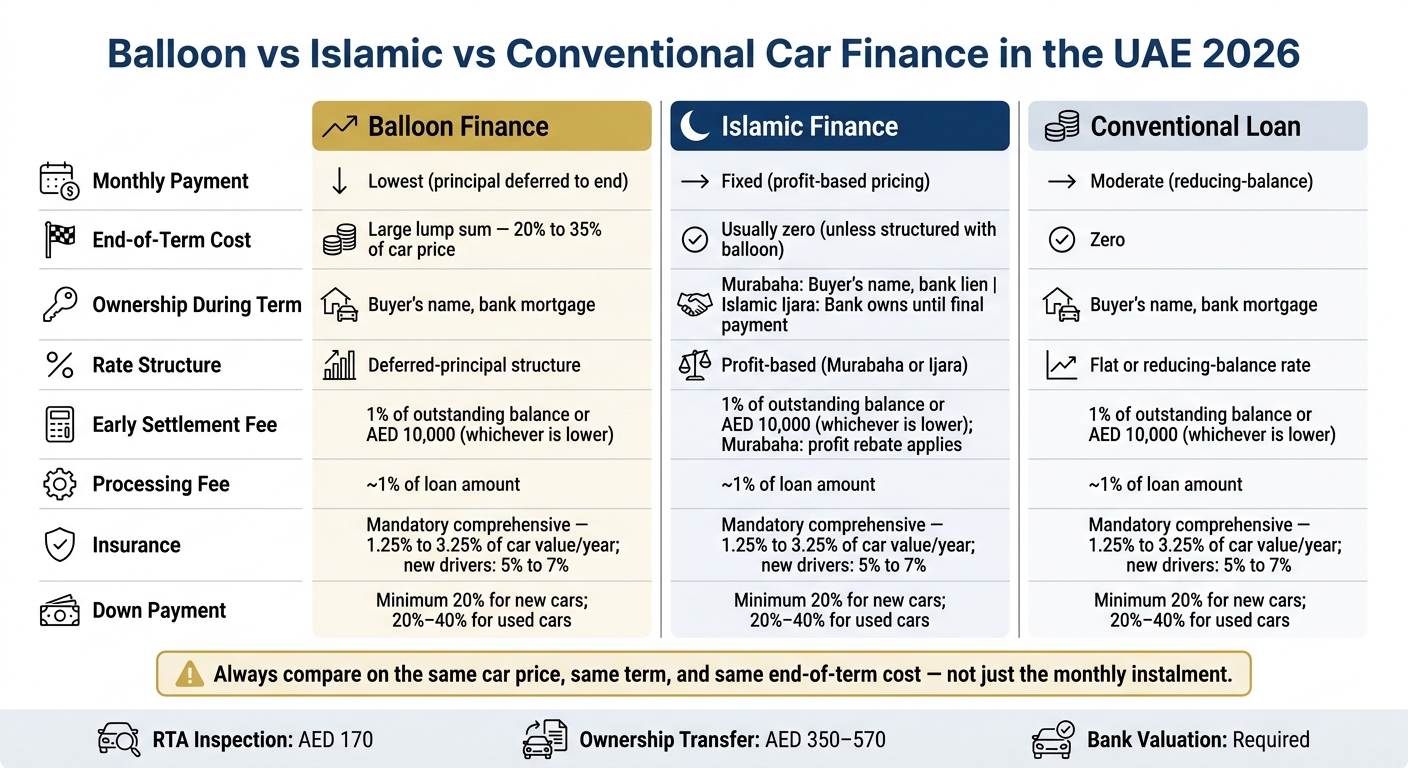
Balloon vs Islamic vs Conventional Car Finance in the UAE 2026
Quick Comparison
Finance type | Monthly payment | End of term | Ownership during term | Main thing I need to watch |
|---|---|---|---|---|
Balloon finance | Lowest | Large lump sum due | Usually my name on the car with bank mortgage | Final balloon amount |
Islamic finance | Fixed | Usually no balloon unless structured that way | Murabaha: mine with lien; Ijara: bank owns until end | Profit amount and settlement rules |
Conventional loan | Moderate | No final lump sum | My name on the car with bank mortgage | Flat vs reducing-balance rate |
What I would compare before signing
Rate type: flat or reducing balance
Total repayment: not just the monthly figure
Down payment: often at least 20% for new cars
Balloon amount: if any
Processing fee: around 1%
Insurance cost: often 1.25% to 3.25% of car value per year, and more for new drivers
Early settlement terms: especially on balloon and Murabaha contracts
Used-car rules: age limits, valuation, inspection, and transfer fees
If I keep those points in front of me, it becomes much easier to see which offer is cheaper, which one carries more end-of-term risk, and which one fits my budget.
How balloon, Islamic and conventional car finance work
The table above covers the main differences. This part shows how each option works in day-to-day terms. Start with repayment, ownership, and the full cost at the end of the term. Those points can shape what you pay more than the monthly instalment figure on its own.
Balloon finance: lower monthly instalments, larger final payment
Balloon finance spreads part of the car cost into smaller monthly instalments, then leaves a larger payment due at the end. That final amount is the balloon payment, and it is usually around 20% to 35% of the purchase price.
So yes, the monthly instalments are usually lower. But the balloon does not disappear. It sits at the end of the agreement and still needs to be paid.
That’s the trade-off in plain terms: lower monthly instalments now, a much larger final payment later.
Islamic car finance: Murabaha and Ijara explained
Islamic finance does not charge interest. Instead, it uses profit-based structures that are Sharia-compliant. In the UAE, the two most common are Murabaha and Ijara.
Murabaha is a cost-plus sale. The bank buys the car and then sells it to you at a fixed deferred price with a known profit margin. That profit amount is set at the start of the contract, and ownership transfers to you straight away.
Ijara takes a different route. The bank owns the car and leases it to you during the term, with ownership transferring at the end of the agreement.
Late-payment rules are also different. Conventional loans apply interest-based penalties. Islamic contracts usually use fixed fees or donation-based penalties.
Conventional car loans: reducing-balance interest and fixed instalments
A conventional car loan runs on a reducing-balance basis. Each monthly instalment covers both principal and interest. As the amount you still owe goes down, the interest part of each payment also falls.
Banks often advertise a flat rate. That sounds simple, but it can blur the picture. When you compare offers, look at the reducing-balance cost, because flat-rate quotes from different lenders are not directly comparable.
In the UAE, lenders usually ask for at least 20% down on new cars and 20% to 40% on used cars. Terms can run up to 60 months, and comprehensive insurance is usually compulsory.
With the repayment structure clear, the next step is to compare instalments, fees, and final-payment risk line by line.
The numbers to compare before you sign
A lot of buyers compare offers by looking at the monthly instalment and stopping there. That’s where people get tripped up. The instalment is just one piece of the bill. What shapes the full cost is the rate type, total repayment, down payment, balloon payment, and the fees tied to the contract.
Feature | Conventional Loan | Islamic Finance | Balloon Finance |
|---|---|---|---|
Rate Type | Flat or reducing-balance rate | Profit-based pricing | Deferred-principal structure |
Monthly Instalment | Standard | Standard | Lowest |
Down Payment | Varies by lender and vehicle age | Varies by lender and vehicle age | Varies by lender and vehicle age |
Final Payment | Zero | Zero | Large lump sum (20–35%) |
Processing Fee | ~1% of loan amount | ~1% of loan amount | ~1% of loan amount |
Insurance | Mandatory comprehensive | Mandatory comprehensive | Mandatory comprehensive |
Early Settlement Charge | Applies | Applies | Applies |
Monthly instalment, profit or interest rate, and total repayment
When you compare offers, put them on the same basis: monthly instalment, total repayment, and end-of-term cost. Do the same with the quoted rate. Compare flat with flat, or reducing-balance with reducing-balance. If a lender gives you only a flat rate, ask for the equivalent reducing-balance cost.
The total repayment matters more than the monthly figure. A lower instalment can look attractive at first glance, but it may come from stretching the tenor. And longer tenors push up total repayment fast. The same thing happens with balloon finance: the monthly number looks lighter, but the full cost by the end can be much higher.
Balloon amount, down payment, tenor and end-of-term cost
Once the rate is clear, check if part of the payment has simply been moved to the end. The cleanest way to compare finance types is to line up the down payment, monthly instalment, and any final balloon payment side by side.
Balloon finance cuts monthly payments by pushing a large share of the principal to the end of the term. That sounds fine on paper. But the final payment is often 20–35% of the car’s value, and that can create a serious problem at the end if you can’t pay it or refinance it.
Processing fees and insurance add-ons
Fees matter too, even when they seem small. Banks usually charge a 1% processing fee on the loan amount.
Insurance is another cost you can’t ignore. Comprehensive insurance is mandatory for any financed vehicle. It usually costs 1.25% to 3.25% of the car’s value per year. For new drivers, the first-year cost can be much higher, often around 5% to 7%.
Settlement terms, ownership rules and used-car conditions
After you compare instalments and total repayment, look at the fine print that changes the deal: early settlement, ownership during the finance term, and the extra checks that come with a used car.
Early settlement and partial settlement in the UAE
Start with settlement fees. They can shift the actual cost of the loan more than many buyers expect.
In the UAE, early settlement fees for conventional loans are capped at 1% of the outstanding balance or AED 10,000, whichever is lower. With balloon finance, that fee is usually calculated on the full outstanding balance, including the balloon amount. So if you plan to close the finance early, that detail matters.
For Islamic Murabaha contracts, ask the lender how the rebate on the remaining profit is handled. That can make a clear difference to what you end up paying.
Some UAE banks also allow partial settlement. Depending on the contract, that can either:
reduce your monthly instalment
shorten the finance term
That’s why settlement terms matter just as much as the monthly figure on the offer.
Who owns the car during the finance period
Ownership depends on the finance structure.
With conventional and balloon finance, the Mulkiya shows you as the registered owner, while the bank keeps the mortgage over the car. With Murabaha, you also get ownership at the time of purchase, but the bank still appears as the mortgagee because the payments are deferred. In an Ijara contract, the bank or leasing company stays the legal owner until you make the final payment.
Feature | Conventional / Balloon Finance | Islamic Murabaha | Ijara (Lease-to-Own) |
|---|---|---|---|
Legal ownership | Buyer, with bank mortgage | Buyer, with bank mortgage | Bank / leasing company |
Title transfer | Immediate, with lien | Immediate, with lien | After final payment |
Mid-contract sale | Only after full settlement | Only after full settlement | Requires buyout first |
Early settlement | 1% fee on outstanding balance | Profit rebate applies | Buyout terms apply |
This part can trip people up. You may be driving the car every day and feel like it’s fully yours, but the legal setup still controls whether you can sell it, transfer it, or close the deal early.
What changes when financing a used car
Used-car finance comes with one more layer: age limits and valuation rules.
Most UAE banks will only finance vehicles that will be no more than 10 years old at the end of the loan tenor, not just at the time you buy them. That’s a big distinction. A car that looks fine today can still fall outside the bank’s rules if the finance term pushes it past the age limit.
Balloon finance is rarely offered on older used vehicles, and Islamic finance can be stricter on age limits than conventional loans.
For a used-car purchase, set aside money for the extra checks and transfer costs:
mandatory bank valuation
RTA vehicle inspection: AED 170
ownership transfer fee: AED 350–570
The bank valuation decides the loan amount. If the valuation comes in lower than the seller’s asking price, you’ll need to pay the difference in cash.
Choose the right finance option for your budget using YallaMotor

A simple decision path for choosing the right finance type
Once you've compared instalments, fees, and early settlement rules, the next step is simple: pick the setup that matches your budget and what you want at the end of the contract.
If your main goal is the lowest monthly instalment, balloon finance usually makes more sense. If you'd rather have fixed monthly instalments with no large final payment, a conventional reducing-balance loan is often the better route. In the UAE, rates in 2026 usually sit between 2.49% and 5% per annum.
If Sharia compliance matters to you, look for Islamic car finance options such as Murabaha or Ijara.
Use YallaMotor to check car prices before comparing finance
Before asking lenders for quotes, make sure you know the car's actual market price. That gives you a clean starting point and helps you compare offers on like-for-like terms.
Use YallaMotor's car valuation tool for an instant market estimate before you speak to any lender. If you're buying new, the price comparison tool shows live dealer prices across the UAE, including VAT. For used cars, YallaMotor's vehicle inspection service can help you spot issues before you commit.
Conclusion: Compare total cost, contract terms and end-of-term risk
After the car price is set, compare each offer using the same AED amount and the same contract length. Look at the total repayment, balloon amount, fees, and settlement terms on the same AED price. Then check your end-of-term exposure before signing.
FAQs
Which car finance type is best for my budget?
The best option comes down to your budget and what matters most to you.
Conventional loans work well for buyers who want standard repayment terms. Islamic finance suits those who prefer a Sharia-compliant Murabaha setup with fixed, clear pricing. Leasing can make sense if you want more flexibility or lower upfront costs.
Whatever route you take, keep your total monthly debt below 50% of your income. And when you compare offers, don’t look at the monthly instalment alone. Check the total repayment and factor in insurance, processing fees, and any early settlement penalties.
How do I compare flat rates and reducing-balance rates?
In the UAE, lenders often quote a flat rate. That rate is worked out on the original loan amount for the entire tenure.
A reducing-balance rate, on the other hand, reflects the interest charged on the remaining principal as it goes down over time. So it gives you a more accurate view of what the loan costs.
Because a flat rate doesn’t factor in the balance dropping each month, it usually looks cheaper than it is. If you want to compare offers properly, ask for the effective interest rate or convert every quote to a reducing-balance basis.
What should I check before financing a used car?
Before you finance a used car in the UAE, do a few checks first. It can save you money, stress, and a bad deal.
Start with the car’s value, history, and age. In most cases, banks in the UAE finance up to 80% of the appraised value. That means if the seller’s asking price is higher than the bank’s valuation, you pay the difference out of pocket.
You’ll also need a valuation certificate, which usually costs AED 300 to AED 500.
It also helps to confirm that the car fits the lender’s age limit. Some banks won’t finance older vehicles, even if the car looks fine on the surface.
Then check the paperwork properly:
Accident history
Service records
VIN records
On the money side, review your credit score and debt burden ratio before applying. And don’t just plan for the monthly instalment. You should also budget for:
Comprehensive insurance
A 20% down payment
Processing fees
That way, you go in with a clear picture of what the loan will cost from day one.