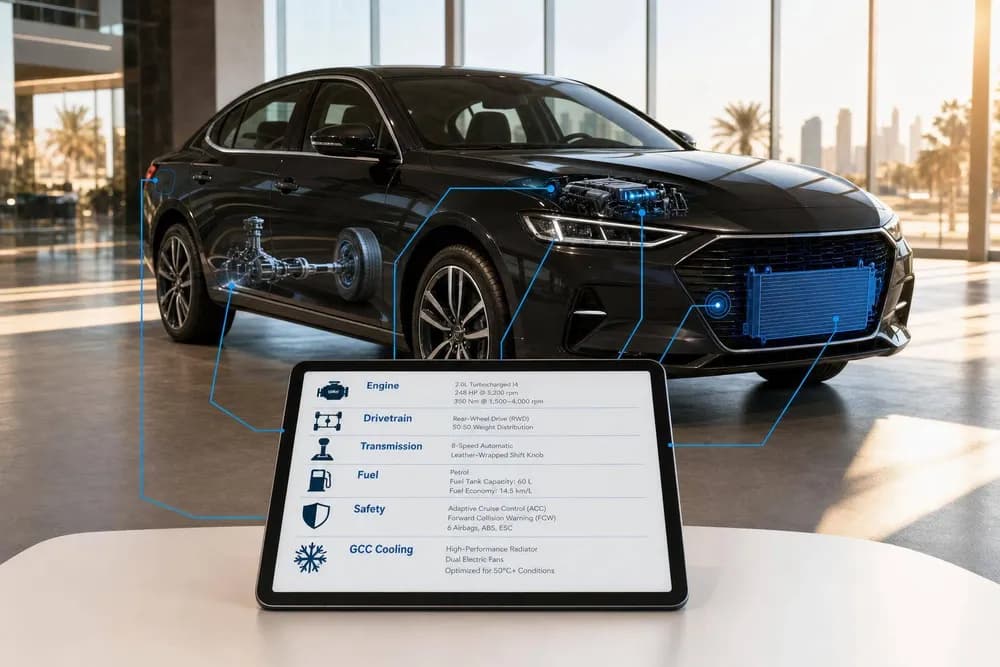
A car spec sheet can save you from buying the wrong trim. If I had to check just a few things first, I’d look at the engine, drivetrain, gearbox, fuel use, safety kit, and GCC cooling details before anything else.
Here’s the short version:
Engine size, hp, and torque tell me how the car will feel in city traffic, highway overtakes, and with passengers on board.
FWD, RWD, AWD, and 4WD change grip, fuel use, and whether the car suits daily roads or deep sand.
AT, CVT, and DCT affect traffic comfort, heat tolerance, and repair cost.
Fuel use in L/100 km helps me estimate monthly petrol spend.
Example: 9.0 L/100 km, 2,000 km/month, AED 3.00/L = about AED 540/month.Length, wheelbase, ground clearance, and boot space show if the car fits my parking, family, and luggage needs.
ABS, EBD, ESC, ISOFIX, TPMS, and airbag count are the safety items I check first.
ADAS features like AEB, ACC, BSM, and LKA help most on UAE motorways and busy city roads.
Dual-zone AC, rear vents, and ventilated seats matter more here than extras that sound nice on paper.
GCC spec often means better cooling, filtration, and heat-focused setup for UAE conditions.
A simple rule I’d use: read the sheet top to bottom in the same order every time, then compare trims line by line instead of trusting labels like full option.
What I check | Why it matters |
|---|---|
Engine + torque | Pull, overtaking, load carrying |
Drivetrain | City use, wet roads, sand driving |
Transmission | Traffic feel, heat behaviour, repair risk |
Fuel use + tank | Monthly cost and driving range |
Dimensions | Parking, cabin space, speed bumps |
Safety kit | Braking, stability, passenger protection |
GCC details | Better fit for UAE heat and dust |
If I’m comparing two cars at AED 90,000, this checklist usually shows the gap fast - even when they look almost the same from the outside.
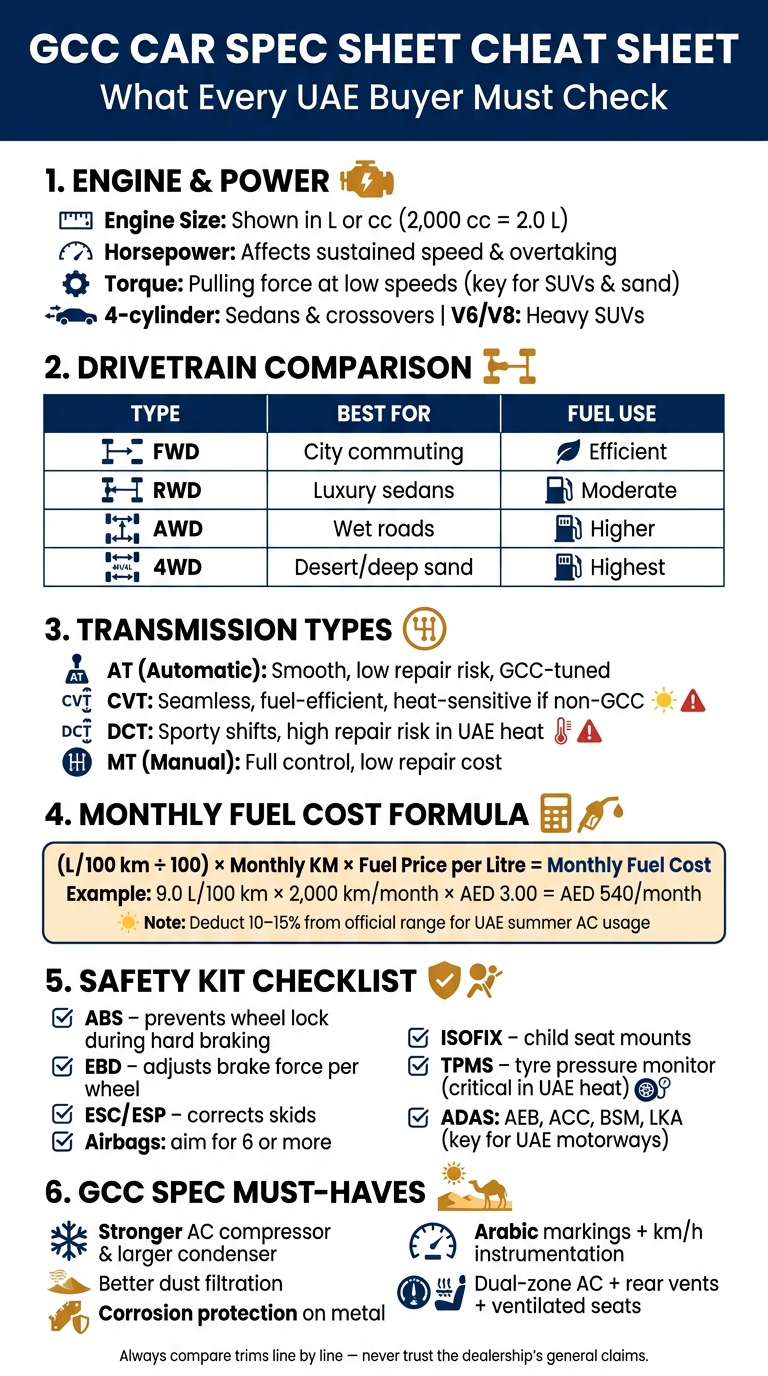
GCC Car Spec Sheet Cheat Sheet: What Every UAE Buyer Must Check
Engine, power and transmission terms explained
Engine size, cylinders, horsepower and torque
Once you know what the car is, the next step is understanding how it actually moves.
Engine size is shown in litres (L) or cubic centimetres (cc). So, 2,000 cc = 2.0 L. In simple terms, a larger engine usually works less hard when the car is carrying people, luggage, or dealing with long highway runs.
Horsepower affects sustained speed and overtaking. Torque is the pulling force you feel at lower speeds, which matters for heavy SUVs, hill starts, and driving on sand.
As a rule of thumb, four-cylinder engines suit most sedans and crossovers. V6 and V8 engines tend to make more sense in heavier SUVs and performance cars. And this is where power-to-weight ratio comes in: the same horsepower can feel much quicker in a lighter sedan than in a heavier SUV.
FWD, RWD, AWD and 4WD for UAE driving conditions
After engine figures, the drivetrain tells you where the power goes. For many buyers in the UAE, that one line on the spec sheet has a big effect on how the car feels in daily traffic, on Sheikh Zayed Road, and out in the desert at the weekend.
Drivetrain | Off-road traction | Fuel Use | Maintenance | Best Use Case |
|---|---|---|---|---|
FWD | Low | Efficient | Simple / Low | City commuting |
RWD | Moderate | Moderate | Moderate | Luxury sedans |
AWD | High | Higher | Complex | Wet roads |
4WD | Best for deep sand | Highest | High | Desert driving |
FWD works well for city commuting. RWD is common in luxury sedans and often gives a different balance on the road. AWD adds grip, which helps on wet roads. But if deep sand is part of the plan, 4WD or 4x4 with a transfer case is the better pick.
Automatic, CVT, DCT and gear count: what they mean for you
Transmission choice changes how the car delivers power in traffic and on the highway.
A traditional automatic (AT) shifts smoothly and is common in GCC-spec cars. A CVT does not use fixed gear steps, so it feels seamless and often uses less fuel, though non-GCC versions can struggle in extreme heat. A DCT shifts fast and suits sporty driving, but it is more sensitive to heat and can cost more to repair.
Transmission | Driving Feel | Efficiency | Ease in Traffic | Repair Risk |
|---|---|---|---|---|
Automatic (AT) | Smooth, traditional | Moderate | High | Low/Moderate |
CVT | Seamless | High | High | Moderate |
DCT | Rapid, sporty shifts | High | Moderate | High (heat sensitive) |
Manual (MT) | Total control | Variable | Low | Low |
For GCC buyers, tuning matters almost as much as the gearbox type itself. GCC-spec transmissions are often set up for hotter weather and long highway driving, which can make a clear difference in UAE conditions.
Fuel economy, dimensions and monthly running costs
Fuel consumption, tank size and estimated range
Once you’ve looked at how the car drives, the next step is simple: check what it will cost you each month.
In the UAE, fuel economy is usually shown in L/100 km. Lower numbers are better. Some imported cars use km/L instead, where higher is better. Estimated range comes from two things working together: tank size and fuel economy. A bigger tank often means fewer trips to the petrol station, but it doesn’t always mean the car is cheap to run.
Treat the official fuel figure as a starting point, not a promise.
"Manufacturer fuel economy figures are tested in controlled lab conditions and rarely reflect real-world driving in the UAE." - Carabia
That gap matters even more here. In UAE summer, the AC is almost always on, and that puts extra load on the engine. A smart rule is to cut the official range by 10–15% if you want a daily estimate that feels closer to normal use.
You can estimate monthly fuel spend with this formula: (L/100 km ÷ 100) × monthly kilometres × fuel price per litre. So if a car is rated at 9.0 L/100 km, you drive 2,000 km per month, and fuel costs AED 3.00 per litre, you’re looking at about AED 540 per month on fuel alone.
Length, wheelbase, ground clearance and boot space
After that, check whether the car actually fits your day-to-day life.
These four measurements tell you a lot about parking, passenger comfort and luggage space.
Overall length affects whether the car fits into a tight villa garage or a mall parking bay without drama. Wheelbase is the distance between the front and rear axles. In most cases, a longer wheelbase means better rear legroom and a more relaxed ride for passengers. Ground clearance is the space between the car’s lowest point and the road. More clearance helps with UAE speed bumps, light sand and rougher patches of road. Boot space, measured in litres, tells you how much luggage the car can carry. Sedans often offer 400–500 L, while most SUVs go past 600 L.
If you park in tight multi-storey car parks, it’s also worth checking the turning radius. A long-wheelbase vehicle can feel awkward on narrow spiral ramps and may need a multi-point turn.
Kerb weight, payload and how weight changes the drive
Weight matters more than many buyers expect, because it changes how the car feels and behaves on the road.
Kerb weight is the car’s weight with all fluids in place, but without passengers or cargo. Gross vehicle weight (GVW) is the maximum total weight of the vehicle, including people and luggage. Payload is the amount of weight you can add in passengers and cargo.
Extra weight can make the ride feel harsher, increase braking distance and push fuel use up. On UAE highways, where stable high-speed driving matters, that’s worth paying attention to. In stop-start traffic, heavier loads can also wear the brakes faster.
If you’re choosing between two similar SUVs, the one with the higher payload figure gives you more room for family, luggage and daily use without eating into its limits.
Safety, comfort and technology abbreviations decoded
ABS, EBD, ESC, airbags and core safety equipment
After power, size and running costs, look at the features that shape day-to-day safety and comfort.
ABS (Anti-lock Braking System) helps stop the wheels from locking during hard braking. That means you can still steer while the car slows down. EBD (Electronic Brakeforce Distribution) works with ABS and adjusts braking force at each wheel based on load. ESC or ESP (Electronic Stability Control) steps in when the car starts to skid and helps bring it back under control. Put simply, ABS, EBD and ESC should be non-negotiable.
Also check the airbag count. Aim for six airbags or more. If you use child seats, confirm the car has ISOFIX mounts. TPMS (Tyre Pressure Monitoring System) is another feature worth having, especially in UAE heat, where tyre pressure can change fast.
Driver assistance features worth checking on the spec sheet
Once the basics are covered, move to the driver-assistance layer. In many spec sheets, this shows up under ADAS.
BSM (Blind Spot Monitoring) is handy on fast, multi-lane roads like Sheikh Zayed Road, where cars move quickly and gaps can disappear in seconds. ACC (Adaptive Cruise Control) keeps a set distance from the car ahead, which helps on long UAE motorway drives. AEB (Autonomous Emergency Braking) can brake for you if a crash is about to happen and you haven't responded in time. LKA (Lane Keep Assist) gives light steering input if you drift out of your lane without indicating.
For parking, a 360-camera gives you much more than a rear camera on its own. It matters even more in large SUVs and tight parking spaces. Parking sensors are also worth a look if you often park in busy city areas.
Climate control, infotainment and trim-level comfort differences
Now get into the features you'll notice every day in UAE traffic and summer heat.
Single-zone AC gives the whole cabin one temperature setting. Dual-zone AC lets the driver and front passenger choose different temperatures. Rear AC vents also matter in the UAE. And when it comes to seats, ventilated seats make more sense than heated seats here. If a car has been sitting in the sun and the cabin feels like an oven, ventilated seats help straight away.
GCC-spec cars feature a more robust, higher-capacity AC compressor and a larger condenser - check that any car you consider is listed as GCC-spec rather than an import.
For infotainment, don't gloss over screen size. An 8-inch display and a 12.3-inch display can feel very different in daily use. Also confirm whether Apple CarPlay and Android Auto are wired or wireless. Wireless setup means one less cable to deal with each day. Higher trims may also include branded sound systems from JBL, Bose, or Harman Kardon.
Keyless entry can be a bit misleading too. Remote entry means you press a button on the key fob. Passive entry means you can unlock the car by touching the door handle while the key stays in your bag or pocket.
This is usually where trim levels split the most. So instead of taking a dealer's “full option” claim at face value, use the spec sheet to check exactly what each trim includes.
GCC specs, trim levels and comparing cars on YallaMotor

What GCC specs typically include
Once you’ve checked the engine, safety, and comfort basics, there’s one more thing to look at: whether the car is built for Gulf conditions.
GCC spec means the car was made for Gulf heat, dust, and traffic from day one. In most cases, GCC-spec cars come with stronger cooling, better filtration, and extra corrosion protection on exposed metal parts.
To confirm GCC spec, look for GCC labels, Arabic markings, and km/h instrumentation.
How trim names can hide major spec differences
The badge on the boot might stay the same, but the equipment can change a lot from one trim to another.
That’s why trim names can be a bit misleading. Two cars may share the same model name, yet differ in engine, safety, comfort, and GCC equipment. So don’t stop at the badge. Go through the spec sheet line by line.
The differences usually show up in the same details you’ve already learned to check, such as:
engine displacement
airbag count
AC type
driver-assist features
Use the spec sheet to see what each trim actually comes with, instead of relying on the trim label alone.
Conclusion: The short spec checklist to use before you buy
After you’ve made sense of the terms, the last step is simple: compare the same model across listings instead of looking at each one on its own.
Before you commit to any car, check the key items on the spec sheet:
engine size
drivetrain type (FWD / RWD / AWD)
safety kit
trim level
GCC cooling details
If any of these details are missing from the listing, ask for them directly.
On YallaMotor, you can filter for GCC Specs and use Compare to line up up to three cars by engine, safety, and comfort. If you’re shopping for a used car, it makes sense to favour Verified or Certified Pre-owned listings.
What is HP, Torque, CC, MPFI, Vehicle Dimension, Boot Space, ABS, Wheel Base etc.
FAQs
How do I tell if a car is truly GCC spec?
Check the wing mirrors, the driver-side door jamb sticker, and the sun visor warning labels for Arabic text. That’s one of the easiest signs the car was set up for this region from the start.
Then look at the instrument cluster. It should show kilometres and km/h, not miles or mph. If the display is miles-first, that’s a red flag and worth digging into.
It also helps to compare the car’s design and features with official regional trims. Small details matter here, from spec and badging to climate-focused equipment and trim options sold in the Gulf.
After that, verify the VIN and ask for a full history report. That step helps confirm whether the car was meant for the Gulf market or brought in from somewhere else later on.
Which spec matters most for UAE daily driving?
For daily driving in the UAE, the cooling system spec matters most. Summer heat can climb past 50°C, so details like strong air conditioning, a larger radiator, and heavy-duty cooling fans can make a big difference. They help the car stay cool in stop-and-go traffic, where heat builds up fast.
Strong engine and cabin air filters matter too. In a place with fine desert dust, they help protect the engine and keep the cabin more comfortable.
How can I compare trims without missing key differences?
Use YallaMotor’s Comparison Tool to put up to three vehicles side by side. It gives you a clear view of the differences in engine specs, fuel economy, safety tech, and cabin features.
That matters more than many buyers think. Two cars can look almost the same on the surface, then differ in the details that shape daily driving.
When you compare models, make sure you’re looking at the same regional specs, such as GCC versus American. Also check the trim level closely. A lower trim can leave out comfort and safety items like advanced driver assistance systems or rear air-conditioning vents.