Saudi Arabia is set to transform the electric vehicle (EV) market in the GCC region with the launch of Lucid Motors' manufacturing plant in King Abdullah Economic City (KAEC). Starting production in 2026, the facility aims to produce up to 150,000 EVs annually by 2029. This move is expected to make EVs more affordable and accessible for GCC buyers, particularly in the UAE.
Key Highlights:
-
Local Production: The KAEC plant will shift from assembling imported kits to full-scale manufacturing, reducing costs and improving availability.
-
Cost Savings: Benefits like 0% customs duties and shorter shipping distances will significantly lower EV prices in the UAE compared to imported models.
-
New Models: UAE buyers can expect more budget-friendly options, including the "Earth" crossover starting at approximately AED 176,000.
-
Lower Ownership Costs: Reduced energy costs, free home chargers, and simplified maintenance will make EVs cheaper to own than petrol vehicles.
Why It Matters:
This development supports Saudi Vision 2030 and UAE's Net Zero 2050 goals while creating jobs and building a local EV supply chain. For UAE buyers, it means better pricing, more model options, and a smoother transition to electric vehicles.
The KAEC plant is not just about manufacturing - it’s reshaping the GCC’s automotive landscape.
Lucid Motors & Advanced Manufacturing Plant, AMP-2.
Lucid's Manufacturing Base in KAEC
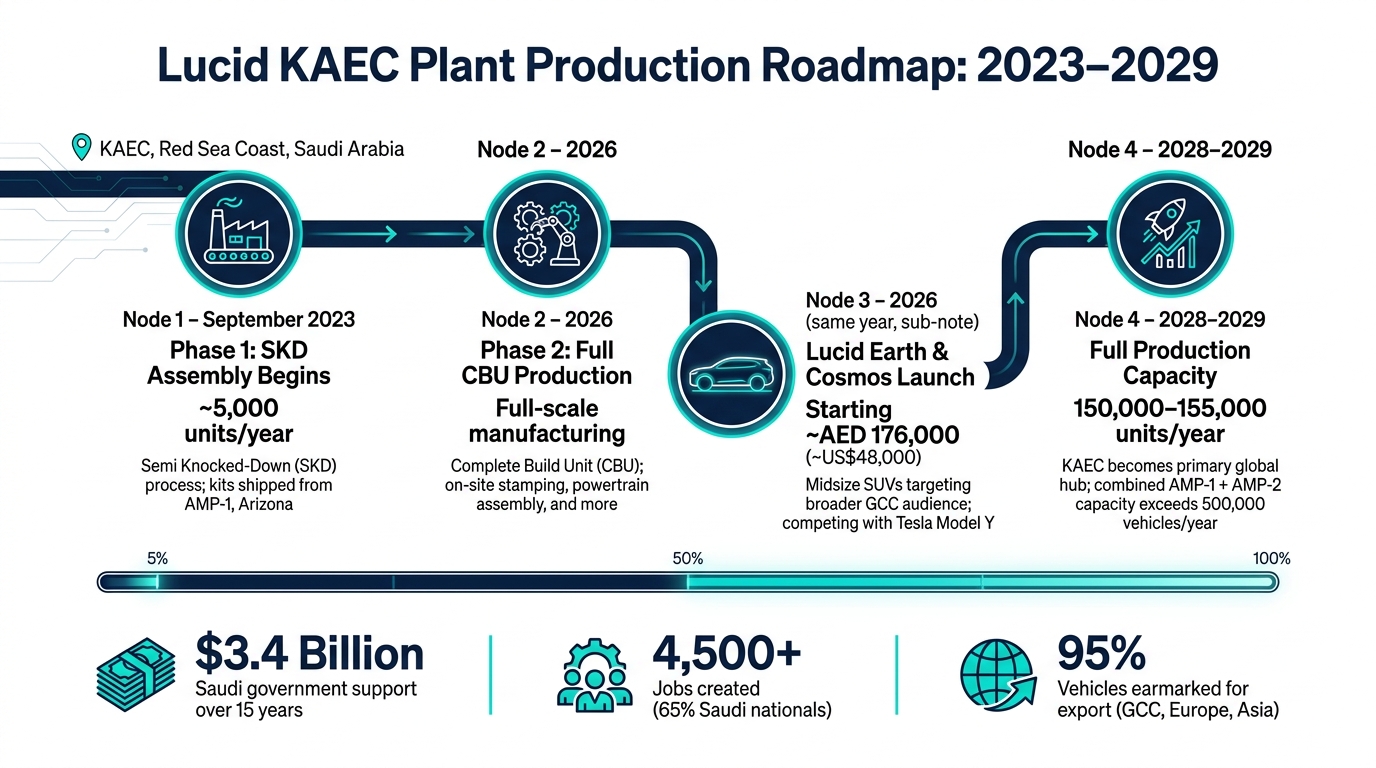
Lucid KAEC Plant: From Assembly to 150,000 EVs – Production Roadmap 2023–2029
King Abdullah Economic City (KAEC) sits along Saudi Arabia's Red Sea coast, about 100 kilometres north of Jeddah. Designed as a hub for industry and logistics, it offers direct access to key markets, strong governmental support, and reduced production costs. These factors make it an ideal location for Lucid's AMP-2 facility.
Inside the AMP-2 Plant
The AMP-2 facility (Advanced Manufacturing Plant-2) spans 1.35 million m², ranking among the largest EV manufacturing sites in the region. It began operations in September 2023 with a Semi Knocked-Down (SKD) process, assembling 5,000 vehicles annually from kits shipped from the AMP-1 plant. This initial phase lays the groundwork for full-scale production.
By 2026, the plant will shift to Complete Build Unit (CBU) production, managing every step of the manufacturing process - stamping, powertrain assembly, and more - entirely on-site. By 2028–2029, it aims to produce between 150,000 and 155,000 units annually. To achieve this, Lucid has implemented advanced manufacturing tools, including digital twin technology and software from Rockwell Automation. Combined with the AMP-1 facility in Arizona, Lucid's global production capacity is projected to surpass 500,000 vehicles per year.
The KAEC plant will also serve as the main production hub for Lucid's upcoming midsize crossover platform, internally dubbed "Earth." This model, expected to start at around US$50,000, is designed to compete directly with the Tesla Model Y.
| Phase | Production Type | Annual Capacity | Timeline |
|---|---|---|---|
| Phase 1 | Semi Knocked-Down (SKD) | ~5,000 units | Started Sept 2023 |
| Phase 2 | Complete Build Unit (CBU) | Transitioning to full scale | 2026 |
| Full Production | Full Manufacturing & Export | 150,000–155,000 units | 2028–2029 |
Why the KAEC Location Works
KAEC's location adds significant value to Lucid's operations. The plant is situated in KAEC's Industrial Valley, close to King Abdullah Port, which handles over one-third of the Western Region's container traffic. This proximity provides logistical advantages, as approximately 95% of AMP-2's vehicles are earmarked for export to the GCC, Europe, and Asia (excluding China).
Its designation as a Special Economic Zone offers reduced customs duties and taxes, lowering production costs. Additionally, the Saudi government has pledged US$3.4 billion in financing and incentives over 15 years to support the project. Access to affordable energy and raw materials further strengthens the plant's suitability for large-scale EV production.
"KAEC will serve as a global launchpad for new sustainable mobility innovations such as electric vehicles, furthering its standing as a vision‐ready platform that supports Saudi Vision 2030 objectives." - Cyril Piaia, CEO of Emaar The Economic City
The facility is expected to create over 4,500 jobs, with about 65% of the workforce being Saudi nationals. This focus on local talent aligns with Saudi Vision 2030's goals of economic diversification and developing domestic industrial expertise.
"The plant's strategic location near Jeddah will also act as a catalyst to further grow and expand the newly established domestic supply chain, creating demand for local suppliers and fostering long-term growth." - Faisal Sultan, Vice President and Managing Director Middle East, Lucid Group
How Local Production Will Change Lucid EV Prices in the GCC
Producing cars closer to where they’re sold can drastically cut costs, and Lucid is putting this into action at its KAEC facility.
Importing EVs vs. Building Them Locally: A Cost Breakdown
When Lucid imported fully assembled vehicles from its Arizona plant (AMP-1) to the GCC, buyers had to cover hefty trans-Atlantic freight charges and a 5% GCC customs duty on imported vehicles. These costs pushed up the retail price.
The KAEC plant flips this equation. Located within a Special Economic Zone, the facility enjoys 0% customs duties on imported components. Plus, with shorter shipping routes to UAE ports, the cost per unit for delivery is far lower than shipping cars all the way from Arizona.
Scaling production amplifies these savings. The KAEC plant is moving from assembling 5,000 units annually during its SKD phase to a planned capacity of 150,000–155,000 units per year by 2028–2029. This scale lowers production costs significantly. As Faisal Sultan, Lucid Motors’ President for the Middle East, explained:
"Our strategy is based on strengthening resilience and adaptability by diversifying global supply sources, reducing costs and relying on a flexible, vertically integrated platform."
Here’s a quick look at the cost advantages:
| Cost Factor | Importing from Arizona | Producing at KAEC |
|---|---|---|
| Customs duties | ~5% on finished vehicles | 0% on components (SEZ) |
| Shipping distance | Trans-Atlantic to GCC ports | Red Sea to GCC ports |
| Production scale | Shared global capacity | Dedicated regional hub |
| Government support | None specific to GCC | US$3.4 billion over 15 years |
These efficiencies directly translate to savings for UAE buyers.
What This Means for Retail Prices in the UAE
The UAE is one of Lucid's main markets in the region, so the benefits of local production are particularly relevant here. By cutting costs through the KAEC facility, Lucid can offer more competitive prices, giving it an edge in the GCC market.
The upcoming midsize platform, codenamed "Earth", is a prime example. Built at KAEC, it leverages local production efficiencies to target a starting price of approximately US$48,000 (around AED 176,000). This price point is aimed at a broader audience, especially those seeking more affordable options compared to the premium Lucid Air.
For context, in 2022, Lucid raised the base price of the Air sedan by up to 13% due to supply chain challenges and the high costs of shipping from the US. With local production ramping up by 2026, Lucid can better stabilise prices and even lower them, shielding buyers from such fluctuations.
What Saudi-Made Lucid EVs Mean for UAE Buyers
Model and Trim Availability
UAE buyers currently have access to the Lucid Air sedan, starting at Dh299,000, and the Lucid Gravity SUV, which starts below Dh294,000 with deliveries beginning in the first half of 2025. By 2026, the lineup will expand with the launch of two midsize SUVs, the Lucid Cosmos and Lucid Earth, produced at KAEC (King Abdullah Economic City). These models are expected to start at approximately Dh176,000. This broader range ensures options that cater to various budgets and preferences.
Total Cost of Ownership for UAE Drivers
Local production brings more than just competitive pricing - it significantly reduces ownership costs for UAE drivers. Here's how Lucid EVs stack up against petrol luxury vehicles:
| Cost Area | Lucid EV (KAEC‑Built) | Petrol Luxury Vehicle |
|---|---|---|
| Customs duties | 0% (SEZ benefit) | Standard import duties apply |
| Fuel/energy cost | Low (home charging + 100+ free AC chargers) | High (Brent crude above $120/barrel) |
| Routine maintenance | 70–80% handled via mobile service units at home | Requires visits to service centres |
| Home charger | Free unit + free installation | Not applicable |
With Brent crude projected to remain above $120 per barrel in 2026, the savings on fuel costs become a major advantage. Additionally, mobile service units, which cover up to 80% of maintenance needs at the owner's home, make upkeep far more convenient and affordable compared to petrol vehicles.
"The shift toward electric vehicles is not only tied to demand dynamics, but also to changing consumer awareness of the long-term value of owning these vehicles, including total cost of ownership and the ease of home charging." - Faisal Sultan, Vice-President and Managing Director of Lucid Middle East
Financing, Leasing, and Resale Value in the UAE
Affordable pricing and reduced operating costs create opportunities for better financing and leasing terms in the UAE. Lucid's direct-to-consumer model eliminates dealership markups, ensuring transparent pricing for buyers, whether they choose outright purchases or financing options.
Lucid vehicles also come with standout features like an 838 km range and NACS charging ports, which will be standard from 2025. These enhancements, combined with accessible lease rates for the Dh176,000 midsize SUVs, make Lucid EVs a compelling option. Resale value tools help UAE buyers compare ownership costs over three to five years, making these vehicles an attractive choice for a wider range of drivers in the region.
The Wider Effect of KAEC on the GCC EV Market
Supporting Saudi Vision 2030 and UAE Net Zero 2050
Lucid's new manufacturing plant at KAEC plays a critical role in aligning with Saudi Vision 2030 and the UAE's Net Zero 2050 strategy. By committing to purchase up to 100,000 Lucid vehicles over the next decade, the Saudi government ensures steady demand for the plant's output. This not only supports its financial sustainability but also accelerates the shift to electrified fleets. On top of that, Saudi Arabia is investing $6 billion in a domestic EV battery metals plant and a steel plate mill, laying the groundwork for a localised supply chain that could reshape the regional automotive industry.
How the Plant Could Shift the GCC Auto Industry
KAEC is quickly becoming a cornerstone for automotive manufacturing in the region. Lucid's AMP-2 facility is strategically located alongside operations planned for Hyundai and Ceer - a local brand created through a partnership between the Public Investment Fund (PIF) and Foxconn. This clustering reduces the region's reliance on imported vehicles. Additionally, local supplier integration is on the rise, with materials like aluminium from Ma'aden and polymers produced within Saudi Arabia. These connections are strengthening the region's supply chains and boosting competitiveness in the market.
The Lucid Earth midsize crossover, priced at about US$50,000 (around AED 184,000), is positioned to compete directly with the Tesla Model Y. Thanks to the SEZ's zero customs duties, the vehicle is more accessible to GCC buyers.
"The Saudi factory is being groomed as the primary global hub for this more affordable crossover... designed to go toe-to-toe with the Tesla Model Y." - CleanTechnica
In 2025, Lucid's global production doubled to 18,378 vehicles, a 104% increase compared to 2024. With AMP-2 aiming to reach an annual capacity of 150,000 units by 2029, this growth is poised to redefine the premium EV market across the GCC.
Policy and Incentive Changes to Watch
The region is also benefiting from updated trade and policy frameworks that support local production. Saudi-manufactured vehicles can now be exported tariff-free to other GCC countries like the UAE, Qatar, Kuwait, Bahrain, and Oman, thanks to the GCC Customs Union. Non-tariff barriers have also been minimised, which helps lower retail prices for consumers in the UAE.
"Saudi-manufactured vehicles destined for GCC markets benefit from zero import duties and minimal non-tariff barriers, providing a natural export corridor." - Donovan Vanderbilt, Vision 2030 Intelligence
In addition, new building codes across the GCC require EV charging stations in all new residential and commercial projects. Saudi Arabia's Electricity Company is also rolling out fast chargers along major highways, making EV ownership more practical and reducing range anxiety for drivers.
For UAE residents, these changes - paired with tariff-free imports from Saudi Arabia, better charging infrastructure, and an increasing variety of locally made EVs - are steadily lowering the barriers to adopting electric vehicles. This momentum is setting the stage for a lasting transformation in the GCC's automotive landscape.
Conclusion: What Lucid's KAEC Plant Means for the GCC EV Market
Lucid's AMP-2 facility in King Abdullah Economic City (KAEC) is poised to reshape the EV market across the GCC. With production kicking off in 2026 and an ambitious goal of reaching 150,000 units annually by 2029, the plant represents a shift from semi knock-down assembly to full-scale local manufacturing. Its location in a Special Economic Zone (SEZ), offering 0% customs duties, directly addresses one of the biggest hurdles for EV adoption in the region: high costs.
For UAE buyers, this is great news. The current Lucid lineup already benefits from reduced logistics expenses and SEZ tax incentives. On top of that, the upcoming mid-size platform promises to make EVs more accessible to a wider audience.
This shift is part of a broader regional trend.
"We are already in the UAE - we have a retail outlet and a service location... we are rapidly expanding in the UAE and in Saudi Arabia, which [are] Lucid's two core markets in the region." - Faisal Sultan, Vice-President and Managing Director of Lucid Middle East
But it’s not just about pricing. The KAEC plant is set to enhance the entire regional EV ecosystem. From localised supply chains and Saudi-trained professionals to the growth of a domestic automotive industry, the ripple effects will be substantial. Lucid projects that Saudi Arabia’s manufacturing base could contribute up to $3.4 billion in value over the next 15 years, underscoring its importance to the region's long-term economic development.
For UAE buyers navigating this evolving market, YallaMotor provides the tools and insights needed to evaluate both current and future Lucid EV models with confidence.
FAQs
When will Saudi-built Lucid cars be available in the UAE?
Saudi-manufactured Lucid vehicles are set to make their way to the UAE by 2026. Full-scale production is planned to commence at the new facility in Saudi Arabia, with deliveries expected to follow soon after production begins.
How much cheaper could UAE prices get with KAEC production?
The KAEC production plant has the potential to make electric vehicles (EVs) more affordable in the UAE. By leveraging local manufacturing, production costs could decrease, ultimately reducing retail prices. While the exact price drop hasn't been disclosed, this move is anticipated to make EVs more accessible to buyers across the region.
Will UAE servicing and spare parts improve with local manufacturing?
Lucid's new manufacturing facility in King Abdullah Economic City (KAEC) is set to bring noticeable advantages to the UAE. By producing vehicles closer to home, the plant will make servicing and accessing spare parts much easier and faster. Local production streamlines supply chains, cutting down on wait times and reducing costs, which is great news for both businesses and customers.
With vehicles now being manufactured in Saudi Arabia, the UAE market stands to gain from quicker distribution and enhanced after-sales support. Thanks to the GCC's strong regional ties, maintenance services could become more efficient, and consumers might even enjoy lower overall costs.