If I sell my car privately in the UAE, I don’t just hand over the keys and take the money. I need to clear fines, sort any bank finance, make sure the buyer has insurance, complete the transfer with the right traffic authority, and then cancel my insurance.
Here’s the short version:
I clear all fines first, including Salik and parking fines.
If the car is financed, I settle the loan and wait for the bank release or NOC. This can take 1–5 working days.
I gather the transfer papers: Mulkiya, Emirates ID, licence, inspection paper if the car is over 3 years old, and bank release if needed.
I only accept safe payment: cash at the centre, manager’s cheque, or a bank transfer I can see as cleared.
I complete the transfer in person with the buyer at the right authority: RTA in Dubai, Abu Dhabi Police/TAMM in Abu Dhabi, and the local traffic department in other emirates.
I cancel the insurance after transfer and ask for any pro-rata refund, less the usual AED 100–AED 300 cancellation charge.
I check 7–14 days later that the car is no longer under my traffic file.
A few numbers matter here. Transfer fees are often around AED 350–AED 400 for the buyer, while inspection is often AED 120–AED 170 if needed. If I miss a finance release, expired Mulkiya, or buyer insurance, the sale can stop at the counter.
The goal is simple: get paid, transfer the car the right way, and make sure I’m no longer linked to it after the sale.
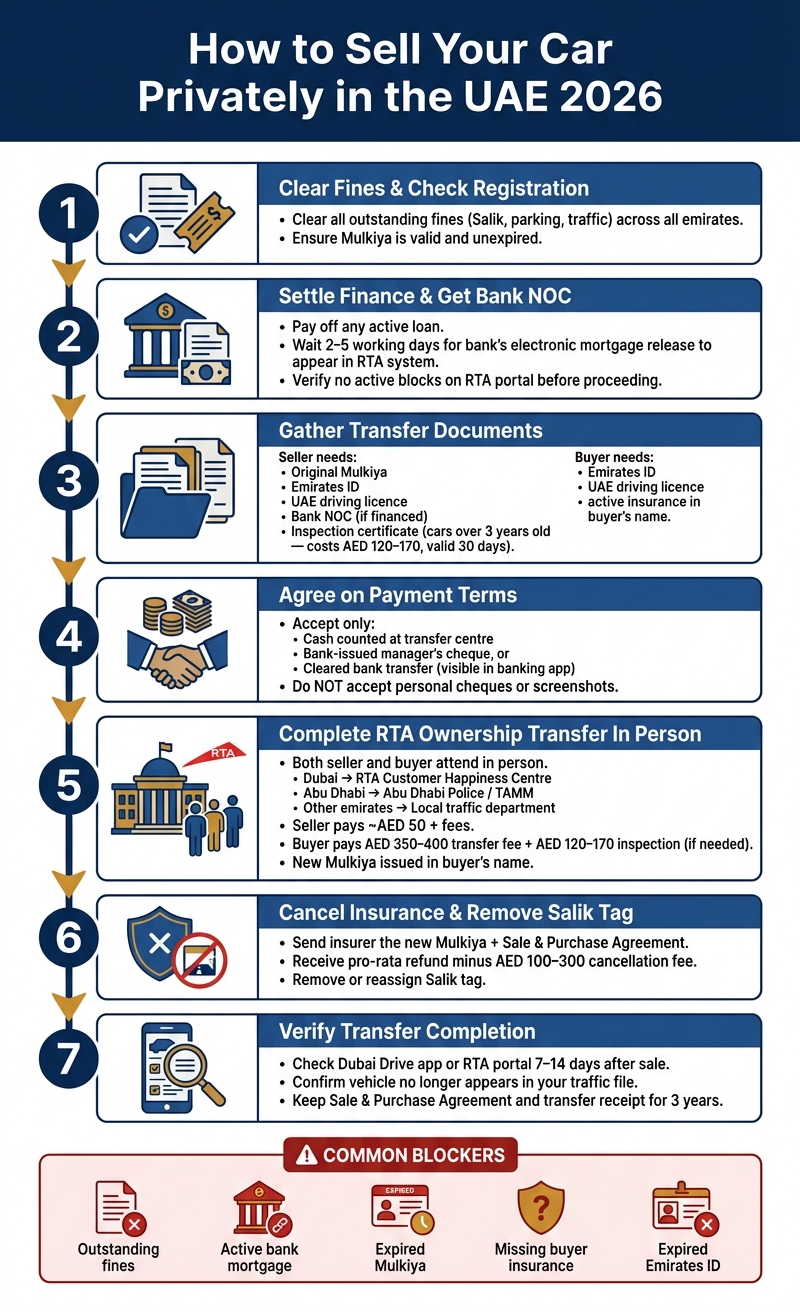
How to Sell Your Car Privately in the UAE: Step-by-Step Process
Prepare the car and sale documents
Clear fines, loans and registration issues before listing
Any open fine, finance balance, or registration problem can stop the sale right before transfer.
Outstanding fines in any emirate will block the transfer, so check across all emirates before you list the car. Salik tolls and parking violations need to be cleared too. You should also deactivate or transfer the Salik tag before handover, or you could end up paying for someone else’s trips.
If the car is under finance, settle the loan first and wait for the bank’s mortgage release. Also, make sure the Mulkiya is still valid. If the registration has expired, the transfer won’t go through.
Once the fines and finance are sorted, put the transfer paperwork together.
Gather the documents required for transfer
Missing just one document can hold up the RTA transfer. Sellers usually need the following at the transfer counter:
Document | Notes |
|---|---|
Original Mulkiya | Must be valid and unexpired |
Identity documents | Original Emirates ID; if expired, passport and residency visa copies |
UAE driving licence | Required for RTA profile and UAE Pass |
Bank NOC or mortgage release | Only if the car was financed |
Inspection certificate | Mandatory for cars older than three years; valid for 30 days |
Make sure both you and the buyer have active UAE Pass accounts. The Dubai Drive app uses them for electronic signatures on the Sale and Purchase Agreement.
With the paperwork in place, the next step is getting the car ready for inspection.
Get the car ready for buyer inspection
A clean file and a tidy car make the whole process smoother. They also give the buyer fewer reasons to push back at the last minute. Full service records support the car’s condition and can help you hold your asking price.
Bring together all the usual items: service receipts, any accident records, the spare key, and the owner’s manual. If things are missing, buyers often start to wonder how well the car was maintained.
For cars older than three years, an RTA-approved inspection certificate is required for transfer. Getting it done before listing gives buyers a report they can review and often cuts down on hard bargaining. The inspection costs between AED 120 and AED 170. It also helps to mention GCC-spec status in the listing.
After the car and documents are set, move on to payment and handover terms.
Agree on payment and handover terms
Confirm buyer identity, payment method and transfer readiness
Before anything changes hands, check the buyer’s original Emirates ID against the details on the transfer papers. Make sure they also have a valid UAE driving licence and insurance in their own name. You’ll need both to complete the RTA transfer.
When it comes to payment, keep it simple and safe. Accept cash counted at the transfer centre, a bank-issued manager’s cheque, or a cleared bank transfer that you can see in your banking app. Don’t rely on a screenshot or SMS as proof of payment. And don’t accept personal cheques.
Hold on to the keys and the Mulkiya until the RTA confirms the transfer and the money is fully in your account.
If the car still has finance on it, the next step is getting the bank NOC and the mortgage release.
Set a handover checklist for transfer day
Use this checklist on transfer day so nothing slips through the cracks:
Item | Action | Who |
|---|---|---|
Salik balance | Clear it and remove the tag after transfer | Seller |
All keys (including spares) | Hand over only after RTA confirms transfer | Seller |
Service records | Provide the full records | Seller |
Emirates ID and driving licence | Bring the original documents to the counter | Both |
Buyer's active insurance | Must be in the buyer’s name before transfer | Buyer |
Once the new Mulkiya is issued, hand over the keys and any accessories you agreed to include. Keep the Sale and Purchase Agreement and the transfer receipt for three years.
Get the bank NOC and clear any finance
Once you’ve agreed on payment terms, sort out any finance block before you book the transfer. If the car still has an active finance mortgage, the RTA won’t process the ownership transfer until that mortgage is cleared from the vehicle record. After the mortgage is removed, the transfer can move ahead.
If the loan is already settled: confirm the mortgage release
Paying off the loan doesn’t automatically remove the mortgage record from the RTA system. After the finance is settled, the bank must notify the RTA electronically so the mortgage hold can be removed. This update usually shows within 1–2 business days.
Before you book a transfer appointment, check the vehicle status on the RTA portal, the RTA app, or the Dubai Drive app to make sure there are no active blocks. Book the transfer only after the block has disappeared.
If the mortgage still appears after 48 hours, contact the bank and ask for a clearance letter or NOC.
If finance is still active: settle the loan and get the bank NOC
Start by asking the bank for a liability letter. It should show the amount still due, plus any early settlement charges. Don’t depend on the app balance alone.
The loan can be settled by the seller, or the buyer can pay the bank directly on the seller’s behalf. If the buyer is covering the settlement, it’s best if both parties go to the bank together so the release can be started there and then. Once payment is made, allow two to five working days for the bank’s electronic release to reach the RTA system.
Book the final transfer only after the mortgage block no longer appears in the RTA system. Don’t hand over the car or the Mulkiya until the block is cleared and the transfer is fully done.
Complete the RTA ownership transfer and close the sale
Once the mortgage is cleared, you’re down to the final admin: the RTA transfer, insurance cancellation, and handover. The transfer must be completed at an RTA Customer Happiness Centre or an approved testing and registration centre. In Dubai, you can begin the process online through Dubai Drive or the RTA website using UAE Pass, but the transfer still has to be finished in person. Both the seller and buyer need to attend, unless either side is represented by a legal representative with a notarised power of attorney.
Documents the seller and buyer must bring to the transfer centre
One missing document can hold up the whole process, so it’s worth checking everything before you head out.
Seller Documents | Buyer Documents |
|---|---|
Original Emirates ID (valid) | Original Emirates ID (valid) |
Original Vehicle Registration (Mulkiya) | Valid UAE Driving Licence |
Passport and Residency Visa copies | New insurance certificate in the buyer's name |
Bank mortgage release or NOC (if previously financed) | Passport and Residency Visa copies |
Vehicle inspection certificate (if the car is over 3 years old, valid for 30 days) | |
Trade licence and authorisation letter (corporate sellers only) |
The buyer’s insurance must already be active and linked to the chassis number or plate before the RTA can process the transfer.
Once the paperwork is in order, the transfer itself is usually simple.
Transfer steps, fees and how to handle common blockers
At the centre, the agent checks the documents, fines, blocks, and inspection validity. If everything is clear, the fees are paid and the new Mulkiya is issued in the buyer’s name.
Typical fees to expect: the seller usually pays about AED 50, plus Knowledge and Innovation fees. The buyer usually pays AED 350 to AED 400 for the ownership transfer, plus AED 120 to AED 170 for inspection if needed.
At the counter, the plates can be returned, reserved, or transferred, depending on what both sides agreed. Wait until the RTA confirms the transfer is done before handing over the physical plates or the Mulkiya. The new registration card must be issued in the buyer’s name first.
Blocker | Required Fix |
|---|---|
Outstanding fines, Salik charges or parking violations | Pay in full before attending |
Active bank mortgage | Clear the loan and wait for release |
Expired registration | Renew the Mulkiya before transfer |
Missing buyer insurance | Buyer must activate insurance before transfer |
Expired Emirates ID | Renew or present passport with valid visa |
Inter-emirate sale | Obtain an Export/Transfer Certificate |
14-day deadline missed | Buyer must finalise registration within 14 days or the transaction is cancelled and fees are not refunded |
Cancel or transfer insurance and complete the handover
After the new Mulkiya is issued, sort out the insurance policy and Salik account. Send your insurer the new registration card (Mulkiya) and the Sale and Purchase Agreement to cancel the policy and request any pro-rata refund for unused cover. A cancellation fee of about AED 100 to AED 300 is usually deducted from that refund. You should also remove or reassign the Salik tag after the transfer.
Then do one last check. Open the Dubai Drive app or the RTA portal 7 to 14 days after the sale and make sure the vehicle no longer appears under your traffic file. Keep the agreement and transfer receipt, especially in case you need to challenge any fine issued after the transfer date.
Hand over the keys, manuals, and accessories only after the transfer has been confirmed.
FAQs
Can I sell a financed car before the bank release appears?
No. You can’t sell a financed car until the loan is fully settled and the mortgage is removed from the vehicle record. The RTA won’t process the ownership transfer while the bank still has a registered interest in the car.
You have two clear options:
Settle the loan and get a No Objection Certificate (NOC) from the bank
Go to the bank with the buyer to arrange a formal finance transfer
Don’t rely on informal agreements.
What if the buyer wants to pay before transfer day?
If the buyer wants to pay before transfer day, put safety first. Do not hand over the car, Mulkiya, or number plates until the RTA confirms the ownership transfer.
Skip personal cheques. If the buyer pays in advance, stick to a cleared bank transfer or a certified Manager's Cheque. Until the registration is updated in the buyer’s name, you are still legally responsible for the car, including any fines or traffic violations.
How do I prove the car is no longer under my name?
Complete the official ownership transfer at an RTA or MOI service centre. Once the transfer is done, a new Mulkiya is issued in the buyer’s name.
In some cases, you may also receive a Possession Certificate that confirms the vehicle has been removed from your traffic file. This part matters more than many sellers think. Until the transfer is officially registered, you are still the legal owner and can be held liable for fines, Salik charges, or accidents.