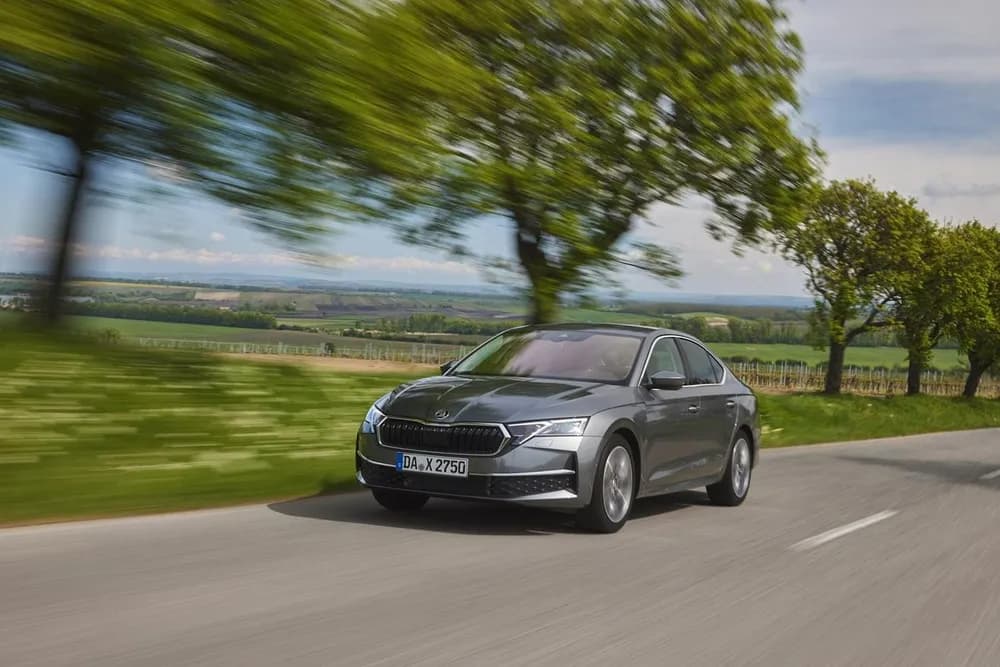
With summer nearing across the GCC, countries around the region are encouraging residents to holiday closer to home through an expanding lineup of domestic and regional tourism campaigns. Saudi Arabia’s “Summer Our Way”, Qatar’s “Hala Summer”, Bahrain’s family-focused GCC tourism season and the UAE’s “Make it a Dubai Summer” are all drawing attention to the road trips that connect urban centres, seaside escapes, mountain roads and inland destinations.
For driving enthusiasts, this trend brings renewed attention to how engines perform in everyday conditions. Long-distance travel, constant highway cruising, overtaking at speed and climbing towards cooler mountain areas all depend heavily on the way torque is delivered through the low- and mid-range. In situations like these, performance is measured by more than headline horsepower figures.
Škoda developed its TSI engine technology specifically around this real-world operating window. By bringing together turbocharging and direct fuel injection, TSI engines provide strong pulling power from low revs, often starting at around 1,500 rpm, and sustain that strength throughout the mid-range where daily driving happens most. This helps create smoother acceleration, reduces unnecessary downshifts and gives the car a more relaxed character without the need for a larger engine capacity.
Torque delivery: where real-world performance begins
Škoda engineers calibrate TSI engines to produce torque early and maintain it across a broad mid-range band, usually from roughly 1,500 rpm to 3,500-4,000 rpm. That setup gives drivers access to usable performance in the part of the rev range they rely on most, rather than forcing the engine to work at high revs before it responds.
This characteristic becomes especially useful on extended summer drives, where motorists may want progressive acceleration from cruising speed, assured overtaking ability on fast roads or consistent pulling power on uphill sections. Because the torque band is broad, the engine reacts more smoothly to throttle inputs, making motorway driving feel calmer while also limiting unnecessary gearbox downshifts.
Turbocharging: smaller engine, stronger response

At the heart of TSI is the principle of downsizing, which means extracting solid performance and efficiency from a smaller, lighter engine. Rather than relying only on displacement, the turbocharger uses exhaust gas energy to push additional air into the engine, allowing it to generate stronger torque when needed.
That approach enables a compact engine to offer the kind of response many drivers would normally expect from a larger naturally aspirated unit. In everyday use, the advantage appears in the form of better pull at lower revs, smoother acceleration and less dependence on downshifting.
The comparison in specific output highlights how far the engineering has advanced. In the early 2000s, a naturally aspirated 1.0-litre petrol engine would generally produce about 50–60 HP. Škoda’s 1.0-litre TSI delivers 115 HP from the same capacity, while also being lighter, cleaner and more efficient.
For drivers in the GCC travelling between cities, along coastal roads or towards destinations at higher elevations, this means the engine can provide meaningful responsiveness without depending only on larger displacement.
Direct fuel injection: precision that supports performance
The second core element of the TSI concept is direct fuel injection. Fuel is delivered straight into the combustion chamber at pressures of up to 350 bar, compared with roughly 3-5 bar in conventional port-injection systems.
By injecting fuel at such high pressure, the system creates a fine mist that helps the engine burn fuel more evenly and with greater efficiency. It also adjusts injection timing and quantity continuously in response to throttle input, engine load and temperature conditions.
From the driver’s perspective, this helps sharpen acceleration response and makes power delivery more consistent under load. From the engine’s perspective, it supports cleaner combustion and assists with temperature control when the turbocharger is building boost.
Engine architecture: the details behind the response

In addition to turbocharging and direct injection, TSI engines incorporate supporting technologies that enhance both performance and efficiency in everyday driving. One example is the integrated exhaust manifold, which shortens the path exhaust gases travel to reach the turbocharger and helps the turbo react faster at lower engine speeds.
Variable valve timing on both the intake and exhaust camshafts also allows the engine to adapt more effectively to changing conditions. Under light loads, it can improve efficiency by reducing pumping losses. During harder acceleration, it helps optimise airflow and combustion efficiency.
Although these engineering details are not always obvious from behind the wheel, they play a major role in shaping the driving experience by making the engine feel responsive at low revs, smooth through the mid-range and composed during long periods of cruising.
Efficiency beyond engine size
The efficiency of TSI is not simply a by-product of a smaller engine. It comes from the way the powertrain operates throughout a normal drive cycle. A smaller displacement reduces weight and internal friction, turbocharging delivers extra air only when stronger performance is needed, direct injection meters fuel precisely, and variable valve timing helps regulate breathing according to demand.
Against equivalent naturally aspirated engines, TSI can achieve around 20% lower fuel consumption and approximately 15% lower CO₂ emissions. In practical driving terms, this means drivers get the benefit of early torque without needing to rev the engine hard, while still maintaining efficient cruising ability on longer journeys and enough flexibility for overtaking.
For summer journeys across the GCC, that combination supports confident performance together with more efficient long-distance operation, rather than treating those two goals as separate priorities.
More than two decades of TSI development
TSI technology has been under development and continuous refinement for more than two decades. During that time, it has become a key pillar of Škoda’s petrol engine strategy by combining everyday usability with measurable advances in efficiency and performance. Its value comes from balance: strong torque in the low and mid rev range, intelligent fuel delivery, reduced engine mass and well-developed engineering.
As Škoda continues shaping its powertrain portfolio around intelligent, efficient and accessible engineering, TSI shows why usable torque remains one of the clearest indicators of real-world performance.