If you still slow down only at the camera, you’re more likely to get fined in 2026. I’d sum it up like this: roads in the UAE and Saudi Arabia are now watched over a longer stretch, across more lanes, and for more than just speed.
Here’s what that means for you in simple terms:
-
Speed is checked over distance, not only at one point
-
Phone use, no seatbelt, tailgating, swerving, and shoulder misuse are easier to spot
-
Black points add up, and in KSA, 24 points in one Hijri year can mean a 3-month licence suspension
-
Used-car buyers should now check violation history more closely, because repeated road-behaviour fines may point to harder use
A few numbers stand out straight away:
-
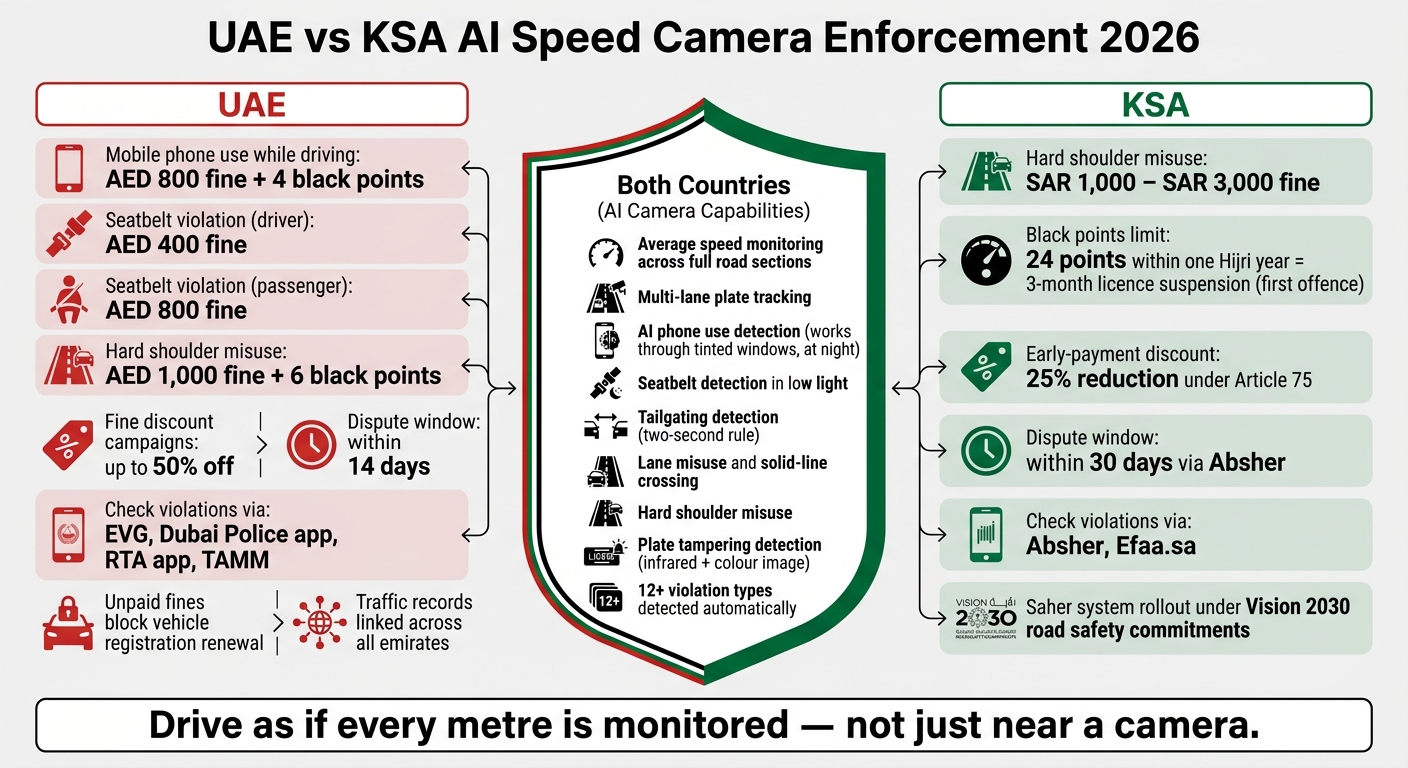
In the UAE, mobile phone use while driving = AED 800 + 4 black points
-
Hard shoulder misuse in the UAE can mean AED 1,000 + 6 black points
-
In KSA, some shoulder-use offences can reach SAR 3,000
-
KSA offers a 25% early-payment reduction in some cases
-
UAE discount drives can go up to 50%
My takeaway is simple: drive as if every metre is being checked, not just the space near a camera. That one shift in habit explains most of what’s changing in 2026.
| What changed | Older setup | 2026 setup |
|---|---|---|
| Speed checks | One camera point | Full road section, including average speed |
| Lane tracking | Limited | Multiple lanes at once |
| Driver behaviour | Often missed | Tailgating, swerving, shoulder use, line crossing |
| Inside-car checks | Usually missed | Phone use and seatbelt checks, day or night |
| Plate checks | Easier to dodge | More image checks across plate views |
If I were to reduce the whole article to one message, it would be this: the risk now comes from repeat driving habits, not just one fast moment.
UAE vs KSA AI Speed Camera Enforcement 2026: Fines, Points & Rules Compared
Why Older Cameras Missed So Much and New Systems Do Not
What older speed cameras could and could not detect
Older radar cameras in the UAE and KSA were built for a narrower job. They mostly caught speeding at a fixed point and red-light violations at intersections.
What they couldn't do was just as important. They couldn't spot phone use or seatbelt use. They couldn't follow a vehicle across lanes. And they had no way to measure what happened between one camera and the next.
That left a big blind spot. The stretch of road between cameras was, in practice, unmonitored. Standard ANPR also had weak points. Drivers could sometimes get around it with tampered plates, including sprays, films, and physical changes meant to block infrared or visible-light capture. Violations like shoulder misuse, tailgating, and unsafe lane changes were also hard for these systems to catch.
Why the UAE and Saudi Arabia are rolling out smarter cameras in 2026
That gap is exactly what 2026 enforcement is meant to close.
In the UAE, the move is linked to smart city plans and a target of 100% transport digitalisation. In Saudi Arabia, the wider Saher rollout sits under Vision 2030 road safety commitments. The system now automatically detects more than 12 types of traffic violations. AI has also been added to monitor phone use and seatbelt use inside the vehicle, even in low-light conditions.
So the shift is pretty clear: both countries are closing the same weak spots.
For motorists, this means more violations can now be detected across the full road stretch, not just at one camera point.
The table below shows where older systems fell short and what 2026 AI cameras now cover:
| Violation Type | Older Camera Capability | 2026 AI Camera Capability |
|---|---|---|
| Speeding | Point speed only | Point speed, average speed, variable limits |
| Mobile phone use | Usually missed | Detects phone light patterns and hand movements |
| Lane discipline | Limited to specific junctions | Detects swerving, solid-line crossing and lane misuse |
| Tailgating | Not detected | Calculates real-time distance between vehicles |
| Plate tampering | Vulnerable to sprays and films | Uses infrared and colour image checks |
| Occupant safety | Not detected | Distinguishes seatbelts from clothing |
The result is simple: driving style now matters as much as speed. Drivers now need to think about every metre of the road, not just the camera post.
How AI Cameras Detect More Violations on UAE and KSA Roads
Average-speed monitoring and variable speed limits
These systems record when your car enters and leaves a monitored road section, then work out your average speed. So, drivers aren’t checked at just one camera spot. They’re measured across the whole stretch.
Variable speed limits make things even tighter. In school zones and roadwork areas, digital signs show live speed limits as conditions change. In many of these places, there’s little or no margin, so the posted number is the one that counts - not the speed limit you remember from your last drive.
Multi-lane plate tracking, phone use and seatbelt detection
Multi-lane plate tracking now watches the full width of the road. In plain terms, switching lanes near a camera won’t help you avoid detection.
AI video systems can also spot handheld phone use and missing seatbelts, even through tinted windows and at night, and they can do it without a visible flash. The fines aren’t small either. In the UAE, using a mobile phone while driving brings an AED 800 fine and 4 black points, while seatbelt breaches cost AED 400 for the driver and AED 800 for a passenger.
Tailgating, lane misuse and unsafe driving patterns
AI systems now review driver behaviour over several seconds of footage instead of relying on one snapshot. That makes it much easier to catch tailgating, sudden swerving, hard shoulder misuse, and crossing solid lines. Tailgating is checked against the two-second rule, while hard shoulder misuse carries AED 1,000 and 6 black points in the UAE, and SAR 1,000 to SAR 3,000 in KSA.
What this means on the road is pretty clear: cameras are no longer focused only on fixed points. They’re picking up unsafe behaviour across a longer stretch, which puts everyday driving habits under much closer watch.
How to Drive Differently and Avoid Fines Under AI Enforcement
Driving habits that reduce fine risk under continuous monitoring
Once a road is watched from start to finish, the little things start to count more than that last-second brake before a camera. AI enforcement closes the old one-camera gap. So the safer move is simple: stay within the speed limit for the entire monitored stretch.
That matters even more on long roads like Sheikh Zayed Road or inter-city highways in KSA, where your speed can creep up without you feeling it. In that case, cruise control or a speed limiter is one of the easiest ways to keep things steady.
Speed isn't the only issue now. Some everyday in-car habits can cost you money fast. Put your phone in the glove box or in a secure mount, and switch on Do Not Disturb While Driving before you head off. AI systems can pick up hand movements and screen glow, even through tinted windows and in low light.
Seat belts matter just as much. Make sure every passenger is buckled up before the car moves. AI systems can spot unfastened belts even in low light. On the road, leave at least a two-second gap between you and the car ahead, or four seconds in wet conditions. And stay clear of solid lines and the hard shoulder unless you're allowed to use them.
The risk now isn't only one fine. It's picking up several on the same journey.
Planning trips and managing fines and licence points
Before a long drive, check your violations and payment status. In the UAE, you can do that through EVG, the Dubai Police app, the RTA app, or TAMM in Abu Dhabi. In KSA, use Absher or Efaa.sa.
It also helps to keep your mobile number up to date on Absher and UAE PASS so SMS alerts reach you straight away. That small admin task can save a lot of hassle.
There may also be a chance to pay less if you act early. KSA gives a 25% reduction under Article 75 for early payment, while the UAE runs periodic discount campaigns that can go up to 50%.
If you think a fine was issued by mistake, move fast. File your objection within 14 days in the UAE or 30 days in KSA, since radar data and footage may be cleared after those windows close.
If you're driving in KSA, keep an eye on your black points too. Hitting 24 points within one Hijri year leads to a three-month licence suspension for a first offence. And one more thing that catches drivers out: the amber light means get ready to stop. Crossing the pedestrian line after the light turns amber can lead to a heavy fine. In the UAE, unpaid fines can also block vehicle registration renewal.
| Action | UAE | KSA |
|---|---|---|
| Check violations | EVG, Dubai Police app, RTA app, TAMM | Absher, Efaa.sa |
| Early-payment discount | Periodic campaigns (up to 50%) | 25% early-payment reduction under Article 75 |
| Dispute window | Within 14 days | 30 days via Absher |
What AI Enforcement Means When Buying or Selling a Used Car
Why a car's violation history matters more in 2026
A used car's violation record now says more than many buyers used to think.
It’s no longer just about fines. With AI enforcement, a car’s history can hint at how it was driven day to day. Repeated fines for tailgating, swerving, or lane misuse can suggest rougher use over time. And that can mean more strain on parts like brakes, tyres, and suspension.
Unpaid fines also block ownership transfer and registration renewal until the record is cleared.
In the UAE, traffic records are linked across emirates, so violations don’t vanish just because the car was driven in another location. That changes the way buyers should read a record. The kind of violation matters more than the total amount alone.
A car with a few parking fines is one thing. A car with repeated behavioural violations such as tailgating, sudden swerving, or lane misuse is another story.
Before buying, check the official traffic record first. Then look past the total in AED and study the pattern.
| Factor | Clean Violation History | Frequent AI-Detected Violations |
|---|---|---|
| Transfer | Smooth | Blocked until all fines are settled |
| Wear | Standard | Higher wear on brakes, tyres, suspension |
| Buyer confidence | High | Low; signals hard use and potential hidden damage |
How YallaMotor tools help buyers and sellers make safer decisions

For sellers, this record is part of what’s being sold. Clearing all fines before listing removes a major buyer concern. It also helps support a stronger asking price.
YallaMotor’s vehicle inspection services and car valuation tools help both sides see the car more clearly.
For buyers, the smart move is to match the inspection report with the violation history. If a car shows repeated speeding fines, it makes sense to check brake pad thickness and tyre tread more closely. That’s a simple cross-check, but it can save a lot of hassle later.
For sellers, a documented inspection report paired with a clean traffic record gives buyers more comfort. It shows the car isn’t carrying loose ends that could delay transfer or hint at rough use.
Conclusion: Drive as if every stretch of road is monitored
AI enforcement in the UAE and KSA now catches much more than a brief speed jump near a camera. Persistent speeding, tailgating, phone use, seatbelt violations, and lane misuse are all logged, and that record follows the vehicle - not just the driver.
For everyday motorists, the shift is straightforward: drive by the rules for the full trip, not only when a camera is in sight. For used-car buyers, checking a vehicle’s violation history before signing anything now matters just as much as checking the service record. For sellers, a clean record is a strong selling point worth keeping.
FAQs
How do average-speed cameras work?
Average-speed cameras track your vehicle between two points on a road, not at just one camera.
They log the time you pass the first point and the time you pass the second, then use the known distance between them to work out your average speed.
If your average speed across that stretch is above the posted limit, you can be fined. So slowing down for one camera and then speeding up again won’t help - you can still end up with a violation.
Can AI cameras detect phone use at night?
Yes. Modern AI-powered cameras in the UAE and Saudi Arabia are built to detect mobile phone use at night.
They use computer vision to spot distracted driving, including hand movements and light from phone screens, even in low-light conditions. These systems work day and night, so drivers should assume they are monitored 24/7.
Should I check violation history before buying a used car?
Yes. Checking a used car’s violation history is a must before you finalise the purchase.
In the UAE and Saudi Arabia, traffic violations are linked to the vehicle’s registration record. That means unpaid fines don’t just sit in the background. They can affect registration renewal and, in some cases, parts of the transfer process.
Use official channels to check the car’s status, such as:
-
EVG
-
Dubai Police
-
Absher
A quick check now can save you a headache later, especially if the car looks fine on the surface but has unpaid penalties attached to it.