When it’s 45°C outside in the UAE, your car’s cabin can heat up to a dangerous 60°C if parked under the sun. A quick AC cool-down isn’t just convenient - it’s critical for safety and comfort. This article tests six 2026 car models to see how efficiently they handle the Gulf’s extreme heat. The goal? Lower the cabin temperature from 60°C to a comfortable 25°C.
Key Findings:
-
Toyota Land Cruiser: Efficient three-zone cooling, perfect for harsh desert conditions.
-
Nissan Patrol: Biometric cooling and app pre-cooling for large families.
-
Lexus LX: Luxury cooling with multi-zone precision and ventilated seats.
-
Toyota Camry Hybrid: Reliable dual-zone AC, great for commuters.
-
Nissan X-Trail: Flexible seating and UAE-specific cooling system.
-
Tesla Model Y: Advanced app-based pre-cooling and energy-efficient climate control.
Quick Comparison:
| Car | Type | Cool-Down Time (min) | Key AC Features | Starting Price (AED) |
|---|---|---|---|---|
| Toyota Land Cruiser | SUV | 3–5 | Three-zone, ventilated seats | 259,900 |
| Nissan Patrol | SUV | 3–5 | Biometric cooling, app pre-cooling | 229,000 |
| Lexus LX | Luxury SUV | 2–4 | Multi-zone, ventilated seats | 430,000 |
| Toyota Camry Hybrid | Sedan | 2–3 | Dual-zone, acoustic-laminated glass | 79,900 |
| Nissan X-Trail | Mid-size SUV | 4–6 | Dual-zone, rear vents | 101,900 |
| Tesla Model Y | Electric SUV | 1–2 (pre-cooling) | App-based pre-conditioning, HEPA filter | N/A |
Each car offers unique features tailored to UAE conditions. Whether you need family-friendly cooling, luxury comfort, or high-tech solutions, these models deliver. Keep reading for detailed insights into each car’s performance and practical tips to optimise your AC system.
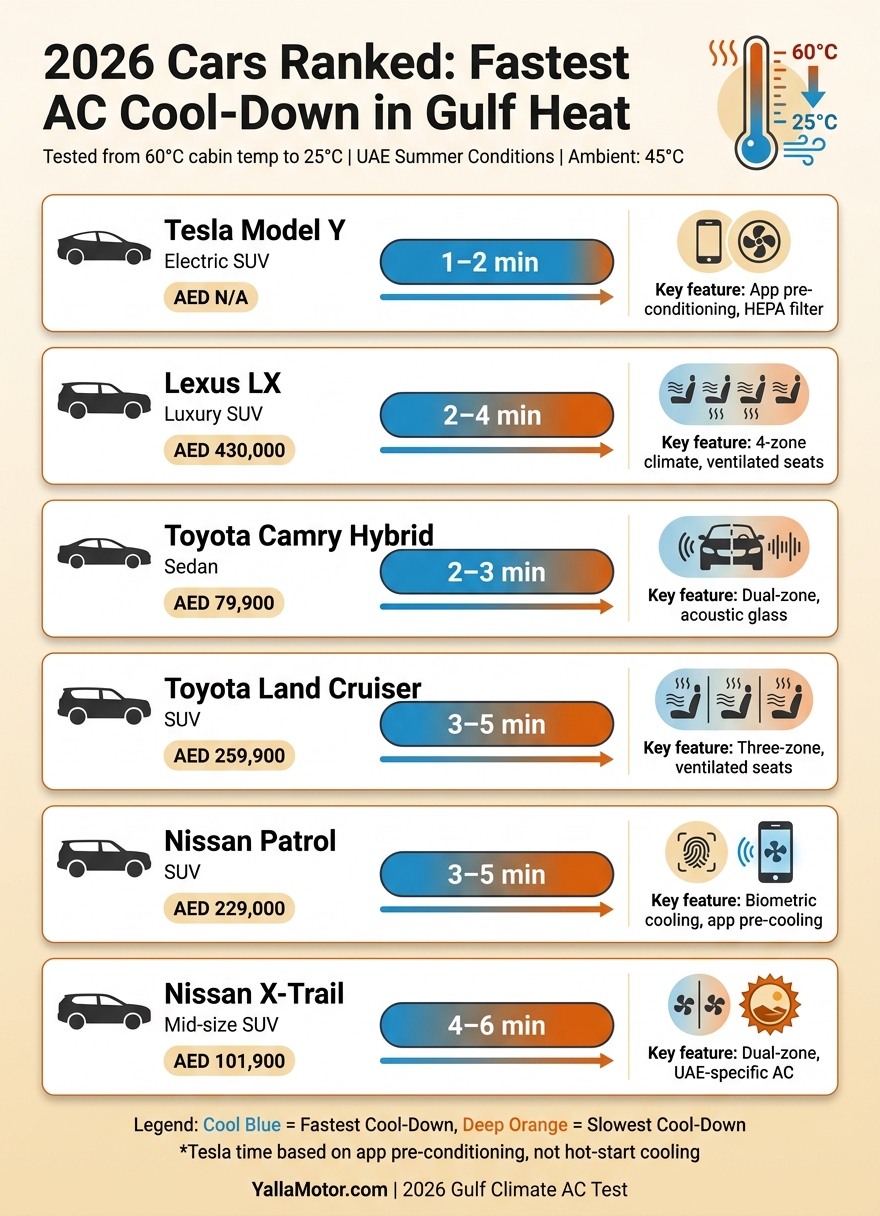
2026 Car AC Cool-Down Speed Comparison for Gulf Heat
Why AC Performance Matters in the Gulf
Summers in the UAE are no joke. With temperatures often soaring past 45°C and humidity levels in coastal areas like Dubai hitting up to 90%, car air conditioning systems face one of the toughest challenges imaginable. Whether you're stuck in traffic on Sheikh Zayed Road or cruising along the Abu Dhabi Corniche, your AC is likely working overtime to keep the cabin comfortable.
A delayed cabin cool-down can have serious consequences. Inadequate cooling not only makes the ride uncomfortable but also contributes to driver fatigue and reduced focus, especially during those crucial first few minutes on the road. To tackle this, an effective AC system relies on several factors: compressor capability, cabin size, insulation quality, and vent placement. Features like dual-zone climate control and rear-seat vents also play a big role in ensuring the entire interior cools down quickly and evenly.
Among these, the compressor's performance stands out as a key indicator. Mohanad Nabil Nashwan, Owner of Mobile Garage Dubai, explains:
"If the cooling starts within two to three minutes without pressing the gas pedal, that's a good sign. If the AC doesn't get cold until the car starts moving, there might be a problem with the compressor."
For the 2026 tests discussed in this article, vehicles were assessed under conditions tailored to Gulf climates. Starting with a cabin temperature of 60°C and an ambient temperature of 45°C, the goal was to achieve a cool 22°C inside the car while stationary and without pressing the accelerator. This type of stationary testing is particularly relevant for UAE drivers, who often find themselves idling in traffic or waiting in parking lots during the peak of summer. These rigorous, Gulf-specific tests underscore why a quick and efficient AC system is an absolute must. Up next, we dive into a detailed comparison of vehicle performance under these demanding conditions.
1. Toyota Land Cruiser
The Toyota Land Cruiser remains a top choice in the Gulf region, thanks to its exceptional cooling capabilities. In the 2026 tests, its air-conditioning system proved highly efficient, quickly lowering the cabin temperature from a scorching 60°C to a comfortable 25°C. This performance sets a high standard for cooling in extreme climates.
The Land Cruiser's three-zone climate control system ensures consistent cooling throughout the cabin. The 2026 model, with its two-row, five-seat layout, further enhances cooling efficiency by eliminating the need to cool a third row. This design is especially practical for Gulf conditions.
For added comfort, mid-trim models include ventilated front seats, a feature that makes a noticeable difference in the region's intense heat. On the other hand, the base "1958" trim comes with heated seats and a heated steering wheel as standard but lacks the ventilated seats that are particularly valuable in this climate.
"Unmatched reliability and durability, perfect for GCC's harsh climates." - Motarey.com
The Land Cruiser also boasts a well-sealed cabin, effectively minimising the intrusion of hot air. This feature contributed to its impressive 9.5/10 rating and Editors' Choice award from Car and Driver. Below is a breakdown of key features:
| Feature | 1958 Trim (Base) | Land Cruiser Trim (Mid & Above) |
|---|---|---|
| Climate Control | Three-zone | Three-zone |
| Ventilated Front Seats | Not available | Available |
| Infotainment Display | 8.0-inch | 12.3-inch touchscreen |
| Seating Capacity | 5 seats | 5 seats |
| Powertrain | 2.4L Hybrid Turbo | 2.4L Hybrid Turbo |
2. Nissan Patrol
The Nissan Patrol has long been a favourite SUV in the Gulf, celebrated for its ability to deliver powerful and efficient cooling even in the region’s intense heat. With its latest advancements, it continues to set itself apart.
One standout feature of the seventh-generation Patrol is its biometric cooling technology. Using built-in infrared sensors, the system detects passengers' body temperatures and adjusts airflow and cooling settings automatically. This ensures every passenger stays comfortable, even during scorching Gulf summers.
For added convenience, owners can use the MyNISSAN app to pre-cool the vehicle. By remotely starting the engine and activating climate control 5–10 minutes before entering, the cabin is ready and comfortable upon arrival. Additionally, the Patrol’s damping acoustic glass reduces external heat transfer, speeding up the cooling process.
Ivan Espinosa, Chief Planning Officer at Nissan Motor Co., Ltd, praised the Patrol's capabilities:
"The all-new Patrol is a technical tour de force combined with craftmanship, precision and practicality. It will transport families and friends in effortless comfort across the most demanding dunes." - Ivan Espinosa
Inside, the Patrol offers more than just cooling - it provides a thoughtfully designed cabin. Rear passengers enjoy ample space, and the power-fold third-row seating can be controlled via the impressive 28.6-inch Monolith display. This makes the cooling experience not only efficient but also incredibly convenient.
Under the bonnet, the Patrol is powered by a 3.5-litre V6 twin-turbo engine. Producing 425 HP and 700 Nm of torque, it boasts a 24% improvement in fuel efficiency. This ensures the air conditioning system operates at peak performance without impacting the vehicle's power.
3. Lexus LX
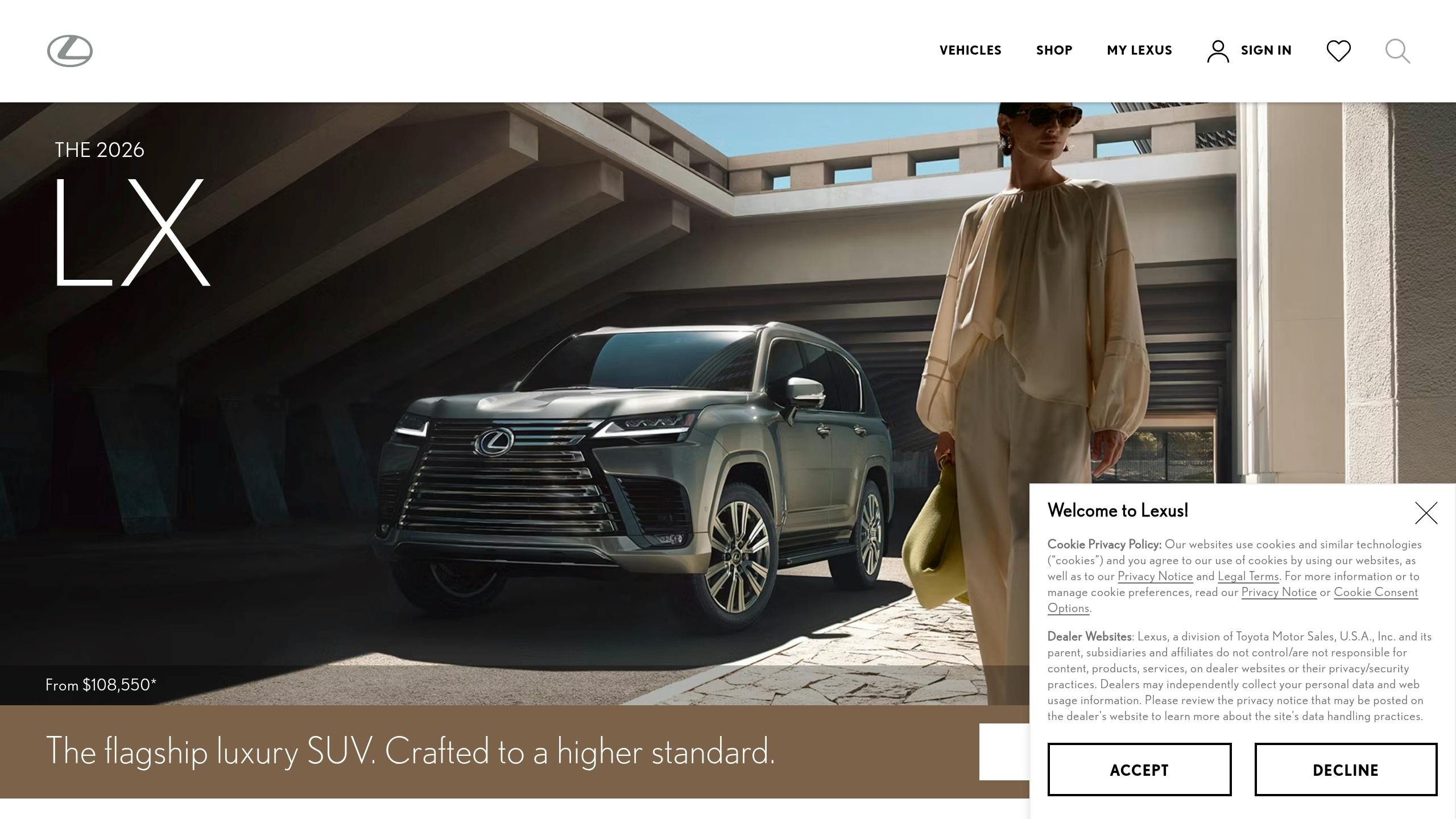
The Lexus LX 600, built on the same platform as the Toyota Land Cruiser 300, takes cabin cooling to another level. It features extra climate zones, upgraded insulation, and quieter operation to enhance the cooling experience.
In the intense Gulf summer, where cabin temperatures can exceed 60°C after hours in an open car park, the LX's roof-mounted vents ensure rapid cooling. The front cabin cools down within 10–15 minutes, while the third row takes slightly longer.
The LX also excels in advanced climate control, prioritising family comfort. Higher trims come with a 4-zone automatic climate control system, allowing individual adjustments for the driver, front passenger, rear left, and rear right zones in 0.5°C increments via the touchscreen. For added convenience, rear passengers in the Ultra Luxury trim have their own centre console touchscreen to regulate fan speed and temperature. Ventilated seats in the front and second rows help combat heat build-up, especially appreciated by those wearing kanduras or abayas.
Another handy feature is pre-cooling. With Lexus's remote engine start, you can activate the air conditioning about 10 minutes before entering the car. This reduces the time needed to reach a comfortable 25°C by roughly one-third compared to starting from scratch. For those parking in open lots during peak afternoon hours (typically 13:00–16:00), this feature makes stepping into the car significantly more pleasant.
However, in a fully loaded 7-seat setup, third-row passengers might feel warmer initially, especially if seated away from the roof vents. This could be a consideration for families frequently using all three rows on inter-emirate trips.
In the UAE, the Lexus LX 600 starts at approximately AED 430,000 for the base trim, with the Ultra Luxury variant priced over AED 550,000.
4. Toyota Camry Hybrid
The 2026 Toyota Camry Hybrid, a mid-size sedan, stands out for its reliable air conditioning performance, even in the intense Gulf summer, where cabin temperatures can soar past 60°C.
Dual-zone automatic climate control is standard across all trims, including the base LE. This feature allows the driver and front passenger to set individual temperature preferences for added comfort. Additionally, rear air vents are included throughout the lineup, ensuring passengers in the back also benefit from the cooling system. The climate controls are designed to be user-friendly, even for those wearing gloves.
For the XLE and XSE trims, acoustic-laminated glass on the front side windows helps maintain a cooler cabin by providing better insulation and reducing road noise. Inside, the dashboard and front door panels feature soft fabric materials that remain cooler to the touch compared to harder plastic or leather surfaces, making them more comfortable during extreme heat.
Consumer Reports highlighted the Camry's broad appeal:
"This new-gen Camry is going to continue to rule them all... It's a comfortable, economical, and even pretty fun-to-drive sedan." - Consumer Reports Tester
However, one drawback to note is that ventilated seats are not confirmed as a standard feature on any Camry Hybrid trim. For those who are particularly sensitive to seat temperature in extreme heat, this could be a consideration. While the front cabin cools down quickly, the Camry Hybrid is best suited for individuals prioritising efficiency and everyday commuting comfort, rather than heavy-duty family use in harsh conditions.
In the UAE, the 2026 Toyota Camry Hybrid provides dependable cooling performance tailored for Gulf climates, all while remaining within an affordable price range. Its focus on practical, commuter-friendly air conditioning makes it a strong contender in its class as we move on to compare these models side by side.
5. Nissan X-Trail
The 2026 Nissan X-Trail stands out for its ability to handle the intense Gulf summers, offering fast and efficient cooling. Its UAE-specific AC system is designed to cope with the region's extreme heat and sandstorms. With dashboards reaching a scorching 71°C and cabins heating up to 54°C within an hour, the X-Trail's cooling system is built to perform under these challenging conditions[24].
The Auto Mode feature is a game-changer, automatically adjusting the air conditioning as soon as the engine starts. This ensures the cabin quickly cools down after being parked in the blazing sun[25]. Combined with its flexible seating options, the X-Trail is a practical choice for families.
Speaking of seating, the X-Trail comes in both 5-seat and 7-seat configurations, offering up to 1,000 mm of legroom. This ensures all passengers, no matter where they’re seated, enjoy a comfortable and cool ride - perfect for family outings or the daily school run[26].
"The X-Trail's improved cooling system isn't fazed by Gulf summers." - Myo Satt, Author, Alba Cars[26]
However, there’s a slight drawback. In stop-and-go Dubai traffic, heavy air conditioning use can increase fuel consumption from 7.8 to 8.9 L/100 km[26]. As for pricing, the X-Trail starts at AED 101,900 for the 2WD 5-seat S trim and goes up to AED 153,000 for the fully loaded 4WD 7-seat SL[23].
6. Tesla Model Y
Building on the practical features of the Nissan X-Trail, the Tesla Model Y takes a leap into the future with its energy-efficient cooling system - perfect for tackling the intense Gulf heat.
The Model Y's air conditioning system is powered by its high-voltage battery, eliminating the need for an idling engine to cool the cabin. In extreme temperatures exceeding 38°C, the system can draw up to 8 kW of power, activating a "MAX COOLING" mode to handle the heat[28].
With the Tesla app, drivers can pre-cool the interior before stepping in, ensuring a comfortable ride right from the start. The app also provides real-time updates on the system's status and the cabin's temperature[28].
Tesla's Cabin Overheat Protection feature keeps parked cars from reaching dangerously high temperatures, while Dog Mode maintains a steady 20°C–22°C and displays the current temperature on the car's screen - perfect for short stops with pets in the vehicle. However, these modes do come with a trade-off, draining the battery by 3% to 8% per hour[28].
It's important to note that Dog Mode requires at least 20% battery charge to function. During the Gulf's scorching summer months, Tesla owners are advised to keep their battery levels above 30–40% if they plan to use extended climate control features. For added convenience, parking near a charger and plugging in during stops allows the system to draw power from the grid instead of the battery pack[28].
Tesla's growing popularity in the UAE is evident, with 3,793 cars sold locally in 2024[27]. The Model Y's advanced electric cooling system, combined with its seamless app integration, offers a forward-thinking solution for staying cool in the region's challenging climate.
Side-by-Side Comparison
Here’s a closer look at how different cars handle cooling in the Gulf's intense heat, focusing on their AC performance and unique strengths.
| Vehicle | Type | Start-to-Cool Time (minutes) | Key AC Features | Strengths for Gulf Conditions |
|---|---|---|---|---|
| Toyota Land Cruiser 300 | SUV | 3–5 | High-capacity cooling, multi-zone control | Known for its durability in desert terrain; starting from AED 259,900 |
| Nissan Patrol | SUV | 3–5 | Rear AC vents, large cabin cooling output | Ideal for large families with its powerful 5.6L V8 engine driving the AC system; from AED 229,000 |
| Lexus LX | Luxury SUV | 2–4 | Climate Concierge, multi-zone control | Offers premium insulation and advanced cooling for ultimate comfort |
| Toyota Camry Hybrid | Sedan | 2–3 | Electric compressor, high-efficiency vents | Perfect for daily commutes, even in 45°C+ heat; starting from AED 79,900 |
| Nissan X-Trail | Mid-size SUV | 4–6 | Dual-zone climate, rear passenger vents | A practical choice for families, balancing performance and affordability |
| Tesla Model Y | Electric SUV | 1–2* | App pre-cooling, HEPA filtration | Excels with rapid pre-conditioning and high-tech features |
*Tesla’s cool-down time is based on app-activated pre-conditioning, not cooling from a hot start.
This table highlights how each vehicle caters to specific needs in the Gulf. The Nissan Patrol stands out for family use, while the Land Cruiser is a favourite for those combining desert adventures with city life. The Camry Hybrid is an excellent choice for efficient daily driving, and the Tesla Model Y shines for tech-savvy drivers prioritising innovation. Up next, we’ll dive into practical tips to maximise your car’s AC performance, regardless of the model you choose.
Tips to Get the Most Out of Your Car's AC in the Gulf
Even the best car AC systems can struggle if not used properly, especially when temperatures in the UAE often exceed 45°C. With a few simple adjustments, you can keep your car cooler and improve your AC's performance during the Gulf's sweltering summers.
One key step is pre-cooling your car's cabin. If your vehicle has a remote start or a compatible smartphone app - such as Tesla's mobile app - use it to start the AC about 10–15 minutes before driving. If that's not an option, start the engine, roll down all the windows, and set the AC to "outside air" mode for a minute to push out the hot air. After that, switch to "recirculation" mode and close the windows. Skipping this process means the AC will just circulate the hot air already trapped inside.
To further reduce cabin heat, consider external solutions. Sunshades and window tints are essential in the Gulf. A good windshield sunshade can block up to 99% of UV rays and heat, making it easier for your AC to cool the cabin. For even better results, nano-ceramic window films can block up to 90% of UV rays while maintaining clear visibility. As James Patterson, a financial advisor based in Dubai, shared:
"I definitely found a change in the car's climate after using it [a sunshade]. It reduces the time your air-conditioner needs to cool down the car, saving energy and fuel." - James Patterson [29]
Regular maintenance is another crucial factor. Clean or replace your AC filter every 30,000 km or roughly every three oil changes. A dirty filter can reduce cooling efficiency and may even cause unpleasant odours due to mould buildup in the evaporator. Additionally, check your AC's refrigerant pressure: it should be between 30–35 on the low-pressure side and around 200 on the high-pressure side. If the readings are off, it could indicate a refrigerant leak.
Another helpful habit is to always turn off the AC before switching off the engine. This prevents unnecessary strain on the compressor when you start the car again. If your AC only blows cold air while the car is moving but not when stationary, it might be a sign that the compressor needs servicing.
For those considering a new car, platforms like YallaMotor provide ownership guides, in-depth reviews, and comparison tools tailored to UAE conditions. These resources can be especially useful if AC performance is a priority in your next purchase.
Conclusion
In the UAE's sweltering summer months, having an efficient air conditioning system in your car is more than just a comfort - it's a necessity for safe and enjoyable driving. The six 2026 models highlighted - Toyota Land Cruiser 300, Nissan Patrol, Lexus LX, Toyota Camry Hybrid, Nissan X-Trail, and Tesla Model Y - all stand out for their AC performance, designed to tackle the region's intense heat.
The Toyota Land Cruiser 300 and Nissan Patrol are ideal for larger families, offering powerful cooling for spacious interiors. The Lexus LX combines luxury with effective cooling, while the Toyota Camry Hybrid is a reliable choice for daily commuting, thanks to its quick and efficient cooling. For families seeking a practical SUV, the Nissan X-Trail provides excellent cooling alongside versatility. Meanwhile, the Tesla Model Y introduces app-based pre-conditioning, allowing you to cool the cabin before even stepping inside. Each model has been carefully selected to meet the demands of the Gulf’s challenging climate.
"Prioritise cooling capacity, reliability, and resale value when making your decision – and your UAE driving experience will be far more enjoyable." - MotorCar App
When choosing a car in the UAE, focusing on AC performance is crucial for a safe and comfortable driving experience. To explore these models further and find in-depth reviews, visit YallaMotor. With over 1.4 million monthly visitors and access to 75+ automotive brands, it’s the perfect platform to help you find a car that meets the unique demands of UAE driving conditions.
FAQs
How was the AC cool-down test done in 45°C Gulf heat?
The AC cool-down test conducted in the sweltering 45°C Gulf heat evaluated how quickly air conditioning systems could lower cabin temperatures to a comfortable level. The test emphasised both cooling speed and efficiency, simulating extreme conditions to provide insights into how these systems perform in such harsh environments.
What makes a car’s AC cool faster when the car is stationary?
When a car is stationary, the AC system can often cool the cabin more effectively. This is because it doesn't have to deal with the extra strain caused by moving airflow or the engine's load during driving. At low speeds or while idling, these factors can sometimes reduce the system's efficiency. By staying still, the AC can concentrate entirely on cooling the interior, which can be especially helpful in very hot weather.
Does using pre-cooling (remote start/app) significantly affect fuel or battery use?
Using pre-cooling through a remote start or app can lead to increased fuel or battery consumption. This happens because the air conditioning compressor works to cool the cabin before you begin driving. While the exact impact varies depending on the vehicle's system, it typically means higher energy usage to maintain comfort in intense heat.