The short answer: the cheapest car to buy is not always the cheapest car to own. Over 5 years in the UAE, the biggest cost is often depreciation, while fuel, insurance, and service bills decide how fast your total climbs.
If I boil this guide down, it says:
Low-cost sedans like the Nissan Sunny and Toyota Corolla stay near the bottom on 5-year cost.
Big SUVs like the Nissan Patrol and Toyota Land Cruiser cost the most overall because fuel and insurance are high.
The Toyota Hilux stays more competitive than many large vehicles because resale is strong.
The Tesla Model Y is cheap to charge, but resale loss can cancel out much of that saving.
Mid-size SUVs like the Ford Territory, Mitsubishi Outlander, Hyundai Tucson, and Jetour T2 sit in the middle, but each one gets there for a different reason.
The baseline used here is 20,000 km per year, with costs in AED and resale based on UAE market patterns.
Before you compare cars, I’d focus on these seven cost areas:
Purchase price
Insurance
Fuel or charging
Servicing
Registration
Repairs
Depreciation
That matters because a car can lose 20% to 30% of its value in year one, and some brands still keep only 35% to 45% after five years, while others may hold 50% to 60%.
Quick Comparison
Car | 5-year cost position | Main cost pressure | Main money saver |
|---|---|---|---|
Toyota Hilux | Low-to-mid | Fuel | Strong resale |
Nissan Patrol | High | Fuel, insurance | Good resale |
Toyota Land Cruiser | High | Fuel, insurance, price | Strong resale |
Nissan Sunny | Low | Depreciation, CVT risk | Low fuel and service cost |
Jetour T2 | Mid | Fuel, resale risk | Lower service and hybrid efficiency |
Tesla Model Y | Mid-to-high | Depreciation | Low charging cost |
Ford Territory | Mid | Depreciation | Fair entry price |
Mitsubishi Outlander | Mid | Fuel, insurance | Decent resale |
Toyota Corolla | Low | Depreciation | Low running costs |
Hyundai Tucson | Mid | Depreciation, fuel | Lower upfront SUV price |
In simple terms: if you want the lowest 5-year bill, start with Sunny and Corolla. If you want a large SUV, expect a much bigger total even if resale is strong. And if you want an EV, don’t look at charging cost alone.
1. Toyota Hilux
5-Year Total Cost of Ownership
The Hilux does well on 5-year TCO for one main reason: resale value. It tends to hold its value better than many rivals, which takes some of the sting out of depreciation. So even after adding fuel and insurance, the five-year ownership bill stays competitive.
Depreciation
Depreciation usually follows a fairly steady pattern: about 15–20% in year one, 15–18% in year two, and then 12–15% per year from years three to five. A full service history from authorised dealers helps support resale value, and low mileage plus full dealer history can push resale up by 8–12%.
That edge on depreciation is a big part of the Hilux story. Over five years, resale often matters more than small differences in day-to-day running costs.
Running Costs
Typical annual ownership costs sit within the range below:
Cost Category | Estimated Annual Cost (AED) | 5-Year Total (AED) |
|---|---|---|
Registration + Tasjeel | 540 – 860 | 2,700 – 4,300 |
Scheduled Maintenance | 1,300 – 2,500 | 6,500 – 12,500 |
Insurance (Comprehensive) | 1,800 – 5,500 | 9,000 – 27,500 |
Fuel (1,500–2,000 km/month) | 6,500 – 12,000 | 32,500 – 60,000 |
Salik and Parking Fees | 600 – 3,600 | 3,000 – 18,000 |
Unexpected Repairs Reserve | 500 – 1,500 | 2,500 – 7,500 |
Estimated Annual Total | 11,240 – 25,960 | 56,200 – 129,800 |
Fuel is the biggest cost for drivers covering more distance each month. Servicing at the dealer helps keep maintenance more predictable and also supports resale when it’s time to sell.
Cost Per Kilometre
Running costs work out to roughly AED 0.56–1.30 per km before depreciation. Add depreciation and that number goes up, of course. But the Hilux claws back part of that hit through stronger resale.
That’s what keeps it in the lower-to-mid TCO band across this list, especially for buyers who stay on top of mileage and maintenance.
Next comes the Nissan Patrol, where a larger SUV footprint shifts the mix between fuel, insurance, and resale.
2. Nissan Patrol
5-Year Total Cost of Ownership
The Nissan Patrol sits near the top end of the TCO range. It’s a big SUV, so fuel and insurance do most of the damage. Resale holds up well for a vehicle in this class, but heavy yearly driving chips away at that upside. That’s what makes the Patrol a very different case from the Hilux: both can hold value well, but the Patrol comes with much heavier fuel exposure.
Depreciation
The Patrol follows the usual UAE depreciation pattern, but high mileage makes the drop steeper. A January 2026 example shows this clearly: a 2020 Nissan Patrol bought used in 2021 for AED 140,000 and driven 35,000 km per year was estimated to be worth AED 67,760 in 2026. That’s a fall of AED 72,240, or 51.6%.
Once you go past 25,000 km a year, depreciation can climb by 10–20% above standard rates. So yes, resale is solid, but it’s not bulletproof. Pile on the kilometres and the maths changes fast.
Running Costs
Before depreciation even enters the picture, annual running costs can go beyond AED 30,000.
Cost Category | Estimated Annual Cost (AED) | 5-Year Total (AED) |
|---|---|---|
Registration + Tasjeel | 540 – 860 | 2,700 – 4,300 |
Scheduled Maintenance | 1,300 – 2,500 | 6,500 – 12,500 |
Insurance (Comprehensive) | 3,500 – 7,000+ | 17,500 – 35,000+ |
Fuel (V6/V8 fuel use) | 12,000 – 18,000+ | 60,000 – 90,000+ |
Salik and Parking Fees | 600 – 3,600 | 3,000 – 18,000 |
Unexpected Repairs Reserve | 500 – 1,500 | 2,500 – 7,500 |
Estimated Annual Total | 18,440 – 33,460+ | 92,200 – 167,300+ |
The pattern is pretty clear. If you drive a Patrol a lot, the 5-year bill climbs in a hurry. Fuel and insurance are the main pressure points, while resale softens the hit only to a point - and mostly when annual mileage stays moderate.
Next is the Toyota Land Cruiser, which sits in the same large-SUV bracket but shifts the balance differently between fuel, depreciation, and resale.
3. Toyota Land Cruiser
5-Year Total Cost of Ownership
Like the Patrol, the Land Cruiser is a large SUV, so ownership isn’t cheap. But there’s a twist: strong resale value softens the blow.
The Land Cruiser still costs a lot to buy and run. Even so, resale helps trim the 5-year total more than you might expect from the sticker price alone. That said, it remains one of the most expensive cars on this list over five years, even after resale is taken into account.
The main costs come from fuel, insurance, depreciation, and service history.
Depreciation
Japanese SUVs like the Land Cruiser usually keep 50% to 60% of their value after five years. That’s a big reason this model holds up better than many other large SUVs.
A full authorised-dealer service history can add an 8% to 12% premium at resale. On the other hand, driving more than 25,000 km a year can increase depreciation by 10% to 20%. Extreme heat can add another 5% to 8% because parts wear out faster.
So yes, resale helps. But mileage and condition still matter a lot.
Running Costs
Resale is the main lever here, but fuel and insurance keep yearly costs high no matter what.
Cost Category | Estimated Annual Cost (AED) | 5-Year Total (AED) |
|---|---|---|
Registration + Tasjeel | 540 – 860 | 2,700 – 4,300 |
Scheduled Maintenance | 1,500 – 3,000 | 7,500 – 15,000 |
Insurance (Comprehensive) | 4,000 – 8,000+ | 20,000 – 40,000+ |
Fuel (V6/V8 fuel use) | 13,000 – 19,000+ | 65,000 – 95,000+ |
Salik and Parking Fees | 600 – 3,600 | 3,000 – 18,000 |
Unexpected Repairs Reserve | 500 – 1,500 | 2,500 – 7,500 |
Estimated Annual Total | 20,140 – 35,960+ | 100,700 – 179,800+ |
If you keep mileage low, the Land Cruiser becomes easier to live with. Push the kilometres up, and depreciation starts biting much harder.
That gap stands out even more when you look at the Nissan Sunny, where low-cost ownership starts with the purchase price.
4. Nissan Sunny
5-Year Total Cost of Ownership
At the other end of the scale from the Land Cruiser, the Nissan Sunny is the budget pick. Its formula is simple: a low buy-in, light fuel use, and modest insurance. Put those together, and the five-year ownership bill stays fairly low.
Cheap servicing also helps soften the hit from depreciation. That’s why the Sunny is one of the most affordable cars on this list to own over five years. Annual running costs usually sit between AED 14,000 and AED 19,500, excluding depreciation.
New Sunny prices start at about AED 61,500 and go up to around AED 81,500. In the used market, 2018–2020 models are often listed for AED 30,000 to AED 40,000.
Depreciation
The Sunny usually keeps 50–60% of its value after five years. In the UAE used market, clean cars tend to sell fast.
Running Costs
Cost Category | Annual Estimate (AED) | 5-Year Total (AED) |
|---|---|---|
Fuel (20,000 km per year at 6.5–7.2L/100 km) | 3,200–3,800 | 16,000–19,000 |
Insurance (TPL) | 1,200–1,700 | 6,000–8,500 |
Registration renewal + inspection for vehicles over three years old | 550 | 2,750 |
Scheduled Maintenance | 800–1,200 | 4,000–6,000 |
Unexpected Repairs Reserve | 500–1,000 | 2,500–5,000 |
One area needs a bit of attention: the CVT transmission. Preventive CVT fluid changes every 30,000 km cost about AED 280–380 per service. That small spend is the best way to avoid a rebuild or replacement bill of AED 4,500–7,000 at an independent workshop.
Day-to-day maintenance is still cheap. Synthetic oil changes usually cost AED 85–110, front brake pads come in at AED 180–280, and an AC compressor replacement tends to run AED 900–1,400.
Cost Per Kilometre
Running costs come to about AED 0.48/km. Add depreciation, and the all-in figure lands at around AED 0.68/km.
Next, the Jetour T2 shifts the maths from budget sedan pricing to compact SUV territory.
5. Jetour T2
5-Year Total Cost of Ownership
Using the same 5-year TCO approach as the other models, the Jetour T2 does well for three simple reasons: strong resale, sensible servicing costs, and lower energy spend in hybrid form. The 2026 line-up has three trims: Standard at AED 138,000, Luxury Plus at AED 144,000, and i-DM Hybrid at AED 159,000. It also comes with a lifetime powertrain warranty, which helps cut some of the worry around long-term repair costs.
Depreciation
The T2’s biggest edge is depreciation. It’s reported to hold about 75% of its original value, which is well above normal GCC market averages. For the Luxury Plus, that means a depreciation cost of about AED 36,000 over five years. The Hybrid drops a bit more in absolute terms, at around AED 39,750.
That’s a strong starting point. But resale value alone doesn’t settle the full 5-year cost. Fuel and servicing still do a lot of the heavy lifting.
Running Costs
Cost Category | Luxury Plus (AED) | i-DM Hybrid (AED) |
|---|---|---|
Fuel / Energy (5 years, 20,000 km/year) | ~18,720 | ~13,500 |
Scheduled Servicing (AED 600/10,000 km) | ~6,000 | ~6,000 |
Depreciation (25% of purchase price) | ~36,000 | ~39,750 |
Fuel is the big swing factor here. The Luxury Plus returns about 9 km/L, while the Hybrid manages 15–20 km/L and can drop to about AED 0.10/km with home charging. That gap adds up fast over 20,000 km per year.
Add in insurance, registration, and a modest repair reserve, and the T2 still holds its ground well because its main cost pressures are depreciation and fuel. In plain terms, it doesn’t get hit as hard from resale loss, and the Hybrid trims running costs where it matters most.
For buyers chasing the lower long-term bill, the Hybrid is the safer pick. The Luxury Plus works better if the lower upfront price matters more to you and most of your driving happens without charging.
Cost Per Kilometre
Over five years, the i-DM Hybrid is the cheaper T2 to own, even with its higher sticker price.
Next is the Tesla Model Y, where electricity takes over from petrol as the main running cost.
6. Tesla Model Y
5-Year Total Cost of Ownership
After the Jetour T2’s low-energy hybrid edge, the Model Y shows the other side of the story. You spend far less on charging than you would on petrol, but that doesn’t always mean the full five-year cost stays low. In the UAE, resale can hit harder than many buyers expect.
Depreciation
For the Model Y, depreciation matters more than day-to-day running costs. UAE EVs still tend to lose value faster than similar petrol cars, largely because buyers worry about batteries and how fast EV tech changes.
If you drive more than 20,000 km a year, the picture gets tougher. High-mileage owners can see depreciation run 10–15% faster on top of the usual rate. That can take a bigger chunk out of resale value than many people plan for.
5-Year Running Costs Excluding Depreciation
Cost Category | Estimated 5-Year Cost (AED) |
|---|---|
Charging (home or free DEWA Green Chargers, 20,000 km/year) | 7,000–12,000 |
Scheduled Maintenance | 6,500–12,500 |
Insurance | 9,000–27,500 |
Registration + Tasjeel Inspection | 2,700–4,300 |
Charging usually comes in at AED 0.07–0.12 per km when you use home charging or free public stations, which is far below petrol-car running costs. That’s the Model Y’s clearest money-saving point.
There’s also tyre wear to account for. A standard mid-size estimate sits at AED 900–1,500 per pair.
Cost Per Kilometre
At AED 0.07–0.12 per km, charging gives the Model Y a clear edge over five years. If you cover a lot of distance each year, that lower energy cost helps close the gap.
But here’s the catch: resale loss can wipe out a big part of those fuel savings. So while the Model Y stays cheap to run from week to week, its five-year total can still land in the mid-to-high range once depreciation is added in.
Low running costs help, but depreciation still shapes the Model Y’s 5-year bill. Next up: the Ford Territory.
7. Ford Territory
5-Year Total Cost of Ownership
The Ford Territory is affordable to buy, but its weaker resale value hurts the 5-year ownership picture. That makes it less competitive than the strongest Japanese rivals.
Depreciation
Depreciation is the main thing pulling costs up. In the GCC, American brands often keep only 40–50% of their value after five years, while Japanese brands usually hold 50–60%.
That gap matters more than many buyers expect. Over time, resale can make or break the maths.
Mileage plays a big part too. High-mileage vehicles tend to depreciate around 10–15% faster than average. On the flip side, a full authorised-dealer service history can add an 8–12% premium at resale. So if you're trying to protect the Territory’s value, two habits do the heavy lifting: keep annual mileage low and stick with authorised servicing.
5-Year Running Costs Excluding Depreciation
Depreciation is the bigger risk. Fuel is the more predictable part of the bill.
For a petrol SUV, the Territory’s fuel spend is pretty normal. Over five years, based on 20,000 km per year, fuel cost comes to about AED 35,000–50,000.
Cost Category | Estimated 5-Year Cost (AED) |
|---|---|
Fuel (20,000 km/year at AED 0.35–0.50/km) | 35,000–50,000 |
Non-fuel costs will vary by trim, mileage, and driver profile.
Cost Per Kilometre
At AED 0.35–0.50 per km for fuel alone, the Territory sits in the usual petrol-SUV range. But fuel isn’t the full story. Depreciation can push the 5-year total up fast, which leaves the Territory looking like a mid-range pick at best next to the Japanese options on this list.
Next: the Mitsubishi Outlander, another family SUV with a different resale profile.
8. Mitsubishi Outlander
5-Year Total Cost of Ownership
The Mitsubishi Outlander lands in a fairly safe middle spot for UAE family buyers. It’s a mainstream family SUV with a starting price of AED 100,000 to AED 130,000. That matters, of course, but the bigger story over five years is what happens after you buy it: depreciation, fuel, insurance, and day-to-day upkeep.
This is where the Outlander starts to make sense. It sits between cheaper sedans and big body-on-frame SUVs. So you get family space without taking on Patrol- or Land Cruiser-level fuel costs.
Depreciation
The Outlander should retain around 50–60% of its value after five years. That puts it back into the more stable Japanese-brand middle ground.
Mileage plays a big part here. If you drive more than 25,000 km per year, depreciation can speed up by 10–20%. In plain terms, lower annual mileage and a clean service record will do the most to protect resale value.
5-Year Running Costs Excluding Depreciation
Fuel costs should sit around the middle of the family SUV range, based on 20,000 km per year. Once you add fuel, insurance, registration, servicing, and a small repair buffer, the five-year ownership picture becomes much clearer.
Cost Category | Estimated Annual Cost (AED) | 5-Year Total (AED) |
|---|---|---|
Fuel (20,000 km/year) | 7,000–10,000 | 35,000–50,000 |
Insurance (Comprehensive) | 2,500–5,000 | 12,500–25,000 |
Registration + Tasjeel | 540–860 | 2,700–4,300 |
Scheduled Maintenance | ~2,500 | ~12,500 |
Unexpected Repairs Reserve | 500–1,000 | 2,500–5,000 |
The Outlander’s edge isn’t just the sticker price. It comes from a mix of moderate servicing costs and decent resale. For families who want SUV space without stepping into heavy fuel bills, that balance keeps it in the running, especially if yearly mileage stays low.
Next is the Toyota Corolla, where sedan efficiency pushes ownership costs down even more.
9. Toyota Corolla
5-Year Total Cost of Ownership
Compared with the larger SUVs above, the Corolla is the compact-saloon benchmark for low ownership cost. With a starting price of AED 52,400 for the base 1.2L and an average market price of AED 75,800, it sits among the lowest-cost five-year ownership cases on this list.
Depreciation
The Corolla typically keeps 50–60% of its value after five years. On an AED 75,800 purchase, that works out to a depreciation loss of about AED 30,000–38,000 over the ownership period. Low mileage and authorised dealer servicing can push resale value up by 8–12%.
5-Year Running Costs
These dealer service prices help explain why the Corolla stays cheap to run.
Typical authorised-dealer service items | Typical authorised-dealer price (AED) |
|---|---|
Oil and filter change | 175–210 |
Brake pads | 500–700 |
Battery replacement | 500–1,000 |
Cabin/AC filter | 60–110 |
Spark plugs | 250–400 |
Major service (60,000 km) | 1,800–2,400 |
Based on these service costs, the Corolla’s annual running bill stays around AED 2,800–3,600, with five-year running costs of AED 28,500–34,500.
That low spend keeps the Corolla near the bottom of the five-year cost table before the comparison shifts to the Hyundai Tucson. Next is the Hyundai Tucson, where higher SUV costs start to change the picture again.
10. Hyundai Tucson
5-Year Total Cost of Ownership
The Tucson’s five-year cost is shaped mostly by depreciation and fuel. The upside is a lower entry price than many SUVs. The catch? Its resale value tends to lag behind Toyota and Nissan.
Depreciation
The Tucson usually holds onto 40% to 50% of its value after five years, which is lower than many Japanese rivals, but still reasonable if your main goal is a lower upfront price. In practical terms, that means fuel use becomes one of the biggest swing factors in the Tucson’s five-year cost.
Fuel Cost at 20,000 km/year
Using the article’s baseline of 20,000 km per year, petrol Tucson variants cost around AED 0.35–0.50 per km. Hybrid versions cut that to about AED 0.20–0.30 per km.
That gap starts to matter more as yearly mileage goes up. If you drive a lot, the hybrid has a clearer edge. In this comparison, the Tucson sits somewhere between low-cost sedans and bigger SUVs, which puts it firmly in the middle of the pack on five-year ownership cost.
How These 10 Cars Compare on the Costs That Matter
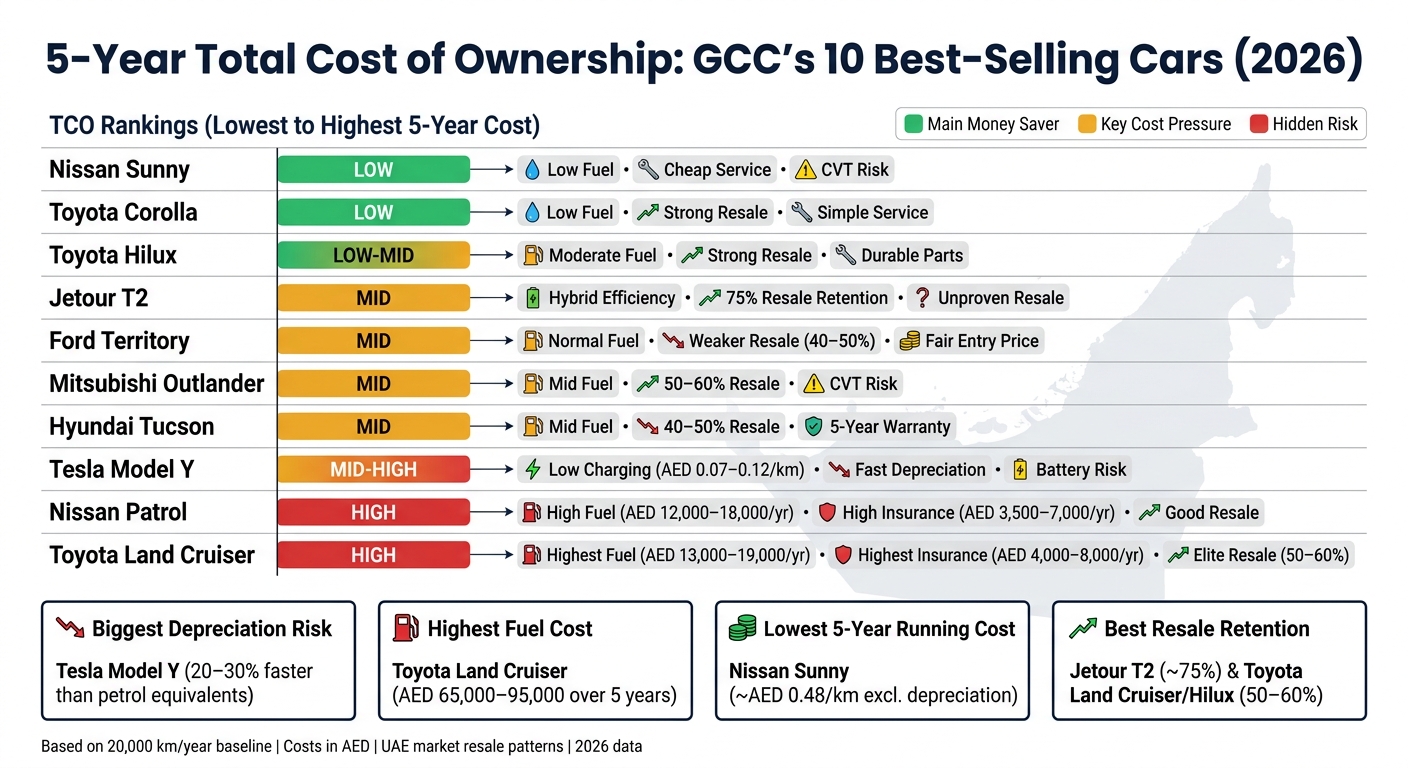
5-Year Total Cost of Ownership: GCC's 10 Best-Selling Cars (2026)
Now that each model has been broken down, the pattern is pretty clear: depreciation sets the ceiling, while fuel and insurance decide how fast costs climb. The sticker price on its own doesn’t tell you what you’ll spend over five years.
That’s the catch. A car with low day-to-day running costs can still leave you with a high five-year bill if depreciation hits hard. On the flip side, models that hold their value well - usually keeping about 50–60% of their original price after five years - can make up for higher fuel and insurance costs in a way cheaper cars often can’t.
In the UAE, there’s another layer to this. Heat puts extra strain on batteries, tyres, AC systems, and filters. That means climate-related maintenance isn’t some edge case; it’s part of the ownership bill. On top of that, comprehensive insurance adds a noticeable yearly premium, especially for economy cars.
The table below groups the 10 models by ownership profile and cost behaviour.
Ownership Profile | Models | 5-Year TCO Outlook | Key Cost Drivers | Resale Strength |
|---|---|---|---|---|
Budget-Friendly | Nissan Sunny, Toyota Corolla | Lowest | Insurance, fuel, CVT maintenance | Moderate |
Balanced | Hyundai Tucson, Ford Territory, Mitsubishi Outlander, Jetour T2 | Moderate | Dealer servicing, mid-range fuel | Moderate |
Large SUVs | Nissan Patrol, Toyota Land Cruiser, Toyota Hilux | Highest nominal cost | Fuel, insurance, heavy-duty parts | High |
EV / High Depreciation Risk | Tesla Model Y | High (EV depreciation risk) | Battery depreciation, electronics | Low to Moderate |
This breakdown makes the trade-offs easier to judge in the next section.
The ownership bands are fairly wide, but the cost pattern stays consistent. Budget sedans average AED 2,800–3,800 a year, mid-size SUVs sit around AED 4,000–5,500, and large SUVs run at more than AED 7,000. Strong resale can ease that gap for high-utility models, but only when mileage and service history are kept under control.
Pros and Cons of Each Car Through a TCO Lens
This table cuts the comparison back to what most buyers care about: costs, risk, and long-term ownership pain. It shows where each car saves money, where it can quietly drain your budget, and who it makes the most sense for.
Model | Key Pros (TCO Lens) | Key Cons (TCO Lens) | Ideal Owner Type |
|---|---|---|---|
Toyota Hilux | Extreme durability; high resale; easy parts | High fuel consumption; basic interior | Fleet user |
Nissan Patrol | Strong resale; rugged | Very high fuel and service costs; V8 repair risk | Large family |
Toyota Land Cruiser | Elite resale value; massive parts network | High annual maintenance (>AED 7,000); high price | Large family |
Nissan Sunny | Low entry price; cheapest spare parts | CVT repair risk; costly if maintenance is skipped | Fleet user |
Jetour T2 | Strong feature set for the price; usable 4WD | Unproven long-term resale; tech complexity | Value-focused family |
Tesla Model Y | No petrol spend; low routine servicing | High depreciation (20–30% faster than petrol equivalents in the UAE); tyre wear | Urban commuter |
Ford Territory | Competitive mid-range pricing; spacious | Higher depreciation than Japanese rivals | Value-focused family |
Mitsubishi Outlander | Simple mechanicals; affordable parts | CVT repair risk; basic cabin tech | Value-focused family |
Toyota Corolla | Low fuel use; strong resale; simple servicing | Parts cost more than budget rivals | Urban commuter |
Hyundai Tucson | 5-year warranty; modern tech features | Costs rise sharply post-warranty; mid resale | Value-focused family |
The biggest hidden repair risk in this list is transmission cost. That matters more than many buyers think. Skip a CVT service, and a car that looked cheap to own can suddenly become a major expense, with overhaul bills reaching AED 12,000.
Conclusion
The sticker price is just the starting point. Once you run the numbers, depreciation is still the biggest cost driver in the calculator. Japanese sedans and SUVs tend to cost less over five years because they hold their resale value better. Large SUVs sit at the expensive end because fuel and insurance eat up a big part of the budget. And while the Model Y cuts energy costs, it still ranks high once depreciation is added back in.
There’s a clear pattern here: cars with strong resale tend to hold the line on total ownership cost, while vehicles with high fuel and insurance bills get expensive fast.
The sharpest drop in value usually happens in the first year. So a car that seems affordable on day one can end up costing much more over five years. In many cases, buying a 2–3 year old model gives you better five-year value.
Across this comparison, three things changed the rankings the most:
resale value
mileage
how long you plan to keep the car
That’s why resale value matters just as much as the entry price.
Use YallaMotor's Resale Value Tool and vehicle history report to estimate year-five value and check for hidden risk before you buy.
FAQs
How much does mileage change 5-year ownership cost?
Higher annual mileage can push up your 5-year ownership cost in a big way. The main pressure points are fuel, maintenance, and depreciation.
Fuel spend climbs as you drive more, and it can often land between AED 6,500 and AED 12,000 per year. Then there’s servicing. More kilometres on the clock usually means more garage visits, with maintenance often due every 10,000 km.
Depreciation also tends to hit harder on high-mileage cars. Vehicles driven more than 25,000 km per year often lose value faster. And once a car goes past 130,000 km, the odds of pricey non-routine repairs usually go up as well.
Is buying used better than buying new for TCO?
Generally, yes. In the UAE, a used car usually comes with a lower total cost of ownership because new cars lose value fast, often dropping by 40 to 50 per cent in the first three years.
A used car can also mean lower insurance, registration, and finance costs. New cars do come with warranty cover, but certified pre-owned options can offer similar peace of mind while giving you better long-term value.
Which cost matters most after the purchase price?
In the UAE, depreciation is often the biggest cost of owning a car over five years. In many cases, it ends up costing more than fuel and maintenance put together.
A lot of buyers look first at fuel economy or the monthly instalment. That makes sense. Those costs are easy to see month by month.
But depreciation is where the bigger hit often happens. A new car can lose up to 60% of its value over that five-year period. And because depreciation is tied to the car’s starting price, it can become the largest financial loss in car ownership.