Yes, you can buy a car in Saudi Arabia and register it in the UAE in 2026 - but only if the papers, customs steps, inspection, and registration are done in the right order. If you skip one check, you could lose time, pay extra fees, or get refused at the border or registration centre.
Here’s the short version in plain terms:
Check yourself first: I need a valid UAE residence visa, Emirates ID, and UAE driving licence
Check the car first: it should be left-hand drive, usually GCC-spec, with no finance, no salvage or flood record, and matching VIN details
Get Saudi export papers before moving the car: mainly the Export Certificate, original invoice, Saudi registration card, and any bank clearance
Pay UAE import taxes: 5% customs duty on the CIF value, then 5% VAT on the value plus duty
Finish the UAE side: customs clearance, inspection, insurance, traffic file, registration, Mulkiya, and plates
A simple cost example: if UAE Customs values the car at AED 50,000, duty is AED 2,500, then VAT is AED 2,625, so tax alone becomes AED 5,125 before inspection, insurance, and registration fees.
What usually causes problems?
Outstanding Saudi finance
VIN mismatch
Non-GCC cars that fail UAE checks
Missing export papers
Flood or total-loss history
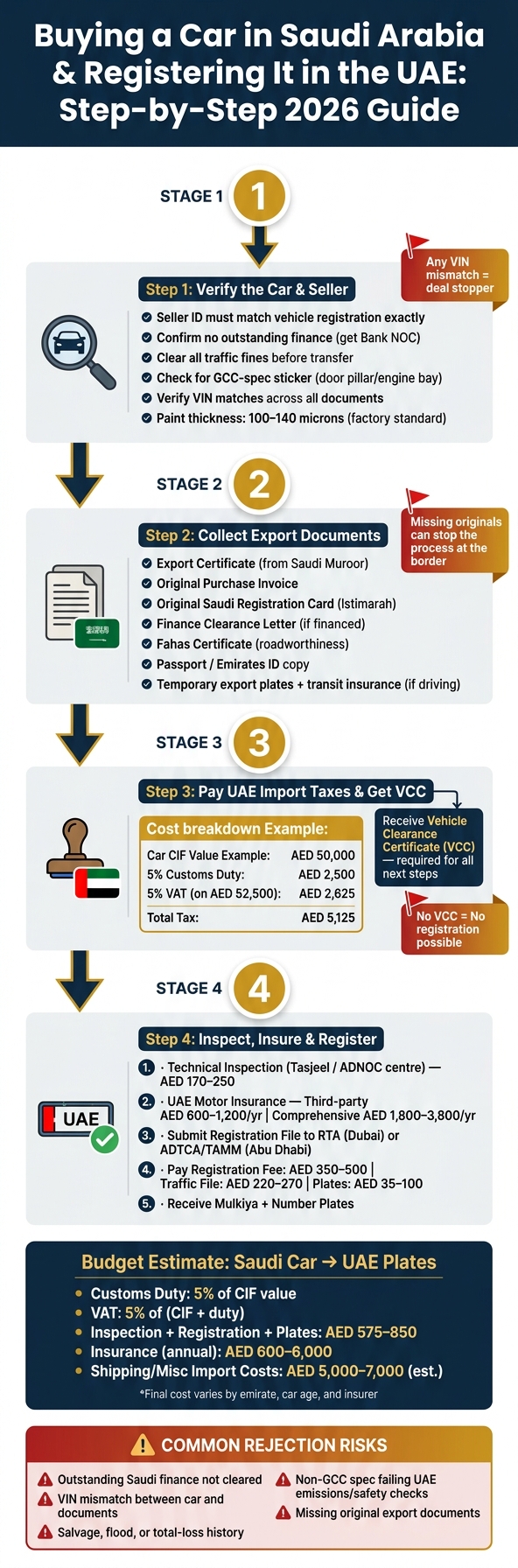
How to Buy a Car in Saudi Arabia & Register It in the UAE (2026)
Quick comparison
Stage | What I need to do | Main cost or risk |
|---|---|---|
Pre-purchase | Check seller, VIN, GCC spec, fines, finance | Buying a car that cannot be exported |
Saudi export | Collect export and ownership papers | Missing originals can stop the process |
UAE customs | Pay 5% duty + 5% VAT and get VCC | Understated invoice can be reassessed |
UAE registration | Pass test, get insurance, register car | Failed inspection or insurance issues |
Bottom line: if I confirm the car’s legal status before paying, keep the original Saudi papers, and budget for taxes plus AED 5,000–7,000 in extra import and setup costs, the process is much more straightforward.
Step 1: Check the car and seller before you buy in Saudi Arabia
This step screens out cars that can't be exported to the UAE. If you skip it, the car can get stopped at the border or fail later during registration. So yes, Step 1 is the gatekeeper for everything that follows.
Confirm export eligibility, ownership status, and finance clearance
Start with the seller. Their ID should match the vehicle registration exactly. If a middleman is involved, be careful unless the transfer paperwork is already sorted.
If the car is under finance, ask for the bank release or NOC before you pay. An unpaid loan or legal dispute can stop the export. The same goes for traffic fines. Those need to be cleared before the transfer starts, because unpaid fines can block the transfer.
Once that checks out, you can move on to the Saudi export papers.
Check GCC specifications, VIN consistency, and vehicle condition
GCC spec matters more than many buyers think. In the UAE, GCC-spec cars are usually easier to register and insure. Non-GCC cars may need modifications.
Look for a GCC sticker on the door pillar, door jamb, or under the bonnet. It also helps if the manual is bilingual. Then check the VIN. Use it to confirm the car's origin, market spec, and accident history. Also compare the VIN on the car against every document. Even one mismatch is enough to stop the deal.
If service history is available, that's another good sign. Regular maintenance at GCC-region dealerships can point to a genuine GCC-spec car.
Check | What to look for | Red flag |
|---|---|---|
Seller identity | ID matches the vehicle registration card exactly | Any mismatch or middleman seller |
Finance status | Bank NOC or finance release letter | No documentation of clearance |
Traffic fines | Zero balance confirmed by seller | Outstanding fines on the vehicle |
GCC spec | GCC sticker; bilingual manual | No sticker; manual in one language only |
VIN consistency | Same VIN on vehicle and documents | Any discrepancy across documents |
Paint thickness | 100–140 microns on factory panels | Readings above 180–200 microns |
Use YallaMotor tools to check pricing and arrange inspection

Use YallaMotor listings and valuation tools to compare prices against the UAE market. This gives you a better sense of whether the asking price makes sense.
Then book an inspection. It can spot issues like transmission wear, air-conditioning faults, and hidden body repairs before the car leaves Saudi Arabia. That timing matters. If the report shows a problem, you can still walk away.
If the car clears these checks, the next move is the Saudi export paperwork before it leaves.
Step 2: Complete the Saudi export paperwork before the car leaves
Once the car clears your pre-purchase checks, get the Saudi export paperwork sorted before it leaves the Kingdom.
Saudi export documents to collect from the seller and authorities
These are the first papers UAE Customs and registration centres will ask for.
Document | Who Issues It | Key Requirement |
|---|---|---|
Export Certificate | Saudi authorities / Muroor | Required for UAE customs and registration |
Purchase Invoice | Seller / dealership | Must be original |
Original Saudi registration card (Istimarah) | Saudi authorities | Must be original |
Finance Clearance Letter | Bank or finance company | Required if the car was financed |
Fahas Certificate | Saudi inspection centre | Confirms roadworthiness before export |
Passport / Emirates ID copy | Buyer | Required for the UAE import file |
The main paper here is the Saudi Export Certificate. You’ll also need the original purchase invoice, because UAE Customs uses it to assess the car’s value for duty and VAT. And the original Saudi registration card (Istimarah) needs to come from the seller as proof of the car’s registration history.
If the car was financed before, ask for a finance clearance letter or NOC from the bank or finance company. That clears any lien linked to the vehicle. You should also keep a valid Fahas certificate from a Saudi inspection centre before export.
Driving the car into the UAE instead of shipping it? Then you’ll need temporary Saudi export plates and transit insurance that covers the border crossing.
Once this file is complete, the car is ready to move to UAE Customs.
What to confirm on collection day in Riyadh or Jeddah
This is your last check before the car leaves Saudi Arabia.
Match the physical documents to the car itself. Start with the VIN and make sure it matches every single document. Then check that the seller’s name on the Saudi registration matches their original Iqama or passport. Your own name and Emirates ID number should also match the paperwork exactly.
It’s also smart to confirm, one last time, that all fines and record blocks have been cleared. And don’t hand over the full payment until the transfer has been started at the Saudi Traffic Department.
After handover, the file should be set for border clearance. With the export papers and transit plates in place, move to UAE Customs.
Step 3: Clear UAE customs and get the right import documents
With the Saudi export papers sorted, the car can move to UAE Customs. This is the next checkpoint after entry into the UAE, and you need to clear it before inspection and registration can start.
Customs duty, VAT, and how the vehicle value is assessed
UAE Customs charges 5% duty on the vehicle’s CIF value. CIF means Cost, Insurance, and Freight. So Customs does not look only at the amount you paid the seller. The purchase invoice is the starting point, but Customs can reassess the market value if the declared price seems too low.
Then VAT at 5% is charged on the total amount after adding the customs duty. Here’s how that works in practice:
If a vehicle is assessed at AED 50,000, the customs duty is AED 2,500 and VAT is calculated on AED 52,500, adding another AED 2,625 - bringing duty and VAT to AED 5,125 before any port or clearance charges.
That means the tax bill can be higher than many buyers first expect, especially if they only budget for the sale price.
Vehicle Clearance Certificate and the traffic file for registration
After you pay the duty and VAT, UAE Customs issues the Vehicle Clearance Certificate (VCC). This document is a must-have. Without the original VCC, the RTA in Dubai or the Abu Dhabi Traffic and Compliance Authority (ADTCA/TAMM) will not open the vehicle’s traffic file for testing and registration.
In plain terms, no VCC means no next step.
Document checklist by stage
Use this table to keep track of what you need at each point.
Stage | Required Documents | Purpose |
|---|---|---|
UAE Customs | Saudi Export Certificate, Original Purchase Invoice, Bill of Lading (if shipped), Passport and Emirates ID | To assess CIF value, pay 5% duty and 5% VAT, receive the VCC |
UAE Registration | Vehicle Clearance Certificate (VCC), UAE Technical Inspection Report, UAE Insurance Certificate, Emirates ID / UAE Driving Licence | To open a traffic file and receive UAE plates and the Mulkiya |
Keep the originals safe. You’ll need the VCC, invoice, and export papers again during inspection and registration.
Once the VCC is issued, the file moves on to inspection, insurance, and registration.
Step 4: Pass UAE inspection, get insurance, and complete registration
The VCC from UAE Customs clears the way for the last part of the process. From here, the order matters: inspection first, insurance second, registration last.
Technical inspection and compliance testing in the UAE
After customs clearance, the car goes through inspection before anything else.
Every imported vehicle must pass a technical inspection at an authorised centre before registration can happen. In Dubai and the Northern Emirates, that usually means Tasjeel, Al Shamil, Tamam, or Wasel. In Abu Dhabi, go to an ADNOC Vehicle Inspection centre or a Muroor-authorised centre.
This check makes sure the vehicle that entered from Saudi Arabia is the same one cleared by UAE Customs. Inspectors review roadworthiness, emissions, the chassis number, and the VIN against the customs documents. They also look for unauthorised modifications, engine oil leaks, and A/C function. If the VIN or chassis number doesn’t match, the car is rejected at this stage.
Get UAE insurance before registration
Once the vehicle passes inspection, you can use the pass certificate to activate the insurance policy.
You must have an active UAE motor insurance policy before the vehicle can be registered. Insurers usually ask for the VCC, the VIN, and the inspection pass certificate before they issue the final policy.
Pricing depends on the car’s age, declared value, and repair history. Third-party cover usually costs about AED 600 to AED 1,200 per year, while comprehensive cover often lands between AED 1,800 and AED 3,800 per year for a standard used import. Saudi-bought GCC-spec cars are often easier to insure, and they may come with lower premiums than non-GCC imports.
Submit the registration file and receive the Mulkiya and plates
With inspection and insurance sorted, you can submit the registration file to the right authority: RTA in Dubai or ADTCA/TAMM in Abu Dhabi.
You’ll need proof of residence as part of the file - Ejari in Dubai or Tawtheeq in Abu Dhabi. Along with that, submit the same import file used for customs, plus the inspection pass and insurance certificate. That includes:
Emirates ID
UAE driving licence
Passport and visa copy
Original Saudi export certificate
Purchase invoice
VCC
Technical inspection pass
Insurance certificate
Registration fees usually range from AED 350 to AED 500. Opening a new traffic file costs about AED 220 to AED 270, and standard plates cost AED 35 to AED 100. Once the fees are paid and the documents are checked, the authority issues the Mulkiya and number plates.
Conclusion: Total costs, common rejection risks, and a final pre-purchase checklist
After the Saudi purchase, export, customs, inspection, and insurance steps, the last thing to pin down is total cost and what can stop the car from getting UAE plates.
What the full process can cost from Saudi purchase to UAE plates
A lot of buyers look at the sale price and think that’s the main number. It isn’t. The landed cost is what matters.
Plan for 5% customs duty on CIF, then 5% VAT on the duty-inclusive total.
Cost Category | Estimated Amount (AED) |
|---|---|
Customs Duty | 5% of CIF value |
VAT | 5% of (value + duty) |
Technical Inspection | 170 – 250 |
Registration Fee | 350 – 500 |
New Traffic File (if applicable) | 220 – 270 |
Standard Number Plates | 35 – 100 |
Comprehensive Insurance (annual) | 1,500 – 6,000 |
As a rough guide, budget for 5% duty, 5% VAT, and about AED 5,000 to AED 7,000 for shipping, inspection, registration, and insurance. The final figure changes by emirate, the car’s age, and the insurer.
The errors that block registration
In most cases, registration gets blocked for one of three reasons:
Outstanding finance - a car under an active Saudi loan can’t be exported until the lender releases it
VIN mismatch - if the VIN on the customs papers doesn’t match the physical chassis number, registration stops
Salvage or flood history - cars with salvage titles, flood damage, or a total-loss declaration can’t be imported
There’s one more thing to watch if the car is non-GCC-spec. These vehicles may fail UAE emissions or safety checks unless you pay for modifications, and insurance may be harder to get.
Confirm before paying
Before you send any money, check these points carefully. A five-minute check here can save you a major headache later.
Export eligibility - confirm with Saudi authorities that no blocks exist on the vehicle's traffic file
VIN match - verify the VIN against the GCC-spec label in the door jamb or engine bay
Seller identity - ensure the seller's name on the title matches their Iqama or passport exactly
Full Saudi document set - original purchase invoice, export certificate, and proof of ownership must be in hand before the car moves
FAQs
How long does the full Saudi-to-UAE car import process usually take?
The full process usually takes several days to a few weeks. The exact timing depends on how smoothly the Saudi export paperwork is processed and how fast UAE customs clearance moves.
Most delays come down to incomplete paperwork or missing compliance documents. That’s the part that often slows everything down.
If you prepare export certificates and customs clearances in advance, the RTA registration step tends to move with fewer hold-ups and less back-and-forth.
Can I register the car in any UAE emirate, or only where my visa is issued?
You must register the car in the emirate tied to your residence visa. You’ll also need proof that you live there, such as a tenancy contract or a utility bill for that same emirate.
If you buy the car while living in another emirate, there’s an extra step. You must complete an inter-emirate transfer, which includes a clearance certificate and a technical inspection in your emirate of residence.
What happens if UAE Customs values the car higher than my purchase invoice?
If UAE Customs values the car at more than the amount shown on your purchase invoice, the mandatory 5% customs duty and 5% VAT will be charged on the customs value, not the invoice price.
Put simply, if customs decides the car is worth more, you’ll pay tax on that higher amount before you can get your clearance certificate and move ahead with registration.