
Thinking of driving an EV from Riyadh to AlUla in 2026? It’s possible, but you’ll need careful planning. With only 420 public chargers outside major Saudi cities, the 1,100 km journey requires strategic stops and the right vehicle. Here’s a quick guide:
-
Route Overview: Riyadh → Al Qassim → Hail → AlUla (~1,100 km). The Hail to AlUla stretch (~450 km) has limited chargers, so plan ahead.
-
EV Requirements: Choose a car with at least 480 km highway range and CCS2 charging compatibility.
-
Charging Stops: Use apps like EVIQ or PlugShare to confirm charger availability. Aim to stop every 250–350 km, charging to 80% for efficiency.
-
Desert Driving Tips: Travel during cooler months (October–March) to avoid battery strain from heat. Drive at 105–113 km/h to conserve energy.
-
Budget: Charging costs ~SAR 0.99/kWh, making EVs more cost-effective than petrol.
Saudi Arabia’s EV infrastructure is growing, but inter-city charging still has gaps. With proper preparation, this trip offers a sustainable way to explore AlUla’s stunning landscapes. Keep reading for detailed tips on route planning, vehicle selection, and charging strategies.
وصلنا السعودية الرياض بسيارة كهربائية بلاد البترول بقى فيها كهربا
Breaking Down the Riyadh to AlUla Route for EV Drivers
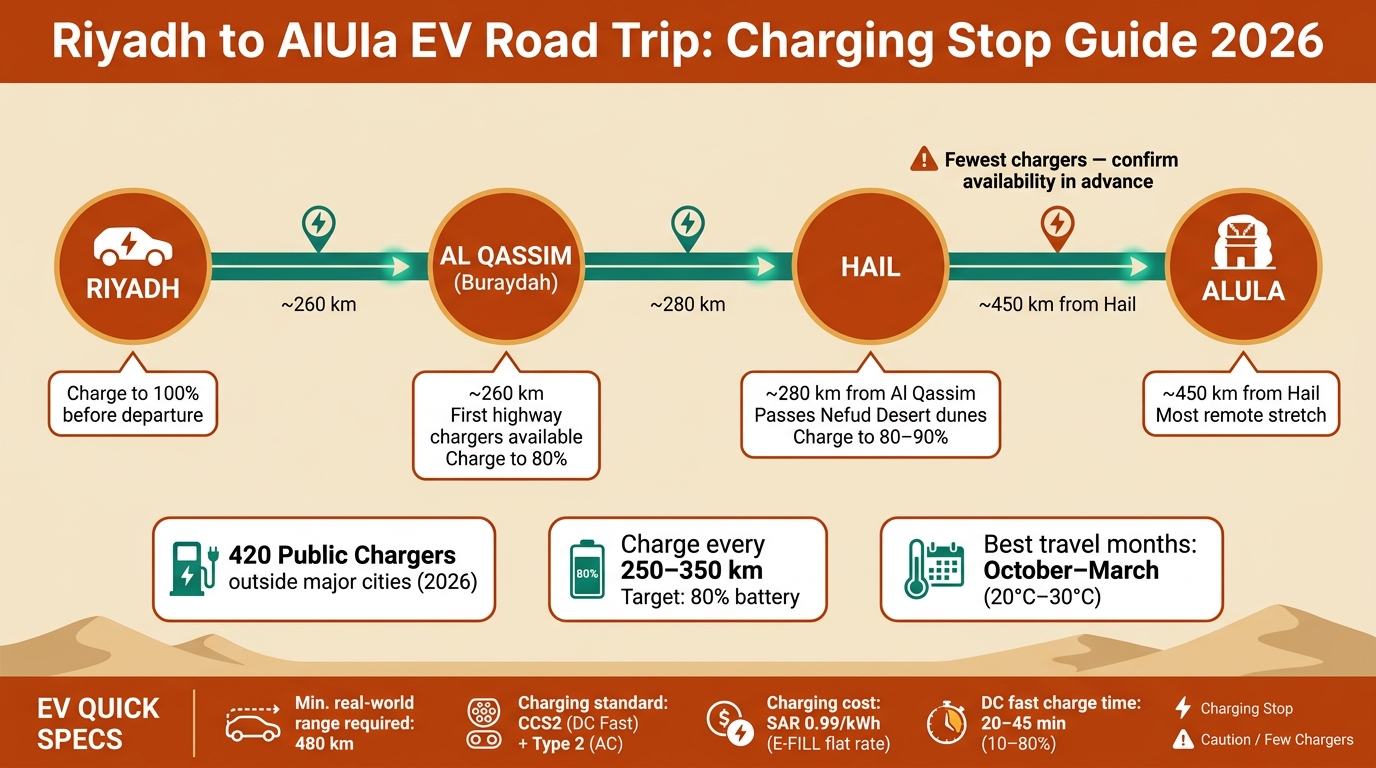
Riyadh to AlUla EV Road Trip: Charging Stop Guide 2026
Route Options and Key Segments
The Riyadh to AlUla route (around 1,000 km) follows a well-established corridor: Riyadh → Al Qassim (Buraydah) → Hail → AlUla. This route is a solid choice for EV drivers due to its reliable charging infrastructure. The roads are wide, well-maintained, and feature clear bilingual signage in Arabic and English, making navigation straightforward. Here's a breakdown of the journey into three segments to help you plan your charging stops effectively:
| Route Segment | Approx. Distance | Key Considerations |
|---|---|---|
| Riyadh to Al Qassim | ~260 km | First highway chargers available here |
| Al Qassim to Hail | ~280 km | Passes through the Nefud Desert dunes |
| Hail to AlUla | ~450 km | Remote stretch; confirm charger status in advance |
While the route benefits from a growing network of chargers, the Hail to AlUla segment requires extra caution. At roughly 450 km, it has the fewest charging options. A malfunctioning charger at a critical stop could disrupt your plans. Additionally, you'll need to factor in how desert heat and terrain might impact your EV's performance.
How Desert Heat and Terrain Affect EV Range
Saudi Arabia's summer temperatures can be brutal, often exceeding 50°C from June to August. This extreme heat forces your EV's battery management system (BMS) to use extra energy to keep the battery cool. As a result, you may experience reduced range and slower charging speeds, even at fast chargers.
The best time to travel is between October and March, when temperatures are more manageable, typically ranging from 20°C to 30°C. If you're planning this journey from the UAE, choosing the cooler months can significantly improve your vehicle's efficiency. For summer trips, it's wise to schedule charging stops every 250–350 km to offset the heat's impact on range.
Speed is another critical factor. Saudi expressways have a legal speed limit of 140 km/h, but driving at this speed can drain your battery much faster compared to cruising at 110–120 km/h. Over such a long route, this difference could result in the need for an additional charging stop.
"Hardware must also meet international safety standards for high ambient temperatures and dust, a specific Saudi operating constraint." - Arafat Hossain, Tech Reviewer, opaui.com
This highlights the importance of planning your charging stops carefully before setting off.
Using Charger Maps Before You Leave
Before starting your journey, use the EVIQ app to check the live status of chargers along your route. Download offline maps from Google Maps or Waze to navigate areas with weak mobile signals, particularly in the Nefud Desert. For additional reliability, cross-check charger availability using PlugShare, especially for the Hail to AlUla stretch where infrastructure is sparse.
The EVIQ network, which uses the CCS2 charging standard, is the largest in Saudi Arabia. It has been deploying fast-charging stations every 50 to 100 km along major highways. By early 2025, EVIQ had installed 88 fast chargers across 35 locations, and its CEO, Mohammad Bakr Gazzaz, has announced plans to expand to 5,000 chargers across 1,000 locations by 2030. While progress is evident, the 420 public chargers outside major cities by 2026 underscore the need to verify charger availability in real time before each leg of your trip.
Choosing the Right EV for the Riyadh to AlUla Trip
Minimum EV Specs You Need for This Trip
If you're planning a long desert drive, you'll need an EV that can handle the journey. For this route, look for a vehicle with an actual highway range of at least 480 km. Keep in mind that factors like high-speed driving, wind resistance, and air conditioning can reduce WLTP ratings by 10–25%. For example, an EV rated at 600 km WLTP may realistically deliver 420–500 km under these conditions.
For quicker charging stops, consider EVs with 800-volt architecture, which allows for faster charging times. Models like the Hyundai Ioniq 6 Long Range and Kia EV9 can charge from 10% to 80% in about 18–20 minutes at compatible DC fast chargers. Another great option is the Volvo EC40 Twin Motor, which offers up to 650 km WLTP range and recharges from 10% to 80% in around 28 minutes at a 200 kW DC station. The Tesla Model Y Long Range is also a reliable choice, featuring built-in trip planning and battery pre-conditioning, with an actual highway range of 418–466 km.
| Model | WLTP / Real‑World Range | 10–80% Charge Time | Architecture |
|---|---|---|---|
| Hyundai Ioniq 6 LR | ~580 km WLTP | ~18 min | 800V |
| Kia EV9 | 480+ km real‑world | ~20 min | 800V |
| Volvo EC40 Twin Motor | ~650 km WLTP | ~28 min (200 kW) | 400V |
| Tesla Model Y LR | ~418–466 km | 15–25 min (10–60%) | 400V |
"300+ real‑world highway miles on a full charge is becoming the new normal for road‑trip‑capable EVs." - Recharged
While range and charging speed are vital, it's equally important to ensure your EV's charging system is compatible with Saudi Arabia's infrastructure.
Charging Standards and Adapters to Know About
Beyond range, understanding charging compatibility is critical. Saudi Arabia's public charging network uses the IEC 62196 plug system, with Type 2 connectors for AC charging and CCS2 connectors for DC fast charging. The EVIQ network, the largest in the Kingdom, exclusively supports CCS2 across its highway stations. Most modern EVs sold in the GCC already support these standards, so additional adapters are rarely needed.
"If your car has a Type 2 AC inlet and CCS2 DC inlet (most GCC‑sold EVs do), you'll be compatible with the majority of public chargers." - Green City Directory
For EVs with older or non-standard connectors, it's best to verify compatibility before starting your journey. Tesla owners should also confirm whether local Superchargers are accessible to non-Tesla vehicles or if a CCS2 adapter is necessary.
If you're driving from the UAE, you'll find that charging standards are consistent across the border. Public AC chargers typically range from 7.4 to 22 kW (Type 2), while DC fast chargers deliver between 50 kW and 350 kW on newer corridors. In Saudi Arabia, the E‑FILL network charges a unified rate of SAR 0.99/kWh, compared to approximately AED 1.20/kWh for DC charging in the UAE.
How to Use YallaMotor to Compare EVs

Once you've identified the key specs and charging requirements, head to YallaMotor to compare EV options. The platform covers over 75 automotive brands and offers a wide selection of new and used EVs available in the GCC. You can filter by range, price, and model year, as well as review detailed technical specifications and expert reviews.
For UAE drivers planning to upgrade before the trip, YallaMotor's tools make it easy to compare models like the Ioniq 6, Kia EV9, and Volvo EC40 side by side. The platform also provides car financing solutions, which can be helpful when investing in a long-range EV suited for extended desert journeys. This comprehensive comparison ensures you choose the best vehicle for navigating Saudi Arabia's growing charging network.
How to Plan Your Charging Stops Along the Route
Locating Chargers and Calculating Stop Distances
When travelling through rural areas with limited charging infrastructure, careful planning is essential. Before departing Riyadh, use tools like the EVIQ app, PlugShare, and Google Maps to confirm the location, connector types, and real-time availability of chargers. Cross-check information across these platforms to avoid surprises.
For EVs with a range of 400–500 km, plan to charge every 250–350 km. This keeps a 10–20% battery buffer, accounting for factors like cooling requirements and high-speed driving. If the next station is over 200 km away, consider charging to 90–95% to ensure a larger safety margin.
Focus on stations operated by established networks like EVIQ (the Kingdom’s largest state-backed network), Electromin (offering up to 150 kW), and Shell Recharge (typically 50–150 kW). By early 2025, EVIQ had already installed 88 fast chargers across 35 locations and aims to expand to 5,000 chargers at 1,000 strategic points by 2030.
"This is a landmark moment for EVIQ… our plans to deploy 5,000 fast chargers across 1,000 strategic locations by 2030." - Mohammad Bakr Gazzaz, CEO, EVIQ
Once your stops are mapped out, it’s important to understand the differences between AC and DC charging.
DC Fast Charging vs AC Charging: What to Expect
For road trips, DC fast charging is your go-to option. Knowing how these chargers differ from AC chargers can help you plan stops more effectively. AC chargers, with outputs of 7–22 kW, are ideal for overnight charging as they take 8–12 hours for a full charge. On the other hand, DC fast chargers can add 20% to 80% charge in just 20–45 minutes, depending on the station's power and your EV’s capabilities.
| Feature | AC Charging | DC Fast Charging |
|---|---|---|
| Power Output | 7–22 kW | 50–350 kW |
| 80% Charge Time | 8–12 hours | 20–45 minutes |
| Best Use Case | Overnight charging | Highway road trip stops |
| Battery Impact | Low | Higher – use sparingly |
To save time, limit charging to 80%, as charging speeds drop significantly beyond this level to protect the battery. As EVcourse explains:
"Two stops of 15 minutes each will get you further in less total time than one stop of 50 minutes."
If your EV has a battery preconditioning feature - available in models like the Tesla Model Y or Hyundai Ioniq 6 - use it. This feature warms the battery to its optimal temperature before reaching the charger, potentially shaving 10–15 minutes off your charging time.
Avoiding Charger Queues During Busy Travel Periods
Even with a solid charging plan, you’ll need to consider peak travel times to avoid long wait times at chargers. Busy periods like Saudi public holidays, Eid, and events such as the Winter at Tantora festival can lead to congestion at charging stations. Travelling early in the morning or late at night can help you sidestep these crowds. Use the EVIQ app to check real-time charger availability and have a backup option within 10–20 km of your primary stop in case of delays.
Finally, check if your charging network offers subscription plans for cost savings. For instance, E-FILL provides a flat rate of SAR 0.99/kWh, while highway DC fast charging typically costs between SAR 2.00 and SAR 3.00/kWh.
Driving Techniques to Get More Range on Desert Roads
Eco-Driving Tips for Long Desert Stretches
Driving at a steady speed of 105–113 km/h instead of pushing up to 130 km/h can save you 15–25% in energy consumption. This small adjustment could extend your range by 60–100 km on a 400 km stretch. Using cruise control is another helpful tactic - it keeps your speed consistent and helps you avoid the temptation to match faster traffic.
When summer temperatures climb above 45°C, blasting the A/C can reduce your EV’s efficiency by as much as 41%. To counter this, try pre-cooling your car while it’s still plugged in, then switch to a moderate A/C setting once you’re on the road. If your car has ventilated seats, use them instead - they only draw about 75W compared to the 3,000–5,000W needed for full cabin cooling.
"A 10–15 km/h reduction on the motorway can significantly lower consumption and may reduce charging time overall." - Stay Fully Charged Editorial
Switching to Eco mode can also make a difference. It softens throttle response and enhances regenerative braking, helping you recover energy during deceleration. Another tip: ditch roof racks or cargo boxes when they’re not needed. These can increase energy consumption by 30–50% on highway drives. These strategies are particularly useful on routes like Riyadh–AlUla, where charging stations are few and far between.
What to Check Before and After Each Charging Stop
Fine-tuning your approach at every charging stop can help you stick to your energy-saving plan.
Start by checking your tyre pressure during each stop. Under-inflated tyres create more rolling resistance, which can gradually eat into your range. While your vehicle charges, take a moment to review the next leg of your journey. Double-check distances, charger availability, and any potential route updates.
About 10–15 minutes before you arrive at the next charging station, confirm its status using an app. If your EV supports it, set the station as your destination to precondition your battery for faster charging. On remote routes with limited charging options, confirming availability ahead of time is crucial to avoid unnecessary delays.
Aim to arrive at charging stops with a 10–20% buffer and leave with around 80% charge. This approach helps you avoid overly long charging sessions and keeps you moving efficiently.
Staying Safe and Comfortable on the Road
While energy efficiency is key, staying safe and comfortable is just as important on long desert drives. Preparation is everything - always carry at least 2–3 litres of water per person. Breakdowns in extreme heat can quickly become dangerous without proper hydration.
Plan your longest stretches of driving for early mornings or after sunset. These cooler parts of the day reduce stress on your battery’s cooling system and your car’s A/C. You can also make your journey feel less tedious by aligning your 25–40 minute DC fast charging stops with prayer times or meal breaks.
Keep an eye on your trip computer’s real-time efficiency (kWh/100 km). If you notice higher energy use due to headwinds or uphill climbs, dropping your speed by 10–15 km/h can help conserve your range and maintain a safe energy buffer.
What UAE-Based Drivers Need to Prepare Before the Trip
Travelling from the UAE to Saudi Arabia in an EV requires more than just charging preparation. Drivers should also focus on documentation, budgeting, and understanding local driving practices to ensure a smooth and safe journey.
Documents, Insurance, and Roadside Assistance
Crossing into Saudi Arabia means having the right paperwork in order. Your passport needs to be valid for at least six months from your entry date. While your UAE driving licence is accepted - as Saudi Arabia recognises licences from 67 countries for up to 90 days - carrying an International Driving Permit (IDP) is highly recommended. Rental companies often require an IDP for insurance purposes, and only physical copies are accepted.
If you're using a rental EV, you’ll need written cross-border authorisation from your rental company. Be aware that extra fees, such as one-way drop-off charges starting at SAR 75, may apply. Additionally, standard Collision Damage Waiver policies might not cover Saudi Arabia, so confirm your coverage with your rental provider or credit card company.
| Document/Requirement | Detail |
|---|---|
| Passport | Must have at least six months of validity |
| Driving Licence | Valid physical UAE licence accepted |
| IDP | Strongly advised, required by rental firms |
| Rental Authorisation | Written cross-border approval needed |
| Minimum Age | 21 for standard rentals; 25 for luxury cars |
Budgeting for the Trip in AED and SAR
One perk of Saudi highways is that they’re toll-free. EV charging is also much more economical compared to petrol. For instance, E-FILL offers a flat rate of SAR 0.99/kWh. Charging a 75 kWh battery from near-empty costs about SAR 74 (around AED 73), whereas petrol at SAR 2.33 per litre makes driving a petrol car roughly 32% more expensive.
For a 1,000 km drive, such as Riyadh to AlUla, an EV with a 350 km range would typically need two DC fast-charging stops. This cost advantage makes EVs an appealing choice for long-distance travel in the region.
Alongside managing your budget, it’s essential to understand local customs and driving regulations for a smoother border-crossing experience.
Local Customs, Prayer Times, and Driving Norms
Saudi Arabia’s Saher AI camera system enforces road safety by monitoring speeding, seatbelt use, mobile phone usage, and unsafe lane changes on highways. On expressways, the speed limit is 140 km/h, with a strict +4 km/h buffer for fines. Urban areas allow a slightly more lenient +10 km/h buffer. Speeding fines range from SAR 150–300 for minor violations to SAR 800–1,000 for exceeding limits by 30–40 km/h.
Prayer times are another consideration, especially on Fridays. Some service stations and charging facilities may adjust their hours, opening only after 5:00 PM to accommodate midday prayers. Apps like Electromin or EVIQ can help you check the operating hours of charging stations in advance. For assistance, the Electromin support line at +966 8002440331 is available. Planning your stops around prayer times can help avoid unnecessary delays.
Conclusion: Is the Riyadh to AlUla EV Road Trip Worth It?
With the right EV, a solid charging plan, and reliable apps, the 2026 Riyadh to AlUla trip is entirely doable. While it demands extra preparation, the rapidly advancing EV infrastructure in Saudi Arabia is making journeys like this more practical. This section ties together key points about route planning, vehicle compatibility, and charging logistics to ensure a smoother experience.
A Quick Checklist for GCC EV Drivers
-
Vehicle: Make sure your EV supports CCS2 (DC) and Type 2 (AC) connectors, which are standard across Saudi Arabia's public network.
-
Range: Your EV’s range should comfortably cover the distance between charging stops, even in harsh desert conditions.
-
Charging stops: Plan to stop every 250–350 km, aiming for DC fast chargers with at least 150 kW of power.
-
Battery management: Keep your battery levels between 20% and 80% during stops to maintain efficiency and prolong battery life.
-
Apps: Use apps like EVIQ or PlugShare to check real-time charger availability before hitting the road.
-
Budget: Factor in charging costs - around SAR 0.99/kWh with the E-FILL flat rate - and enjoy toll-free highways in Saudi Arabia.
What to Expect From Saudi EV Infrastructure by 2026 and Beyond
Saudi Arabia’s EV infrastructure is evolving rapidly, making long-distance trips more accessible. By early 2025, the EVIQ network had 88 fast chargers operational across 35 locations, with plans to expand to 5,000 fast chargers at 1,000 strategic sites by 2030. This is part of a larger goal to install over 10,000 charging points across the Kingdom.
"This is a landmark moment for EVIQ… our plans to deploy 5,000 fast chargers across 1,000 strategic locations by 2030." - Mohammad Bakr Gazzaz, CEO, EVIQ
Highway corridors are now a key focus. Chargers are being upgraded to 350 kW ultra-fast units capable of delivering an 80% charge in under 15 minutes. Partnerships with fuel retailers like SASCO are integrating these chargers into highway rest stops, complete with cafes and other amenities. Looking beyond 2026, drivers can expect charging stations every 50–100 km on major inter-city routes, making an EV trip from Riyadh to AlUla as seamless as driving a petrol vehicle today.
Saudi Arabia's EV market is projected to reach 30% penetration in major cities by 2030. For UAE-based drivers willing to plan ahead, the Riyadh to AlUla journey in 2026 offers a glimpse into the future of long-distance EV travel across the GCC.
FAQs
What’s my backup plan if a charger is offline on the Hail–AlUla stretch?
With fewer public chargers available outside major cities, especially on the Hail–AlUla stretch, it’s important to have a backup plan in case a charger is offline. Here’s how you can stay prepared:
-
Map out alternatives: Look for backup charging stations along your route or in nearby towns, such as Afif or Al Quwayiyah. Having options can be a lifesaver.
-
Preserve battery life: Drive at a moderate speed and minimise energy use until you reach a charging point.
-
Rely on real-time apps: Use apps to check the status of chargers ahead of time, saving you from unnecessary detours.
A little preparation can make your journey much smoother.
How much range should I budget for heat, headwinds, and A/C on this route?
When planning your EV trips, it's wise to budget an extra 20–40% of your vehicle's range. Why? Factors like high temperatures, strong headwinds, and using air conditioning can all increase energy consumption. By accounting for these variables, you can ensure a smoother journey and adjust your charging stops accordingly.
Which passes, apps, or payment methods do I need to activate charging in Saudi?
To charge your EV in Saudi Arabia, start by downloading a charging network app like EVIQ. These apps are incredibly handy for finding charging stations, checking their availability, and handling payments. You can link your credit or debit card, or use digital wallets such as Apple Pay or Mada Pay for convenience. Once you've registered your payment method in the app, you're all set to begin and end your charging sessions with ease.