Saudi number plates are no longer just car registration items. They now trade like high-end collectibles, with top sales reaching SAR 21 million in Saudi Arabia and about SAR 56 million across the GCC.
If you want the short version, here it is:
-
Top plates sell for millions because supply is tiny and demand is driven by status, meaning, and public visibility.
-
Single-digit plates lead the market, with sales like أ 1 for SAR 21 million and ي 1 for SAR 10 million.
-
Letter meaning matters just as much as the number. Plates tied to words, rank, or first-letter status can fetch far more.
-
Absher changed pricing by moving auctions to a national online system with large bidder pools and clear transfer rules.
-
This is a tradeable asset class for some buyers, but it is still a slow, mood-driven market with resale risk at the top end.
-
Costs do not stop at the winning bid. Buyers also face 15% VAT, commission, transfer rules, payment deadlines, and holding limits.
If I strip the story down to one point, it is this: Saudi vanity plates now sit in the same luxury-asset conversation as rare watches, art, and top-end collectables.
Here’s what the article covers in plain terms:
-
why some plates cost more than supercars
-
which sales reset buyer price views
-
how rarity, number patterns, and Arabic letters shape price
-
how Absher auctions work from bid to transfer
-
where the resale risks sit for collectors and investors
-
when a premium plate makes sense for car owners
For most people, the main lesson is simple: a plate’s asking price means little on its own - sold prices, format, and buyer demand matter far more.
How the Saudi license plate market reached record prices
A small number of high-profile deals pushed Saudi vanity plates into the ultra-premium bracket. More than anything else, these sales changed what buyers felt was a fair price.
Key sales that reset buyer expectations
In January 2024, Saudi rally champion Yazeed Al Rajhi paid SAR 10 million for "1 V" (ي 1), putting single-digit plates firmly in the national spotlight.
Then, in April 2024, "1 E" (أ 1) sold for SAR 21 million at an Absher auction after 10 bidding rounds. That sale reset expectations for ultra-premium plates and gave the market a new reference point.
The reaction was almost immediate. Other single-digit plates reportedly climbed 15%–25% within 48 hours.
Another major deal followed at the Riyadh Car Show, where "KLZ 1" (م ل ك 1) sold for SAR 15.7 million, including VAT and commission.
Once deals like these became public, the logic of the market started to shift. A record sale didn’t just stand on its own. It made the next top-tier plate easier for buyers to defend as an investment.
How government auctions and digital platforms grew the market
Those headline prices mattered because the auction system itself had already become broader, faster, and easier to track.
A big part of that shift came from Absher. The platform widened access, standardised bidding, and made the process more open. Major Diamond-tier auctions now draw more than 80,000 registered viewers and 50,000 active bidders.
The back-end process changed too. Ownership transfers now run through the Ministry of Interior system, which cuts down fraud and disputes. On top of that, a 10-minute auto-extension rule helps limit last-second sniping.
Offline events still have extra pull. Live auctions can push prices 10%–20% higher than standard online bidding.
As prices became public and repeatable, plate values started to rest less on guesswork and more on format, scarcity, and the way bidders behaved in the room or on the platform.
What makes a Saudi plate worth millions
Those headline sales follow a pretty simple pricing logic. In most cases, a plate’s value comes down to four things: format, letters, visibility, and market depth.
Short formats, single digits, and clean number patterns
The biggest driver of value is digit count. There are only nine single-digit combinations per letter group, which makes them about 1,000 times rarer than a standard four-digit plate.
After that, buyers tend to pay much more for plates that look clean and are easy to remember. Repeating number patterns like 7777 or 9999 jump out straight away on the road. Sequential runs like 1234 have a neat, logical feel. Mirror or palindrome formats like 1221 often sell for 20%–40% more than non-palindrome plates.
A good example is "9999 DDD". It sold for SAR 620,000 to a Dammam-based entrepreneur. Compare that with a random four-digit plate with ordinary letters, which usually sells for around SAR 2,000 to SAR 10,000 in 2026. That gap shows how much pattern alone can change the price.
And when the numbers are strong, the letters can add even more weight.
Arabic letter combinations and their effect on price
Letters can matter just as much as digits. KLZ 1 (م ل ك 1) sold for SAR 15.7 million because it spells Malik, meaning king. أ 1 sold for SAR 21 million because Alef is the first Arabic letter.
There’s also a supply limit built into the system. Only 17 of the 28 Arabic letters are allowed on Saudi plates, which means meaningful letter groupings are naturally scarce. Put simply, when fewer letter options exist, the combinations people want become harder to find.
Scarcity, public visibility, and GCC price benchmarks
In cities like Riyadh and Jeddah, a plate isn’t just a registration marker. It also acts as a moving status signal. A premium plate is estimated to be seen by around 500 people per day. Over ten years, that works out to roughly 1.8 million impressions.
Saudi pricing also sits inside a bigger GCC frame. The regional benchmark is Dubai’s "P7", which sold for about AED 55 million - roughly SAR 56 million. That deal set a mental ceiling for ultra-rare plates across the region, and Saudi Arabia’s top-tier plates now sit in that same ultra-rare bracket.
Those traits matter on paper, but the price only becomes real when bidders start pushing against each other.
How Saudi plate auctions work
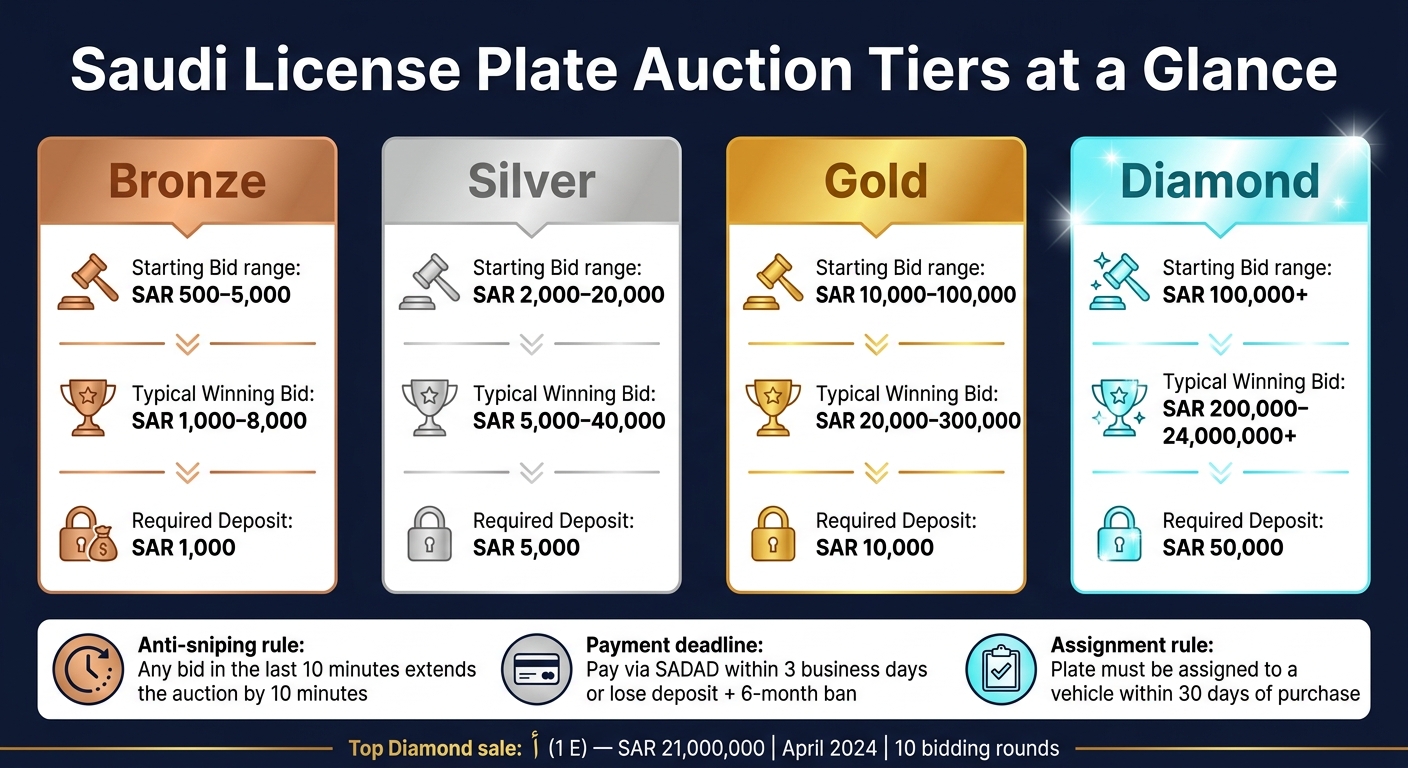
Saudi License Plate Auction Tiers: Starting Bids, Winning Bids & Deposits (2024)
Auction format, bid progression, and buyer behaviour
Those eye-catching prices come from an auction setup built to keep people bidding. Absher runs weekly plate auctions, and they usually open on Sunday and close by Wednesday or Thursday. Before bidding starts, there’s often a 1–2 day preview period where the plates are listed but not yet open for offers. Once the auction goes live, bidding usually stays open for 3–7 days.
Plates are split into four tiers - Bronze, Silver, Gold, and Diamond - and each tier has its own starting bid and deposit level:
| Tier | Starting Bid (SAR) | Typical Winning Bid (SAR) | Deposit (SAR) |
|---|---|---|---|
| Bronze | 500 – 5,000 | 1,000 – 8,000 | 1,000 |
| Silver | 2,000 – 20,000 | 5,000 – 40,000 | 5,000 |
| Gold | 10,000 – 100,000 | 20,000 – 300,000 | 10,000 |
| Diamond | 100,000+ | 200,000 – 24,000,000+ | 50,000 |
Here’s where things get tense: any bid made in the last 10 minutes adds another 10 minutes to the clock. That anti-sniping rule can trigger round after round of extensions, and the closing stretch often turns into a fast bidding war.
Live auctions can push prices up by 10%–20%, mainly because the crowd effect gets people bidding faster than they would in an online-only sale.
Payment, transfer, and the secondary resale market
Winning the auction is only part of the story. Buyers have to pay through SADAD within 3 business days. If they miss that deadline, they lose the deposit and get banned from all future Absher auctions for 6 months. On top of the hammer price, buyers also pay 15% VAT and a 2.5% auction commission.
After payment, the plate has to be assigned to a vehicle registered in the buyer’s name within 30 days. If that doesn’t happen, the buyer can lose the right to the plate. Physical plates are then made at a licensed facility, usually in 15–30 minutes, for a fee of SAR 100–150.
Saudi Arabia also uses an Absher plate wallet, which lets owners keep a plate before linking it to a car. Once a plate has been assigned, it can later be resold privately through Absher, but official resale is locked for 12 months. Ownership updates take under 24 hours, and the total fee is SAR 380.
For sellers, mid-tier plates in the SAR 20,000–200,000 range often move within 30–90 days. For buyers, there’s one simple rule: check ownership first in Absher or Najiz before doing a private deal.
Those rules matter because they shape how collectors and investors plan their way out of a deal.
What this market means for collectors, investors, and car buyers
How to assess plate value and risk before buying
Now that the auction side is clear, the next step is simple: decide what you're buying. Is it a collectible, a status symbol, or something you may want to trade later?
Not every plate that sells at auction is a smart buy. Before putting serious money on the table, four things usually matter most: numerical rarity, Arabic letter meaning, past auction benchmarks, and likely buyer demand. In plain terms, plate value comes down to rarity, meaning, and how many people may want it.
The upside gets attention, but the risk is just as real. Plates worth SAR 500,000 or more can take 6–18 months to sell, and if the owner has to sell in a hurry, the final deal can land 20–40% below what they expected. That makes this market very sentiment-driven. Prices are tied to prestige and buyer mood, not income from the asset, so a weaker economy or softer demand can hit values fast.
Against cars, watches, and property, premium plates are harder to sell quickly, but they're cheaper to keep. There are no storage, insurance, or servicing costs, and private sales in Saudi Arabia currently do not face capital gains tax. That sounds good on paper, but timing still does a lot of the heavy lifting.
When a premium plate adds value to car ownership
For most buyers, the main issue isn't whether a plate might go up in price. It's whether the extra cost makes sense for the car you're putting it on.
In most cases, a SAR 5,000–50,000 plate is a lifestyle purchase, not an investment. Judge it against the car's full ownership cost, including finance, insurance, and resale. A good plate can make a premium car feel more exclusive and may help with resale positioning, but that's not the same as saying it will deliver investment-style returns.
A simple way to think about it: if the plate budget starts eating into what you can spend on the car itself, you've probably gone too far. Look at the full ownership picture before deciding how much goes to the plate and how much stays with the vehicle.
Conclusion: Why Saudi vanity plates now behave like a niche asset class
The Saudi plate market didn't get here by accident. Government-run Absher auctions gave the market trust and scale. Rare number formats and meaningful Arabic combinations pushed prices to new highs. Social prestige kept demand firm even as prices moved up.
The clearest example is the "1 E" (أ 1) plate, which sold for SAR 21 million in April 2024. That sale gave the market a clear top-end benchmark. It showed that, at the highest level, vanity plates can trade like a niche asset class.
The main discipline in this market is separating personal meaning from resale value. A plate you love may do nothing for the next buyer. That's why sold listings matter more than asking prices. And if you may need your money back within 12 months, the premium end of this market is the wrong place to park it.
FAQs
Why do some Saudi plates sell for millions?
Because they’re both official identifiers and scarce, high-value assets. Prices tend to climb because of rarity, especially with single-digit plates, and with number patterns people actively want, such as repeats, sequences, and palindromes.
They also carry strong social prestige. Letter combinations that form recognised words or names can add extra status and meaning, which can push prices even higher.
Are vanity plates a good investment in Saudi Arabia?
Yes - vanity plates can be a good investment in Saudi Arabia. They’re scarce, transferable assets, and their value comes down to a few simple things: the number of digits, rare letter combinations, social meaning, and buyer demand.
Official Absher auctions have already shown what the top end of the market looks like, with SAR 21 million paid for “1E”. That said, returns and liquidity can vary a lot. Lower-priced plates may move faster, while ultra-premium plates can take longer to sell and are less predictable.
What extra costs apply after winning an auction?
After you win an auction on Absher, you’ll need to pay the final bid amount plus any issuance fees that apply. If you paid a security deposit to enter the auction, Absher automatically deducts that amount from the total, which makes things a bit simpler.
Payment is completed through the Absher platform. After that, the new plate must be registered within 30 days from the end of the auction.