

If I drive in the UAE, I need to read signs fast, follow road markings at once, and never assume the same speed rule applies in every Emirate.
This guide comes down to a few simple points:
Regulatory signs tell me what I must or must not do
Warning signs tell me what is ahead
Directional and service signs help me choose the right route early
Temporary signs warn me about roadworks and short-term changes
Road markings show lane use, stopping points, crossings, and parking rules
A few facts stand out. Speed limits are shown in km/h. Distances are shown in kilometres. And while many Emirates are known for a 20 km/h buffer, Abu Dhabi does not apply it. The article also notes that road traffic fatalities are the UAE’s second leading cause of death and the top cause of death for children.
Here’s the short version I’d keep in mind before any trip:
Stop means a full stop
Give way means let priority traffic pass
No entry means do not enter
Blue circles usually mean I must follow the instruction
Red-bordered circles usually mean an action is banned
Triangular signs usually warn me about hazards
Yellow box junctions must stay clear unless my exit is open
Solid lines must not be crossed
Broken lines can be crossed only when safe
Parking rules depend on both the sign and the bay or kerb marking
Category | What it tells me |
|---|---|
Regulatory signs | Rules, priority, parking, speed, lane control |
Warning signs | Bends, crossings, merges, schools, roadworks |
Directional signs | Inter-emirate routes, local routes, tourist places, services |
Temporary signs | Short-term changes near works or diversions |
Road markings | Lane position, turns, stop lines, crossings, parking zones |
In other words: signs tell me the rule, and markings tell me where to follow it.
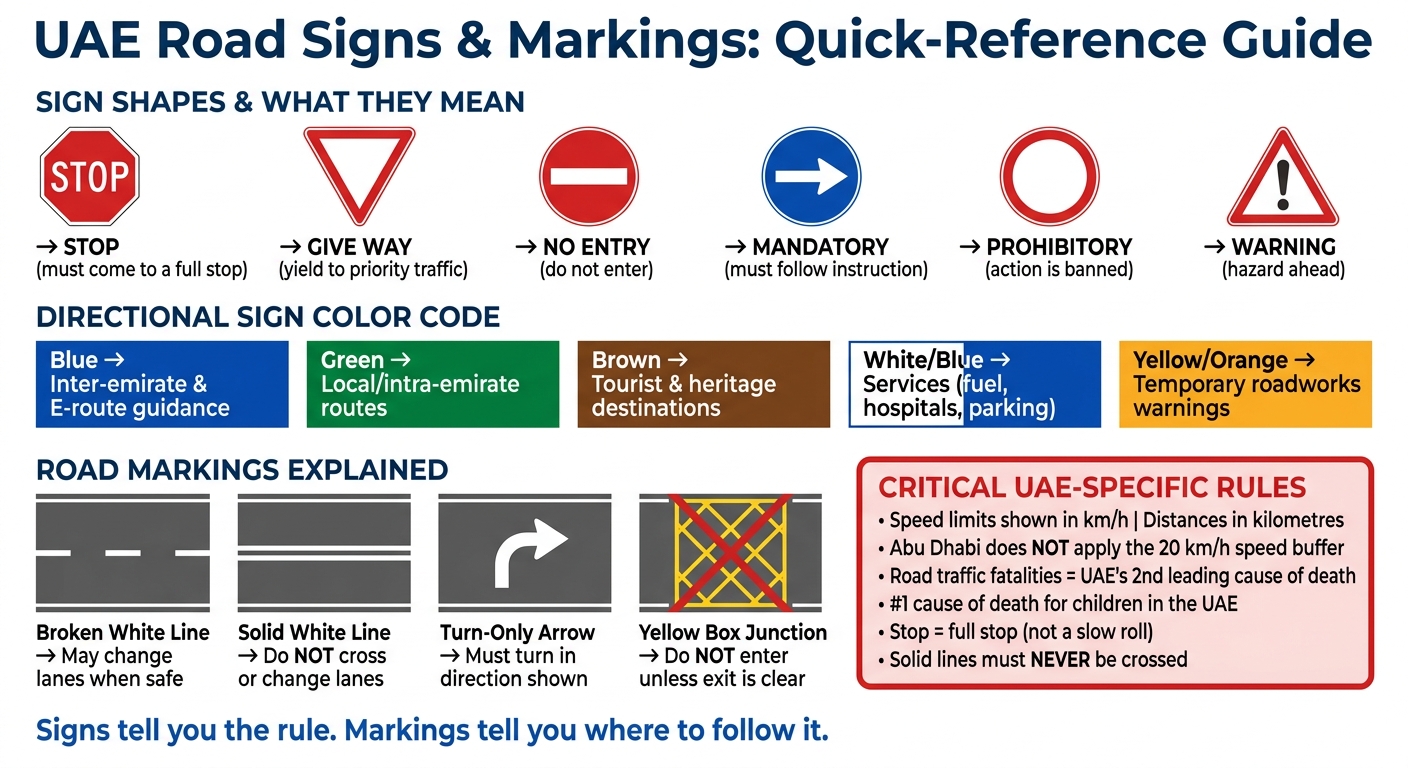
UAE Road Signs & Markings: A Visual Quick-Reference Guide
UAE Road Signs and Their Meanings | RTA Driving Test Prep
Regulatory signs drivers must obey in the UAE
Regulatory signs set the rule on the spot. You’ll see them at intersections, along city roads, on E-routes, and in parking areas. They tell you what you must do, what you must not do, and when other traffic has priority.
Sign Category | Shape & Colour | Common Examples | Driver Obligation |
|---|---|---|---|
Control & Priority | Red octagon / inverted red triangle | Stop, Give Way, No Entry | Must stop completely or yield to main-road traffic |
Mandatory | Blue circle | Ahead only, Keep right, Minimum speed | Must follow the direction or instruction shown |
Prohibitory | White circle with red border | No U-turn, No overtaking | Must not do the action shown |
Parking Control | Blue or red circle / square | No parking, No stopping, Disabled parking | Must follow specific stopping or permit rules |
Freeway Control | Large blue or green rectangular sign | Freeway begins/ends, Lane open/closed | Must follow lane discipline and entry/exit rules |
The examples below show how these signs work in day-to-day driving.
Control and priority signs: stop, give way, and no entry
A Stop sign is the red octagon. It means you must come to a full stop before moving on. Not a slow roll. A complete stop.
A Give Way sign is the inverted red triangle. It tells you to slow down and let traffic with priority pass before you join the road. A No Entry sign, shown as a red circle with a white horizontal bar, means exactly that: do not enter.
These are usually the first signs drivers need to read when approaching intersections and road entrances, because they set who moves first and who must wait.
Mandatory and prohibitory signs: required directions, speed limits, and banned manoeuvres
Blue circular signs show actions you are required to follow. An Ahead Only sign means you can’t turn. A Keep Right sign means you must pass to the right of a median or obstruction. A Minimum Speed sign shows the lowest speed allowed on that stretch.
Red-bordered circular signs show actions that are not allowed. Common examples include No U-turn and No overtaking. Speed-limit signs are also mandatory, which means you must follow the posted limit for your vehicle type.
Parking control and freeway control signs on city roads and E-routes
No Parking and No Stopping signs ban parking or stopping, while disabled bays are only for drivers with a valid permit. If you park in a prohibited bay, you can be fined. In permit-only zones, the parking permit must be clearly displayed inside the vehicle.
On major freeways, control signs help manage fast-moving traffic. An E-road begins sign tells you motorway rules now apply. Overhead lane signals matter too: a green arrow means the lane is open, while a red cross means the lane is closed.
Warning, directional, and temporary signs on UAE roads
Once you know the rules, the next step is reading the signs that show what’s coming up and where you need to go. On UAE roads, these signs warn you about hazards, guide you along the right route, and flag short-term changes such as roadworks.
Warning signs for hazards, crossings, bends, and roadworks
In the UAE, warning signs are usually red-bordered triangles with a white background. You’ll see them before bends, merges, lane drops, crossings, and school zones.
School zones need extra care. Slow down early, not at the last second. Roadworks signs are usually yellow or orange, and they must be followed. In work zones, reduce speed, follow diversion arrows, and merge early.
Directional and information signs: colour coding and where to find them
The background colour of a direction sign tells you what kind of route or destination it refers to.
Sign Background Colour | Typical Use | Typical Location |
|---|---|---|
Blue | Travel between emirates and E-route guidance | Major highways and routes connecting different emirates |
Green | Local or intra-emirate routes | Urban streets and local roads within a city or emirate |
Brown | Tourist and heritage destinations | Near landmarks, cultural sites, and historical attractions |
White/Blue (Service) | Fuel stations, hospitals, parking, and rest areas | Freeway exits and service points |
Yellow/Orange | Temporary warnings and roadworks | Active construction zones and short-term road changes |
Blue signs guide drivers between emirates. Green signs are used for local routes within a city or emirate. Brown signs point to tourist and heritage destinations. White-and-blue service signs show the way to places such as fuel stations, hospitals, parking, and rest areas.
Read these signs early. That gives you time to move into the correct lane without sudden swerving or late lane changes.
These signs also work with road markings, which show lane use and road discipline directly on the surface.
Road markings, lane discipline, and parking zone rules
Signs tell you where to go. Road markings tell you how to stay in the right lane, when to stop, and where you can park.
They guide lane position, right of way, and stopping rules. In some cases, they also separate traffic by vehicle type. On some freeways, heavy vehicles must use designated lanes.
Lane lines and arrows: broken lines, solid lines, centre lines, and turn-only lanes
Treat painted lines and arrows as direct instructions, not suggestions.
Use only the lanes marked for your vehicle type. Then follow the marking in that lane:
Broken lines: you may change lanes when it is safe.
Solid lines: do not cross or change lanes.
Centre lines: stay on your side unless the marking allows movement across it.
Turn-only arrows: you must turn in the direction shown.
A simple way to think about it: if the road has already been “written on” for you, follow the script.
Pedestrian crossings, stop lines, give way lines, and yellow box junctions
At a stop line, stop before the line. At zebra crossings, give way to pedestrians. At give way lines, slow down and let other road users pass when required.
Yellow box junctions are just as clear: do not enter unless your exit is clear. If you drive into the box and can’t leave it, you block traffic. That’s exactly what the marking is there to prevent.
Kerb colours and marked parking areas in the UAE
The same idea applies when you park. Markings on the ground and kerb colours show where stopping is allowed, limited, paid, or set aside for certain users.
Before you leave your car, check both the bay marking and the kerb colour, then match them with the nearby sign. If one says parking is not allowed, restricted, paid, or reserved, follow that rule.
Key UAE road signs and markings every driver should know
These rules help you read the road faster and avoid fines. Put simply, signs tell you what to do; markings tell you where to do it.
Warning and directional signs give you the information you need before a hazard or junction comes up. Road markings work the same way. They guide your position, movement, and timing on the road.
One exception drivers often miss: Abu Dhabi does not apply the 20 km/h speed buffer that other Emirates generally allow. So don’t assume you have extra room above the posted limit. Check the sign every time.
Road traffic fatalities are the UAE’s second leading cause of death and the number one cause of death for children. That puts road signs and markings in plain terms: they’re not just rules on a pole or paint on asphalt. They help stop split-second mistakes before they happen.
Know the signs, follow the markings, and check the posted limit before every manoeuvre. Master these signs and markings, and you’ll drive with more confidence, more care, and stay on the right side of the law in the UAE.
FAQs
How do I know if a sign is mandatory or prohibitory?
In the UAE, mandatory and prohibitory signs are usually easy to spot because they’re circular and have a red border.
They tell drivers what they must not do on the road. That includes signs for no entry, no U-turn, and speed limits. In many cases, you’ll also see a red diagonal slash, which means the action shown is not allowed.
These signs aren’t optional. Drivers need to follow them at all times to stay safe and avoid traffic fines.
When can I cross a broken or solid lane line?
You can cross a broken white line to change lanes or overtake when it’s safe. Just make sure you don’t disrupt traffic or break any other road safety rules.
You must not cross a solid line. That line means lane changes are not allowed for safety reasons.
Before you move across a broken line, always check your surroundings and use your indicators. It’s a small step, but it helps other drivers read what you’re about to do.
Do speed limits work the same in every Emirate?
No. Speed limit rules are not the same across the UAE. Each Emirate sets its own maximum and minimum limits.
In most Emirates, drivers get a 20 km/h buffer above the posted limit. Abu Dhabi is the exception, and that buffer does not apply there.
That means going over the limit in any Emirate, including any allowed buffer where it applies, can lead to fines and penalties. The safest move is simple: follow the speed limit signs on each road.