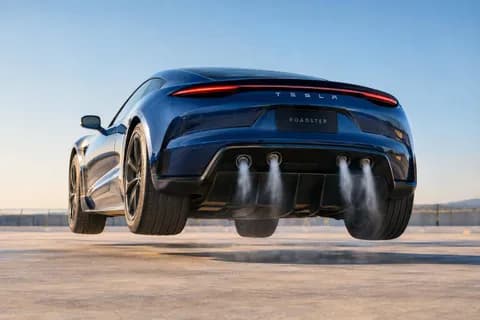
Abu Dhabi Police uses two types of cars at once: headline cars for public attention, and working cars for daily police use. In this list, I’d sum it up like this: the Lykan Hypersport and Rolls-Royce Phantom are there for image and road-safety campaigns, while the Nissan Patrol, Mercedes-Benz E-Class, Ford Taurus, and Volkswagen Touareg handle the jobs that need space, reach, and regular road use.
If you want the short answer, here it is:
Most expensive car: Lykan Hypersport at about AED 12.8 million
Fastest car: Lykan Hypersport at up to 395 km/h
Main patrol picks: Nissan Patrol, Ford Taurus, Mercedes-Benz E-Class, Volkswagen Touareg
Event and awareness cars: Lamborghini Huracan, Nissan GT-R, Rolls-Royce Phantom, Chevrolet Camaro
Main idea behind the fleet: part public image, part road-safety work, part day-to-day policing
What stands out to me is the spread. The list runs from saloons near 200 km/h to a hypercar near 395 km/h, from desert-ready 4x4s to low-slung supercars. That tells you this fleet is not built for one job only.
Quick Comparison
Model | Type | Top Speed | Main Use |
|---|---|---|---|
Lykan Hypersport | Hypercar | 395 km/h | Public outreach |
Lamborghini Huracan | Supercar | 310–325 km/h | Visibility |
Nissan GT-R | Sports car | ~315 km/h | Events / escorts |
Rolls-Royce Phantom | Luxury saloon | ~240 km/h | Ceremonial use |
Volkswagen Touareg | SUV | Up to 240 km/h | General patrol |
Mercedes-Benz E-Class | Saloon | 250 km/h | Traffic patrol |
Ford Taurus | Saloon | 200–218 km/h | Routine patrol |
Executive saloon | 235–250 km/h | Patrol / response | |
Chevrolet Camaro | Muscle car | 249–318 km/h | Highway presence |
Nissan Patrol | 4x4 SUV | ~200 km/h | Off-road patrol |
I’d read this fleet as a clear snapshot of Abu Dhabi itself: fast, polished, public-facing, and built for both city roads and desert ground.
Why Abu Dhabi Police Cars Draw Global Attention
Abu Dhabi Police’s fleet stands out because it turns high-end cars into public-facing symbols. These vehicles do more than patrol roads. The headline models show up at tourist spots, malls, parades, and special events, where they boost visibility and make it easier for people to engage with the police.
The Lykan Hypersport, for example, has been displayed at tourist locations and malls across the capital. The Rolls-Royce Phantom was introduced during GCC Traffic Week at Yas Mall as part of road safety campaigns. And the F999 concept was unveiled during Abu Dhabi’s first Formula 1 race to promote awareness about speeding and seatbelt use.
That public role is a big part of the story. In many ways, these cars matter just as much for where they appear and what they signal as for the badges on them.
At the same time, they do not replace the day-to-day police fleet. They sit alongside standard patrol cars and help project Abu Dhabi’s modern, high-end image.
The next models show how this approach plays out across supercars, SUVs, and saloons.
1. Lykan Hypersport
The Lykan Hypersport is the headline car in the fleet. It’s a limited-production hypercar from W Motors, a maker that designs and engineers its cars in the UAE. Only seven units were made worldwide. Abu Dhabi Police added one in June 2015 for about AED 12.8 million, which made it the world’s most expensive police car at the time.
Under the body, it runs a 3.7–3.8-litre twin-turbo flat-six from RUF. Output sits at about 750–770 hp and 1,000 Nm of torque. It can go from 0–100 km/h in about 2.8 seconds, with a claimed top speed of 385–395 km/h. A carbon-fibre monocoque helps cut weight and stiffen the chassis.
Abu Dhabi Police finished the car in its red-and-white livery, complete with official markings and light bars. The cabin leans into the car’s high-end image, with a holographic-style display, premium leather, and gold-thread stitching. Its LED headlights are diamond-set.
Abu Dhabi Police said the Lykan was added to promote traffic safety, with a focus on younger residents. So this isn’t a car for day-to-day patrols or high-speed chases. Instead, it shows up at malls, tourist spots, and public events, where it supports campaigns around speeding and seat-belt use.
That balance between showpiece and day-to-day policing runs through the rest of the fleet as well.
2. Lamborghini Huracan
In the UAE, the Huracan starts at around AED 450,000. If the Lykan is the fleet’s showpiece, the Huracan is the more familiar supercar name, but it still turns heads in seconds.
It runs a 5.2-litre naturally aspirated V10 with a 7-speed dual-clutch gearbox, makes about 600 bhp, does 0–100 km/h in roughly 3.0 seconds, and reaches a top speed of 310–325 km/h. Those figures make it a better fit for public events and awareness work than day-to-day patrol duty.
Its aero setup, stiff chassis, and traction systems also support high-speed driving. Put simply, it’s built to stay planted when speeds climb.
In the UAE, Lamborghini carries a clear link to performance and status, which gives the Huracan strong visual pull in Abu Dhabi’s police fleet. So this car does more than look fast. It helps the force get noticed.
From here, the fleet shifts from pure supercars to another global performance name.
3. Nissan GT-R
The Nissan GT-R - better known as "Godzilla" - is priced at about AED 500,000 in Abu Dhabi Police coverage and is used mostly for controlled events and high-profile appearances, rather than day-to-day patrol work.
That makes sense. The GT-R brings Japanese performance to Abu Dhabi Police’s public-facing fleet, and its mix of speed and instant recognisability made it a strong match for police use in front of the public.
Under the bonnet is a 3.8-litre twin-turbo V6 with 565 hp and 633 Nm, matched with a 6-speed dual-clutch automatic and all-wheel drive. It can go from 0–100 km/h in about 2.9 seconds and reach roughly 315 km/h.
Abu Dhabi Police first revealed the GT-R in police livery around November 2009. It later showed up in a 2015 chase-style promotional video, which helped cement its performance-focused police image. In that role, the car supports the force’s visibility-led road safety approach.
The GT-R is kept for trained officers, event security, planned escorts and awareness filming. It sits in the middle of the fleet - above daily patrol cars, but below the headline supercars - while still giving Abu Dhabi Police a performance name that many people know on sight.
Next comes a more luxury-focused name in the lineup.
4. Rolls-Royce Phantom
The Rolls-Royce Phantom is a ceremonial and PR car first, and a police vehicle second. Abu Dhabi Police added it in March 2015 and unveiled it at Yas Mall during GCC Traffic Week. The point here is clear: this car is about image. Still, the numbers are part of the story too.
Under the bonnet, the Phantom uses a 6.75-litre V12 that makes about 453-460 bhp and 720 Nm of torque, sent to the rear wheels through an automatic transmission. It can go from 0-100 km/h in around 6.1 seconds, with top speed electronically capped at about 240 km/h. That sounds fast, and it is, but this car is built for comfort and quiet running, not high-speed pursuit work.
On the outside, it wears Abu Dhabi Police’s white-and-purple livery, along with a roof light bar, a 999 plate, and a gold Spirit of Ecstasy. It looks the part straight away. You see it, and you know it’s meant to be noticed.
In day-to-day use, the Phantom usually appears at malls, tourism spots, and major public events, where it helps with tourism and road-safety campaigns. Officers may use it for ceremonial drives, VIP escort duties, and media appearances, but it is not part of normal patrol rotations and it is not used to chase offenders. More than anything, the Phantom works as a moving statement about Abu Dhabi’s public image. Next comes an SUV that shifts the focus from ceremony to everyday utility.
5. Volkswagen Touareg
After the ceremonial Phantom, the focus shifts to day-to-day patrol work. That’s where the Volkswagen Touareg comes in. It brings the practical side of the fleet, and as a mid-size SUV, it fits highway patrol, city traffic duties, and light off-road use with little fuss.
The UAE-spec Touareg delivers up to 340 hp, paired with an 8-speed automatic and all-wheel drive. In plain terms, it has enough punch for patrol work when officers need pace and control.
Size helps too. At 4.88 m long, with an 810-litre boot, the Touareg has room for police gear, cameras, and communications kit. Its driver-assistance and stability systems also make sense for daily enforcement work, where long hours and mixed traffic are part of the job.
With all-wheel drive and traction control, the Touareg is a good fit for UAE conditions, whether that means urban roads, motorways, wet weather, or stretches of sand.
That practical role leads neatly into the fleet’s next group of saloons and patrol cars.
6. Mercedes-Benz E-Class
After the practical SUV, Abu Dhabi Police moves to a saloon that fits patrol and admin work with ease. The Mercedes-Benz E-Class is used for traffic patrol, office-related duties, and at times VIP transport. It’s one of the fleet’s standard saloons, picked for its mix of speed, comfort, and road presence. Its executive look also makes sense for a police car that needs to appear formal while still handling traffic and public-facing work.
On paper, the police-spec E-Class has a top speed of 250 km/h, makes around 280 bhp, and can go from 0–100 km/h in about 6 seconds. In day-to-day police use, that gives officers enough pace for highway response and sharp lane changes on Abu Dhabi’s multi-lane roads.
Inside, the focus is on helping officers stay comfortable during long hours. Climate control, supportive seating, and digital displays make the cabin easier to work in without making it feel cramped or messy. In the UAE, pricing starts at about AED 326,900, which makes it a serious fleet purchase built around speed, comfort, and presentation.
Next comes another saloon that fills a similar day-to-day role.
7. Ford Taurus
After the E-Class, the Taurus moves the spotlight from executive image to day-to-day police work. The Ford Taurus serves as the fleet’s routine patrol sedan, used for traffic patrols, accident response, and high-visibility patrols. In 2021, Abu Dhabi Police publicly unveiled new Ford Taurus patrol vehicles as part of an updated vehicle livery, which underlined its place as a core traffic and general-duty car.
In UAE-spec trim, the Taurus uses a 2.0-litre EcoBoost turbocharged four-cylinder engine, matched with an 8-speed automatic transmission and front-wheel drive. Output sits at about 232–240 hp and 382–390 Nm of torque, while top speed is roughly 200–218 km/h.
Inside, the focus is on comfort and patrol use. Dual-zone climate control and driver-assistance tech help officers get through long shifts on Abu Dhabi’s motorway stretches. Fleet-spec upgrades also add radio, siren, and equipment mounting points.
That makes the Taurus a sensible middle ground between the fleet’s show cars and its other daily-use saloons.
8. BMW 5 Series
After the Ford Taurus, the 5 Series takes the fleet back into premium executive territory. In the UAE, the BMW 5 Series is a premium executive sedan that fits day-to-day police work well, especially when comfort, road presence, and dependability all matter.
What gives it an edge over the E-Class and Taurus? It comes down to three things: a stronger performance range, a premium badge, and factory-backed police conversion support.
BMW's official police-conversion programme adds factory wiring, power supply, and mounting points for lights, sirens, radios, and computers. That makes the 5 Series a solid fit for emergency service use.
UAE-spec 5 Series models produce from 184 to 462 hp. They can do 0-100 km/h in about 4.6 to 8.0 seconds, with top speeds of 235-250 km/h. Buyers can choose rear-wheel drive or all-wheel drive, and AWD can help on dusty or wet roads.
Inside, the car is built for long hours on patrol. Multi-way adjustable seats, efficient climate control, and a digital instrument cluster help officers stay comfortable during long shifts in the UAE heat. And while it's a premium saloon, it still works as a daily tool. At about 4,963 mm long with a 530-litre boot, it offers enough space for officers and gear without feeling too big in city traffic.
In the UAE, prices start at around AED 299,000 and go up to AED 380,000. That mix of executive appeal and daily usability sets up a clear contrast with the more image-led Chevrolet Camaro.
9. Chevrolet Camaro
After the BMW 5 Series, the Camaro takes things in a very different direction. Instead of executive practicality, it brings classic American muscle to the lineup.
Abu Dhabi Police added the Camaro to its fleet in 2009, making it the first American muscle car in the force’s police fleet.
The force operates at least two Camaro coupes in patrol livery. These cars are usually used for high-profile events, where they help discourage speeding and support traffic-safety outreach. A big part of the Camaro’s role is simple: when it shows up, people notice.
The Camaro SS comes with a 6.2-litre LT1 V8 that makes around 455 hp. Reported performance figures go up to 318 km/h, with 0–100 km/h in 4.4 seconds, depending on the trim.
It’s easy to recognise, easy for the public to connect with, and a strong fit for youth outreach and road-safety campaigns.
10. Nissan Patrol
The Nissan Patrol is Abu Dhabi Police’s practical SUV. It’s built for the jobs supercars and saloons simply can’t do, which is why its off-road setup matters so much.
It’s used on desert edges, remote farms, construction sites, and other rough routes. With 4WD, high ground clearance, and low-range gearing, the Patrol fits both city patrols and desert work. Middle East-tuned versions also come with extra cooling and filtration to deal with extreme heat and sand.
The Pro-4X has 244 mm of ground clearance, which rises to around 297 mm with Adaptive Air Suspension. It also gets a 34° approach angle and can do 0–100 km/h in 6.7 seconds. Under the bonnet, the latest Patrol uses a 3.5-litre twin-turbo V6 with 425 hp and 700 Nm of torque, while the NISMO version pushes that figure to 495 hp.
That means it isn’t just big; it’s properly capable. It can seat up to eight people, carry a full team, and use features like Invisible Hood View to help officers read the terrain when cresting dunes or moving across rough ground. In plain terms, it helps bridge the space between headline-grabbing police cars and the vehicles used every day.
It’s also one of the UAE’s most recognisable SUVs, whether in civilian trim or police livery. People know it at a glance. That familiarity gives it instant presence in patrol work and public-facing duties, while its usefulness keeps it central to the fleet’s mix.
Abu Dhabi Police Cars: Side-by-Side Comparison
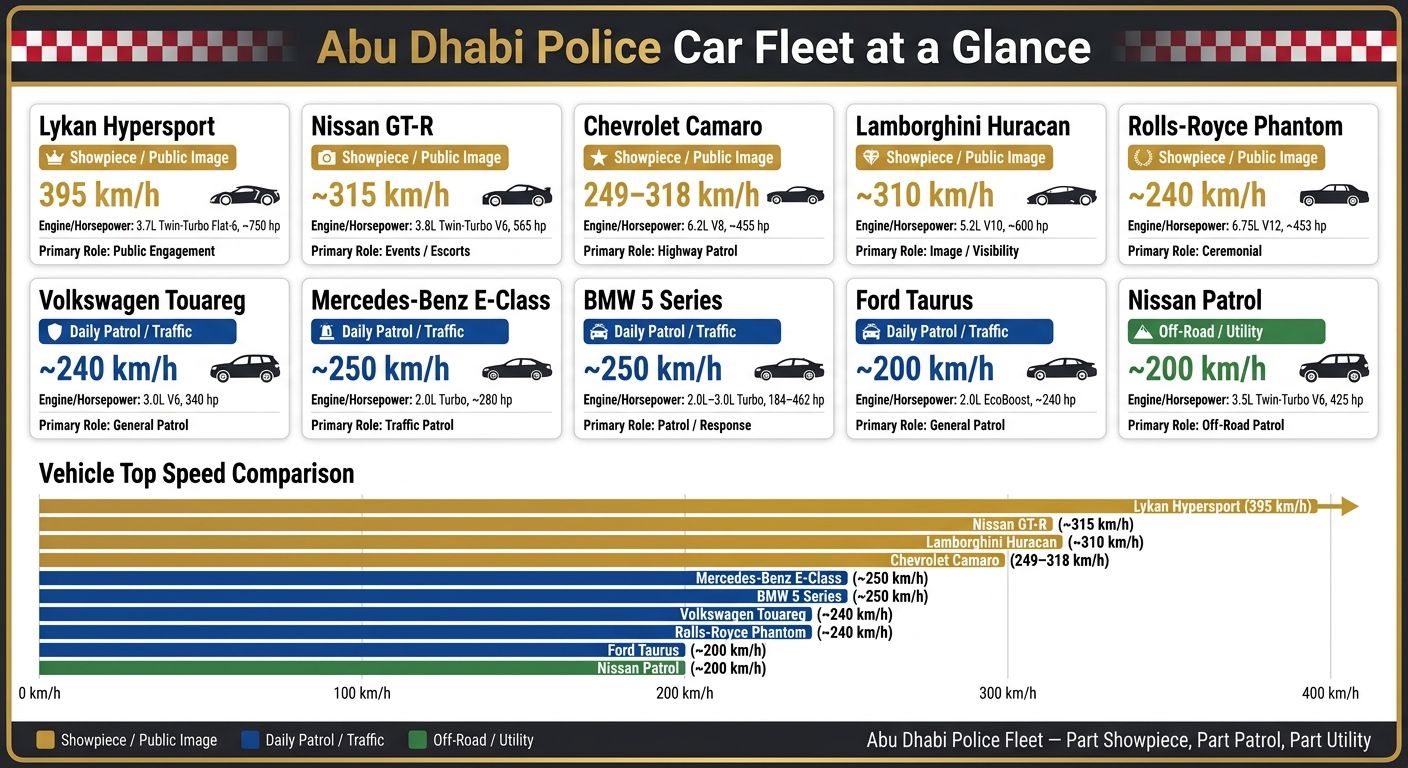
Abu Dhabi Police Car Fleet: Speed, Power & Role Comparison
Here’s the fleet side by side. The mix is pretty clear once you see it in one table: some cars are there to be seen, some are built for day-to-day patrol work, and some are meant for rough ground.
Model | Category | Top Speed | Engine / Powertrain | Primary Role |
|---|---|---|---|---|
Lykan Hypersport | Supercar | 395 km/h | 3.7L Twin-Turbo Flat-6, ~750 hp | Public engagement |
Lamborghini Huracan | Supercar | ~310 km/h | 5.2L V10, ~600 hp | Image / visibility |
Nissan GT-R | Sports car | ~312 km/h | 3.8L Twin-Turbo V6, 565 hp | Rapid response |
Rolls-Royce Phantom | Luxury saloon | 250 km/h (limited) | 6.75L V12, ~453 hp | Ceremonial |
Volkswagen Touareg | SUV | ~240 km/h | 3.0L V6, 340 hp | General patrol |
Mercedes-Benz E-Class | Executive saloon | ~250 km/h | 2.0L Turbo Four-Cylinder, ~280 hp | Traffic patrol |
Ford Taurus | Saloon | ~200 km/h | 2.0L EcoBoost Four-Cylinder, ~240 hp | General patrol |
BMW 5 Series | Executive saloon | ~250 km/h | 2.0L–3.0L Turbo, 184–462 hp | Patrol / rapid response |
Chevrolet Camaro | Muscle car | 249–318 km/h | 6.2L V8, ~455 hp | Highway patrol |
Nissan Patrol | Full-size 4x4 SUV | ~200 km/h | 3.5L Twin-Turbo V6, 425 hp | Off-road patrol |
The top-speed gap runs from about 200 km/h in the Nissan Patrol and Ford Taurus to 395 km/h in the Lykan Hypersport. That range isn’t random.
The supercars help with visibility and public-facing duties. The saloons and executive cars take care of routine enforcement and traffic work. Then the SUVs step in where extra space, ground clearance, and rough-terrain ability matter more than outright speed.
Put simply, this spread is what gives Abu Dhabi’s police fleet its identity. It’s part showpiece, part working patrol line-up, and part utility set-up.
What These Cars Say About Abu Dhabi's Car Identity
This fleet isn’t random. It’s a deliberate blend of performance, presence, and practicality. And that balance stands out most clearly when you start with the Lykan Hypersport.
The Lykan Hypersport shows that mix better than anything else: a UAE-built hypercar used as a traffic-awareness symbol. That choice matters. Using a home-grown Middle Eastern hypercar says something clear about Abu Dhabi. It ties the police fleet to local identity while also projecting the emirate’s place on the global car scene.
You can see the same thinking on the SUV and patrol side of the fleet. The Nissan Patrol lines up with the UAE’s long-standing preference for large SUVs. It’s practical, roomy, and well suited to mixed road conditions.
Then there’s the other side of the garage: the cars built for image. Supercars add that aspirational edge. A Lamborghini Huracan or Chevrolet Camaro in police livery doesn’t just get attention. It makes police presence part of the city’s car culture and links law enforcement with Abu Dhabi’s everyday street image.
Taken together, these vehicles show that Abu Dhabi Police uses its fleet as more than transport. It uses it as a public statement.
Conclusion
Put it all together, and the logic behind the fleet becomes clear. Abu Dhabi Police uses a broad mix of vehicles because Abu Dhabi's roads call for it. The same fleet has to cope with motorways, busy city streets and desert routes, so range matters.
The split between roles is clear too. At one end, the Lykan Hypersport and Rolls-Royce Phantom pull in global attention and strengthen Abu Dhabi's luxury-car image. At the other, the Nissan Patrol, Mercedes-Benz E-Class and Ford Taurus take care of day-to-day policing.
That balance between showpiece and utility reflects Abu Dhabi's car culture. It's ambitious, practical and designed to project an image.
For car enthusiasts, the fleet puts Abu Dhabi's automotive confidence on full display. For everyone else, it's a reminder that in Abu Dhabi, even policing has a place in the car culture.
FAQs
Why does Abu Dhabi Police use both supercars and regular patrol cars?
Abu Dhabi Police uses a mixed fleet to handle different jobs on the road.
Supercars are mostly deployed for high-visibility patrols in tourist areas and major city centres. They also help with community engagement and support the force’s modern public image.
Regular patrol cars, on the other hand, are built for day-to-day law enforcement. The focus here is on efficiency, reliability, advanced in-car technology, and electrified mobility that supports long-term smart city goals.
Are Abu Dhabi Police supercars used for real chases?
There’s no confirmation in the material provided that Abu Dhabi Police supercars are used for actual high-speed chases.
What the source does point to is something a bit different: a focus on specialised fleet tech, including the Ghiath smart patrol vehicles, along with broader autonomous mobility work across the region.
Which Abu Dhabi Police cars are used every day?
The available information doesn’t say which Abu Dhabi Police vehicle models are used for day-to-day patrols.
It only states that Abu Dhabi Police vehicles are exempt from the DARB toll system. There’s no list of the makes or models used in the daily fleet.