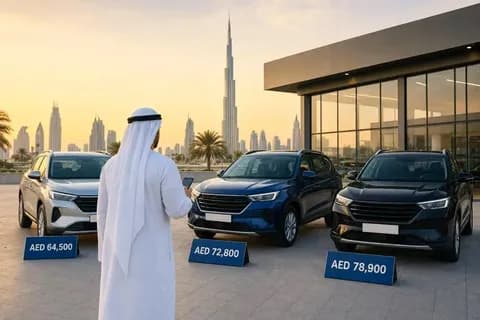
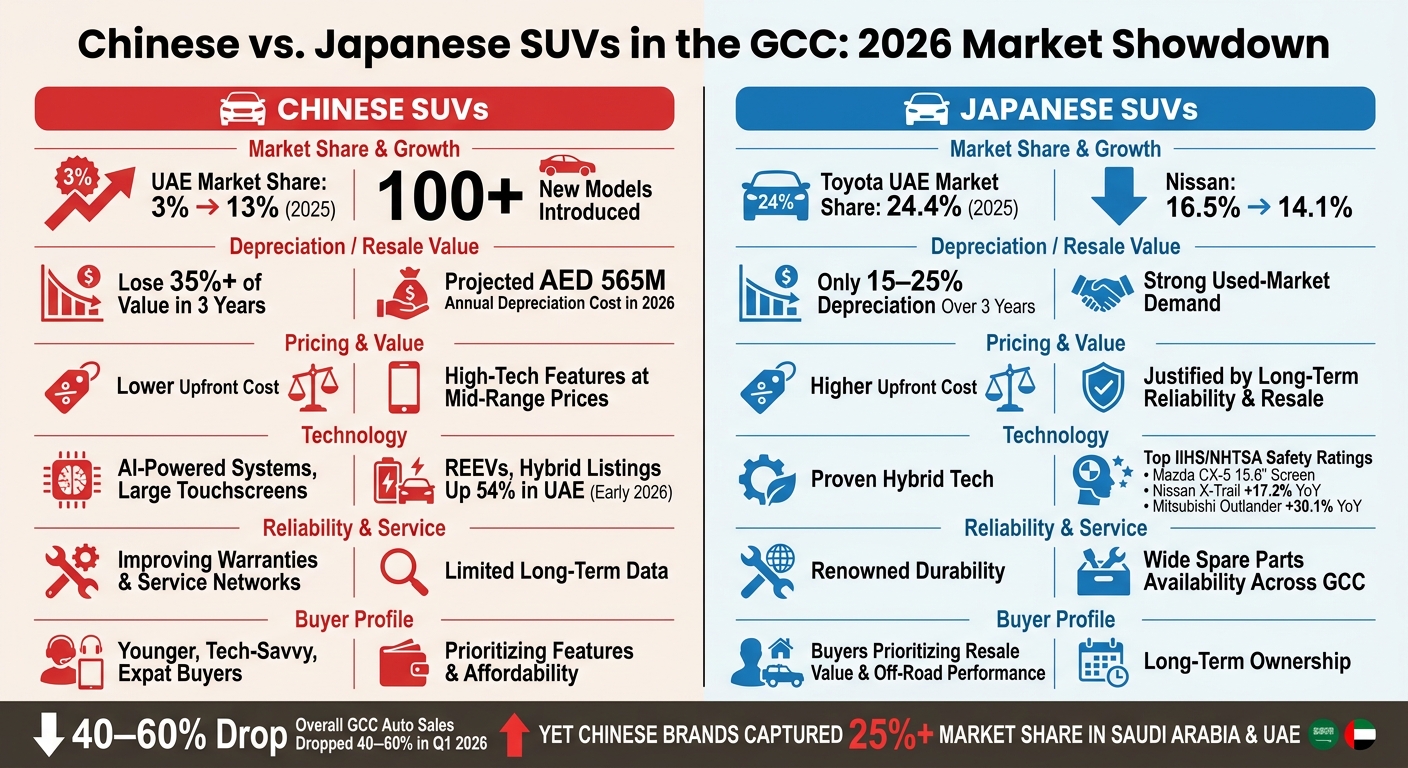
Chinese SUVs are now outselling Japanese competitors across the GCC, marking a major shift in the region’s automotive market. Once considered budget-friendly options, these vehicles now combine affordability with advanced features like AI-powered systems and hybrid powertrains. In 2025, Chinese brands grew their UAE market share from 3% to 13%, with over 100 new models introduced. However, while Chinese SUVs attract buyers with lower prices and cutting-edge technology, they depreciate faster - losing over 35% of their value in three years compared to 15–25% for Japanese SUVs.
Japanese brands, on the other hand, remain strong in reliability, resale value, and long-term ownership costs. Models like the Toyota Land Cruiser and Nissan Patrol continue to dominate in off-road performance and resale demand. Yet, the rise of Chinese brands is reshaping buyer preferences, especially among younger, tech-savvy consumers looking for modern features at mid-range prices.
Here’s the quick takeaway:
-
Chinese SUVs: Affordable, feature-packed, but depreciate quickly.
-
Japanese SUVs: Reliable, strong resale value, but higher upfront costs.
This evolving competition highlights changing priorities in the GCC market, with buyers balancing costs, features, and long-term value.
Chinese vs Japanese SUVs in the GCC: Key Stats & Comparison 2026
1. Chinese SUVs
Sales Figures
Chinese car brands are making impressive strides in the GCC market, with steady year-on-year sales growth seen in countries like Saudi Arabia, the UAE, and Iraq as of early 2026. In February of the same year, Chinese imports became the top vehicle source in Australia, marking a global trend that mirrors their growing influence in the Gulf region.
Here’s a snapshot of individual model performance from March 2026:
| Model | Monthly Sales (Units) | YTD Sales |
|---|---|---|
| LI i6 | 24,198 | 57,088 |
| ES8 | 16,256 | 45,185 |
| TAI7 | 15,041 | 43,896 |
| YU7 | 13,558 | 71,623 |
| M7 | 8,284 | 24,905 |
(Source: Gasgoo / China Passenger Car Association [6])
Pricing
Chinese SUVs are not just affordable; they offer advanced technology and premium interiors that deliver more value per dirham compared to many established competitors. Models such as the BYD Sealion 8 and BYD Shark 6 are marketed as premium yet budget-friendly options, appealing to buyers who might otherwise lean toward slightly older Japanese SUVs.
That said, there’s a trade-off. Chinese cars in the UAE typically lose 35% or more of their value after three years, compared to the 15–25% depreciation of Japanese models. In 2026 alone, the annual depreciation of Chinese vehicles is projected to cost buyers over AED 565 million, suggesting that a lower upfront price doesn’t always translate to lower ownership costs.
Features
Chinese SUVs stand out by packing in high-tech features. Many models now come with advanced driver-assistance systems, large touchscreen displays, AI-powered functions, and dual-powertrain options like Range Extended Electric Vehicles (REEVs), all at mid-range price points. The UAE market has seen a significant rise in hybrid options, with listings doubling and model variety increasing by over 54% by early 2026.
"China's automotive industry has a fundamental advantage: they built their entire sector from scratch using modern techniques... The result? Vehicles that are 'dramatically better' at their price points." - Steve Greenfield, General Partner at Automotive Ventures
Buyer Perception
Expatriates and younger affluent buyers are leading the charge in adopting Chinese SUVs. They’re particularly drawn to features like high-quality infotainment systems, seamless connectivity, quiet driving experiences, and sleek modern designs. Brands such as BYD, GWM, and Chery are often highlighted for their cutting-edge appeal and technical sophistication.
However, concerns around resale value and long-term reliability persist. Issues like spare parts availability, software durability, and overall trust in the brand’s longevity remain sticking points for many buyers. To combat this, Chinese automakers are strengthening local partnerships and expanding service networks, but building that trust will take time.
These shifting consumer preferences lay the groundwork for a closer look at how Chinese SUVs stack up against Japanese competitors in the region.
I Compared 5 Japanese and Chinese SUVs at the Same Price. Here's What I Got
2. Japanese SUVs
Japanese SUVs continue to hold a strong position in the GCC market, even as competition from Chinese brands intensifies.
Sales Figures
Japanese brands have long been dominant in the GCC, but recent trends reveal a more nuanced picture. In the UAE, Toyota retained a commanding 24.4% market share in 2025, while Nissan experienced a decline, with its share dropping from 16.5% to 14.1% during the same period. Across the GCC, overall auto sales saw a sharp drop in Q1 2026, with total sales decreasing by 40% to 60% year-over-year. Nissan, in particular, faced a significant regional demand decline of over 40%.
The full-size SUV segment remains a stronghold for Japanese brands. In Kuwait, the Toyota Land Cruiser (6,379 units) and Nissan Patrol (4,181 units) led large SUV registrations in 2025. However, the mid-size category is showing signs of disruption, as the Jetour T2 managed to outsell the Nissan Patrol to secure the #3 spot overall. These shifts highlight a need for Japanese manufacturers to re-evaluate their pricing and positioning strategies.
Pricing
Japanese SUVs are known for their higher price tags, but they justify this with long-term value. Models built to GCC specifications, with accident-free histories and verified service records, tend to sell quickly and maintain better resale values compared to their basic-spec counterparts. As noted in an Auto Trader UAE Market Study:
"UAE SUV buyers are scrutinising asking prices more than in earlier boom years... However, GCC-spec, accident-free SUVs with dealer or specialist service history continue to achieve stronger prices." - Auto Trader UAE Market Study
The strong demand in the used market further underscores their appeal. Japanese SUVs aged three to five years remain a cornerstone of pre-owned sales, thanks to their proven reliability and lower maintenance costs. However, competition is heating up in the mid-range segment, with Chinese brands offering premium features at competitive prices, challenging the traditional Japanese value proposition outside the full-size category.
Features
Japanese manufacturers are staying ahead by integrating advanced technology into their vehicles. The 2026 Mazda CX-5, for instance, boasts a 15.6-inch infotainment screen. Alongside models like the Honda CR-V and Mazda CX-50, it received top safety ratings from both the IIHS and NHTSA in 2026. Mazda is also venturing into the near-luxury space, offering premium build quality that rivals Lexus but at a more accessible price point.
Hybrid technology is another area where Japanese brands excel. With GCC buyers increasingly favouring hybrids for better fuel efficiency without the range anxiety associated with EVs, Japanese manufacturers offer a wide range of options. Notably, the Nissan X-Trail and Mitsubishi Outlander showed strong year-on-year growth in the UAE, with increases of 17.2% and 30.1%, respectively, in 2025.
Buyer Perception
For many in the GCC, Japanese SUVs like the Land Cruiser and Patrol are synonymous with desert-tested reliability and strong resale value, a legacy newer brands have yet to match. With depreciation rates of just 15–25% over three years, these vehicles remain attractive to those planning a resale within a few years.
However, younger, tech-savvy buyers are increasingly prioritising features over brand prestige. As Ali Bahbahani, Founder of Ali Bahbahani & Partners, observed:
"Big-ticket SUVs still symbolise achievement, but the Territory's rise shows buyers will trade down in badge to trade up in tech."
To address shifting preferences, Japanese brands are exploring strategies such as regional editions, fleet sales, and moving slightly upmarket in the mid-size segment. This evolving landscape sets the stage for a closer examination of the strengths and weaknesses of Japanese SUVs in the GCC market.
Pros and Cons
Deciding between a Chinese or Japanese SUV in the GCC comes down to balancing their distinct advantages and trade-offs. Here's a side-by-side breakdown of how they compare:
| Factor | Chinese SUVs | Japanese SUVs |
|---|---|---|
| Pricing | Offers competitive pricing with high-end features at lower costs | Higher prices justified by brand reputation and reliability |
| Technology & Features | Packed with advanced AI, frequent software updates, and dual-powertrain options | Reliable tech with a focus on hybrids, though slower to adopt cutting-edge features |
| Reliability | Backed by improving warranties, but long-term performance data is limited | Renowned for durability and easy access to spare parts across the GCC |
| Resale Value | Faster depreciation, leading to lower resale value after three years | Stronger resale performance, with depreciation rates of only 15–25% after three years |
| Parts & Service | Service networks are growing steadily | Excellent service coverage and widely available parts region-wide |
| Market Perception | Seen as modern and budget-friendly, but still earning long-term trust | Viewed as dependable with strong resale and reliability |
This comparison underscores key differences, particularly in resale value and overall ownership costs. For buyers in the GCC, Japanese SUVs stand out for retaining value better, making them a smarter choice if you plan to sell within a few years. On the other hand, Chinese SUVs appeal to those seeking affordability and advanced features upfront.
Conclusion
The analysis highlights a significant shift in market dynamics where technology and value intersect in surprising ways. The GCC automotive market is undergoing rapid transformation. Chinese SUVs, once seen as budget-friendly alternatives, have emerged as formidable competitors, capturing over 25% of the market share in pivotal regions like Saudi Arabia and the UAE by early 2026. This period also saw a sharp decline in overall regional auto sales, dropping by 40–60% during Q1 2026. Such trends reflect the evolving priorities of consumers in the region.
Buyers now face the challenge of balancing upfront costs with long-term ownership expenses. Japanese SUVs remain a top choice for their reliability in tough off-road conditions and strong resale values. On the other hand, Chinese brands are gaining traction by focusing on cutting-edge technology and expanding their service networks. This shift is prompting dealers to reassess their service offerings to meet changing consumer expectations.
Building trust in after-sales service is becoming essential for dealers. As James Wang, Vice President of GAC International, explained:
"GAC's goal in going global is not simply to expand sales volume, but to gradually move from 'entering the market' to 'taking root in the market and winning the market.'"
This approach is redefining how after-sales support is perceived, and those who prioritise service quality will be better positioned to compete with the growing presence of Chinese brands.
As both buyers and dealers adapt to this evolving landscape, maintaining long-term resilience is critical. Residual value remains a key consideration. While Chinese EVs and NEVs are enjoying strong sales, the lack of comprehensive depreciation data makes it essential for stakeholders to closely track their value trends in the coming years.
FAQs
Are Chinese SUVs reliable long-term in GCC heat and sand?
Currently, there isn’t detailed data on how well Chinese SUVs hold up over time in the GCC’s harsh climate, which includes extreme heat and sandy conditions. When evaluating these vehicles for such environments, it’s wise to look into aspects like the brand’s track record, the warranty terms offered, and feedback from local owners.
How much will a Chinese SUV lose in resale value in the UAE?
Chinese SUVs in the UAE tend to experience a depreciation of about 20-30% in resale value during the first few years. This range reflects general trends in vehicle depreciation and the growing popularity of Chinese car brands. However, the actual depreciation rate can fluctuate based on factors like the specific model, included features, and the prevailing market conditions.
What should I check for parts and warranty before buying Chinese SUVs?
Before buying a Chinese SUV, it's crucial to check for parts availability and confirm the warranty coverage. In the UAE, this step is key to ensuring dependable after-sales support. Without it, you might face delays or extra costs, which can greatly affect your overall ownership experience.