Finding the right used car in the UAE can be tricky, especially when comparing two similar options. A simple scorecard can help you evaluate cars objectively, saving time and avoiding costly mistakes. Instead of focusing only on price, consider these key factors:
-
Price (AED): Include extra costs like repairs, insurance, and registration.
-
Mileage (km): Expect 15,000–20,000 km per year. Beware of unusually low mileage.
-
Condition: Check mechanical systems, cosmetic wear, and signs of accidents.
-
Features: Strong air conditioning and GCC specs are essential for UAE conditions.
-
Seller Reliability: Verify VIN, service history, and ownership details.
By assigning weights to these criteria and scoring each car, you can make a confident choice. Tools like YallaMotor's valuation tool and pre-purchase inspections (AED 500+) can further ensure you're getting a fair deal. Remember to check for depreciation trends and resale value, as these can impact your long-term costs.
Quick Comparison Table
|
Criterion |
Weight (%) |
Car 1 Score |
Car 1 Weighted |
Car 2 Score |
Car 2 Weighted |
|---|---|---|---|---|---|
|
Price |
25% |
|
|
|
|
|
Mileage |
20% |
|
|
|
|
|
Condition |
25% |
|
|
|
|
|
Features |
15% |
|
|
|
|
|
Seller Reliability |
15% |
|
|
|
|
|
Total Score |
100% |
|
|
|
|
This method ensures you evaluate cars fairly and focus on what matters most for UAE driving conditions.
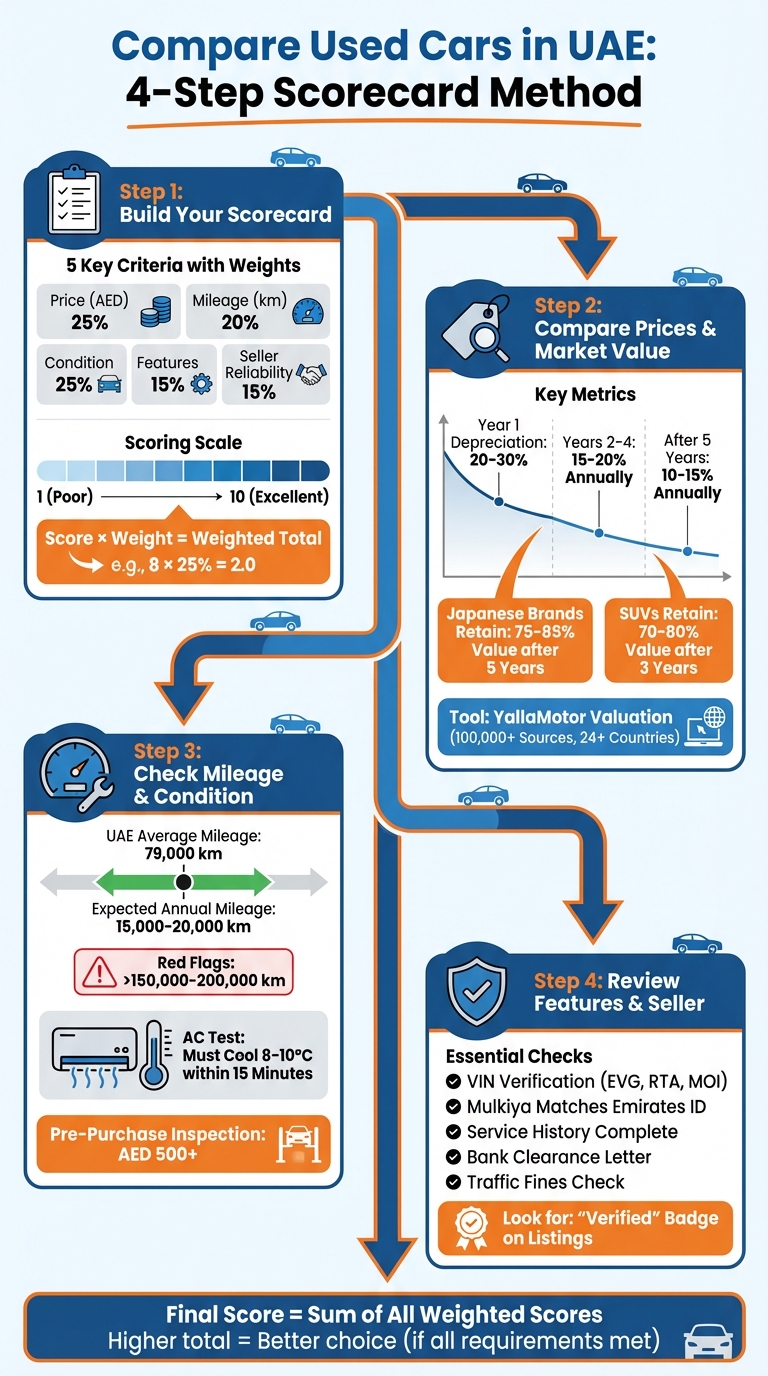
4-Step Used Car Evaluation Scorecard for UAE Buyers
Step 1: Build Your Used Car Scorecard
Choose Your Evaluation Criteria
Creating a scorecard is a practical way to compare used car options in the UAE. It ensures that you evaluate every car using the same standards, making your decision more objective. Focus on five key criteria that are particularly relevant in the UAE: price (in AED), mileage (in kilometres), vehicle condition, features, and seller reliability.
-
Price: This includes not just the asking price but also additional costs like insurance, registration fees, and any immediate repairs needed.
-
Mileage: Mileage gives you a sense of how much life the car has left. In the UAE, the average annual mileage typically falls between 15,000 and 20,000 km.
-
Condition: This covers both mechanical aspects (engine, transmission, cooling system) and cosmetic factors like scratches or interior wear.
-
Features: For UAE drivers, essentials like a strong air conditioning system (capable of cooling by 8–10°C within 15 minutes) and GCC specifications are must-haves.
-
Seller Reliability: This involves checking the Vehicle Identification Number (VIN), reviewing service history, and confirming that the seller’s Emirates ID matches the Mulkiya (registration card).
Set Up Weights and Scoring
Not all criteria are equally important, so assigning weights helps reflect your priorities. For instance, you might allocate 25% to price, 20% to mileage, 25% to condition, 15% to features, and 15% to seller reliability. If you're working with a tight budget, you could place greater emphasis on price. Conversely, if you plan to keep the car for a long time, condition and mileage might take precedence.
Rate each car on a scale of 1–10:
-
9–10: Excellent
-
7–8: Very Good
-
5–6: Average
-
3–4: Below Average
-
1–2: Poor
Multiply each score by its assigned weight to calculate the weighted total. Add up all the weighted scores to get the car’s final score. The car with the higher total is generally the better choice, provided it meets critical requirements like a valid Mulkiya and a clear VIN history.
Scorecard Table Template
Here’s a template to guide your evaluation:
|
Evaluation Criterion |
Weight (%) |
Car 1 Score (1–10) |
Car 1 Weighted |
Car 2 Score (1–10) |
Car 2 Weighted |
|---|---|---|---|---|---|
|
Price (AED) |
25% |
|
|
|
|
|
Mileage (km) |
20% |
|
|
|
|
|
Condition (Mech/Cosmetic) |
25% |
|
|
|
|
|
Features (AC/GCC Specs) |
15% |
|
|
|
|
|
Seller Reliability/History |
15% |
|
|
|
|
|
TOTAL SCORE |
100% |
|
|
|
|
Fill in the table with scores based on your research. The car with the higher total score is likely your best option, as long as it meets essential deal-breakers like a clear service history and matching registration details.
Step 2: Compare Prices and Market Value
Use YallaMotor's Car Valuation Tool
It's essential to ensure the seller's asking price is in line with the current market value. YallaMotor's car valuation tool is a great resource for this. By analysing data from over 100,000 sources across 24+ countries, it provides a reliable benchmark for pricing. Start by entering the vehicle's VIN to access key insights, including a valuation range based on real-time transactions and market trends.
If the asking price is significantly higher than the valuation range, you’ve got a solid reason to negotiate. For more detailed information, consider purchasing the full vehicle history report for AED 99. This report reveals accident records and maintenance history, which can justify requesting a 10–30% price reduction if issues like hidden damage or poor upkeep are uncovered. Cross-check the VIN with RTA records for additional verification. These steps will give you a strong foundation for your negotiation approach.
Once you’ve determined the market value, it’s time to think about depreciation and how the car might hold its value in the future.
Factor in Depreciation and Resale Value
In the UAE, depreciation is a key consideration. Cars typically lose 20–30% of their value in the first year and 15–20% annually over the next three to four years. After five years, depreciation usually slows to about 10–15% per year. Brand reputation is also a major factor - Japanese brands like Toyota and Lexus often retain 75–85% of their value after five years, while some European luxury cars may depreciate by as much as 25% annually.
For better resale prospects, focus on models with high demand. SUVs, for instance, tend to keep 70–80% of their value after three years, making them a safer choice if you plan to sell or upgrade later. Also, check if authorised dealers are offering discounts on new models - this can impact the fair market price of slightly older used cars. Don’t forget to account for the total cost of ownership, which includes maintenance, fuel consumption, and insurance premiums. These factors can vary widely by brand and influence your overall decision. By combining these insights with market valuation and depreciation data, you can refine your final choice with greater confidence.
Step 3: Check Mileage and Vehicle Condition
What's Good Mileage for the UAE?
In the UAE, used cars often clock around 79,000 km, which is significantly higher than the global norm of 47,000 km. A good rule of thumb is to expect 15,000 to 20,000 km per year. Cars with mileage under 100,000 km tend to retain their value better. However, once a vehicle crosses the 150,000 to 200,000 km range, critical components like the engine and transmission are more likely to show wear.
That said, high mileage isn't always a red flag. For instance, a car with 120,000 km driven mainly on highways between Dubai and Abu Dhabi might be in better shape than a car with 60,000 km spent in stop-and-go city traffic.
Be wary of mileage that seems unusually low. For example, if a three-year-old car shows 20,000 km, it could hint at odometer tampering or prolonged inactivity, which can lead to issues like dried seals or rust. Always cross-check the service history to ensure the mileage adds up. Brands like Toyota, Honda, and Subaru are known for their durability, often surpassing 320,000 km with proper upkeep.
Once you’ve considered mileage, shift your focus to the car's overall condition.
Inspect Mechanical and Cosmetic Condition
The next step is to thoroughly inspect the vehicle. Start by checking the fluids: the transmission fluid should be pink or red, and the engine oil should appear clear - not milky. Burnt-smelling or dark transmission fluid could point to serious issues.
The UAE’s climate - marked by intense heat and coastal salt - can take a toll on a car. Heat can damage seals, bushings, and hoses, while salt exposure can lead to rust, especially on vehicles from coastal areas. Inspect the car's underside for rust and ensure air filters are clean, as desert dust can clog them if not replaced regularly. Test the air conditioning rigorously - it should cool the air by 8–10°C within 15 minutes. In this region, a malfunctioning AC isn’t just an inconvenience; it’s a dealbreaker.
"It is possible for garages to manipulate the odometer or do some basic body work and sell the car for a profit. So, it is important to get the car checked from a trusted garage."
– Amal Kumar, General Manager, Royal Prince Auto Care
Look out for mismatched paint colours on different panels, as these could signal past accident repairs. Test the suspension by pressing down firmly on the car’s front and rear - if it continues to bounce, the suspension might be worn. Check the tyres as well; all four should be the same brand with even tread wear. Uneven patterns could indicate alignment problems or rough driving.
To ensure nothing is missed, consider a Pre-Purchase Inspection (PPI) at an independent, RTA-approved centre like Tasjeel or Shamil. While such inspections typically cost upwards of AED 500, they can uncover hidden issues and give you leverage during negotiations.
Lastly, run a VIN check through official platforms like Emirates Vehicle Gate (EVG), the RTA website for Dubai, or the Ministry of Interior (MOI). These checks will provide details on the car’s accident and maintenance history, helping you make a more informed decision in the next step.
Step 4: Review Features and Seller Reliability
Compare Features That Matter to UAE Drivers
Once you've assessed the car's price, mileage, and condition, it's time to dive into the features that truly matter for driving in the UAE. Given the region's extreme heat, a reliable air conditioning system is a must. Without it, a car can become unusable during the scorching summer months. Leather interiors, while stylish, can suffer from fading or cracking under intense sunlight, so inspect them carefully.
For those considering SUVs, these vehicles are highly favoured for their ability to handle desert terrain and provide spacious interiors. If you're debating between an SUV and a sedan, think about whether 4WD or AWD is necessary for your lifestyle - especially if weekend desert adventures are on the agenda. Safety features like blind-spot monitoring and parking sensors are also worth prioritising, particularly for navigating crowded city streets.
Fuel efficiency is another key factor. Check the vehicle's L/100 km rating, especially if you frequently travel between emirates. For many buyers, Japanese brands like Toyota and Honda are appealing because they tend to retain their value in the UAE market.
Once you're satisfied that the car's features align with your needs, it's time to shift focus to the seller's reliability.
Verify Seller Reliability
A trustworthy seller is just as important as a reliable car. Begin by looking for a "Verified" badge on the vehicle listing on YallaMotor. This badge indicates that the car has passed basic screening. Also, ensure the car has a complete service history with no unexplained gaps.
Double-check ownership details by confirming that the Mulkiya (registration card) matches the seller's Emirates ID or passport. To dig deeper into the car's history, perform a VIN check through platforms like Emirates Vehicle Gate (EVG), the RTA website, or the Ministry of Interior. If you're dealing with a company, ask to see their trade licence. Additionally, request a bank clearance letter to verify that the car is free of loans, and check for any unpaid traffic fines via the Dubai Police or MOI websites.
"If the seller or the dealer refuses to give you the VIN, do not buy the vehicle. If this number is scratched off, missing, or altered anywhere, walk away from the deal." – PCR.ae
Be wary of vehicles that have changed hands multiple times - more than three to four ownership transfers in a short span could indicate hidden mechanical issues or prior use as a taxi or rental car. For added peace of mind, consider Certified Pre-Owned vehicles or dealer listings. These often include multi-point inspections (sometimes up to 150 checkpoints) and may come with warranties. While they might cost more upfront, the added assurance can be worth it. This step, like others, plays a crucial role in shaping your final decision.
Your Ultimate Guide to Buying a Used Car in Dubai: Avoid Hidden Surprises & Make the Perfect Choice
Conclusion
The scorecard method simplifies the process of evaluating used cars, making it easier to compare options in the UAE without diving into exhaustive research. By assigning weights and scores to your chosen criteria, you can focus on what truly matters for long-term satisfaction, rather than being swayed by superficial factors like appearance.
This approach also encourages you to factor in UAE-specific considerations that are often overlooked, such as air conditioning performance, resilience in extreme weather, and resale value trends. It ensures a consistent and thorough evaluation of different car listings. With these insights, you'll feel more confident during negotiations and make smarter purchasing decisions.
YallaMotor's platform further enhances this process with features like side-by-side comparisons for up to three vehicles, detailed specifications, and tailored financing options. Their extensive used car listings help you determine fair market prices, ensuring you don't overpay. Additionally, YallaMotor Finance simplifies financing by letting you compare multiple bank offers - ranging from 2.5% to 4.5% interest rates - all in one place, saving you time and helping you secure better deals.
FAQs
What’s the best weight split for my scorecard?
When creating a scorecard to compare used cars in the UAE, the ideal weight split depends on your priorities. Typically, condition should take up around 40-50% of the weight, as it directly impacts the car's longevity and performance. Price often follows with a 30-40% weight, reflecting its importance in staying within your budget. Smaller percentages can be allocated to other factors like features and seller reliability.
Your personal needs should guide the emphasis. For example, if safety is your top concern, you might assign more weight to features that enhance it. On the other hand, if you're working with a tight budget, price might take precedence. Adjusting the weight split ensures your decision aligns with what matters most to you.
When should I pay for a pre-purchase inspection in the UAE?
Before sealing the deal on a used car in the UAE, it's wise to invest in a pre-purchase inspection. This step ensures you're fully aware of the car's condition and safety, helping you sidestep any unexpected expenses. Inspection services in the UAE generally start from AED 150 to AED 500+, depending on the provider and the thoroughness of the inspection.
How do I spot a risky seller before I meet them?
To spot a potentially risky seller, keep an eye out for warning signs like prices that seem too good to be true, hesitation to share a detailed vehicle history, or conflicting details about the car’s condition. It's crucial to verify the seller’s reliability by looking at reviews and ensuring they are transparent about the car’s background. If the seller appears overly aggressive or something doesn’t sit right, trust your gut - it's better to be cautious or walk away than to fall victim to a scam.
Looking for a used car in Dubai or new car deals? Explore YallaMotor’s verified listings today.