Skip the check, and a used car can cost you an extra AED 3,200 in the first year. In some cases, surprise repairs hit AED 3,000 to AED 25,000 within the first 6 months.
If I were buying a used car in the UAE, I’d use this checklist to do four things before paying:
Confirm the paperwork is clean
Check the car is GCC-spec
Look for accident, flood, rust, or sand damage
Test the A/C, electronics, and road behaviour
This guide covers all 47 checks in one simple flow:
Documents and VIN
Service history, fines, loan clearance, and warranty
Exterior, paint, glass, tyres, and underbody
Interior wear, warning lights, belts, airbags, and electronics
A/C test in UAE heat
Engine bay, fluids, brakes, steering, gearbox, and test drive
A few numbers matter straight away:
Normal annual driving in the UAE is about 15,000 to 25,000 km
Factory paint is often around 100–140 microns
Tyres older than 5 years should be treated as expired in GCC conditions
A used-car transfer often costs about AED 350 to AED 500
A/C compressor repair can range from AED 1,200 to AED 3,500, and more on some European cars
A proper PPI often costs AED 150 to AED 800
What should you check first? The seller’s ID, the Mulkiya, the 17-digit VIN, accident history, traffic fines, Salik, and any bank loan. If any of these do not line up, I’d stop there.
What usually gets missed in the GCC? Weak A/C at idle, non-GCC imports, old tyres, underbody rust from coastal use, flood signs, trapped sand, and poor past repair work hidden by repainting or undercoating.
Here’s the short version: start with the legal checks, inspect the car in daylight, test the A/C for 10 minutes, then do a 20–30 minute drive before talking price. After that, pay only when the RTA system shows the car is clear for transfer.
The rest of the article walks through each check in order, so I can review one car - or compare a few - without missing anything.
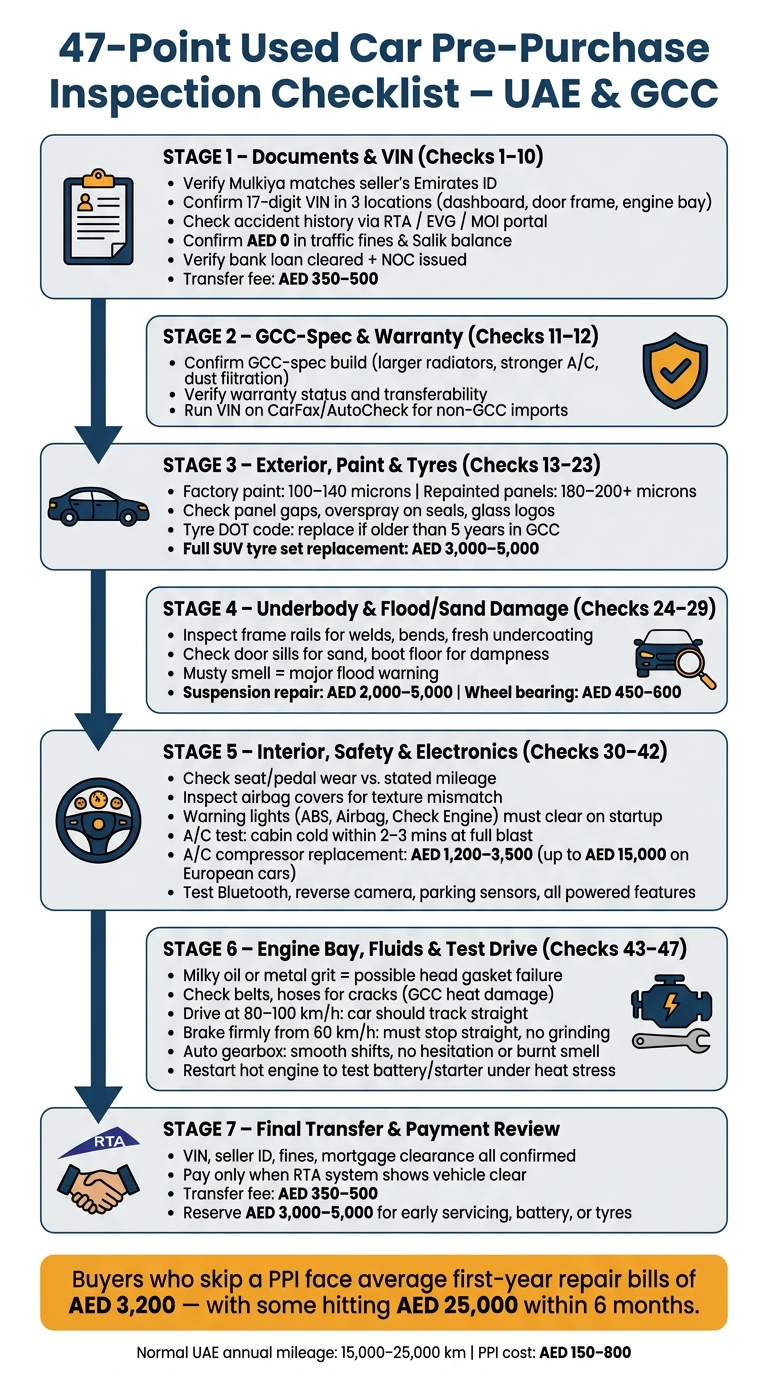
47-Point Used Car Inspection Checklist for the UAE & GCC
NEVER BUY A USED CAR IN THE UAE WITHOUT A PROFESSIONAL INSPECTION.
1. Documents, history, and GCC-spec checks
Start with the paperwork first. If anything looks off here, stop and walk away.
Checks 1–10: VIN, Mulkiya, service records, accident history, fines, and finance clearance
The first job is to make sure the seller has the legal right to sell the car. The Mulkiya should match the seller’s Emirates ID. If the person selling the car is acting for someone else, they need a legal Power of Attorney (POA).
Next, verify the 17-digit VIN in three places on the car: the dashboard plate visible through the windscreen, the driver-side door frame, and the engine bay firewall. All three must match the Mulkiya exactly. If even one digit is different, treat it as a major warning sign. It can point to theft, cloning, or repairs the seller is trying to hide. Also look closely for scratches around the plate, odd fonts, or signs the plate was re-riveted or glued.
After that, match the VIN and mileage against the service history. Agency records from names like Al-Futtaim or Gargash are often preferred because they tend to show original parts and dealer work. Good independent specialists are fine too, as long as the file is clear and complete. The mileage in those records should line up with the odometer.
Mileage also needs to make sense for the UAE. A normal range is around 15,000 to 25,000 km per year. If the reading is far below or above that, don’t ignore it. A low number may sound good, but it can still mean the odometer has been tampered with or the car sat unused for long stretches.
You’ll also want an official accident history check. Use the RTA portal for Dubai-registered cars, the Emirates Vehicle Gate (EVG), or the Ministry of Interior (MOI) app. There isn’t one national accident database, so check the portal tied to the emirate where the car was registered.
Before agreeing to anything, make sure the car has AED 0 in outstanding fines. In the UAE, fines stay with the vehicle rather than the driver. Check through the RTA or the police portal for the right emirate. Do the same for the Salik balance, because unpaid toll charges can also delay or block a transfer.
Finance status matters just as much. If the car still has an active bank loan, it cannot be transferred until the loan is fully settled and the bank has issued a No Objection Certificate (NOC) to the RTA. Don’t take someone’s word for it. Ask to see the NOC in writing.
You should also confirm the car already has a valid roadworthiness pass before transfer. Then, when payment happens, do the ownership transfer on the same day at a Tasjeel or RTA centre. That cuts legal risk in a very direct way. Transfer fees usually fall between AED 350 and AED 500, plus about AED 20 for a new registration card.
Checks 11–12: GCC-spec confirmation and warranty status
Once the legal side is clean, check the car’s build spec.
Ask the seller plainly if the car is GCC-spec. If they can’t answer clearly, treat that as a warning sign. Then confirm it through the VIN and service history. You can also use RTA, Abu Dhabi Police, or MOI lookup tools to check the chassis number and vehicle history. If the car has an import background, run the VIN through CarFax or AutoCheck. That can help flag salvage or flood titles in the country of origin.
Warranty is worth checking too. Ask if the manufacturer’s warranty is still active and whether it transfers to the new owner. Get clear on what is and isn’t covered before you move forward.
If the paperwork and GCC-spec checks pass, move on to the body, underbody, and damage inspection.
GCC-spec vs non-GCC-spec: key differences to check before you proceed
GCC-spec vehicles are built for Gulf conditions. That usually means larger radiators, stronger fans, tougher A/C compressors, better dust filtration, and rust protection suited to coastal humidity. That matters in a place where road temperatures in the UAE can go past 60°C in summer.
"GCC-specification vehicles were manufactured for Gulf climate: the cooling systems handle sustained temperatures above 45 degrees Celsius, the suspension is calibrated for UAE road surfaces, and the parts are stocked across UAE independent workshops." - Omar Al-Fayed, Senior Automotive Consultant
In simple terms, GCC-spec cars are set up for the heat, dust, and humidity you get here. Non-GCC imports may struggle in UAE summer conditions, and they can be harder to deal with when you need parts, finance approval, or resale later on.
2. Exterior, underbody, and damage inspection
Once the paperwork checks out, inspect the car in daylight. Dim parking areas can hide paint issues, leaks, and ripples in the panels. At this stage, you’re checking whether the body matches the story told by the history report.
Checks 13–23: Body panels, paint, glass, lights, and tyres
Start about 3 metres away and walk around the car slowly. Look for straight body lines and even panel gaps. The gaps around the doors, bonnet, and boot should be consistent. Then crouch down and scan the sides in the sun. If the reflections look wavy, or the gaps change from one end to the other, that often points to filler or past accident repair. Factory paint will usually measure 100–140 microns. Repainted panels, or panels with filler underneath, often come in at 180–200+ microns.
Check for overspray on rubber window seals, plastic trim, and inside the door jambs. That’s often a sign of a rushed repaint job. Then move to the glass. Each window should carry the same manufacturer’s logo. If one pane has a different logo, it means that glass was replaced.
Tyres deserve a close look too. Find the four-digit DOT code on the sidewall. For example, 3521 means the tyre was made in the 35th week of 2021. In the GCC, tyres older than five years should be treated as expired, even if the tread still looks fine. Also look at the wear pattern. Uneven wear, especially on one side, often points to alignment or suspension trouble. And this isn’t a small cost. Replacing a full set on a large SUV such as a Nissan Patrol can cost AED 3,000 to AED 5,000, so it should affect the price you’re willing to pay.
If all that looks clean, get low and inspect what’s underneath.
Checks 24–29: Underbody condition, suspension, rust, and flood or sand damage signs
Underbody checks matter a lot in the GCC. Heat, sand, salt air, and flash floods can leave damage that doesn’t show up from above. Use a lift if you can, or get low enough to see the underbody properly.
Check the frame rails for weld marks, bends, or patches of fresh undercoating. Those can be used to hide rust or past structural work. Be extra careful if the car was registered in a coastal area such as Sharjah or Ajman, where salt air and humidity can speed up corrosion underneath.
For flood or sand damage, inspect the door sills for trapped sand, the boot floor foam for dampness, and the area under the carpets for silt or residue. A musty smell inside the cabin is a major flood warning. Then do a simple suspension check: push down hard on each corner of the car. It should settle almost at once. If it keeps bouncing, the shocks are likely worn.
These repairs can add up fast. Minor suspension work can cost AED 2,000 to AED 5,000, and replacing just one front wheel bearing can cost AED 450 to AED 600.
Refusal to allow an independent PPI is a red flag.
Accident repair signs vs factory-condition bodywork
Feature | Factory Condition | Accident Repair Signs |
|---|---|---|
Panel Gaps | Even and symmetrical across the vehicle | Uneven, tapering, or mismatched widths |
Paint Finish | Smooth, consistent reflection | Wavy reflections, "orange peel" texture, or a finish that doesn't match nearby panels |
Paint Thickness | 100–140 microns | 180–200+ microns |
Rubber Seals | Clean and black with no paint marks | Overspray (paint droplets) on edges |
Bolt Heads | Paint on bonnet/door bolts intact and unscratched | Scratched or rounded bolts indicating panel removal |
Glass Logos | Matching manufacturer logos on all windows | Mismatched brands or missing logos on specific panes |
Underbody | Uniform factory coating or light dust | Fresh undercoating hiding welds, bends, or rust |
If anything looks off, book a PPI before you commit. Costs usually range from AED 150 to AED 800, depending on how deep the inspection goes.
If the outside and underbody look sound, continue inside for cabin, safety, and electronics checks.
3. Interior, safety systems, and electronics
Inside the cabin, problems often show up fast. In many cases, the interior will reveal mileage mismatch, flood history, or weak A/C before the exterior gives anything away.
Checks 30–38: Seats, odours, warning lights, controls, and safety equipment
Start with wear points. Check the seats, steering wheel, and pedals, and see if that wear makes sense for the stated mileage. A low-mileage car with a shiny wheel, tired seat bolsters, or worn pedal rubbers should make you pause.
Pay attention to smells too. Smoke, dampness, or heavy fragrance can tell a story. Sometimes sellers use strong perfume to cover up something they don't want you to notice.
Pull each seat belt all the way out and inspect the belt ends. Look for moisture stains or grit. That kind of residue can point to flood damage. Then test each belt properly. It should retract smoothly and lock when you give it a sharp tug.
Next, inspect the airbag covers on the steering wheel and dashboard. The texture and colour should match the surrounding trim. If one cover looks slightly off, that's often a sign the airbag has deployed before.
Then turn the ignition to ON without starting the engine. The warning lights should come on briefly. Once the engine starts, they should go out. Watch the key ones closely:
ABS
Airbag
Check Engine
If any of them stay on, you're looking at an active fault.
After that, go through the controls one by one. Work in a fixed pattern so you don't miss anything. Test the windows, mirror adjusters, stalks, steering wheel buttons, and seat motors. Everything should respond as it should, without delay or odd noises.
Checks 39–42: A/C performance, infotainment, cameras, sensors, and power features
In the UAE, A/C isn't a nice extra. It's a must. And this is one area where a quick viewing can fool buyers, because some sellers top up the gas just before showing the car.
Set the A/C to full power: maximum fan, lowest temperature. Leave it running for 10 minutes while the car is standing still. In UAE heat, the cabin should feel properly cold within 2–3 minutes.
If it cools only when the car is moving, or if the airflow gets weaker at idle, that usually points to a condenser fan or compressor problem. A simple gas refill can hide a slow refrigerant leak for a short time, so the only way to confirm the system is sound is with a professional pressure test.
Also smell the vents. A musty, mouldy, or "vinegar" smell can mean bacteria in the evaporator. In worse cases, it can hint at flood history.
For the infotainment system, connect your phone over Bluetooth and make sure it pairs without fuss. Open the navigation and then shift into reverse to check that the camera comes on straight away.
Parking sensors need a proper test too. Walk around the car while someone watches the sensor display or listens for the warning tones. Each sensor should react as you get closer. If one stays silent, there's a good chance it isn't working.
Test every powered feature you can reach, including:
Windows
Mirrors
Seat motors, if fitted
Typical UAE repair ranges:
Strong A/C vs weak A/C in UAE conditions
Feature | Strong A/C (Healthy) | Weak A/C (Warning Signs) | Likely Causes | Typical Repair Cost (AED) |
|---|---|---|---|---|
Cooling Speed | Reaches comfortable temp within 2–3 mins | Blows warm air for 5+ mins or only when moving | Low refrigerant; failing compressor | 300–1,000 (refill/leak fix); 1,200–3,500 (compressor) |
Airflow | Strong, consistent blast from all vents | Weak airflow even on max setting; whistling noises | Clogged cabin filter; blower motor failure | 150–800 |
Stability at Idle | Maintains temperature at traffic lights | Air warms at idle | Condenser fan failure; clogged condenser | 500–1,500 |
Odour | Neutral or fresh | Musty, mouldy, or "vinegar" smell | Bacteria in evaporator; previous flood damage | 200–600 (cleaning) |
Compressor replacement usually runs from AED 1,200 to AED 3,500, and can reach AED 15,000 on some European models. If anything feels off during that 10-minute A/C test, keep that cost in mind before you agree on a price.
If the cabin checks out, move on to the engine bay and the road test.
4. Mechanical checks, test drive, and final signing review
Checks 43–47: Engine bay, fluids, tyres, brakes, steering, gearbox, and road behaviour
Once the cabin and A/C check out, it’s time to look under the bonnet and take the car on the road.
Start with the engine off. Pull the dipstick and inspect the oil. If it looks milky or you spot metal grit, that can point to coolant mixing with the oil or internal engine damage, including possible head-gasket failure. Check the coolant too, and look closely at belts and hoses for cracks, hardening, or brittle spots. In GCC heat, these parts take a beating.
Then move to the tyres. Check:
Pressure
Sidewall cracks
Bulges
Uneven wear
On a straight road at 80–100 km/h, briefly loosen your grip on the wheel. The car should stay straight. If it drifts or pulls to one side, you may be looking at alignment trouble or uneven tyre wear. Also listen for a low hum or drone once you’re above 80 km/h. That sound often points to a worn wheel bearing.
Go over a speed bump slowly and pay attention to any knocking from the suspension. After that, brake firmly from around 60 km/h. The car should stop in a straight line. If it pulls while braking, something’s off. Grinding or squealing usually means the pads or rotors need work.
If the car has an automatic gearbox, watch how it shifts. It should feel smooth and quick, not lazy or confused. Hesitation, repeated hunting between gears, or a burnt transmission smell are major red flags.
After the drive, switch the car off and start it again while the engine is still hot. This is a smart check because some starter motor and battery faults only show up under heat stress. Before you make any call, look underneath for any fresh leaks.
Final review before transfer and payment
If the drive feels clean, do one last paperwork check before any money changes hands. This final review can save you from a messy handover.
Item | What to Verify | Who Acts |
|---|---|---|
VIN / chassis number | Matches the car and documents exactly | Buyer |
Seller identity | Matches ownership documents and Emirates ID | Buyer |
Traffic fines | Clear on RTA system | Seller |
Bank mortgage | Clearance letter received | Seller |
Agreed price | Final AED figure confirmed in writing | Both parties |
Keys, manuals, and warranty papers | All handed over | Seller |
Insurance | New policy arranged before transfer | Buyer |
Don’t pay the full amount until the RTA system shows the vehicle is clear. The ownership transfer fee at RTA or Tasjeel centres is about AED 350 to AED 500. It’s also smart to keep aside another AED 3,000 to AED 5,000 for early servicing, a battery, or tyre replacement, since these costs often show up in the first few months.
Conclusion: Use the 47-point PDF to compare cars with confidence
Buyers in the UAE who skip a pre-purchase inspection report first-year repair bills from AED 1,800 to AED 14,000, with a median of about AED 3,200. That’s a painful surprise, and it’s often avoidable.
A structured checklist gives you a steady way to judge each car, spot trouble before it lands on you, and use what you find to push for a fairer price.
The downloadable PDF version of this 47-point checklist follows the same order as this article: documents first, then exterior, interior, and finally mechanical checks and paperwork. That makes it easy to use during an actual viewing without losing track. Browse listings on YallaMotor, shortlist the cars that fit your budget, and take the PDF with you.
FAQs
Do I still need a PPI if the car has full service history?
Yes. A full service history shows the car has been looked after over time. But it doesn't tell you exactly how the car is doing right now, and it may not show hidden issues that came up recently.
A pre-purchase inspection gives you an independent, up-to-date check before you sign. It can spot accident damage, flood issues, and repairs the car may need straight away.
How can I confirm a car is truly GCC-spec?
Check the car’s VIN before you go. It can help you confirm where the car came from and whether it has an import history. Also ask the seller, plainly, if the car is GCC-spec. If the answer feels vague, hesitant, or slippery, take that as a warning sign.
When you inspect the car, look for factory-fitted features made for Gulf conditions. That usually includes heavy-duty cooling, a stronger A/C compressor, and special air filters built to handle heat and dust.
What should make me walk away immediately?
Walk away at once if the VIN on the chassis doesn’t match the official documents, or if the seller won’t allow an independent pre-purchase inspection.
Other major red flags include flood damage, bad structural or chassis repairs, missing maintenance records, unclear GCC-spec status, or wear on the steering wheel and pedals that doesn’t line up with the stated mileage.