If I’m staying under 18 months, I’d usually rent. If I’m staying 2–3 years or more, I’d usually buy used. If I want car swaps and low hassle, I’d look at subscription - but only if the premium is worth it.
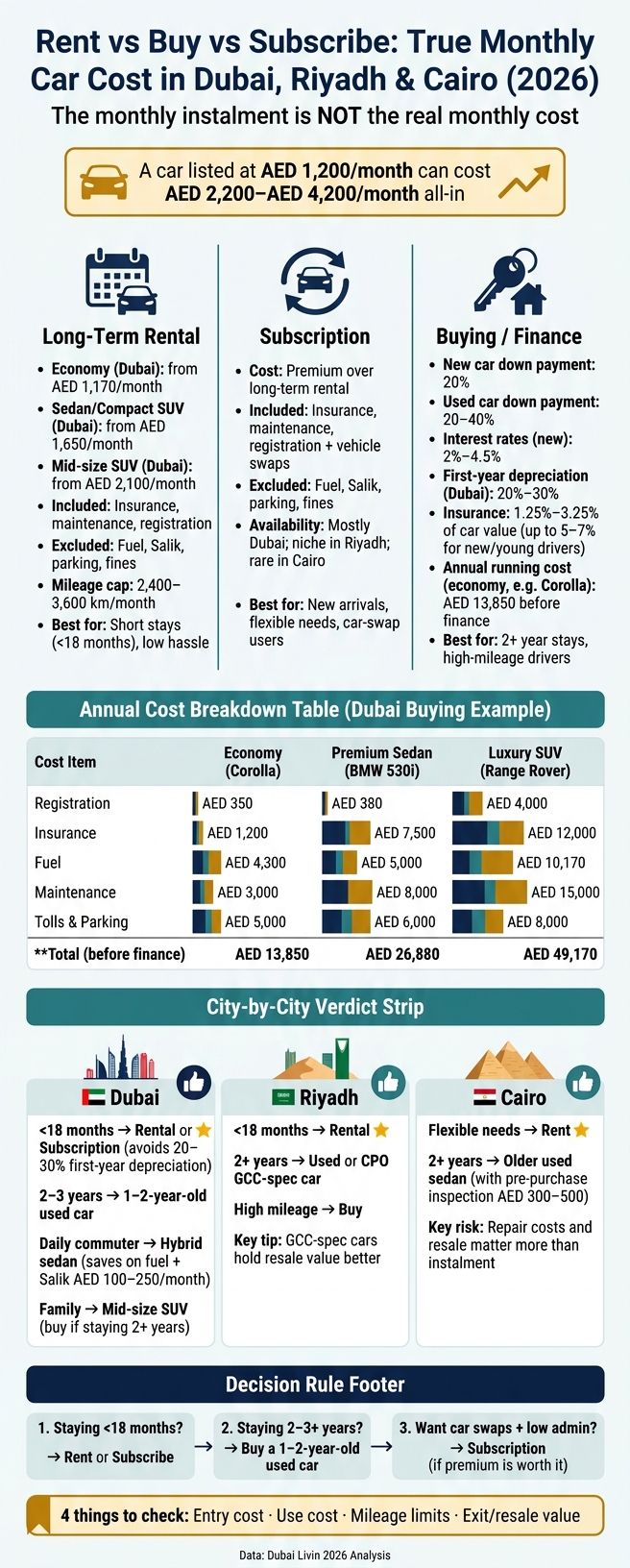
The main point is simple: the monthly instalment is not the real monthly cost. In Dubai, a car that looks like AED 1,200/month can end up closer to AED 2,200–AED 4,200/month after insurance, fuel, registration, Salik, parking and maintenance. That’s why I’d compare 12, 24 and 48 months, not just the sticker payment.
Before I choose, I’d check these four things:
Entry cost: deposit, down payment, registration
Use cost: fuel, charging, insurance, service, tolls, parking
Limits: mileage caps and overage charges
Exit cost: depreciation and resale value
Here’s the short version by city:
Dubai: rental or subscription often makes more sense for short stays because first-year depreciation can hit 20%–30%
Riyadh: buying often starts to win over a longer period, especially for moderate- and high-mileage drivers
Cairo: used-car repair risk and resale matter more than the instalment alone
Rent vs Buy vs Subscribe: True Monthly Car Cost in Dubai, Riyadh & Cairo (2026)
Leasing vs Buying a Car in Dubai | Compared & Explained
Quick Comparison
Option | Best for | What I pay for | Main downside | Where it often fits |
|---|---|---|---|---|
Long-term rental | Short stays, low hassle | One monthly fee plus fuel, tolls, parking and fines | Mileage caps, no resale upside | Dubai, Riyadh, Cairo |
Subscription | Short stays, people who want car swaps | Rental-style monthly fee, usually with swap access | Higher monthly cost than rental | Mostly Dubai |
Buying / finance | 2+ year stays, high-mileage use, people who can resell well | Down payment, instalments, insurance, fuel, service, fees | Depreciation, resale work, repair risk on used cars | Stronger over longer stays |
My rule of thumb: if I need flexibility, I’d pay for it on purpose. If I need the lowest long-run cost, I’d run the numbers on a 1–2-year-old used car, then compare that with a rental that includes insurance and maintenance.
The rest of the article breaks down where each option wins in Dubai, Riyadh and Cairo, and how I’d do the math without missing the hidden monthly costs.
Long-term rental vs subscription: bundled-cost options across all three cities
Long-term rental and subscription both roll the admin side of car use into one monthly payment. The main difference is simple: a long-term rental keeps you in the same car, while a subscription lets you switch vehicles.
That swap option can be handy. You might use a compact sedan during the week, then move to a mid-size SUV for the weekend. But that added flexibility comes at a premium. If you don't plan to switch cars, a standard rental will usually cost less. So the key question becomes: does that extra monthly premium still beat buying once insurance, fuel and depreciation are factored in?
Long-Term Rental | Car Subscription | |
|---|---|---|
Monthly cost (economy, Dubai) | From AED 1,170 | Premium over long-term rental |
Monthly cost (sedan/compact SUV, Dubai) | From AED 1,650 | Premium over long-term rental |
Monthly cost (mid-size SUV, Dubai) | From AED 2,100 | Premium over long-term rental |
Riyadh | Predictable monthly rentals for sedans and SUVs | Niche |
Cairo | Primarily rental-led | Rare |
Included | Insurance, maintenance and registration | Insurance, maintenance, registration and vehicle swaps |
Excluded | Fuel, Salik, parking and traffic fines | Fuel, Salik, parking and traffic fines |
Mileage limit (Dubai typical) | 2,400–3,600 km/month | Varies by plan |
Dubai: when an all-in monthly fee makes sense
In Dubai, both models wrap insurance, servicing and RTA registration into one monthly charge. Fuel, Salik, parking and fines sit outside that price.
The extra value in a subscription is flexibility. That can make sense for new arrivals, or for people whose plans still feel up in the air. If your routine is steady and you just need one car every day, long-term rental is often the cheaper route. And that's where the ownership comparison gets more interesting, because depreciation can wipe out what looks like a lower monthly cost on paper.
Riyadh and Cairo: where rental stays practical and subscription stays limited
Riyadh offers steady monthly rental options for sedans and SUVs, while subscription stays niche. Cairo is still led mainly by rentals, with subscription choices harder to find.
That gap comes down to market maturity, availability and how clear pricing is in each city. In Cairo, it's worth checking the small print on maintenance, because "all-in" can mean different things from one provider to another. In both Riyadh and Cairo, the real comparison is whether owning a car comes out cheaper than this bundled monthly cost once depreciation and resale are added.
Buying and financing: the full cost after insurance, fuel and depreciation
Buying only makes sense if the total cost of owning the car stays below what you'd pay for a rental or subscription. And that’s the key point: rental and subscription plans are bundled. So if you buy, your monthly outlay has to come in lower even after depreciation and the amount you may get back when you sell.
Dubai and Riyadh: when financing works and when buying used wins
In Dubai, a new car usually loses 20%–30% of its value in the first year alone. That drop hits hard. On top of that, comprehensive insurance often costs 1.25%–3.25% of the car’s value, and it can climb to 5%–7% for new drivers or drivers under 25.
Then come the day-to-day costs: Salik tolls at AED 4 per gate, RTA registration, fuel and parking. Put it all together, and annual running costs for a typical economy car like a Toyota Corolla can reach AED 13,850 before any loan repayment.
In Riyadh, the maths often leans more in favour of buying. Over a three-year period, buying will usually beat renting, especially if you drive a moderate to high number of kilometres.
A 1–2-year-old used car often hits the sweet spot. The first owner takes the biggest depreciation hit, while the car may still have part of its manufacturer warranty left. That can make a big difference.
New car finance usually calls for a 20% down payment, with interest rates around 2%–4.5%. Used car loans can need 20%–40% down, and the rates are often higher because lenders price in more risk.
Cost Item | Economy (e.g., Corolla) | Premium Sedan (e.g., BMW 530i) | Luxury SUV (e.g., Range Rover) |
|---|---|---|---|
Registration | AED 350 | AED 380 | AED 4,000 |
Insurance | AED 1,200 | AED 7,500 | AED 12,000 |
Fuel | AED 4,300 | AED 5,000 | AED 10,170 |
Maintenance | AED 3,000 | AED 8,000 | AED 15,000 |
Tolls and parking | AED 5,000 | AED 6,000 | AED 8,000 |
Total annual cost before finance | AED 13,850 | AED 26,880 | AED 49,170 |
Source: Dubai Livin 2026 analysis
For GCC drivers, GCC specifications matter too. Cars built to GCC spec are set up with stronger cooling and filtration for extreme heat, which can help with reliability and resale.
Cairo: why used-car numbers matter more than monthly instalments
Cairo changes the equation. Here, the bigger issue is often repair risk and resale, not just the finance plan. It makes more sense to judge a car by its purchase price plus likely repair bills over 2–3 years, rather than by the sticker price alone.
That’s why an independent pre-purchase inspection matters so much. It usually costs AED 300–500, and it’s one of the best ways to avoid buying someone else’s problem.
Using YallaMotor to check the purchase costs
Once you’ve worked out the ownership cost, it helps to check live market data before you commit. YallaMotor lists new and used cars, offers AI-powered valuation tools so you can compare your numbers with current asking prices, and provides vehicle inspection services to cut the risk of hidden faults.
The platform also includes financing and insurance options, which makes it easier to review the full purchase cost in one place. That gives you a cleaner way to compare buying against the city-by-city numbers above.
City-by-city verdicts: which option fits which type of driver
The right pick comes down to how long you’ll stay, how much you drive, and which city you’re in.
Driver Profile | Dubai | Riyadh | Cairo |
|---|---|---|---|
Short-stay expat (<18 months) | Monthly rental or subscription | Monthly rental or subscription | Monthly rental |
2-to-3-year resident | 1–2-year-old used sedan | Used sedan or CPO | Older used sedan |
Family | New or CPO mid-size SUV | Buy a larger vehicle or finance it | Buy a reliable used family car |
Daily commuter | Purchase a hybrid sedan | Buy an economy or hybrid sedan | Buy |
High-mileage driver | Buy (new or used) | Buy | Buy |
Budget-first used-car buyer | Certified Pre-Owned (CPO) | Used GCC-spec sedan | Older used sedan with pre-purchase inspection |
Use the table if you want the fast answer. The notes below show where the grey areas are.
Dubai: expats, commuters and families
In Dubai, stay length is the first filter. If you’re here for less than 18 months, a rental or subscription often makes more sense because it helps you dodge the 20%–30% first-year depreciation hit and the hassle of selling the car later.
After that, the numbers shift. If you commute every day and pass through two Salik gates twice a day, you could be looking at AED 100–250 a month in tolls. Add fuel on top, and the gap between car types starts to matter. A hybrid sedan using about 4.5 L/100 km can cut fuel spend compared with a standard petrol car.
For families, the maths is pretty simple. Mid-size SUV rentals start from AED 2,100 a month, so if you’re staying for a few years, buying usually works out better.
Riyadh: long-term residents, contract workers and families
In Riyadh, the big question is how long your contract runs. If you’ll be there for more than two years, buying a used car or CPO model tends to be the better move, even more so if you drive a moderate or high number of kilometres.
There’s also a local detail that matters: go for a GCC-spec car where possible. These cars are better suited to the local climate, and they tend to hold resale value more steadily than non-GCC imports.
Cairo: low-cost ownership vs renting for flexibility
In Cairo, the trade-off is pretty direct: lower upfront cost versus repair risk.
An older used sedan keeps the entry price down, which is why it suits many buyers. But there’s a catch. You need a pre-purchase inspection to avoid hidden mechanical issues that can turn a cheap buy into an expensive mistake.
If your driving needs are uncertain, renting gives you more room to move. If you already know you’ll use the car for several years, buying can work - but only after inspection.
Conclusion: how to run your own 2026 car-cost calculation
The choice usually comes down to how long you'll stay, how much you'll drive, and what the car will be worth when you exit. Shorter stay? Rental or subscription often makes more sense. Longer stay? Buying can pull ahead once resale value starts to offset depreciation. Use the city verdicts above as your first filter, then run the numbers.
Check four things: total monthly outflow, mileage overage, resale value, and city fees.
For total monthly outflow, add fuel, monthly insurance, and a maintenance reserve of AED 800–1,500 to your loan instalment or rental fee. This is where many people slip up. They compare a rental payment with only the loan instalment, which leaves out a big chunk of the actual cost.
For mileage, compare your monthly kilometres with the plan cap. In Dubai, standard long-term rentals usually include 2,400–3,600 km per month. If you go past that often, ownership starts to look better.
For resale value, use a grounded estimate based on first-year depreciation, not the sticker price. Sticker price can make the maths look nicer than it is. What matters is what you can likely sell the car for later.
For city fees, include costs such as Salik tolls. In Dubai, those can add AED 100–250 per month to a commuter's cost.
If buying still comes out ahead, use YallaMotor to check current listings and five-year-old sale prices for the same model. That gives you a more realistic residual value for your calculation instead of a finger-in-the-air guess.
Most drivers miss the same thing: they compare rental fees against only the loan instalment and skip fuel, insurance, maintenance, and city-level charges. Put all of it into one monthly view, line it up with your stay length, and the better option usually becomes pretty clear.
FAQs
How do I calculate my true monthly car cost?
Add your monthly loan or subscription payment to a monthly share of annual fixed costs like comprehensive insurance, registration, and scheduled maintenance.
Then add your average monthly running costs:
fuel
Salik
parking
It also helps to set aside a small reserve for surprise repairs or fines. And don’t overlook depreciation. It’s the hidden cost that chips away at your car’s value over time.
When does buying become cheaper than renting?
Buying usually makes more financial sense than renting when you’re staying for the long term - in most cases, more than two years.
Renting gives you flexibility. Your monthly cost is easy to plan for, and you don’t have to worry about maintenance or the car losing value over time. That said, those rental payments can stack up month after month.
If you expect to keep the car for longer, a one- to two-year-old car often hits the sweet spot on price and value.
How much do mileage caps affect rental value?
Mileage caps can have a big effect on rental value because they set the point where extra charges start. In the UAE, most monthly rental packages include 2,400 km to 3,600 km.
That sounds fine at first. But if you drive past that limit on a regular basis, the extra per-kilometre fees can add up fast. A deal that looks simple and fixed can suddenly cost more month after month.
So before you sign, check the mileage cap in the contract. It’s one of those small details that can turn a fixed monthly price into a variable cost.