If you tint first and check the law later, you could end up paying for it. In the GCC, cabin temperatures can go past 70°C in summer, but the legal tint limit changes by country and by window.
Here’s the short answer: if you want one setup that is more likely to stay on the safe side across GCC driving, I’d stick with a clear front windscreen, about 70% VLT on front side windows, and lighter ceramic film on the rear than the legal maximum if factory glass is already dark. That matters because officers check the final combined VLT, not just the film label.
Before you tint, these are the points I’d check:
-
UAE: front side windows up to 50% VLT; fines can reach AED 1,500
-
Saudi Arabia: front side windows must stay at 70%+ VLT; fines run from SAR 500 to SAR 900
-
Qatar: front side windows up to 50% VLT; fines can reach QAR 500
-
Rear glass rules differ from one country to another
-
Reflective and metallic films are generally not allowed
-
Medical permits may allow darker tint in some cases
-
Ceramic film can cut heat well without going very dark
-
A meter reading after fitting is the check that counts
Quick comparison
| Area | UAE | Saudi Arabia | Qatar |
|---|---|---|---|
| Front windscreen | 90%+ VLT / near-clear | 70%+ VLT | Clear |
| Front side windows | 50% VLT | 70%+ VLT | 50% VLT |
| Rear side windows | 50% VLT | 30% VLT | 30% VLT |
| Rear windscreen | 30%–50% VLT | Not allowed unless exempt | 30% VLT |
| Main fine | Up to AED 1,500 | Up to SAR 900 | Up to QAR 500 |
If I were choosing for 50°C Gulf heat, I would focus less on dark film and more on ceramic film plus legal VLT. That gives you heat control, less glare, and fewer problems at inspection or at the border.
2026 GCC window tint laws by country
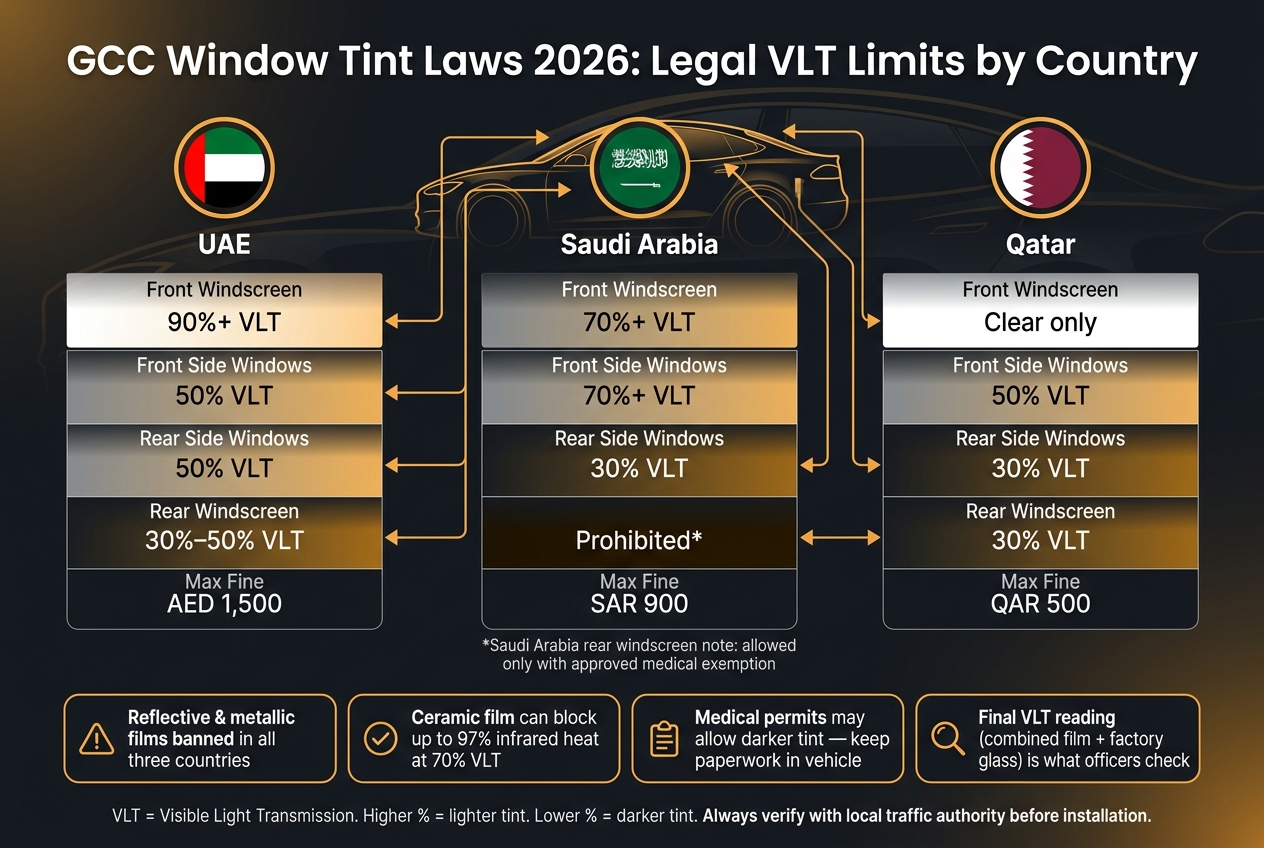
GCC Window Tint Laws 2026: Legal VLT Limits by Country
UAE, Saudi Arabia and Qatar: permitted tint percentages, exemptions and fines
If you drive across the GCC, tint rules can trip you up fast. A setup that’s fine in Dubai may not pass in Riyadh.
In the UAE, the front windscreen must stay clear at 90%+ VLT, although a narrow sun strip is allowed at the top. Front and rear side windows are limited to 50% VLT. The rear windscreen can be 30%–50% VLT. Reflective and metallic films are banned in all GCC markets covered here because they can affect road safety and electronic systems such as SALIK.
If your tint breaks the rules in the UAE, you can face a fine of AED 1,500 and vehicle impoundment. There are exceptions. Drivers with RTA-approved medical or government permits may go beyond the standard limit, but that permit must stay in the vehicle at all times.
In Saudi Arabia, the rules are tighter at the front. The front windscreen and front side windows must stay at 70%+ VLT (Shade 00). Rear side windows are allowed up to 30% VLT (Shade 02). The rear windscreen is prohibited unless there is an approved medical exemption. Taxis, rental cars, cargo vehicles, public buses, and single-door coupes without rear seats are not allowed to carry any tint. The fine ranges from SAR 500 to SAR 900.
In Qatar, front side windows are limited to 50% VLT, while rear side windows and the rear windscreen are allowed at 30% VLT. The front windscreen must remain clear. Fines for non-compliance can reach QAR 500.
| Window Area | UAE | Saudi Arabia | Qatar |
|---|---|---|---|
| Front windscreen | 90%+ VLT | 70%+ VLT | Clear |
| Front side windows | 50% VLT | 70%+ VLT | 50% VLT |
| Rear side windows | 50% VLT | 30% VLT | 30% VLT |
| Rear windscreen | 30%–50% VLT | Prohibited except approved medical exemptions | 30% VLT |
| Maximum fine | AED 1,500 | SAR 900 | QAR 500 |
These are the legal ceilings; the next section compares which VLT works best in 50°C heat.
Kuwait, Bahrain and Oman: permitted tint percentages, exemptions and fines
For Kuwait, Bahrain, and Oman, check the current rules with local traffic authorities before installation, as regulations can change.
Cross-border GCC driving: when your home-country tint is illegal elsewhere
A 50% VLT front side window that passes UAE inspection is not compliant in Saudi Arabia, where those same windows must be at 70%+ VLT. The safe move is simple: use the destination country’s limit as your ceiling before choosing a tint level.
Best VLT for 50°C Gulf heat: 70%, 50%, 35% and 30% compared
Once you know the legal limit, the next step is simpler: pick a VLT that cuts heat without making night driving a pain.
How tint darkness affects heat, privacy and night visibility
Older dyed films mostly depended on darkness to cut heat. Modern ceramic and nano-ceramic films work differently. They can reject heavy heat even at lighter VLT levels, which means a 70% film can still do a solid job under Gulf sun. In fact, a ceramic film can block up to 97% of infrared heat while keeping the glass looking almost clear. So when you're comparing options, film type matters just as much as darkness.
| VLT % | Heat/Glare Control | Privacy | Night Visibility |
|---|---|---|---|
| 70% | Moderate; high with ceramic film | Minimal | Excellent |
| 50% | Strong | Moderate | Good |
| 35% | High | Good | Limited |
| 30% | Strongest glare control | High | Reduced |
UV protection is a separate issue. It comes down to film quality, not how dark the tint looks. Good ceramic films can block up to 99% of UV.
If you drive a lot after dark, 35% to 50% VLT is usually the safer sweet spot.
Which VLT suits front windows and which works better for rear passengers
For front side windows, 70% VLT makes sense if you cross into Saudi Arabia. If you stay within UAE rules, 50% is the more common pick.
For rear side windows, most families and SUV owners tend to settle around 30% to 35% VLT. That range helps shield rear passengers from harsh afternoon sun and adds a decent level of privacy for children or items left on the back seat.
There’s one small catch here. Factory glass already cuts some light, so a 30% film can test darker than many drivers expect after installation. That’s why it’s smart to ask for a post-installation VLT meter reading, not just the film rating on paper.
With that VLT range in view, the next move is to match it to how you drive, who rides with you, and what kind of vehicle you own.
How to pick a legal tint setup without wasting money
Tint setups for commuters, families and SUV owners
Start with the legal ceiling, then pick the tint based on how you use the car. That simple step can save you from paying for film that looks good in the workshop but causes trouble later.
A commuter who leaves the car parked outside for hours will usually do well with 50% VLT nano-ceramic film on the side and rear windows. It gives a solid balance of heat control and legal peace of mind.
For families, a mixed setup often makes more sense. A common option is 50% VLT on the front side windows and 30%–35% VLT on the rear windows. That gives rear passengers a bit more comfort and privacy without making the front too dark.
If you drive an SUV, the usual fit is 30% VLT on the rear windows and 50% VLT on the front sides for better cabin control. Bigger cabins can heat up fast, so this kind of split setup tends to work well.
What to ask your installer and what to check on a used car
Once you've chosen the right VLT, don’t stop at the quote. Check the finished result with a meter before you leave the workshop. Ask the installer to take a VLT meter reading on the glass after the film has been fitted, not just tell you the film’s stated rating. That final reading is what matters.
It also helps to ask for:
-
An installer's compliance note
-
Your invoice, kept in the vehicle with that note
Buying a used car? Be extra careful here. Many used cars already have tint fitted, and some of it is too dark to pass inspection. Before you commit, get the existing tint checked with a meter.
Why fitting slightly lighter than the legal limit is the safer choice
A small compliance margin can save you money and hassle. The reason is simple: factory glass already affects the final VLT reading. So even if the film itself sounds legal on paper, the combined result can end up below the limit.
That’s why it’s safer to choose a film that is slightly lighter than the legal maximum. This leaves room for the factory glass and helps keep the final reading within the law.
Choosing the right GCC tint in 2026
GCC tint laws are not the same across the region. A tint setup that’s legal in one country might fail in another. That’s why exemption paperwork and installation checks matter so much.
If you need darker tint for medical reasons, get formal approval from the relevant traffic authority before fitting the film. And keep that approval in the car at all times. Once you know the legal limit, the next step is simple: pick the best option for heat control without going over it.
In 50°C heat, the smart move is to choose the lightest legal ceramic film that still cuts glare well: 70% on front side windows, 50% on rear glass, and a clear 90%+ windscreen film. That setup gives a strong balance between heat control, visibility, and staying within the law.
There’s one catch. Factory glass already reduces final VLT, so the finished result can end up darker than expected. To avoid that, choose a film that’s slightly lighter than the legal limit and ask for a post-installation meter reading. That check is the one that matters most, especially before installation and before driving across borders.
Check the law first, then go with the lightest film that still keeps the cabin usable in 50°C heat.
FAQs
How is final VLT measured on tinted windows?
Authorities use electronic devices to check how much light passes through your windows. The result shows the combined VLT of the factory glass and the tint film added to it.
Inspectors place the device on the inside of the glass and compare the reading with the legal limit. That detail matters more than many drivers think. Factory glass already cuts some light, so even a film that seems allowed on paper can still push the final reading over the limit.
Will factory-tinted glass affect legal compliance?
Yes. Authorities measure the combined VLT of the factory-tinted glass and any film added on top.
That’s the part many drivers miss. A film can meet the rule on its own, but once it’s applied to factory-tinted glass, the total VLT may drop below the legal limit.
If that happens, the car can fall out of compliance. That may lead to fines or a failed inspection. Before installation, check the combined VLT, not just the film’s stated rating.
What tint setup is safest for GCC cross-border driving?
For GCC cross-border driving, the safest move is to follow the strictest tint rules anywhere on your route. Tint laws change from one country to another, so it makes sense to plan around the most restrictive stop on your journey. That lowers the risk of fines or other penalties.
A practical setup is a high-quality ceramic film with 70% VLT or higher on the front windows and windscreen. It’s a sensible middle ground: you get heat rejection and clear visibility, while staying in a range that supports legal compliance across more GCC markets.