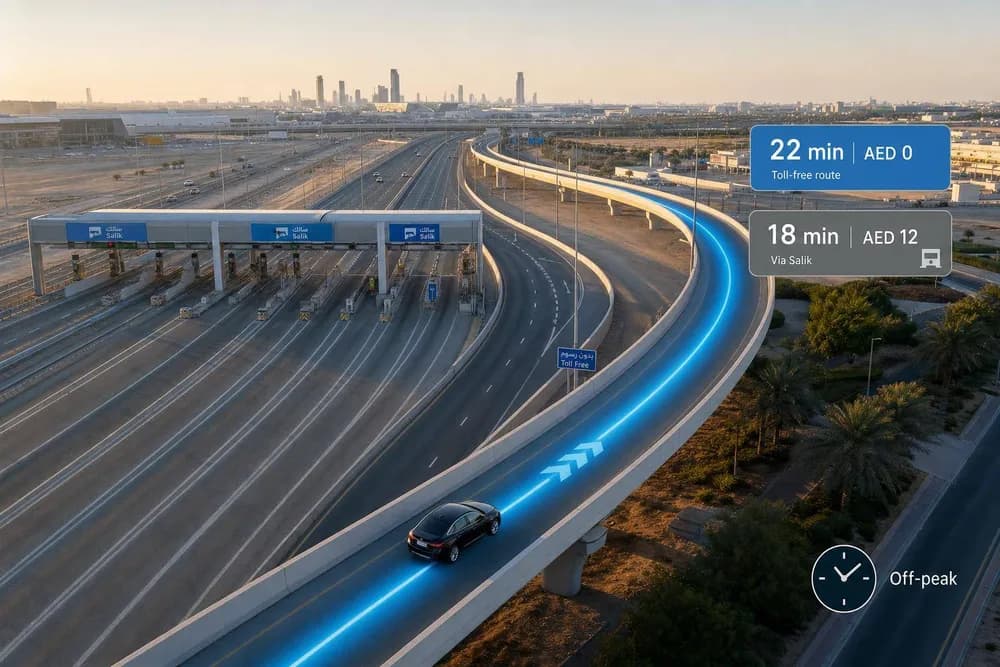
You can cut your monthly toll spend by up to 40% by doing three things: crossing outside peak hours, using fewer tolled roads, and checking your Salik or Darb history before changing anything. If I commute through Dubai or Abu Dhabi often, even a 30-minute shift or one route change can save AED 100+ to AED 250+ a month. In some Dubai cases, moving a four-crossing work trip out of peak times drops the bill from AED 528 to AED 352, and an early start can bring it down to AED 264.
Here’s the full picture in simple terms:
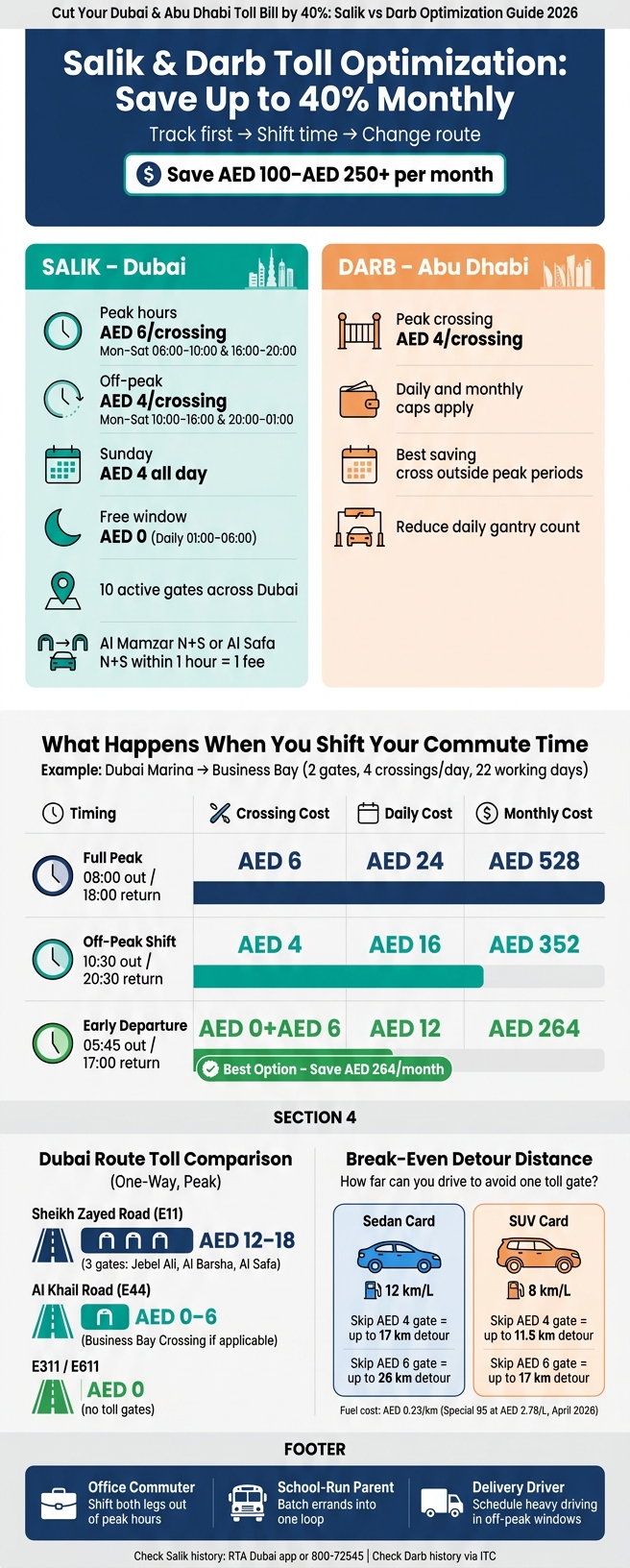
Salik in Dubai uses time-based pricing:
AED 6 during weekday peak windows
AED 4 during off-peak hours
Free from 01:00 to 06:00
Darb in Abu Dhabi charges AED 4 per crossing in peak periods and uses caps
Route swaps such as E11 vs E44, E311, or E611 can cut out one or more toll points
A detour only makes sense if the extra fuel cost is lower than the toll avoided
For a sedan at about 12 km/L, skipping one AED 6 gate is worth about 26 km of extra driving
For an SUV at about 8 km/L, that same gate is worth about 17 km
My take: if I want lower toll costs, I should start with the crossings that happen again and again, mostly the AED 6 Salik trips and peak Darb runs. That is where the monthly savings usually sit.
Salik vs Darb Toll Savings: Timing & Route Optimization Guide 2026
Quick Comparison
System | Where | Main charge | Best way to cut cost |
|---|---|---|---|
Salik | Dubai | AED 6 peak / AED 4 off-peak / Free 01:00–06:00 | Shift repeated crossings out of peak hours and avoid extra gates |
Darb | Abu Dhabi | AED 4 per peak crossing | Cross outside charging hours and cut daily gantry count |
If I had to boil the guide down to one line, it would be this: track first, shift time second, change route third.
How Salik and Darb Charges Work in 2026
Salik and Darb don’t charge in the same way, so it helps to know the rules before you switch routes or head out at a different time.
Salik in Dubai: Peak, Off-Peak and Free Windows
For regular Dubai commuters, the biggest chance to save is simple: move repeat crossings out of the AED 6 slots. Salik uses time-based pricing, which means each gate crossing costs more or less depending on when you pass through. Dubai has 10 active Salik gates, covering key points such as Al Garhoud Bridge, Business Bay Crossing, Al Maktoum Bridge, Al Mamzar, Al Safa, the Airport Tunnel and Jebel Ali.
Time Window | Days | Cost Per Crossing |
|---|---|---|
06:00–10:00 | Monday–Saturday | AED 6 |
16:00–20:00 | Monday–Saturday | AED 6 |
10:00–16:00 | Monday–Saturday | AED 4 |
20:00–01:00 | Monday–Saturday | AED 4 |
All day | Sunday | AED 4 |
01:00–06:00 | Daily | Free |
That timing gap can make a big difference on weekday commutes. Four peak crossings in one day cost AED 24. The same four crossings in off-peak hours cost AED 16.
There’s another detail worth knowing. If you pass Al Mamzar North and South, or Al Safa North and South, within one hour, Salik counts that as one journey fee.
Darb works differently. In Abu Dhabi, the main way to cut costs is to avoid peak charging windows and make the most of the cap system.
Darb in Abu Dhabi: How Peak-Period Charging Works
In Abu Dhabi, savings usually come from crossing gantries outside peak periods or cutting down the number of daily crossings. Darb charges AED 4 per crossing during peak periods and uses daily and monthly caps. That cap setup matters most for frequent commuters who pass several gantries in the same day.
Once you know the charging windows, the next step is to see whether an exemption or cap changes what you pay over a month.
Exemptions, Caps and Local Rules That Affect Your Savings
Exemptions remove toll charges in full for vehicles that qualify, so they matter if they lower your monthly total. Salik exemptions apply to military, police and emergency vehicles, RTA public transport buses, school and college buses, and vehicles registered as People of Determination vehicles.
If your vehicle may qualify, check the RTA and Integrated Transport Centre rules before you count the cost.
Timing Changes That Lower Your Monthly Toll Bill
Once you know the peak windows, the next way to save is simple: move certain trips a little earlier or later. You’re still taking the same route. You’re just crossing at a cheaper time.
Dubai Examples: Shifting a Two-Gate Commute Out of Peak Hours
Take a common office commute from Dubai Marina to Business Bay. If you pass through two Salik gates - Al Safa and Business Bay Crossing - twice a day, that means four peak crossings daily at AED 6 each. Over 22 working days, your monthly total comes to AED 528.
Here’s how the cost changes when the timing changes, even though the route stays the same:
Timing Pattern | Crossing pattern | Cost Per Crossing | Daily Total (4 crossings) | Monthly Total (22 days) |
|---|---|---|---|---|
Full peak | 08:00 outbound / 18:00 return | AED 6 | AED 24 | AED 528 |
Off-peak shift | 10:30 outbound / 20:30 return | AED 4 | AED 16 | AED 352 |
Early departure | 05:45 outbound / 17:00 return | AED 0 (outbound) / AED 6 (return) | AED 12 | AED 264 |
The biggest drop comes from the early-start option. By keeping the outbound leg in the free window, the monthly bill falls to AED 264.
That’s a big gap for a small schedule change. In plain terms, leaving home before the morning rush can cut this sample commute’s toll cost in half.
Abu Dhabi Examples: Crossing Darb Gantries Just After Peak Periods
The same idea works in Abu Dhabi, though the Darb cap affects the final maths a bit.
Say a commuter crosses two Darb gantries during peak time on the way into the city. At AED 4 per crossing, that’s AED 8 each way or AED 16 per day. If the return trip shifts by just 30 minutes, so it happens after the peak window ends, that return leg avoids AED 4 per gantry. The saving comes to AED 8 per day, or about AED 176 per month across 22 working days.
Ramadan and Other Schedule Changes to Watch
Ramadan can change toll windows, so it’s smart to check the live schedule before your first commute under the new hours. If your timing can’t move, then the next place to look is your route.
Route Changes: When a Longer Drive Costs Less Than a Toll-Heavy Shortcut
If changing your travel time still leaves you stuck with peak tolls, the next move is simple: change the route.
Dubai Routes: Sheikh Zayed Road Versus Al Khail Road, E311 and E611
Sheikh Zayed Road (E11) is Dubai’s main toll-heavy corridor. On a one-way trip, you can pass through three Salik gates - Jebel Ali, Al Barsha and Al Safa - which brings the total to AED 18 during peak hours.
For trips that start or end in JVC, Meadows or Al Quoz, Al Khail Road (E44) can often bring that one-way toll down to AED 0–6, depending on where you enter and exit.
For longer drives, such as Sharjah to Jebel Ali or across to Abu Dhabi, Sheikh Mohammed Bin Zayed Road (E311) and Emirates Road (E611) are the main toll-free options. They bypass the Jebel Ali, Al Safa and Al Barsha gates altogether.
Route | Toll Gates Encountered | Peak Toll Cost (One-Way) |
|---|---|---|
Sheikh Zayed Road (E11) | Al Barsha, Al Safa, Jebel Ali | AED 12–18 |
Al Khail Road (E44) | Business Bay Crossing (if applicable) | AED 0–6 |
E311 / E611 | None | AED 0 |
There are also a few route swaps that can save you a gate here and there. The Airport Tunnel gate can be avoided by using Rebat Street (D83), while Al Garhoud Bridge can be bypassed through Business Bay Crossing or Floating Bridge.
That might not sound like much on one trip. But on a repeated weekday commute, skipping even one gate adds up fast across 22 workdays.
For Dubai–Abu Dhabi trips, use the same approach with E11 and Darb: count the gates first, then compare the route.
Abu Dhabi and Intercity Routes: E11 Planning
In Abu Dhabi, it helps to price the journey by gantry count first, not just by distance.
Taking E311 or E611 from Dubai lets you avoid the Jebel Ali gate completely. Once you reach Abu Dhabi, a route with fewer Darb gantries can cut your Darb exposure by one or two crossings on each trip.
A Simple Break-Even Check: Tolls, Fuel and Time
Before you commit to a longer drive, do a quick sense check on tolls, fuel and time.
With Special 95 priced at AED 2.78/L as of April 2026, and a typical sedan averaging 12 km/L, fuel works out to about AED 0.23 per km.
Toll Avoided | Fuel Cost Per km | Break-Even Distance – Sedan (12 km/L) | Break-Even Distance – SUV (8 km/L) |
|---|---|---|---|
AED 4 (off-peak) | AED 0.23 | ~17 km | ~11.5 km |
AED 6 (peak) | AED 0.23 | ~26 km | ~17 km |
Here’s the plain-English version: avoiding one AED 6 peak-hour gate is worth a detour of up to 26 km in a sedan, as long as the trip time stays close.
For an SUV, that limit drops to about 17 km because it uses more fuel. Once the extra distance goes past your break-even point, or the route makes you arrive much later, the toll-heavy road may still cost less overall.
A good final check is to turn on "Avoid Tolls" in your navigation app and compare the live arrival times before you choose.
Build Your Monthly Toll-Saving Routine and Track the Results
Use Map Apps, Salik Records and Darb History to Find Costly Patterns
Start with last month’s Salik record in the RTA Dubai app, on the Salik website, or by calling 800-72545. Then line those crossings up with your usual travel times. Every AED 6 charge points to a peak-hour trip, so that’s the first place to look for savings.
Once you spot those higher-cost crossings, check whether a small timing shift would help. A crossing close to 10:00 or 16:00 is often the easiest one to move fully into off-peak hours. That small change can trim your bill without changing your whole route.
Do the same review for your Darb history if you drive to or from Abu Dhabi. The goal is simple: find the trips that keep showing up, then match each one to the fix that suits how you drive.
For route planning, turn on your map app’s “Avoid Tolls” setting before you leave. After that, compare the ETA with the extra fuel spend before you pick the detour. A toll-free route can look good at first glance, but if it adds too much distance, the saving may disappear.
Three Driver Profiles: Office Commuter, School-Run Parent and Delivery Driver
The best move depends on when you drive and how often you cross toll points.
Office commuter (Dubai, two-gate daily commute): A two-gate commuter usually saves the most by moving both parts of the trip out of peak hours.
School-run parent (Abu Dhabi, multiple short trips): Batch errands into one loop so you don’t rack up extra crossings.
Delivery driver (Dubai, high daily mileage): Delivery work tends to save more when the busiest driving happens in off-peak hours, which keeps more crossings at the lower rate and makes daily route planning simpler.
If you’re weighing up a longer toll-free route, don’t just guess. YallaMotor’s fuel-efficiency reviews and car comparison tools can help you estimate your cost per kilometre before you commit to the detour.
Conclusion: Small Weekly Changes That Add Up Over a Month
Check your monthly Salik or Darb statement, start by cutting the AED 6 crossings, and then repeat what worked the following month.
FAQs
How do I check my monthly Salik or Darb history?
Log in to your account on the official Salik website or app for Dubai tolls, and the Darb website or app for Abu Dhabi tolls.
Once you're in, you can check your past crossings, compare peak and off-peak trips, track your monthly spend, and tweak your route or travel time to help cut costs.
When is a toll-free detour worth it?
A toll-free detour makes sense when the extra driving time doesn’t wipe out the money you save on tolls. That’s often a smart move for non-urgent trips, where a few extra minutes on the road may be worth it.
In Dubai, travelling outside peak hours or using routes such as the Floating Bridge or Sheikh Mohammed Bin Zayed Road (E311) can help you avoid toll gates without throwing your plans off too much. If you want to save on a regular basis, compare your usual route with toll-free options, try to time your crossings for off-peak periods, and group errands into one Sunday trip.
Do Salik and Darb caps or exemptions apply to me?
Exemptions for Salik and Darb are tightly regulated. In most cases, they apply to specific vehicle types or social groups, not to everyday commuters.
Salik exemptions include emergency vehicles, police, military, RTA public transport, school and college buses, and vehicles under the Determined Ones category.
Darb exemptions include emergency vehicles and public transport vehicles, motorcycles, school buses, larger buses, and some eligible residents for one vehicle.