If you want the short answer: the lowest upkeep costs in the UAE usually come from the Mitsubishi Attrage, Nissan Sunny, and Toyota Corolla, while MG is often the cheapest new-car pick during warranty. The big cost split is not just the badge. It is the model, engine, gearbox, workshop type, and whether the car is still under warranty.
Here’s the article in one view:
I looked at 8 mainstream brands: Toyota, Nissan, Hyundai, Kia, Mitsubishi, Honda, Suzuki, and MG
The focus is after-sales spend only: oil service, brake pads, batteries, filters, major services, labour, and some repair risks
Pricing is based on 2026 UAE market rates for GCC-spec cars
In many cases, independent garages cost 30% to 50% less than dealers
For many mainstream cars, annual maintenance in the UAE sits around AED 2,400 to AED 6,200
Naturally aspirated 1.5L to 2.0L cars are usually cheaper to keep than turbo or V6/V8 models
CVT repairs are one of the biggest cost risks, with rebuilds often reaching AED 6,000 to AED 12,000
UAE heat cuts battery life, and many owners end up changing batteries every 12 to 36 months, depending on brand and electrical load
What I’d take from it:
Choose simple engines if low running cost is your main goal
Use the dealer during warranty if needed, then compare a trusted independent workshop in places like Al Quoz, Sharjah, or Mussafah
Be more careful with turbo cars, larger SUVs, and CVT models, because one repair can wipe out any early savings
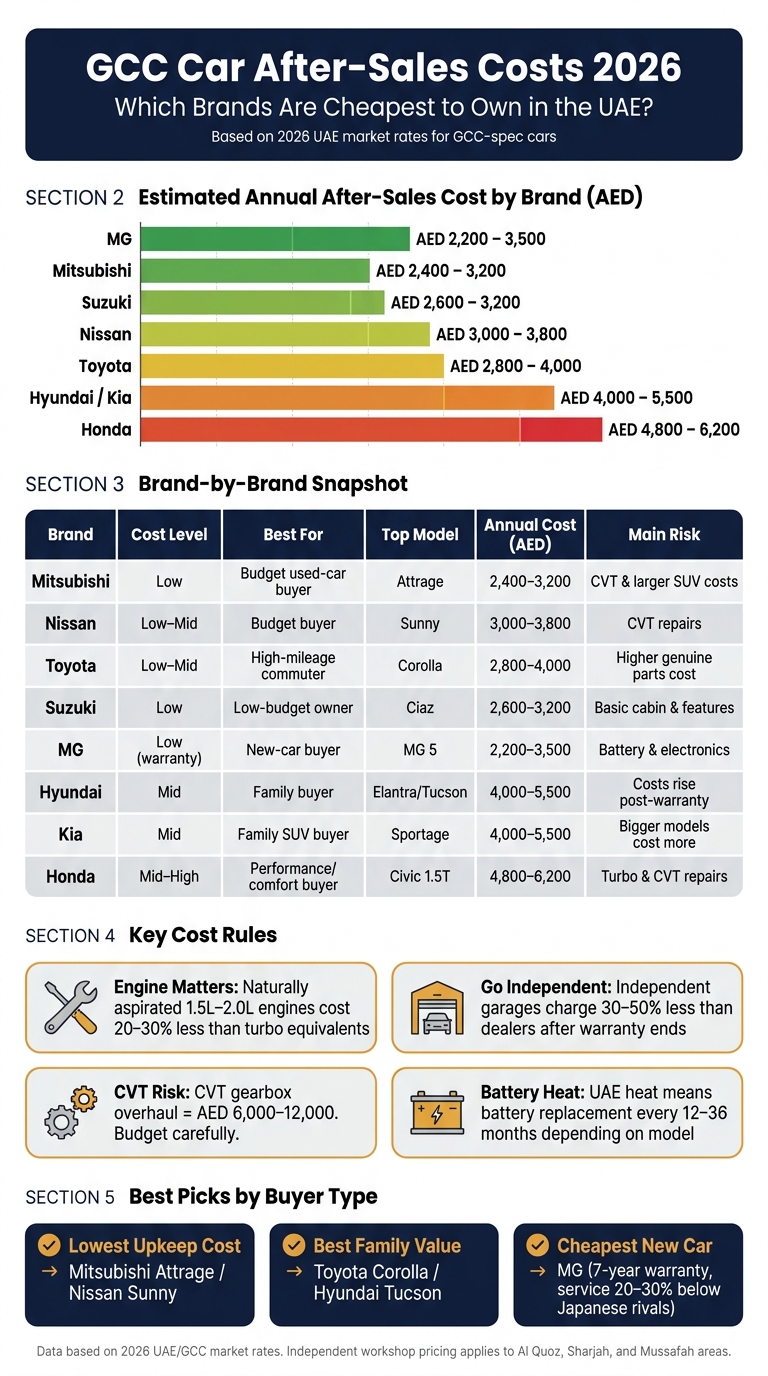
GCC Car After-Sales Costs 2026: Cheapest Brands to Own in the UAE
Quick Comparison
Brand | Cost Level | Best Fit | Main Watch-Out |
|---|---|---|---|
Mitsubishi | Low | Budget used-car buyer | Costs jump on bigger SUVs and CVT work |
Nissan | Low to mid | Budget buyer | CVT repairs can get expensive |
Toyota | Low to mid | High-mileage owner | Genuine parts can cost more than some rivals |
Suzuki | Low | Low-budget owner | Basic cabin and fewer features |
MG | Low during warranty | New-car buyer | Battery and electronics may add cost later |
Hyundai | Mid | Value-focused family buyer | Costs move up after warranty |
Kia | Mid | Family SUV buyer | Bigger models cost more to maintain |
Honda | Mid to high | Buyer who wants comfort/performance | Turbo and CVT costs can climb fast |
Bottom line: if you want the lowest bills, I’d keep the shortlist simple: Mitsubishi Attrage, Nissan Sunny, Toyota Corolla, and Suzuki Ciaz. If you are buying new and want low service pricing in the first years, MG makes a strong case. The rest of the article then breaks down where each brand stays cheap, and where costs start to climb.
1. Toyota
Toyota still sets the pace in the UAE when it comes to low after-sales spend. Parts are easy to find, and most technicians see these cars every day, so fault-finding takes less time and labour charges stay in check. That mix helps keep routine servicing among the lowest in the GCC.
Routine Service Costs
For a GCC-spec Corolla or Yaris, a basic oil and filter change at an independent garage in Al Quoz or Sharjah usually costs AED 120–160. At a Toyota dealer, the same job is usually AED 175–210. The usual service interval is every 10,000 km or 6 months, and the GCC schedule makes sense for UAE heat.
Common Parts and Wear Items
Wear items tell a similar story. Front brake pads tend to wear out early. In one UAE study, 81% of Corollas needed them by the 2-year mark, or about 20,000–32,000 km.
At an independent garage, a front brake pad set costs AED 200–300. At a dealer, expect AED 500–700. Battery replacement usually runs AED 250–500 independently and AED 500–1,000 at a dealer. The cabin filter also matters more than many drivers think, especially with UAE dust. Replacing it every 10,000 km costs about AED 60–90 at an independent garage and AED 60–110 at a dealer.
Wear Item | Independent (AED) | Dealer (AED) |
|---|---|---|
Front Brake Pads | 200 – 300 | 500 – 700 |
Battery Replacement | 250 – 500 | 500 – 1,000 |
Cabin/AC Filter | 60 – 90 | 60 – 110 |
Spark Plugs (Full Set) | 120 – 180 | 250 – 400 |
Major Maintenance and Repair Labour
The 60,000 km major service is where the gap gets more obvious. At a dealer, it costs about AED 1,800–2,400. Independent Toyota specialists usually do it for AED 1,000–1,800. If the AC compressor needs replacement, the bill at an independent garage is usually AED 1,200–1,600. The biggest hit is a Corolla CVT overhaul, which ranges from AED 6,000–9,000 independently and AED 8,000–12,000 at a dealer.
Annual running costs also shift a lot by model. The Corolla lands in the most sensible middle spot at about AED 2,800–3,600 per year for standard mileage of 20,000–25,000 km. The Camry moves up to AED 4,800–6,000, while the Land Cruiser can go past AED 7,000 per year. Toyota genuine parts are a bit pricier than some rivals, but the trade-off is simple: fewer breakdowns and labour costs that don’t swing wildly.
The Corolla stays Toyota’s lowest-cost ownership pick. Camry and Land Cruiser costs climb much faster. Nissan is the next closest match, with a similarly broad service network but a different parts-cost picture.
2. Nissan
Nissan is usually easier on the wallet in the UAE because parts are easy to find, and that helps keep labour and diagnostic bills lower. The Sunny sits at the cheap end of the range, while the Maxima and Patrol are much more expensive to keep on the road.
Routine Service Costs
For a Nissan Sunny, a basic oil and filter change at an independent workshop usually costs AED 140–180. At an authorised Nissan dealer, that same job comes in at AED 165–185. For an Altima or Maxima, expect to pay around AED 200–350 at an independent workshop and AED 350–500 at a dealer.
Common Parts and Wear Items
UAE heat above 50°C puts extra stress on CVT fluid, AC systems, and seals. On the Sunny, engine mounts also tend to wear out more often. In simple terms, the Sunny stays cheap only up to a point. Once CVT work or repairs on V6 and V8 models enter the picture, costs climb fast.
Wear Item | Independent (AED) | Dealer (AED) |
|---|---|---|
Front Brake Pads – Sunny | 240 – 360 | 600 – 1,100 |
CVT Fluid Replacement – Sunny | 350 – 480 | 800 – 1,200 |
AC Recharge/Refill | 200 – 400 | 350 – 600 |
Major Maintenance and Repair Labour
This is why transmission service matters more with Nissan than it does with many other budget brands. If the car uses a CVT, regular transmission-fluid changes are one of the top maintenance jobs to stay on top of in GCC conditions.
A major service at 60,000–100,000 km costs around AED 1,000–2,500 for the Sunny at an independent workshop. For the Altima or Maxima, that climbs to AED 2,500–4,000. A full CVT rebuild costs about AED 6,000–9,000 at a specialist and AED 8,000–12,000 at a dealer. At the top of the scale, a Nissan Patrol V8 engine replacement can hit AED 15,000–25,000.
Annual running costs for a Sunny are roughly AED 3,000–3,800, though surprise CVT issues and engine-mount repairs can push actual ownership costs above the Corolla in day-to-day use.
3. Hyundai
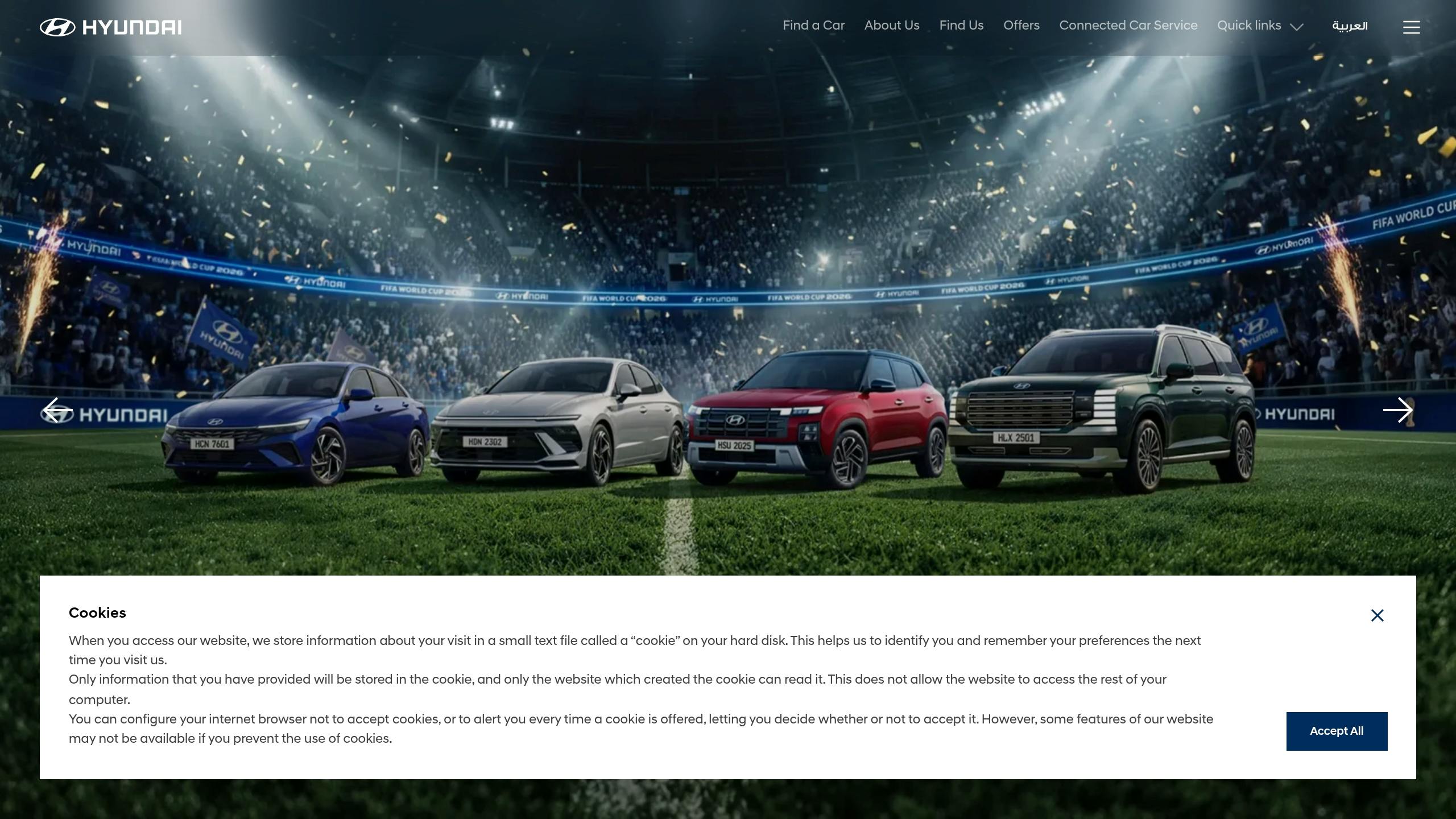
Hyundai sits in the middle of the UAE market when it comes to after-sales costs. It's cheaper than many premium rivals, but it doesn't go as low as Toyota or Suzuki. That makes Hyundai a solid reference point for buyers who want modern features without paying Japanese-brand prices for every part.
Routine Service Costs
For Elantra and Accent, an oil and filter change usually costs AED 200–350 at independent garages and AED 350–500 at dealerships. For Tucson and Santa Fe, routine service tends to land at AED 300–600 and AED 600–900.
Hyundai recommends service every 10,000 km, though UAE driving conditions can be tough on oil. In GCC heat, it's smart to bring oil changes forward to around 7,500 km.
Routine servicing is fairly easy on the wallet. The pressure usually starts later, when wear items stack up or the battery needs changing.
Common Parts and Wear Items
Common wear-item prices stay fairly moderate.
Wear Item | Cost (AED) |
|---|---|
Air Filter | 30–55 |
Cabin Filter | 37–66 |
Sedan brake pads | 300–500 (independent) / 500–700 (dealer) |
Brake rotors (pair) | 295–515 |
Battery Replacement | 250–500 |
AC Service | 250–700 |
In UAE use, Hyundai batteries often need replacement every 2–3 years. If the car is out of warranty, aftermarket parts can cut costs by 40–60% compared with OEM parts.
Major Maintenance and Repair Labour
A 60,000 km major service costs around AED 1,285–2,020 for sedans and AED 1,500–4,000 for SUVs at independent garages. Once a car is out of warranty, bigger repairs can change the picture fast. Gearbox or turbocharger replacement usually falls between AED 3,000–8,000.
Over 24 months, Elantra running costs are estimated at AED 12,800–16,200, which puts it a bit above the Corolla at AED 11,400–13,800. Hyundai's 5-year warranty helps keep early ownership costs in check, and shared platforms help limit labour time and parts complexity.
So the pattern is pretty clear: Hyundai is affordable to maintain, but it stops short of being one of the cheapest once repairs and two-year running costs are added in.
4. Kia
Kia sits close to Hyundai on running costs. The gap shows up when you move through the range: smaller budget models stay fairly low-cost, while bigger models with more kit get expensive much faster.
Routine Service Costs
Oil and filter changes for Kia models fall within the usual Korean-brand price band. Dealer pricing is usually AED 350–500, while independent workshops in places such as Al Quoz in Dubai or Abu Shagara in Sharjah often charge AED 200–350 for the same work.
Here’s how routine service costs usually look by model:
Model | Dealer Service (AED) | Independent (AED) |
|---|---|---|
Kia Cerato | 400–650 | 250–450 |
600–850 | 400–600 | |
Kia Sorento | 650–950 | 450–700 |
Model service ranges are based on 2026 GCC market data for Kia routine maintenance [13].
Kia recommends service every 10,000 km or 6 months, but UAE heat makes 7,500 km a safer oil-change interval. That extra margin can help, especially if the car spends a lot of time in traffic or long summer commutes.
Common Parts and Wear Items
One reason Kia ownership can stay fairly low-cost is parts pricing. Aftermarket parts are often 40%–60% cheaper than OEM, and routine items are easy to find in the UAE.
Wear Item | OEM / Dealer (AED) | Aftermarket / Independent (AED) |
|---|---|---|
Air Filter | 30–55 | 15–30 |
Cabin Filter | 37–66 | 20–40 |
Front Brake Pads | 440–660 | 255–405 |
Battery Replacement | 350–600 | 150–300 |
Wear-item prices reflect 2025–2026 GCC market data for Kia and other Korean vehicles [14][10].
Like other brands running in this climate, batteries usually last 2–3 years before replacement. Brake pads on economy Korean models often last 40,000–60,000 km in normal driving. Of course, heavy stop-start use can shrink that range fast.
Major Maintenance and Repair Labour
The 60,000 km major service for Kia economy models usually lands at AED 1,285–2,020 at independent workshops, which is close to Hyundai’s equivalent pricing. There’s also a simple way to trim labour bills: combine related jobs in one visit. For example, doing spark plug replacement at the same time as valve cover gasket work can lower labour cost by cutting out repeated setup time.
The Picanto’s 1.0L engine helps keep annual running costs around AED 2,400–3,100, with 5-year running costs of AED 12,000–15,500. The Sportage sits higher at AED 3,700–5,800 per year, and newer variants can cost more because they need more specialised diagnostics and added tech work.
Once the warranty ends, moving to an independent specialist can cut annual maintenance costs by up to 50%.
Honda follows next, where routine service stays manageable but parts pricing steps up.
5. Mitsubishi

Compared with Kia, Mitsubishi stays close on routine servicing, but it often comes out ahead when the mechanical setup is simpler. In the GCC, Mitsubishi sits near the lower-cost end for ownership. Models like the Attrage, Lancer, and ASX help keep bills down because the hardware is simple and parts are easy to find in Dubai and Sharjah.
That cost edge shows up most in the budget-friendly models.
Routine Service Costs
Dealer pricing for a minor 10,000 km service on the Attrage usually lands at AED 380–420. Go to an independent workshop in Sharjah, and the same job often drops to AED 220–280.
Service / Item | Estimated Cost (AED) |
|---|---|
Attrage minor service (10,000 km) | 380–420 dealer / 220–280 independent |
Major service (Attrage, 40,000 km) | 1,100–1,400 |
Major service (Outlander / Pajero) | 1,800–3,500 |
Routine service estimates based on 2026 GCC market data [2][5][15][16].
Common Parts and Wear Items
Parts for the Lancer, Outlander, and ASX are widely stocked, so pricing stays competitive. Common wear items such as filters and brake pads are often available within an hour at many workshops. That matters more than people think. When parts are easy to get, you usually spend less time waiting and less money on the job itself.
Wear Item | Estimated Cost (AED) |
|---|---|
Air Filter | 65–90 |
Cabin Filter | 60–110 |
Front Brake Pads (Lancer) | 200–320 |
Front Brake Pads (Outlander) | 350–550 |
Front Brake Pads (Pajero / Montero Sport) | 500–800 |
Spark Plugs (Lancer set) | 180–260 |
Battery Replacement | 250–600 |
Parts pricing compiled from Dubai and Sharjah workshop data, 2026 [5][10][15].
Major Maintenance and Repair Labour
The Attrage keeps things low on major servicing too. Its 40,000 km service costs about AED 1,100–1,400. Step up to the Outlander or Pajero, and the bill climbs fast, with major service packages reaching AED 1,800–3,500.
The gap gets even clearer on bigger-engine models. For V6 versions like the Pajero/Montero Sport, timing belt replacement can cost AED 1,800–2,500 at a dealer or AED 1,200–1,800 at an independent specialist.
CVT-equipped models bring a bigger repair risk. A gearbox overhaul or replacement can cost AED 8,000–12,000 at a dealer, or AED 6,000–9,000 at a specialist. That’s the kind of repair that can change the ownership math in a hurry.
For day-to-day running, though, the Attrage stays cheap. Annual running costs sit around AED 2,600–3,200, and the 5-year total is estimated at AED 13,000–16,000. That puts it among the lowest-cost sedans in this segment.
Honda moves up slightly on parts pricing.
6. Honda

After Mitsubishi’s budget-friendly models, Honda steps into a slightly higher cost bracket. It still sits in the mid-range among Japanese brands in the UAE: reasonable to own, but not the lowest-cost option. The Honda City is the cheaper pick, while the Civic 1.5T costs more to service and repair. You’ll usually notice that gap first with routine servicing, then later with parts pricing and CVT-related work.
Routine Service Costs
Routine servicing for the Civic 1.5T is a bit pricier than what you’d pay for a Corolla. A dealer oil change usually costs AED 280–340, compared with AED 175–210 for a Toyota Corolla. A minor service comes in at AED 600–800 at a dealer, or AED 400–600 at an independent workshop.
The City stays easier on the wallet, mainly because its i-VTEC and CVT setup is simpler.
Common Parts and Wear Items
Wear Item | Independent (AED) | Dealer (AED) |
|---|---|---|
Front Brake Pads | 300–500 | 500–700 |
Battery Replacement | 250–600 | 400–900 |
Spark Plugs (set of 4) | ~360 | - |
CVT Fluid Service | 600–900 | 800–1,200 |
AC Service & Gas Recharge | 200–500 | 300–800 |
Parts and service pricing based on 2026 UAE workshop data [1][2][8][17].
Parts are easy to find, and most independent garages know Honda mechanical systems well. That helps keep labour time under control for many common jobs, without the need for brand-only diagnostic work.
Major Maintenance and Repair Labour
The 60,000 km major service for a Civic costs around AED 1,800–2,400 at a dealer, or AED 1,000–2,500 at an independent workshop. So while day-to-day servicing is still within reach for many owners, the Civic’s turbo engine and CVT can push costs up fast if something goes wrong.
The biggest risk is a CVT gearbox overhaul, which can cost AED 8,000–12,000 at a dealer. That’s the kind of bill that can sting. The Civic 1.5T also needs synthetic oil changes every 10,000 km or 6 months. Skip that schedule, and a failed turbocharger may cost AED 3,500–5,500 to replace.
Annual running costs for the Civic 1.5T are estimated at AED 4,800–6,200, with a 5-year total of AED 24,000–31,000. For buyers watching every dirham, that difference matters. In the GCC market, Honda still makes sense as a mid-cost option, but the City is the safer bet if low running costs are the main goal.
7. Suzuki
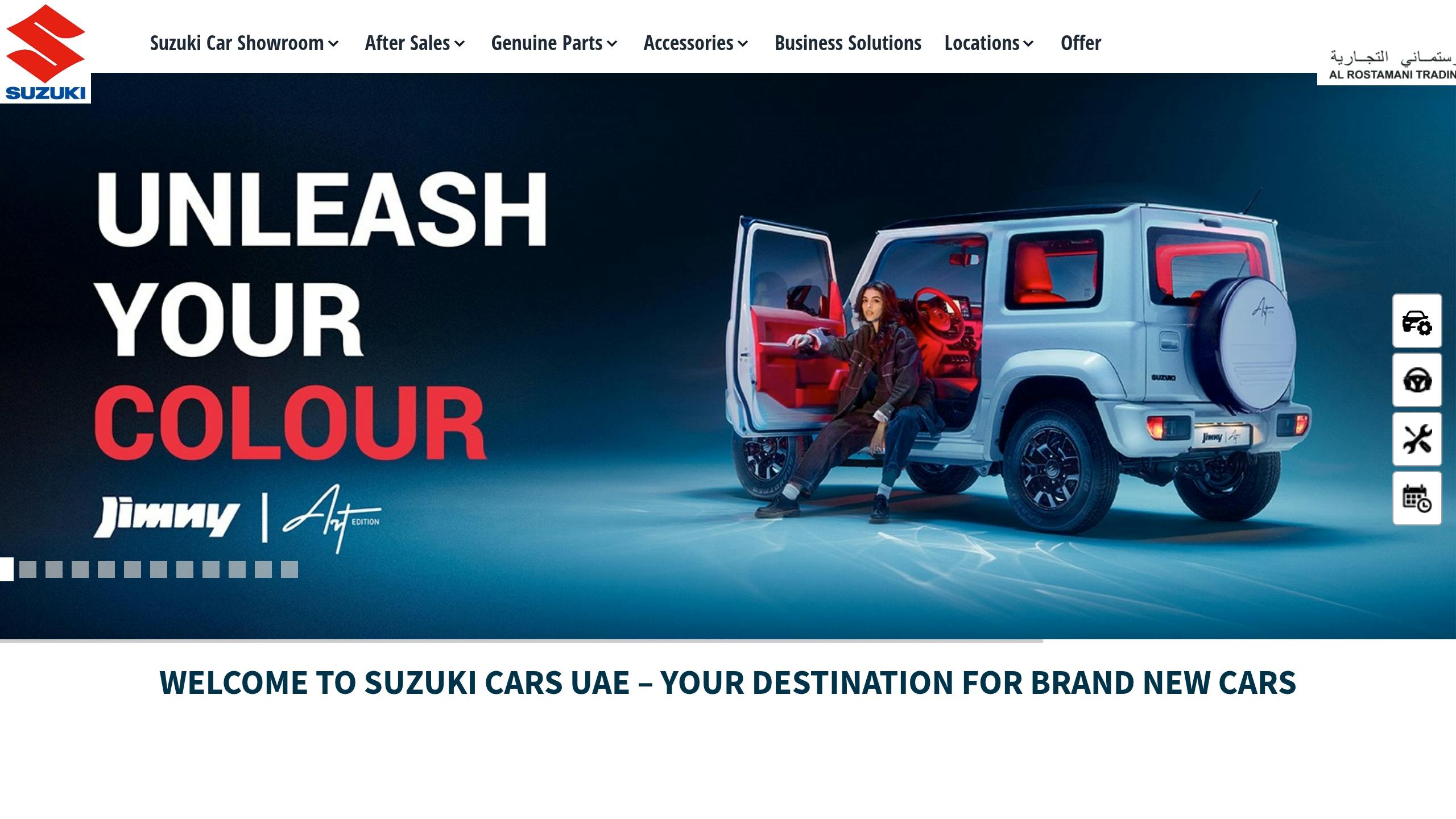
Suzuki sits at the budget end of car ownership in the GCC. The formula is pretty simple: straightforward engines and easy-to-find parts help keep service bills in check. In the UAE, the Suzuki Ciaz stands out as the clearest low-cost option. Its 1.5L K15B VVT engine helps keep repair risk lower and makes long-term running costs easier to predict. That gives Suzuki an edge for buyers who care more about parts and labour costs than badge status.
Routine Service Costs
For day-to-day servicing, Suzuki stays affordable. An oil and filter change usually costs AED 200–350 at an independent workshop and AED 350–500 at a dealer. A minor service package usually falls between AED 400–600 at an independent garage and AED 600–800 at a dealer. Like other Japanese economy brands in the GCC, Suzuki follows a 10,000 km or 6-month service interval.
Common Parts and Wear Items
Wear Item | Independent (AED) | Dealer (AED) |
|---|---|---|
Front Brake Pads | 300–500 | 500–700 |
Battery Replacement | 250–500 | 500+ |
AC Gas Refill | 150–350 | 350+ |
Pricing based on 2026 UAE workshop data [2][9].
Major Maintenance and Repair Labour
Major services at 40,000–60,000 km usually cost AED 1,000–2,500 at an independent workshop and AED 1,800–2,400 at a dealer. For buyers watching every dirham, that keeps Suzuki close to the bottom of the ownership-cost ladder. Once the warranty ends, independent garages often make more financial sense. That low-cost edge tends to stay in place as long as the car’s mechanical setup remains simple.
8. MG

MG is one of the lower-cost brands to service in the GCC. It sits in the budget camp for routine maintenance, though the final spend depends more on the model, engine, and onboard electronics than the badge itself. Parts supply has also got much better. Al Ghandi Auto in Dubai stocks about 92% of common replacement parts, with 48-hour delivery. MG usually offers a 6-year/200,000 km warranty, with 7 years in some GCC markets.
That sounds cheap on paper. In practice, the bill can shift quite a bit based on the engine setup and electrical load.
Routine Service Costs
A basic oil change costs around AED 220, compared with about AED 350 for many competing brands. Minor services at 10,000 km usually land between AED 550 and AED 750, while intermediate services at 20,000 km tend to cost AED 950 to AED 1,200.
Service Interval | Type | Estimated Cost (AED) | Key Items |
|---|---|---|---|
10,000 km | Minor | 550 – 750 | Oil & filter, fluid top-up, health check |
20,000 km | Intermediate | 950 – 1,200 | A/C filter, brake cleaning, tyre rotation |
40,000 km | Major | 1,800 – 2,200 | CVT fluid, spark plugs, brake fluid, air filter |
Source: 2026 UAE service data, MG 5 reference model [16]
The routine pricing is low. But once you get into electronics or turbo-related repairs, costs can climb at a steeper rate.
Common Parts and Wear Items
Front brake pads cost about AED 200 to AED 300 for MG models, versus AED 300 to AED 450 for Japanese equivalents. A replacement headlight assembly is around AED 800, compared with AED 1,200 to AED 1,500 for a similar Japanese SUV.
There is a catch. Turbo engines need high-quality synthetic oil to help avoid oil sludge buildup. Battery replacement may also come sooner - about every 12 to 18 months - because many newer MG models put a heavy load on 12-volt batteries. So while MG starts off cheap, that gap gets smaller with turbo engines, battery changes, and repairs tied to electronics.
Major Maintenance and Repair Labour
For repairs outside warranty, independent workshops in Al Quoz or Sharjah can often source OEM-equivalent parts - such as Bosch sensors or Aisin gearbox components - within 24 hours. Labour for MG is usually cheaper at independent workshops than at dealers. Certified independent garages can also service MGs without voiding the warranty, as long as they use the correct oil and compliant parts.
MG stays close to the budget end of the market, but the model and drivetrain still have a big effect on what you end up paying.
How Rankings Shift by Model, Engine, and Ownership Type
Model, engine, and ownership stage affect running costs more than the badge on the bonnet. Naturally aspirated 1.5L to 2.0L engines - found in models like the Toyota Corolla, Nissan Sunny, and Mitsubishi Attrage - are usually the cheapest to run. Move to a turbocharged or V6 version from the same brand, and service costs often climb by 20–30%. If a turbo needs replacing or a CVT needs major work, the bill can jump fast, with CVT overhauls reaching AED 8,000–12,000.
Vehicle size matters too. Moving from an economy sedan to a mid-size SUV lifts annual maintenance costs by 40–75% on average. So yes, two cars from the same brand can land in very different cost ranges.
Ownership stage changes what you’re paying for. First owners usually deal with scheduled service. Used-car buyers take on more repair risk once the warranty ends. That’s when costs can climb hard, with gearbox overhauls ranging from AED 6,000–32,000 and suspension work on larger SUVs reaching AED 30,000.
For used-car buyers, some models are simply easier on the wallet:
Toyota Corolla
Nissan Sunny
Mitsubishi Attrage
They tend to age well because spare parts are easy to find, many mechanics know how to work on them, and independent workshops often charge less than dealers. That gap in ownership cost is exactly what the next section breaks down by budget.
At the cheapest end, the Mitsubishi Attrage and Nissan Sunny stand out for both first owners and used-car buyers. The Toyota Corolla stays a benchmark because spare parts are widely available. Turbo models usually sit at the expensive end, especially once the warranty is over.
Pros and Cons by Buyer Budget
The cheapest option depends on who's buying and how the car will be used. A brand that looks cheap on paper can stop looking cheap once engine type, warranty cover, and repair risk enter the picture. So instead of sorting brands by badge alone, it makes more sense to group them by buyer need.
Brand | Best For | Core Advantage | Key Drawback | Indicative Annual After-Sales Cost (AED) |
|---|---|---|---|---|
Mitsubishi | Budget used-car shopper | Lowest absolute parts cost; simple drivetrain | Basic cabin; limited features | AED 2,400 – 3,200 |
Nissan | Budget used-car shopper | Cheapest spare parts; widely available | CVT repairs can erase the savings | AED 3,000 – 3,800 |
MG | New-car buyer (running costs) | Service costs 20–30% less than Japanese equivalents; 7-year warranty | Higher electronics and battery-related risk | AED 2,200 – 3,500 |
Hyundai / Kia | Family SUV buyer | 5-year warranty; modern tech and ADAS | Parts and labour sit above Toyota | AED 4,000 – 5,500 |
Toyota | High-mileage commuter | Strong long-term durability; strong resale | Higher genuine parts cost than Nissan | AED 2,800 – 4,000 |
Honda | New-car buyer (performance focus) | More comfort, but higher service costs than simpler rivals | Turbocharged 1.5T models cost more to maintain than simpler alternatives | AED 4,800 – 6,200 |
Suzuki | Budget used-car shopper | Lowest parts and service costs in the budget-used segment | Basic features and cabin refinement | AED 2,600 – 3,200 |
For budget used-car shoppers, the best value usually comes from the Mitsubishi Attrage or Nissan Sunny. Annual maintenance often lands between AED 2,400 and AED 3,800, and that can drop further if you use an independent workshop in Al Quoz or Mussafah after the warranty ends. In many cases, those garages charge 30–50% less than dealer servicing.
If you're buying new and want to keep running costs low, MG stands out. Its service costs are 20–30% lower than Japanese equivalents, and the 7-year warranty takes a lot of the guesswork out of the first years of ownership. That's a big deal if you want cost control without hunting for parts or worrying about surprise repair bills.
For family SUV buyers, the choice between Hyundai / Kia and Toyota is pretty straightforward. The Korean brands give you stronger warranty cover and more in-car tech, while Toyota still has the edge for long-term parts availability and lower genuine-parts pricing.
Those buyer-budget splits shape the final ranking of the cheapest brands overall.
Conclusion
After looking at routine service costs, spare parts pricing, and maintenance data across all eight brands, one thing stands out for 2026: the cheapest car to own depends a lot on the exact model and engine you choose. In plain terms, model choice matters more than the badge on the bonnet.
Among the brands covered here, Mitsubishi Attrage and Nissan Sunny come out on top for low-cost mainstream ownership, while MG is the cheapest new-car option during the warranty period. For new-car buyers trying to keep costs down, MG stands out because routine service is usually 20–30% lower than comparable Japanese models. Toyota still holds its place as the durability benchmark, even if its parts are not always the lowest-priced.
There’s also a rule that shows up again and again across all eight brands: engine choice matters just as much as brand choice. A naturally aspirated engine like Toyota’s 2.0L will usually cost less to maintain than a turbocharged option such as Honda’s 1.5T. Go with a simpler drivetrain, stick to the 10,000 km service interval, and switch to a reputable independent workshop in Al Quoz or Mussafah after the warranty ends. Do that, and you can trim your yearly service bill by 30–50% compared with dealer pricing.
By buyer type, the strongest picks are:
Ownership Goal | Top Pick | Secondary Pick |
|---|---|---|
Lowest upkeep cost | Mitsubishi Attrage | Nissan Sunny |
Best family value | Toyota Corolla | Hyundai Tucson |
Lowest-risk used buy | Toyota Corolla | Toyota Camry |
Simple engines, routine servicing, and trusted independent workshops are still the clearest way to keep GCC ownership costs low.
FAQs
Which car is cheapest to maintain in the UAE?
In the UAE, the Mitsubishi Attrage is the cheapest car to maintain based on estimated yearly upkeep costs.
For moderate driving, you’re looking at about AED 2,600–3,200 per year.
Are dealer services worth the extra cost?
It comes down to your car’s warranty and the kind of work it needs.
If the car is under warranty, servicing it at an authorised dealer usually makes the most sense. It helps protect your cover and keeps your service records in line. Dealers also have manufacturer-trained technicians, brand-specific diagnostic tools, and access to software updates.
For out-of-warranty cars, independent workshops can often offer a similar standard of work for 30% to 50% less than dealer rates. Dealer pricing can run 30% to 100% higher. Even so, many owners still choose dealers for work on critical components.
Which engines cost the least to keep?
In the UAE, simple, efficient engines usually come with the lowest ownership costs. Smaller engines in cars like the Mitsubishi Attrage (1.2L), Kia Picanto (1.0L), and Nissan Sunny (1.5L) are often cheaper to maintain because they’re easier to service and repair.
Compared with high-performance or turbocharged luxury engines, these mass-market powertrains usually have lower routine service costs. Spare parts are also easier to find and often cost less.