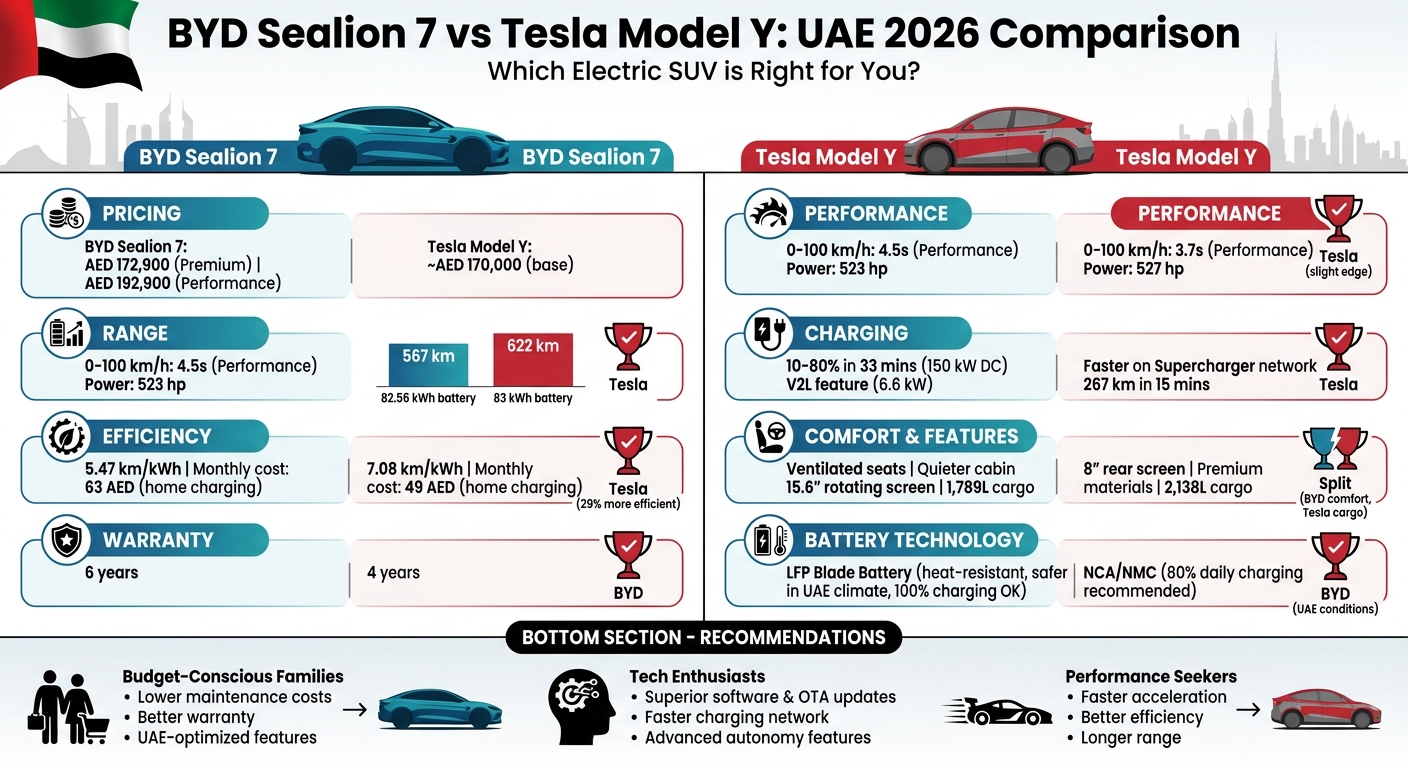
Choosing between the BYD Sealion 7 and Tesla Model Y in the UAE comes down to priorities: price, performance, or tech. BYD's Sealion 7 offers competitive pricing (starting at AED 172,900), excellent build quality, and features tailored for UAE conditions, like its heat-resistant Blade Battery. Tesla's Model Y, starting at slightly lower prices, excels in charging speed, software updates, and brand recognition.
Here’s a quick breakdown:
-
Performance: Tesla Model Y Performance is faster (0–100 km/h in 3.7s vs. Sealion 7's 4.5s).
-
Battery: BYD's Blade Battery is safer in extreme heat, but Tesla's range is higher (622 km vs. 567 km).
-
Comfort: BYD offers ventilated seats and a quieter cabin, while Tesla focuses on tech like an 8-inch rear screen.
-
Charging: Tesla's Supercharger network is faster, but BYD's V2L feature adds utility.
-
Cost: BYD's long-term maintenance costs are lower, though Tesla is more energy-efficient.
Quick Comparison:
|
Feature |
BYD Sealion 7 |
Tesla Model Y |
|---|---|---|
|
Starting Price (AED) |
172,900 |
~170,000 |
|
Max Range (km) |
567 |
622 |
|
0–100 km/h (seconds) |
4.5 (Performance) |
3.7 (Performance) |
|
Battery Type |
LFP Blade Battery |
NCA/NMC |
|
Charging (10–80%) |
33 mins (150 kW) |
Faster on Supercharger |
|
Warranty |
6 years |
4 years |
|
Cargo Space (litres) |
1,789 |
2,138 |
For families prioritising comfort and affordability, the BYD Sealion 7 is a strong choice. Tech enthusiasts or those needing faster charging may lean towards Tesla. Both are great EVs, but the decision depends on your specific needs.
BYD Sealion 7 vs Tesla Model Y UAE Comparison 2026
Price Comparison and Overall Value
Trim Levels and Pricing in AED
The BYD Sealion 7 has entered the UAE market with a simple two-trim lineup. The Premium variant is priced at AED 172,900, while the Performance model comes in at AED 192,900.
Tesla’s Model Y, on the other hand, offers competitive pricing for its base models in the region. When it comes to performance, the Sealion 7 delivers 310 hp in the Premium trim and an impressive 524 hp in the Performance trim. For Tesla enthusiasts, the Model Y Performance variant accelerates from 0–100 km/h in about 3.5 seconds.
Battery technology is another area where the two brands differ. BYD incorporates its Blade Battery (LFP), known for its safety and durability, while Tesla uses nickel-based NCA/NMC batteries.
Now, let’s take a closer look at ownership considerations in the UAE.
Ownership Costs in the UAE
When it comes to owning these vehicles long-term, there are notable distinctions. Tesla’s cutting-edge technology often comes with concerns about build quality and customer service. BYD, however, is recognised for its consistent build quality and reliability, which could translate to lower maintenance expenses over time.
In terms of warranty and service, BYD seems to have an edge. Its rapid growth in the UAE has led to an expanding service network, making maintenance more accessible. That said, it’s always a good idea to confirm warranty details and maintenance packages directly with authorised dealers to ensure clarity.
Performance and Driving Dynamics
Power Output and Acceleration
The BYD Sealion 7 Performance packs 523 hp and 690 Nm of torque, hitting 100 km/h in 4.5 seconds. On the other hand, the Tesla Model Y Performance edges slightly ahead with 527 hp and 660 Nm, reaching 100 km/h in just 3.7 seconds. For those considering mid-tier options, the Sealion 7 Premium delivers 308 hp and 380 Nm, accelerating from 0 to 100 km/h in 6.7 seconds. Meanwhile, the Model Y Long Range offers a more robust 434 hp and 493 Nm, achieving the same sprint in 5.0 seconds.
|
Model |
Drive Type |
Power (hp) |
Torque (Nm) |
0–100 km/h |
|---|---|---|---|---|
|
BYD Sealion 7 Performance |
AWD |
523 |
690 |
4.5 s |
|
BYD Sealion 7 Premium |
RWD |
308 |
380 |
6.7 s |
|
Tesla Model Y Performance |
AWD |
527 |
660 |
3.7 s |
|
Tesla Model Y Long Range |
AWD |
434 |
493 |
5.0 s |
Both flagship models reach a top speed of 215 km/h, which is more than adequate for UAE highways. These figures provide a solid foundation for comparing their real-world performance in local conditions.
Performance in UAE Driving Conditions
The UAE's scorching summer heat presents a tough test for electric vehicles. The BYD Sealion 7, equipped with an LFP Blade Battery, is better suited to handle extreme temperatures compared to the Tesla Model Y's NMC-based battery. This can be a key consideration during the hottest months when temperatures often soar past 45°C.
For long highway drives, the Sealion 7 offers a quieter cabin experience thanks to its soundproofing and active noise cancellation. In contrast, some reviews suggest the Model Y's ride can feel a bit firm and jittery, especially when equipped with larger wheels. The Sealion 7 also boasts a more aerodynamic design, with a drag coefficient of 0.219 versus the Model Y's 0.23, giving it an edge in efficiency at higher speeds.
Urban driving in the UAE also favours the Sealion 7, thanks to its tight 5.85-metre turning radius and ventilated front seats, which enhance comfort in the region's hot climate. Meanwhile, Tesla addresses interior cooling with features like Cabin Overheat Protection and Pet Mode, ensuring the cabin stays manageable even when parked under the sun.
Battery Range and Charging Options
Advertised vs Actual Range
The Tesla Model Y claims a range of 622 km, while the BYD Sealion 7 advertises 567 km. However, in the UAE's real-world driving conditions, these figures are often lower.
The Sealion 7 is equipped with an 82.56 kWh battery, compared to Tesla's 62.5 kWh and 83 kWh options. These differences in battery capacity directly impact efficiency and long-term costs for UAE drivers. Tesla provides more transparent data on actual charging times and range performance, which is crucial for daily commutes and longer trips. On the WLTP cycle, the Sealion 7 Performance variant achieves 181 Wh/km efficiency.
|
Battery & Range Metric |
Tesla Model Y |
BYD Sealion 7 |
|---|---|---|
|
Battery Capacity (kWh) |
62.5 / 83 |
82.56 |
|
Claimed Range (km) |
500–622 |
567 |
|
Efficiency |
Varies by variant |
181 Wh/km (WLTP) |
One standout feature of the Sealion 7 is its LFP Blade Battery, which allows regular 100% charging with minimal degradation. This contrasts with Tesla's recommendation to limit daily charging to 80% to preserve battery health.
Next, let’s take a closer look at how these models compare in terms of charging speed and station compatibility.
Charging Speed and Station Availability
The BYD Sealion 7 supports 150 kW DC fast charging, enabling a 10–80% charge in about 33 minutes. However, typical charging speeds average around 112 kW, despite the 150 kW peak. Tesla’s Supercharger network allows the Model Y to add up to 267 km of range in just 15 minutes, offering a faster charging experience overall.
Both vehicles use the CCS2 charging standard, making them compatible with UAE charging networks like DEWA Green Chargers. Additionally, the Sealion 7 can access Tesla’s Superchargers, which have been opened to non-Tesla vehicles. For home charging, the Sealion 7 requires approximately 7.9 to 8.3 hours to fully charge using an 11 kW AC charger.
Interestingly, the Sealion 7 offers a Vehicle-to-Load (V2L) function, providing up to 6.6 kW for powering external devices - a handy feature for camping trips or emergencies. Tesla Model Y, on the other hand, does not support bidirectional charging.
|
Charger Type |
Power Output (Avg) |
10–80% Time |
Charging Speed (km/h) |
|---|---|---|---|
|
Home AC (7 kW) |
7 kW |
– |
39 km/h |
|
Public AC (22 kW) |
11 kW (Max) |
– |
61 km/h |
|
DC Fast (150 kW) |
112 kW |
33 mins |
619 km/h |
It’s worth noting that even when connected to 350 kW ultra-fast chargers, the Sealion 7 is capped at its internal limit of 150 kW. For long-distance travel across the GCC, Tesla’s extensive charging network and more reliable range estimates make it a more convenient choice.
Interior Space and Safety Systems
Cabin Space and Comfort Features
The BYD Sealion 7 stretches 4,830 mm in length, making it slightly longer than the Tesla Model Y. This added length translates into a more spacious rear cabin, complemented by wide-opening doors - ideal for UAE families who often need to transport children or elderly passengers, especially in the region's intense heat.
"Stepping inside, the cabin feels premium, with high-quality materials and a streamlined design." – The Independent
The Sealion 7 excels in rear passenger comfort, offering adjustable and heated rear seats, which are particularly useful for longer trips. However, Tesla Model Y differentiates itself with an 8-inch rear entertainment screen - a feature absent in the Sealion 7. In terms of cargo space, the Model Y leads with a total volume of 2,138 litres (with seats folded), compared to the Sealion 7's 1,789 litres.
What sets the BYD apart are its climate-specific features, tailored for UAE conditions. It includes ventilated front seats and a cooled 15-watt wireless smartphone charger, designed to prevent overheating of devices. The 15.6-inch rotating touchscreen, equipped with three-finger swipe shortcuts for quick temperature adjustments, ensures the cabin cools down rapidly. Meanwhile, Tesla's 2025 Model Y update introduces more comfortable seats and upgraded materials, but it still falls short of the BYD's luxurious feel.
|
Feature |
BYD Sealion 7 |
Tesla Model Y |
|---|---|---|
|
Standard Boot Space |
520 litres |
~520 litres (to window-line) |
|
Max Cargo Volume |
1,789 litres |
2,138 litres |
|
Front Seats |
Heated & Ventilated |
Heated |
|
Rear Entertainment Screen |
No |
Yes (8-inch) |
|
Smartphone Integration |
Apple CarPlay & Android Auto |
Native Tesla software only |
These thoughtful interior features make the Sealion 7 a strong contender for comfort, while the Tesla Model Y stands out with its tech-focused touches.
Safety Equipment and Driver Aids
The BYD Sealion 7 complements its cabin comfort with a robust safety suite. Both the Sealion 7 and Tesla Model Y adhere to international safety standards, but their approaches differ. The Sealion 7 incorporates BYD's Blade Battery into its structure, which significantly minimises pedal intrusion during frontal impacts.
Inside, the Sealion 7 offers 20 storage compartments, a 12-speaker Dynaudio sound system, and a 10-inch digital instrument cluster. Double-glazed windows and extensive soundproofing ensure a quiet cabin, even at high speeds on UAE highways. While the Tesla Model Y scored 9/10 for its improved ride quality and quiet interior, the Sealion 7 earned a 6/10, with some reviewers pointing out its less refined ride on sharp bends and bumpy urban roads.
Another key advantage for UAE buyers is the BYD's 6-year vehicle warranty, which outshines Tesla's 4-year coverage. This extended warranty offers extra reassurance for those driving in the region's challenging desert conditions.
Energy Use and Operating Costs
Power Consumption and Running Costs
The Tesla Model Y stands out for its efficiency, delivering approximately 7.08 km/kWh, compared to the BYD Sealion 7's 5.47 km/kWh. This represents a 29% difference in efficiency, which directly impacts monthly charging expenses.
For a typical UAE driver covering 1,500 km each month, the Tesla Model Y requires around 212 kWh of electricity, while the BYD Sealion 7 needs about 274 kWh. Using DEWA's residential electricity rate of 23 fils/kWh, this translates to 48.76 AED per month for the Tesla and 63.02 AED for the BYD when charged at home. If using public charging stations, where rates are 38 fils/kWh, the costs increase to 80.56 AED for the Tesla and 104.12 AED for the BYD.
"With a giant 91.3kWh battery on board, we'd expect better efficiency from the BYD, especially with the company claiming to be a tech leader with its blade batteries." – Steve Fowler, EV Editor, The Independent
On an annual basis, home charging costs add up to 585 AED for Tesla owners and 756 AED for BYD drivers, giving Tesla users a saving of roughly 171 AED. While the Tesla Model Y is more cost-effective in terms of energy use, the BYD's Blade Battery could potentially reduce long-term replacement expenses. This efficiency gap not only affects costs but also plays a role in the environmental footprint of both vehicles.
Environmental Impact
The Tesla Model Y's energy efficiency also translates into a smaller environmental impact, as it uses less grid power per kilometre. With the UAE increasingly integrating clean energy sources - such as the Barakah Nuclear Energy Plant and the Mohammed bin Rashid Al Maktoum Solar Park - into its energy mix, Tesla's lower consumption results in fewer carbon emissions per trip.
On the other hand, the BYD Sealion 7's Blade Battery technology offers strong thermal stability, a critical feature for handling the UAE's high summer temperatures, and durability that supports second-life applications like energy storage systems. The lithium iron phosphate chemistry of the Blade Battery performs well in extreme heat but adds extra weight, which impacts overall efficiency. Meanwhile, Tesla's advanced software enhances battery preconditioning and optimises navigation to charging stations, reducing energy loss during long drives.
Infotainment and Software Systems
Screen Size and Connectivity
In the UAE's EV market, digital systems have become just as important as cabin comfort. Take the Tesla Model Y, for example - it features a 15.4-inch central touchscreen that handles everything, from navigation to climate settings, all without a separate instrument cluster. On the other hand, the BYD Sealion 7 steps it up with a 15.6-inch rotating touchscreen, a 10.25-inch digital instrument cluster, and even a head-up display.
Tesla's interface is known for its speed, with touch commands responding in under 0.5 seconds. BYD's DiLink system is slightly slower, though recent updates have made noticeable improvements. Both systems are tailored for the UAE market, offering Arabic language support with right-to-left text alignment and localised navigation features. Tesla integrates Dubai Roads and Transport Authority (RTA) traffic data through its premium connectivity service, which costs around 35 AED per month. BYD, meanwhile, offers free navigation that highlights popular spots like malls and service stations. BYD also includes thoughtful features like prayer time alerts and Ramadan-specific functions, made possible through Etisalat and du eSIM integration.
These infotainment systems provide the foundation for the advanced driver assistance features explored next.
Driver Assistance and Software Updates
The advanced displays in these EVs are matched by equally sophisticated driver assistance systems and software update capabilities. Tesla's Full Self-Driving (FSD) suite includes features such as Autopilot, Navigate on Autopilot, and city-street autonomy. It uses a combination of 360-degree cameras and radar, performing effectively on UAE highways. However, it can face challenges in low-visibility conditions, like sandstorms. BYD's DiPilot system, on the other hand, offers Level 2+ driver assistance, enhanced with LiDAR for better performance in dusty environments. It also features adaptive cruise control, calibrated for speeds of 120–160 km/h on Sheikh Zayed Road, and an automatic parking function designed to navigate the tight spaces of Dubai mall car parks.
Both Tesla and BYD support over-the-air (OTA) updates to keep their systems up-to-date. Tesla rolls out updates every two weeks to a month, with major updates released quarterly. BYD also offers quarterly OTA updates, with significant changes requiring dealer activation. These updates improve voice command functionality and optimise the UAE's charging network. This continuous stream of updates ensures that both vehicles stay relevant, addressing concerns about keeping up with evolving technology.
Final Recommendations
Main Comparison Points
When comparing these EVs, it comes down to value versus brand appeal. BYD stands out with its competitive pricing, while Tesla operates in a higher price bracket. Interestingly, BYD surpassed Tesla as the top global EV seller in 2025, delivering over 2.25 million battery-powered vehicles. Despite this milestone, Tesla retains strong appeal among many UAE buyers, thanks to its well-established brand reputation.
Looking at operating costs, BYD has the edge. Its authorised dealer network across the UAE provides families with reliable service support, ensuring a smoother ownership experience over the long term. While Tesla focuses heavily on self-driving technology and frequent software updates, BYD prioritises durable hardware at prices that are easier on the wallet.
These distinctions help guide tailored advice for different types of buyers.
Buyer-Specific Recommendations
For families mindful of their budget, the BYD Sealion 7 is an appealing choice. With a broader lineup in the UAE that includes both electric and plug-in hybrid options, BYD offers more variety compared to Tesla’s exclusively BEV (Battery Electric Vehicle) range.
Buyers who value performance over cutting-edge tech might lean toward the Sealion 7 Performance trim. Offering 524 hp with AWD at AED 192,900, it delivers an impressive power-to-price ratio. On the other hand, those drawn to advanced autonomous features may find Tesla’s higher price tag justifiable.
For tech enthusiasts, the decision hinges on priorities: Tesla excels in autonomy and frequent software updates, while BYD focuses on solid, practical hardware tailored to UAE driving conditions. The choice ultimately depends on whether you prioritise advanced software capabilities or reliable, performance-driven hardware.
NEW TESLA MODEL Y REAL RANGE VS BYD SEALION 7
FAQs
Which EV handles UAE summer heat better long-term?
The Tesla Model Y stands out as a dependable option for enduring the UAE's intense summer heat. Its advanced thermal management system ensures optimal performance even in extreme temperatures. Tested and proven for durability, it’s a vehicle designed to handle the region’s demanding climate conditions with ease.
Can the BYD use Tesla Superchargers in the UAE?
There’s no official confirmation about whether the BYD Sealion 7 works with Tesla Superchargers in the UAE. The key factor is whether the car’s charging system supports Tesla’s protocol, which is primarily tailored for Tesla models. Unless BYD explicitly states compatibility, it’s unlikely the Sealion 7 can use Tesla Superchargers. For precise information, it’s best to check directly with BYD or local charging providers.
Which is cheaper to own in Dubai for 5 years?
The Tesla Model Y tends to have reduced ownership costs over a 5-year period in Dubai. Although its upfront price is on the higher side, the savings on maintenance and charging costs over time make it a more economical choice in the long run.