The short answer: Flex Drive makes the first 24 months cheaper each month, but it does not cut what you pay over 60 months. If I were checking this plan, I’d focus on three numbers straight away: the payment for months 1–24, the payment from month 25, and the total amount payable over 5 years.
Here’s the deal in plain English:
You finance the car over 60 months
You pay less per month for the first 24 months
You pay more per month for the next 36 months
The car is in your name from day one
The rate stays fixed across the plan
The pressure doesn’t go away - it moves into years 3 to 5
That means this plan is mostly about cash flow timing, not savings. A Toyota may be easier to carry later because the starting price is lower, while a Lexus can look easier at the start but hit harder after month 24 because the car itself costs more. And your monthly outgo won’t stop at the instalment alone - insurance in the UAE can run at around AED 3,000 to AED 8,000 a year, before registration and other costs.
If I were deciding, I’d ask for the full 60-month schedule and read the Key Fact Statement before signing.
Quick Comparison
Point | Toyota Flex Drive | Lexus Flex Drive |
|---|---|---|
Finance term | 60 months | 60 months |
First stage | Lower payments for 24 months | Lower payments for 24 months |
Second stage | Higher payments for 36 months | Higher payments for 36 months |
Entry price example | RAV4 Hybrid from AED 114,900 | IS350 from about AED 199,000 |
Later payment pressure | Lower than Lexus in many cases | Higher in many cases |
Running-cost angle | Lower fuel spend can help | Insurance and fuel tend to cost more |
Main thing to check | Month-25 jump and 5-year total | Month-25 jump and 5-year total |
Bottom line: if the higher payment from month 25 would strain your budget on your current salary, the lower starting instalment may not be worth it.
How Flex Drive Works Compared to a Standard Five-Year Car Loan
For Toyota and Lexus buyers, Flex Drive keeps the loan term at 60 months, just like a standard five-year car loan. But the payment pattern is different.
With a standard 60-month equal-instalment loan, you pay the same amount every month. Flex Drive takes another route: it lowers your instalments at the start, then pushes more of the repayment burden into the final 36 months. The key point isn't just that the first payments are lower. It's how that shift affects the full repayment burden across all five years.
The Two-Year Reduced-Payment Structure in Plain Terms
For the first 24 months, your monthly instalment is lower than it would be on a standard equal-instalment loan for the same vehicle. From month 25 onwards, the instalment goes up and stays at that higher level for the remaining 36 months.
So yes, the opening period feels lighter on your monthly budget. But that lighter start doesn't change the fact that the car is still financed over the same five-year term.
The vehicle is also registered in your name from day one, subject to credit approval and affordability checks.
Where the Cost Trade-Off Shows Up
This is where things start to matter a bit more.
Because less principal is paid down during the first 24 months, more of the repayment burden is carried into years three to five. That's why the full 60-month schedule matters more than the opening instalment on its own.
In plain terms: the lower start can help with early cash flow, but it also means you need to be ready for the step-up later.
The repayment pattern is easiest to see in a side-by-side comparison:
Feature | Al-Futtaim Flex Drive | Standard UAE Car Loan |
|---|---|---|
Total Term | 60 months (5 years) | 60 months (5 years) |
Payment Profile | Lower months 1–24, higher months 25–60 | Equal instalments, months 1–60 |
Principal Repayment Pace | Slower in years 1–2; heavier in years 3–5 | Steady throughout the term |
Budgeting Impact | Easier at the start; requires planning for the step-up | Predictable from day one |
That shift in payments won't feel the same across every Toyota and Lexus model, which is why the next section compares both ranges side by side.
Toyota Flex Drive UAE versus Lexus Flex Drive UAE
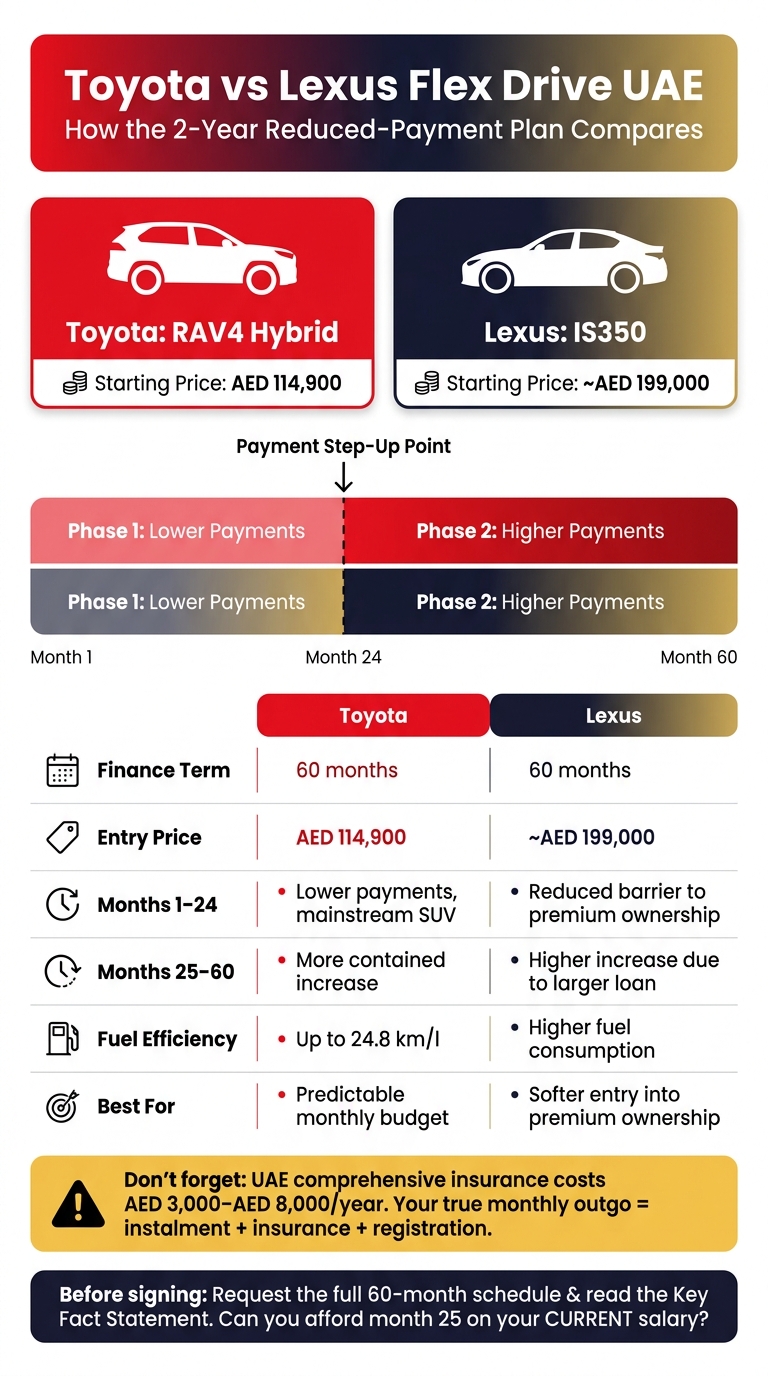
Toyota vs Lexus Flex Drive UAE: 5-Year Payment Plan Breakdown
Both brands use the same two-stage payment setup. But in practice, the hit to your budget changes a lot from one model to another.
So this choice isn't mainly about the finance format. It's about vehicle price, running costs, and whether your budget can handle the payment jump from month 25 onward.
Toyota Flex Drive: Lower Entry Payments on Mainstream Models
Toyota starts at a more accessible price point on its core models. The RAV4 Hybrid starts at AED 114,900, while the Fortuner starts at AED 128,900.
That lower base price matters. On a model like the RAV4 Hybrid, the first two years of payments are easier to carry, which can take some pressure off your monthly spend early on. Fuel use helps too. The 2026 RAV4 Hybrid delivers up to 24.8 km/l, which can keep day-to-day costs lower during those first 24 months.
Lexus Flex Drive: A Lower-Cost Entry into Premium Ownership
Lexus gives buyers a way into a premium badge with lighter payments at the start. The IS350 starts at about AED 199,000, and its 3.5L V6 makes 312 hp.
That said, the higher starting price changes the picture. Yes, the early instalments can make the car feel more reachable. But once the payment steps up in month 25, the bigger price tag tends to show. And the total cost of keeping the car on the road remains higher.
Toyota Flex Drive vs Lexus Flex Drive
Set side by side, the gap comes down to three things: entry price, running costs, and how much the month-25 increase affects your budget.
Feature | Toyota Flex Drive | Lexus Flex Drive |
|---|---|---|
Representative Model | RAV4 Hybrid | IS350 |
Starting Price | AED 114,900 | ~AED 199,000 |
First 24 Months | Lower entry point on a mainstream SUV | Reduced barrier to premium ownership |
Later-Payment Pressure | More contained, because the vehicle price is lower | Higher, because the vehicle price is higher |
Key Ownership Cost Driver | Fuel efficiency up to 24.8 km/l | Premium insurance and higher fuel consumption |
Best Suited To | Buyers prioritising predictable monthly outlay | Buyers wanting a softer entry into premium ownership |
Before signing, compare the month-25 increase, the total five-year cost, and the running costs tied to each model.
What UAE Buyers Should Check Before Signing
The Numbers to Look at Beyond the First Monthly Payment
Once you understand how Flex Drive shifts the payment pattern, the next step is simple: check what the contract will actually cost.
The big number on the ad matters less than the total amount payable over 60 months and what happens in month 25. Ask for the full 60-month repayment schedule, then compare months 1–24 with months 25–60. That jump in month 25 is the number you need to focus on.
In the UAE, comprehensive insurance can cost between AED 3,000 and AED 8,000 per year. Then add registration and other ownership costs. So the amount leaving your account each month will be higher than the instalment on its own makes it seem.
Al-Futtaim Finance provides a Key Fact Statement during the agreement process. Read the whole thing. It lays out the total financing cost, your repayment duties, and what can happen if you settle early or trade in the car before the 60-month term ends. If your income doesn't go up over the next three years, the month-25 increase needs to work on your current salary, not the one you hope to have later.
How to Use YallaMotor to Research the Car Before Choosing the Finance
Before you sign, line up the finance plan with the car itself. The vehicle price shapes the size of the payment jump later on. Use YallaMotor to compare Toyota and Lexus models, specs, prices, and reviews before choosing the finance.
Conclusion: Flex Drive Eases the First Two Years, But the Full Five-Year Cost Is What Counts
After looking at Toyota and Lexus Flex Drive side by side, the main issue is simple: can you still afford the higher payments from month 25?
Flex Drive makes the first two years lighter on your monthly budget. That can help at the start. But from the third year onward, the instalments go up and stay higher for the final three years. So the part that matters most isn’t just the early relief. It’s whether the full 60-month cost works for you without putting pressure on your finances.
Before you sign anything, go through the full repayment schedule, the Key Fact Statement, and the affordability checks carefully.
FAQs
How big is the month-25 payment jump?
There’s no set amount for the payment increase in month 25. The change depends on the vehicle you choose and the finance agreement attached to it.
With Flex Drive, you pay less for the first 24 months. After that, your monthly payments go up for the final 36 months of the five-year term.
For the exact figures, check your repayment schedule with Al-Futtaim Finance.
Can I settle Flex Drive early?
Possibly. But based on the details available, there’s no clear confirmation that early settlement is allowed, or what fees, limits, or terms might come with it.
Before you sign, check this directly with Al-Futtaim Finance. It’s also smart to read the Key Fact Statement and the financing agreement closely for the exact terms.
What income should I budget Flex Drive against?
Budget Flex Drive against your income across the full five-year term, not only the first two years with lower monthly payments.
Make sure your income can comfortably cover the higher instalments later on, along with the full repayment schedule, the total financing cost, and your other financial commitments. Al-Futtaim Finance will also carry out credit and affordability checks.