If I had to simplify it to one line: I’d only pay for the cover that protects me from a bill I can’t handle myself.
In the UAE, car insurance can cost anywhere from about AED 450 for third-party cover to AED 6,500 for a policy with dealer repair. But the main question is not the premium. It’s this: if I crash, flood the car, or face a write-off, who pays for my car?
Here’s the short version:
Third-party liability is the legal minimum. It pays for damage I cause to others, not my own car.
Comprehensive cover adds cover for my own car, such as accident, theft, fire, and in many cases flood or storm damage.
Agency repair is an add-on inside a comprehensive policy. It means my car is repaired at the dealer with genuine parts, which can help with warranty and resale.
A few points stand out in 2026:
Driving uninsured in the UAE can lead to an AED 500 fine and possible impoundment.
If my car is financed, I’ll usually need comprehensive cover.
If my car is new or still under warranty, agency repair can be worth the extra AED 250–600 per year.
If I drive an older car and can afford to replace it myself, third-party may be enough.
If I plan to drive to Oman, I need to check for an Oman extension.
If I’m worried about flash floods, I need to read the wording, because flood cover is not always automatic.
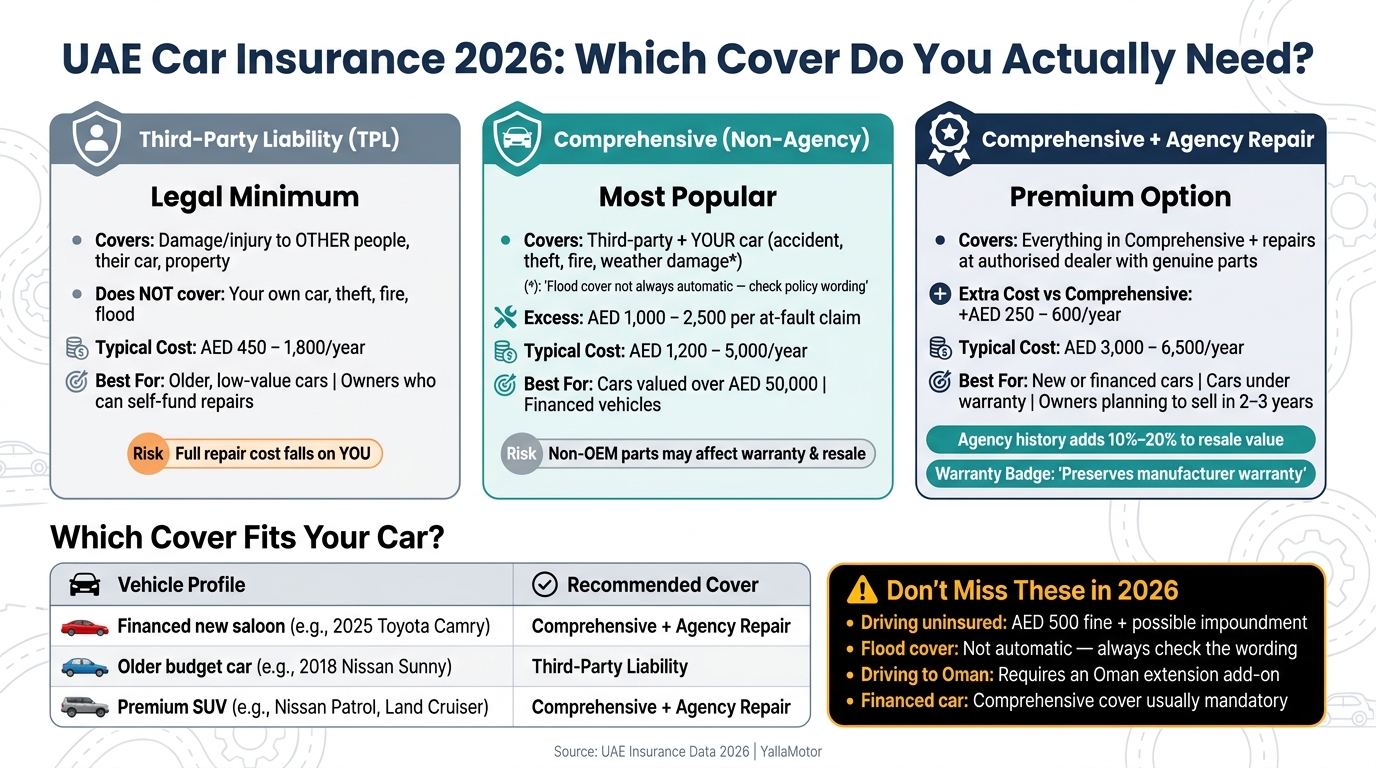
UAE Car Insurance 2026: Third-Party vs Comprehensive vs Agency Repair
Quick Comparison
Option | What it covers | Best for | Main downside | Typical yearly cost |
|---|---|---|---|---|
Third-Party Liability | Damage I cause to other people, their car, or property | Older, lower-value cars | My own car is not covered | AED 450–1,800 |
Comprehensive | Third-party + my own car for accident, theft, fire, and often weather damage | Most drivers with cars they can’t afford to lose | I still pay an excess; repair quality may vary | AED 1,200–5,000 |
Comprehensive + Agency Repair | Same as above, but repair is done at the dealer with genuine parts | New, financed, or higher-value cars | Higher premium | AED 3,000–6,500 |
My takeaway is simple: third-party is about legal cover, comprehensive is about protecting my own car, and agency repair is about where and how the car gets fixed. The rest comes down to the car’s age, value, finance status, warranty, and how much repair cost I could pay from my own pocket.
That’s the lens I’d use to read the full guide.
UAE car insurance basics: legal minimums, policy terms, and what each cover includes
Start with what each policy covers, not the premium. Once the labels are clear, the real question is simple: how much repair risk are you willing to carry yourself?
Third-party liability: the legal minimum
Third-party liability (TPL) is the minimum cover required by UAE law to register your vehicle and drive legally. It covers injury or death of third parties, plus damage to other vehicles or property when you're at fault. That’s it.
Your own car is not covered. Theft, fire, and weather damage are also excluded. In plain terms, TPL protects other people from your mistake, but it does not protect your car from the bill that follows.
TPL premiums usually fall between AED 450 and AED 1,000 per year.
Comprehensive cover: your car plus third-party liability
Comprehensive cover includes third-party liability and adds protection for your own vehicle. That usually means cover for collisions, theft, fire, and floods, storms, and other weather damage.
There’s one detail you should check line by line: flood damage is not always automatic. Some insurers treat it as an add-on, so read the policy wording before you sign anything.
If you plan to drive into Oman, there’s another extra to look for. UAE drivers crossing the border need an Oman extension add-on to stay covered while driving there.
Common add-ons include:
Roadside assistance
Courtesy car
Personal accident cover for passengers
Off-road cover for 4x4s
Premiums usually range from AED 1,200 to AED 6,500 per year.
Agency repair: a repair option, not a separate policy type
Agency repair sits inside a comprehensive policy. It is not a separate cover type.
What changes is where the car goes after a claim. With agency repair, your car is sent to an authorised dealer and repaired using genuine parts. That helps preserve the manufacturer's warranty and can help with resale value. Without it, the insurer usually sends the vehicle to an approved garage, which may use aftermarket parts. In some cases, that can affect warranty.
That small label on the quote can make a big difference later. Two policies may both say "comprehensive", but the repair path can be very different.
Feature | TPL | Comprehensive (Non-Agency) | Comprehensive (Agency Repair) |
|---|---|---|---|
Own vehicle damage | Not covered | Covered | Covered |
Repair location | N/A | Insurer-approved garage | Authorised dealer |
Parts used | N/A | Aftermarket parts | Genuine parts |
Warranty impact | N/A | Can affect warranty | Preserves warranty |
Typical annual cost | AED 450–1,000 | AED 1,200–4,500 | AED 3,000–6,500 |
Agency repair usually adds AED 250 to AED 600 to the annual premium. With the basics clear, the next step is picking the level of cover that fits your car, your budget, and the repair bill you’d rather not pay yourself.
Third-party vs comprehensive vs agency repair: cost, protection, and trade-offs
What you typically pay in the UAE
Now that the cover types are clear, the next thing most people want to know is simple: what do you get for the extra money?
In the UAE, the pricing ladder is pretty straightforward. Third-Party Liability (TPL) is the lowest-cost option. Comprehensive cover sits in the middle. Agency repair costs the most.
That gap in price usually comes down to three things:
Your car’s value
Your driver profile
The repair option in the policy
So, if you drive a higher-value car, expect to pay more. The same usually applies if you’re newly licensed. On the other hand, a clean claims record can bring the cost down.
What each option usually excludes or limits
Price is only one part of the story. The fine print often decides how much risk you’re taking on.
Comprehensive plans usually come with an excess for at-fault claims, often around AED 1,000 to AED 2,500. That means you still pay part of the repair bill yourself.
Flood damage can also be a grey area. Cover often depends on how the damage happened. For example, driving through standing water is often excluded.
Agency repair tends to matter most when the manufacturer warranty is still in play. Once a car is older than five to six years, that extra feature often loses much of its appeal.
Across all policy types, common exclusions usually include racing or track use, driving under the influence, undeclared commercial use, and starting repairs before an insurance surveyor has inspected the vehicle.
Comparison table: cover, repair quality, warranty, and resale impact
Feature | Third-Party Liability | Comprehensive (Non-Agency) | Comprehensive (Agency Repair) |
|---|---|---|---|
Best for | Older low-value cars, budget-conscious owners | Most drivers balancing cost and protection | New or financed cars, warranty-sensitive owners |
Main risk | Full repair cost falls on you | Non-OEM parts may affect warranty and resale | Higher premium with diminishing return on older cars |
Worth the extra cost? | Only if you can self-fund repairs | Yes for most cars over AED 50,000 | Yes for cars under three years old |
Typical annual premium (AED) | AED 450 – 1,800 | AED 1,200 – 5,000 | AED 3,000 – 6,500 |
Resale impact | Negative - no own-damage repair history | Neutral | Positive - agency repair adds 10%–20% to perceived value |
Next, the decision depends on the car you drive and how long you plan to keep it.
Which option suits your car and budget
Start by matching the policy to how you own the car and how long you expect to keep it. That one step clears up a lot.
Financed new car: comprehensive is usually required, agency repair may be worth it
If your car is under finance, comprehensive cover is usually mandatory. In many cases, paying extra for agency repair also makes sense, especially when the car is still new.
There’s a resale side to this too. A full agency service history can add 10% to 20% to a car’s used-market value, so if you expect to sell within three to five years, that extra spend may pay back later.
If you own the car outright, though, the maths changes.
Used budget car: third-party can work if you can cover repairs yourself
If you have an older, lower-value car that’s fully yours, third-party liability can be a sensible pick. But it only works if you’re honestly okay with paying for your own repairs - or replacing the car yourself if it’s written off.
Take a car like a 2018 Nissan Sunny. If it’s declared a total loss after an accident, third-party cover won’t pay anything for your own vehicle. So the key question is simple: could you replace it without putting yourself under financial pressure?
A small premium can save you thousands in repair costs.
One point people often miss is flood risk. Make sure flood damage is clearly listed in the policy, because some insurers treat it as an add-on rather than part of the main cover.
For more expensive cars, repair standards and resale tend to matter more.
Premium SUV or luxury car: weigh agency repair cost against depreciation risk
With a higher-value vehicle like a Nissan Patrol or Toyota Land Cruiser, the numbers shift fast. Genuine parts cost more. Repairs may need specialised diagnostics. And when you sell, buyers often notice the gap between agency-repaired cars and those fixed at independent workshops.
Agency repair matters most when resale value is still part of the plan. If a total loss claim comes up, a steady agency repair history can also help support a higher claim settlement value.
Here’s a quick rule of thumb:
Vehicle Profile | Recommended Cover | Primary Reason |
|---|---|---|
Financed new saloon (e.g., 2025 Toyota Camry) | Comprehensive + Agency Repair | Mandatory under finance; protects early resale value |
Older budget hatchback (e.g., 2018 Nissan Sunny) | Third-Party Liability | Low market value; viable if you can absorb total-loss costs |
Premium SUV (e.g., Nissan Patrol, Toyota Land Cruiser) | Comprehensive + Agency Repair | High parts costs; agency history retains resale value |
Next, use a simple checklist to test the policy before you buy.
How to choose and where YallaMotor helps

A 5-step checklist before you buy a policy
After you’ve compared the main cover types, the next step is simple: work out what’s actually worth paying for.
Market value: If the car would be cheap to replace, comprehensive cover can end up costing more than the repair risk makes sense for.
Finance status: If the car is financed, comprehensive cover is usually required.
Warranty period: Agency repair matters most while the factory warranty is still active.
Planned ownership period: If you expect to sell the car within 2–3 years, an agency service history can help resale value.
How much repair cost you can absorb: If even a mid-sized repair bill would put pressure on your budget, third-party cover alone may be too limited.
Also check the excess against the NCD trade-off, and make sure flood cover is listed in clear terms. In some cases, a small claim can cost more than just paying out of pocket.
If you drive across GCC borders, confirm that GCC cover is included. If you use a 4x4 off-road, check that off-road cover is part of the policy too.
Using YallaMotor to make a better decision
Once you know the type of policy you need, YallaMotor can help you look beyond the headline premium.
Use YallaMotor Car Valuation to set a realistic insured value. That helps you avoid paying too much for cover on a car that has already dropped in value, or insuring it for less than it’s worth.
For used cars, a vehicle inspection can flag hidden issues before you insure the car. That usually costs around AED 150–400 and can bring up problems like worn suspension or cooling-system faults. YallaMotor's inspection service gives you that condition check upfront.
If you’re buying with finance, YallaMotor's financing tools can show what lenders usually ask for, so a mandatory comprehensive clause doesn’t come as a surprise.
And when it’s time to compare policies, YallaMotor's insurance options let you review add-ons side by side, such as:
agency repair
GCC extensions
off-road cover
That’s a much better way to compare than looking at the premium alone.
Conclusion: match the cover to the car, not just the lowest premium
Third-party liability makes sense for older, lower-value cars when you can comfortably handle your own repair costs or even a total loss.
Comprehensive cover is usually the practical default for cars that are financed, newer, or simply worth more than you’d want to lose after one accident.
Agency repair can justify its extra AED 250–600 per year when the car is still under warranty or when you plan to sell within 2–3 years. That matters because an agency-maintained service history can push resale value up by 10% to 20%.
Match the policy to the car’s value, finance status, and the repair bill you could handle without stress.
FAQs
How do I decide if comprehensive is worth it for my car?
It depends on your car’s value, age and financing status. Comprehensive cover is often the right fit for new or high-value cars, and lenders will usually ask for it if the car is under finance.
Because it also pays for damage to your own car, including at-fault accidents and events like floods, it can save you from big repair bills. If you drive an older, lower-value car, third-party insurance may be the more cost-effective choice.
When does agency repair stop making financial sense?
Agency repair often stops making financial sense once the manufacturer warranty runs out, which is usually after the first year or two of ownership.
After that point, the higher premium can outweigh the upside, especially for older or budget cars. In many cases, reliable independent specialists can handle the same repair work at lower labour rates and lower parts costs.
What should I check in the policy wording before I buy?
Check exactly what the policy covers and where your car can be repaired. That part matters more than many drivers think.
If you own a new car or a financed car, make sure agency repair is included. This can help you avoid issues that may affect the manufacturer warranty, and it also gives you more confidence about where the car will be fixed.
It’s also worth checking a few extras that can make a big difference when you need to claim:
Roadside assistance
Car hire during repairs
Personal belongings cover
Flood cover, if it’s included by default or sold as an add-on
A policy might look fine at first glance, but the small details shape how smooth the claims process feels and what standard of repair you can expect.