If the car fails Saudi’s entry rules, stop there. In 2026, the basic checks are simple: the car must be left-hand drive, usually model year 2017 or newer, and must have no salvage, flood, rebuilt, or total-loss record.
If you’re buying in the UAE and sending the car to Saudi Arabia, I’d check these points first:
Import limit: GCC nationals can bring 2 cars per year; expats with an Iqama can bring 1 car per year
Tax stack: expect 5% customs duty on CIF value and 15% VAT on CIF + duty
Extra costs: shipping, insurance, port fees, inspection, broker charges, and registration
EV checks: battery safety, charging fit, and heat-related checks can add more time and cost
Resale rule: an imported car usually cannot be sold in Saudi for 3 years
That means a car priced at AED 200,000 can land closer to AED 249,500 after duty, VAT, and import-related fees. And if the invoice looks too low, customs may reset the value and charge tax on the higher number.
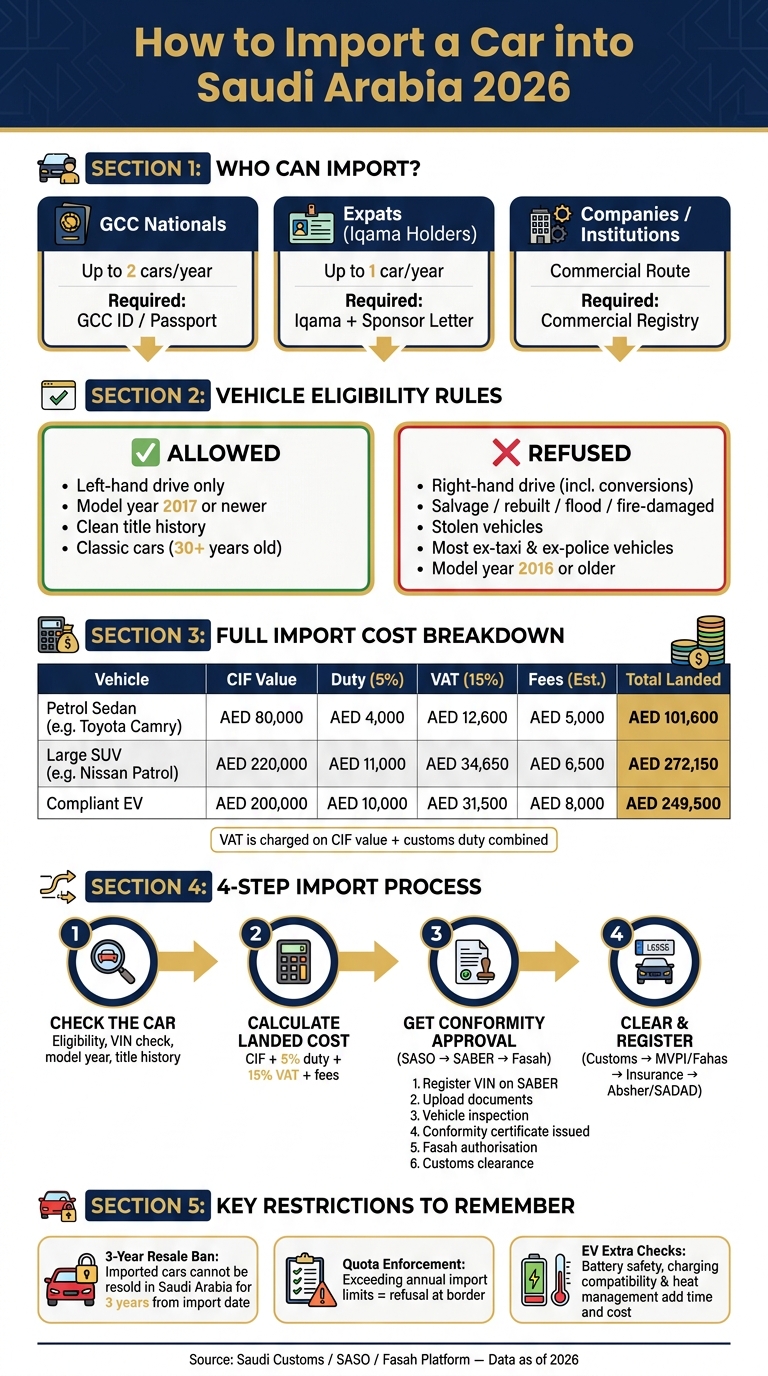
How to Import a Car into Saudi Arabia 2026: Step-by-Step Process & Costs
Ship Your Car to Riyadh | Car Shipping & Import Guide to Saudi Arabia | Affordable Auto Transport
Quick comparison
Check | What to know |
|---|---|
Who can import | GCC nationals, expats with Iqama, and companies through a business route |
Age rule | Usually 2017+ model year |
Cars refused | RHD cars, salvage/rebuilt, flood/fire-damaged, stolen, many ex-taxi and ex-police cars |
Duty | 5% of CIF |
VAT | 15% of CIF + duty |
Pre-clearance approvals | SASO, SABER, Fasah |
Final steps | Customs, Fahas/MVPI, insurance, registration |
Common risk | Wrong model year, bad title history, missing export or customs papers |
I’d treat this as a four-part job: check the car, price the full landed cost, finish conformity approval, then clear and register it without missing a document.
Step 1: Check Whether the Car Qualifies for Import
For UAE-based buyers, the first thing to check is simple: can the car enter Saudi Arabia at all? If the answer is no, the rest of the process doesn't matter.
Who Can Import and How Often
GCC nationals and expats with a valid Iqama can import vehicles for personal use. GCC nationals can import up to two cars per year, while Iqama holders are limited to one car per year. Expats also need a sponsor letter and a valid residency permit before they start the process.
If the vehicle is being imported by a company or institution, it goes through the commercial import route instead. That means the buyer must provide a copy of the commercial registry and an official letter from the owning entity.
Importer Category | Annual Import Limit | Key Document Required |
|---|---|---|
GCC Nationals | 2 cars per year | GCC ID / Passport |
Expats (Iqama Holders) | 1 car per year | Iqama + sponsor letter |
Companies / Institutions | Commercial import route | Commercial registry |
Vehicle Age, Model Year, and Classic Car Rules
The car must be model year 2017 or newer. This rule is based on the actual production year, not the registration year, so it's smart to confirm the manufacture date through the VIN before buying.
There is one exception. Vehicles that are 30 years old or more may qualify under classic-car approval .
If the car clears these checks, the next move is to work out duty, VAT, and shipping costs before you commit.
Vehicles That Will Be Refused Entry
This is where many buyers get caught out. Even if the buyer is eligible, the vehicle itself can still be blocked. The main types to avoid are:
Right-hand-drive vehicles, including RHD conversions. The car must have been built as left-hand drive from the start .
Salvage, rebuilt, flood-damaged, or fire-damaged vehicles .
Ex-taxi and ex-police vehicles, which are usually refused.
Stolen vehicles.
A VIN check is a must before you pay any deposit. If the record shows a salvage, rebuilt, or total-loss title, Saudi customs will reject it.
Once the car passes these filters, move on to landed cost and compliance approvals.
Step 2: Calculate the Full Import Cost Before You Buy
Once the car passes the checks in Step 1, the next job is simple: work out the full import cost before you pay. A lot of buyers look at the sticker price and stop there. Then the car lands in Saudi Arabia, and the extra charges hit all at once.
CIF Value, Customs Duty, VAT, and Port Charges
Saudi customs works from the CIF value, which includes the purchase price, shipping, and insurance. If the invoice price looks lower than market value, customs can reassess it upward. That means higher duty and higher VAT.
After that, the cost stack builds fast. Customs duty is about 5% of the CIF value, and VAT is 15%, charged on the combined total of the CIF value and the duty. Then come the extra items: SASO/SABER fees, MVPI/Fahas inspection, port handling, broker fees, and registration charges. If the car is registered in the UAE, it also needs an RTA Export Certificate. Miss that step, and storage fees can start piling up at the port.
On a large SUV, VAT alone can add more than AED 34,000 to the total. That’s why a landed-cost check matters. It tells you if the deal still makes sense before the car ships.
Landed-Cost Comparison Table
The table below shows how the cost stack can look in three common cases. These are AED estimates for UAE-based buyers planning their budget before shipping.
Vehicle Type | CIF Value (AED) | Customs Duty 5% (AED) | VAT 15% (AED) | SASO / Fees / Port (Est. AED) | Total Landed Cost (AED) |
|---|---|---|---|---|---|
Petrol Sedan (e.g., Toyota Camry) | 80,000 | 4,000 | 12,600 | 5,000 | 101,600 |
Large SUV (e.g., Nissan Patrol) | 220,000 | 11,000 | 34,650 | 6,500 | 272,150 |
Compliant EV | 200,000 | 10,000 | 31,500 | 8,000* | 249,500 |
*EV figure includes estimated costs for EV-specific conformity inspections and charging adapter requirements.
Using YallaMotor to Price and Prepare the Vehicle
Before you agree on a purchase price, use YallaMotor's car valuation tool to compare the asking price with current UAE market data. This step matters for one big reason: customs will also compare your invoice against market data. If your CIF value looks too low, they can reassess it upward, which pushes your duty and VAT higher.
It also helps to get a pre-export inspection. Small damage, hidden wear, or mechanical faults can turn into bigger problems later. In some cases, they can lead to rejection at Saudi customs or cause the car to fail the MVPI check.
Use YallaMotor's export support to get the vehicle and paperwork ready before shipping.
Once the numbers work, move to SASO and SABER approval before shipping.
Step 3: Get SASO, SABER, and Conformity Approval
Once pricing is done, the next move is SASO/SABER approval before the car reaches customs. This part matters more than many buyers expect. If approval drags, storage fees and re-handling charges can start piling up. After the conformity certificate is issued, the vehicle can move on to customs clearance.
What SASO and SABER Require for Imported Vehicles
SASO sets the technical standard, while SABER is the platform used to register the vehicle and get the conformity certificate required for clearance.
For Gulf conditions, GSO compliance covers items like cooling, air-conditioning, filtration, and corrosion resistance. If the vehicle is not GCC-spec, set aside AED 5,000 to AED 15,000 for the needed compliance modifications. That can be an annoying extra cost, but it’s far better than getting blocked later in the process.
Documents, Inspections, and Certificate Steps
The SABER process follows a fixed sequence. And the conformity certificate must be ready before customs clearance. If that certificate is missing, customs clearance stops.
Step | Action | Platform / Authority |
|---|---|---|
1 | Register vehicle details (VIN, model, year) | SABER Platform |
2 | Upload documents (title, photos, technical specs) | SABER Platform |
3 | Vehicle inspection | Approved Inspection Body |
4 | Conformity certificate issued | SASO / SABER |
5 | Fasah authorisation | Fasah Platform |
6 | Customs clearance | Saudi Customs |
In plain terms, you register the car, upload the paperwork, send it for inspection, wait for the certificate, complete Fasah authorisation, and only then move to customs. Miss one piece and the whole chain slows down.
Extra Checks for Electric Vehicles
EVs go through the same SABER process, but the checks are tighter for battery safety, charging compatibility, and thermal management in extreme heat. That makes sense in Gulf weather. Before you submit anything, confirm the extra document list with the approved inspection body so you don’t get stuck fixing paperwork midway.
Step 4: Clear Customs, Register the Car, and Avoid Common Rejections
Customs Clearance and Registration Steps in Order
You’re in the last leg now: customs release, inspection, insurance, and registration.
Once you have SASO/SABER approval, follow this order: clear customs, pass MVPI, buy insurance, and then complete registration.
Step | Action | Required Documents / Platform |
|---|---|---|
1 | Customs declaration | Fasah Platform, export certificate, proof of ownership |
2 | Inspection and duty payment | SASO certificate, 5% customs duty |
3 | MVPI roadworthiness test | Fahas approval |
4 | Insurance | Saudi third-party liability (TPL) or comprehensive insurance |
5 | Final registration |
The Istimara is issued digitally after SADAD payment, and the documents are then delivered through Saudi Post.
High-Risk Scenarios
These are the issues most likely to stop clearance or registration. Each one breaks a different part of the process.
Scenario | Main Compliance Risk | Likely Outcome | Safer Workaround |
|---|---|---|---|
Model year 2016 or older | Age restriction (2017+ only) | Refusal at border / mandatory re-export | Verify production year via VIN before purchase |
Salvage or total-loss title | Safety and roadworthiness failure | Rejection at customs or MVPI | Run a full vehicle history check before shipping |
Right-hand drive vehicle | Configuration violation | Immediate refusal of entry | Confirm factory left-hand drive only |
Expat importing a second car within 12 months | Import quota violation | Refusal of entry for the second vehicle | Stick to the one-car-per-year limit for expats |
Missing Fasah authorisation | Procedural non-compliance | Delays and storage fees | Complete Fasah authorisation before the car ships |
If your car falls into any of these cases, stop the shipment before it reaches the port. That one pause can save you a lot of hassle, storage charges, and back-and-forth paperwork.
Conclusion: Key Checks Before You Transfer or Ship
Before the car leaves the UAE, run through these points:
Confirm your eligibility and import quota
Verify the model year via VIN
Calculate the full landed cost, including 5% customs duty and 15% VAT
Confirm SASO conformity approval
Check the vehicle's condition history for any salvage or total-loss branding
One more thing matters here: imported vehicles cannot be resold in Saudi Arabia for three years from the import date. If you may want to sell the car sooner, that rule needs to be part of your decision.
FAQs
Can I import a non-GCC spec car into Saudi Arabia?
Yes, if it meets Saudi import rules. The car must be left-hand drive, 2017 or newer, and have a SASO conformity certificate.
For non-GCC cars, there may be extra work too. Some models need changes for the local climate, such as better cooling or stronger air conditioning. It also makes sense to check spare parts and service support before you buy, because these can be harder to find for non-regional models.
What documents should I prepare before shipping the car?
Before shipping, get your paperwork in order.
You’ll need the original vehicle registration, export certificate, proof of ownership, Saudi ID or Iqama, passport, and Fasah electronic authorisation.
You should also have:
SASO conformity certificate
customs clearance certificate
police clearance or deregistration document from the origin country
If you’re a non-Saudi resident, you may also need a sponsor-certified identification letter.
It’s smart to keep digital copies of everything during transit and customs clearance. Paper documents can get delayed, misplaced, or held up at a checkpoint, and a soft copy on your phone or email can save time.
How long does Saudi car import approval usually take?
There’s no set timeframe for Saudi car import approval.
The process usually depends on two things: getting a SASO conformity certificate and clearing customs. Both can take more or less time based on one simple factor - whether all your paperwork is complete and correct.
If you want to avoid delays, check your documents carefully before you start. Make sure everything matches local rules and is fully compliant.